PoX consensus mechanism and the upcoming Nakamoto upgrade in the evolution of Stacks make it an innovator at the forefront of Bitcoin.
Original Title: "The Bankless Guide to Stacks"
Author: Bankless
Translation: Luccy, BlockBeats
Editor's Note:
Stacks aims to create a platform for exploring more complex and sophisticated Bitcoin-denominated practical tools, with the ultimate goal of transforming it into a true Bitcoin L2 when technological conditions allow in the future.
The combination of Bitcoin's stable price performance as a store of value and the broader regulatory clarity brought about by the approval of the BTC ETF has increased the demand for the products being built by Stacks. This includes an efficient, flexible, and secure BTC-denominated environment for exploring more complex BTC applications and completing the transformation into a true Bitcoin Layer 2 (L2).
This vision has been gradually making progress, and the Stacks development team plans to complete the Nakamoto upgrade before the Bitcoin halving event in April this year. Bankless explores the PoX consensus mechanism and the upcoming Nakamoto upgrade in detail, and BlockBeats has translated the original article as follows:
Stacks is a Layer 1 blockchain that supports the Ethereum Virtual Machine (EVM) and achieves scalability solutions by extending smart contract functionality on Bitcoin. Therefore, Stacks is often referred to as Bitcoin Layer 2.
How Stacks Works
The Stacks Network adopts the Proof of Transfer (PoX) consensus mechanism, closely associated with Bitcoin, to enhance functionality without modifying Bitcoin itself.
PoX is an adaptation of the concept of Proof of Burn, involving miners transferring Bitcoin, the underlying cryptocurrency, to ensure the security of the Stacks blockchain and earn rewards. Through microblocks, Stacks further improves transaction efficiency, synchronizing these microblocks with Bitcoin transactions to achieve fast settlement independent of Bitcoin's speed.
It is worth noting that the upcoming Nakamoto upgrade for Stacks will introduce a faster block production speed, further overcoming Bitcoin's slower block time by creating new Stacks blocks approximately every 5 seconds. This upgrade will also achieve 100% Bitcoin determinism, meaning Stacks blocks are expected to become as irreversible as Bitcoin transactions.
Stacks' Pulse
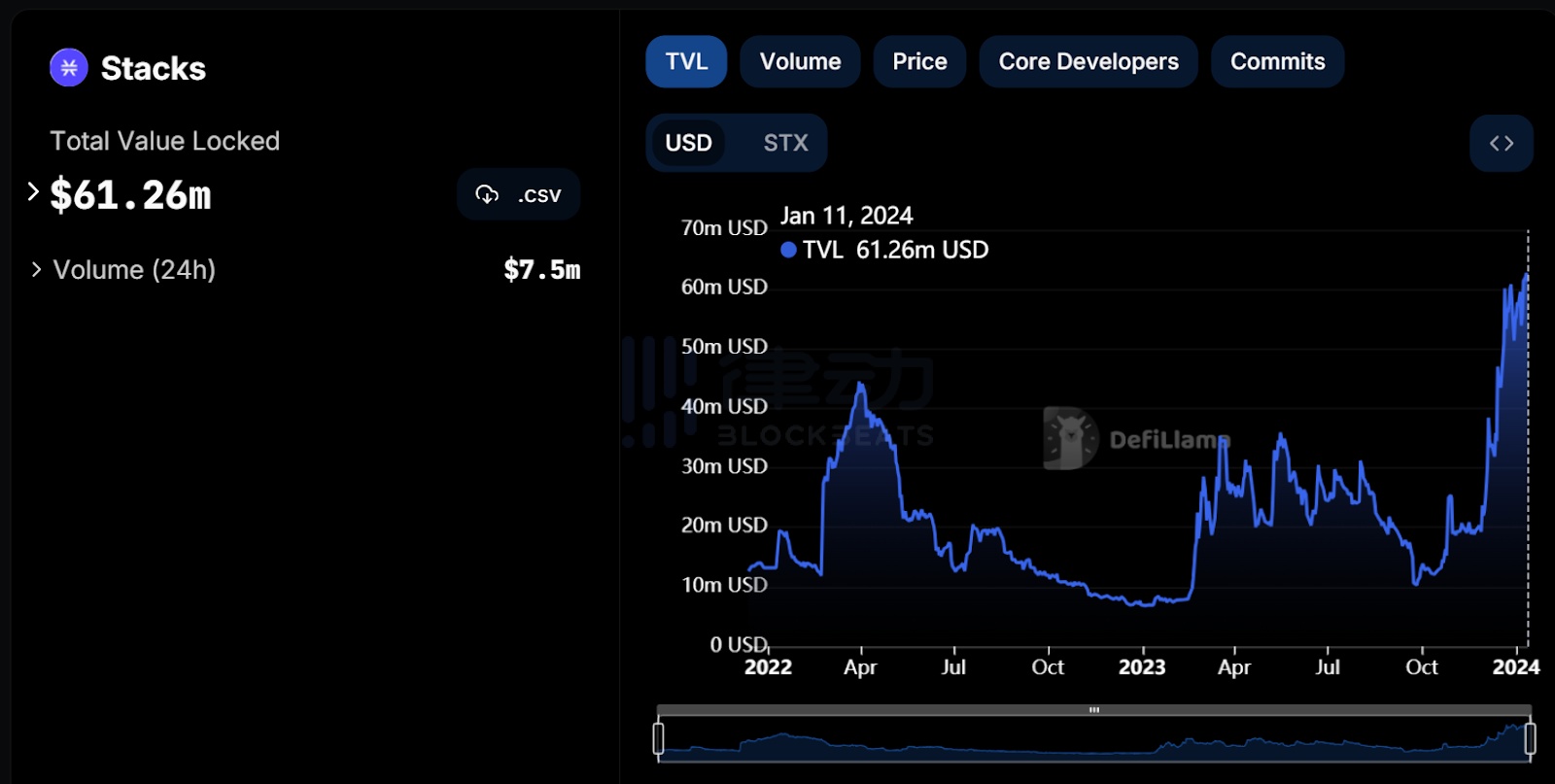
According to DeFiLlama's data, Stacks currently ranks 38th in the DeFi space with a total locked value (TVL) of $61 million. Despite its relatively small application scope, it covers some NFT projects and DeFi protocols in areas such as DEX, lending, and liquidity mining.
Furthermore, due to the surge in interest in minting-style tokens, Stacks' activity has increased significantly in recent months. Looking ahead, the upcoming Nakamoto upgrade for Stacks will enable the network to more efficiently handle future demands.
STX Token
The native token of Stacks, $STX, is used to pay transaction processing fees through the network's Clarity smart contracts. $STX holders can also participate in the network through a process called Stacking, where they lock tokens and run a full node to participate in consensus and earn Bitcoin rewards.
As for mining on Stacks, this process involves using Bitcoin to mine $STX tokens. Miners participate in leader elections on the Bitcoin blockchain, with each round's leader selected through a verifiable random function, giving greater weight to higher $BTC bids. Correspondingly, miners earn $STX through transaction fees, with the $BTC they bid being distributed as rewards to participating $STX holders in the consensus.
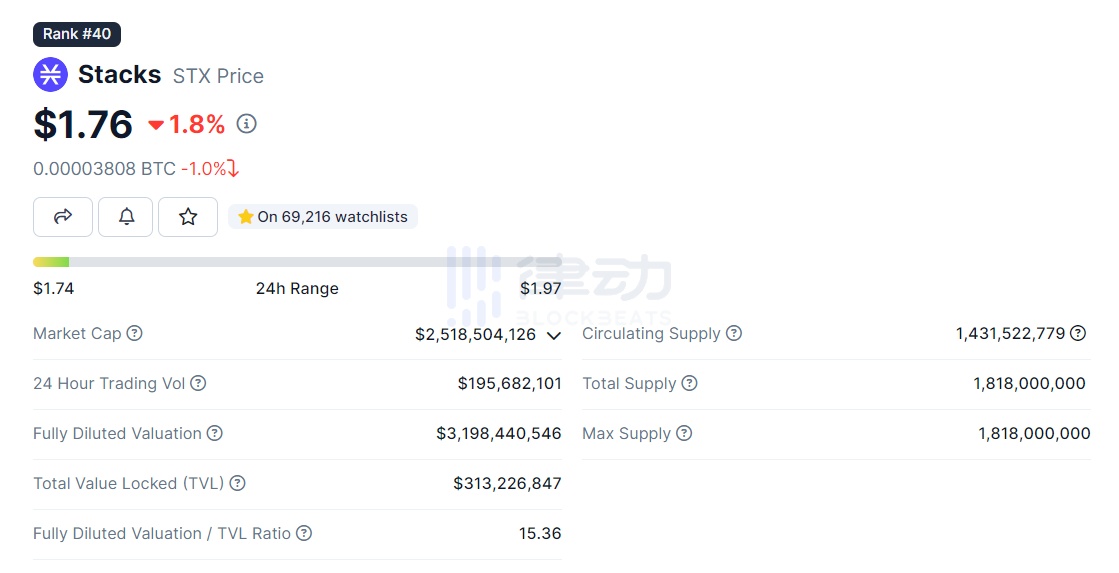
At the time of writing, the trading price of $STX is approximately $1.76, and its market value has reached $2.5 billion, making it the 40th largest cryptocurrency.
Getting Started with Stacks
To delve deeper into the Stacks ecosystem, the following resources provide a helpful starting point:
- Leather and Xverse: Wallets for managing Stacks assets.
- Stacks Docs: Official documentation for Stacks.
- Stacks Explorer: Block explorer for analyzing Stacks data.
- Stacks Bridges: Repository for Stacks bridging solutions.
- Stacks Ecosystem: Application database on Stacks.
- Stacks Stacking: Collection of STX Stacking platforms.
- STX20: Mint-style market on Stacks.
- DefiLlama: Dashboard for Stacks DeFi statistics.
- Gamma: Market for Stacks NFTs.
Conclusion
Overall, Stacks is a network aimed at combining the strength of Bitcoin with the flexibility and scalability of Ethereum-like smart contracts.
In its evolution, the PoX consensus mechanism and the upcoming Nakamoto upgrade are crucial, making Stacks an innovator at the forefront of Bitcoin. While the DeFi and NFT ecosystems on the chain may still be relatively small, with Stacks' continued development, it is poised to become a noteworthy project in the crypto space.
免责声明:本文章仅代表作者个人观点,不代表本平台的立场和观点。本文章仅供信息分享,不构成对任何人的任何投资建议。用户与作者之间的任何争议,与本平台无关。如网页中刊载的文章或图片涉及侵权,请提供相关的权利证明和身份证明发送邮件到support@aicoin.com,本平台相关工作人员将会进行核查。


