SatoshiVM, a decentralized Bitcoin ZK Rollup Layer 2 solution.
Author: Deep Tide TechFlow
Even if the spot ETF is approved, the market still maintains a long-term enthusiasm for BTC-related concepts.
Data on January 14th shows that the cumulative cost consumption of the Ordinals protocol's inscriptions has reached 5,600.22 BTC, indicating the continued activity in the Bitcoin ecosystem.
At the same time, there is still a market for Bitcoin L2 narratives.
Concerns about the Bitcoin block space and the previous inscription that raised Bitcoin transaction fees are still vivid, making it a pressing need to reduce the cost of the Bitcoin mainnet, which has also driven related projects to eye-catching performances in the secondary market.
For example, STX, the token price reached a historical high last week.
In this context, other Bitcoin L2 projects are eager to try, including the recently frequently mentioned SatoshiVM - a decentralized Bitcoin ZK Rollup Layer 2 solution that is compatible with the Ethereum Virtual Machine (EVM) ecosystem and uses native BTC as gas fees.
Bitcoin, L2, ZK… These high-value concepts combined easily trigger FOMO, and the project is currently being widely discussed on Twitter, but it is still unknown whether this is a "collective marketing" or a unanimous "discovery of value."
However, the heat indicates the possibility of short-term opportunities at least.
So we dug into the project's documentation and integrated the currently publicly available test network interactions and initial token issuance information to provide a reference for everyone.
What is SatoshiVM?
SatoshiVM connects the EVM ecosystem with Bitcoin, enabling the Bitcoin ecosystem to issue assets and develop applications.
From the name, it is not difficult to see that the project pays tribute to Satoshi and the "VM" in the name refers to virtual machine. Running smart contracts and issuing assets in the virtual machine provides a possible solution to Bitcoin's current scalability issues.
The most crucial aspect is the ZK Rollup concept of SatoshiVM.
Using Rollup technology to bundle multiple transactions into a batch and verify them as a single transaction on the Bitcoin main network ensures the same level of security as the Bitcoin main network, ensuring data validity and availability.
At the same time, using technologies such as Taproot and Bitcoin Script, contracts can be verified on-chain without changing the Bitcoin network's consensus rules, thereby completing the calculation of fraud proofs.
In simple terms, if ZK Rollup can serve as Ethereum's L2, it can also serve as Bitcoin's L2.
In fact, most of the work of L2 is not executed on the mainnet but is submitted to the mainnet after execution. Therefore, theoretically, transactions can be executed off-chain, and the packaged transaction results can be batch-submitted to the mainnet.
L2 executes transactions, and L1 is responsible for settlement; it's just that the mainnet is replaced with Bitcoin.
But it is worth mentioning that SatoshiVM uses native BTC as EVM gas. Once the project develops, the more applications created on this L2, the more active the ecosystem, the more welcoming it will be for miners.
More specifically, we can take a look at the design structure of SatoshiVM:
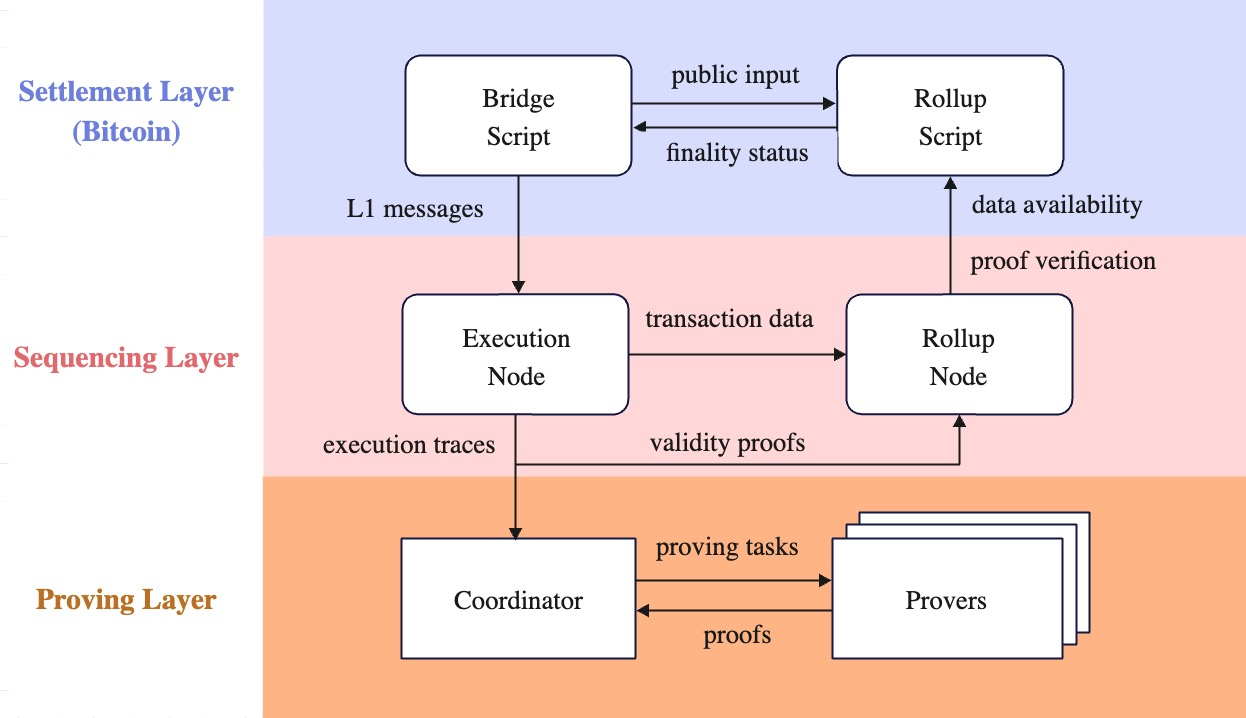
Settlement Layer
This layer provides data availability, sorting, and proof verification for the SatoshiVM chain. It allows users and dApps to send messages and assets between Bitcoin and SatoshiVM. Bitcoin serves as the settlement layer, with bridges and aggregation scripts deployed on the Bitcoin network.
Sorting Layer
This layer consists of an execution node responsible for executing transactions submitted to the SatoshiVM sorter and transactions submitted to the L1 bridge script, generating L2 blocks. It also includes a Rollup node for processing batch transactions, publishing transaction data and block information to Bitcoin to ensure data availability, and submitting validity proofs to Bitcoin to ensure finality.
Verification Layer
This layer includes a coordinator that assigns proof tasks to verifiers and forwards the generated proofs to the Rollup node to complete Bitcoin's finality verification. It also includes a pool of verifiers responsible for generating validity proofs for verifying L2 transactions.
How is it different from other Bitcoin L2 solutions?
Strictly speaking, SatoshiVM is more of a "bridge" than an L2.
Here, the bridge means that by introducing the development format and execution method on Ethereum, you can perform activities similar to those on Ethereum, such as issuing new digital assets or building applications, but using the Bitcoin network for payments and transaction processing.
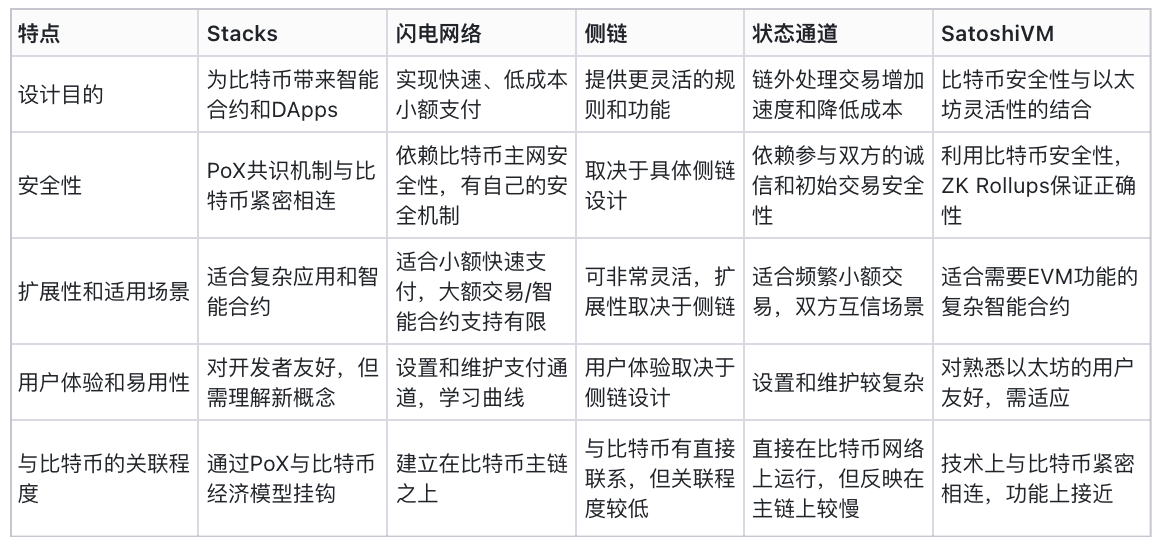
Previously, due to the inherent limitations of Bitcoin's original design, various L2 solutions such as the Lightning Network, sidechains, and state channels were very active in the broader sense of scalability and improving transaction performance, but most were trying to find ways within the ecosystem:
That is, to make Bitcoin itself faster and better in terms of performance, or to enable Bitcoin to handle transactions in certain scenarios.
Later, Stacks tried to enable Bitcoin to support the operation of smart contracts and DApps to support more functionality.
Note that performance and functionality are two different concepts. Given this, from a purpose perspective, SatoshiVM should be compared to Stacks.
We might as well compare the two from the perspectives of technical implementation and integration with Bitcoin.
Technical Implementation and Compatibility:
SatoshiVM: Capable of running Ethereum-compatible smart contracts and using native BTC as fuel.
Stacks: Uses different technology, has its own Proof of Transfer (PoX) consensus mechanism and Clarity smart contract language. It does not directly support EVM but provides a different way to create smart contracts and applications on Bitcoin.
Integration with Bitcoin:
SatoshiVM: By utilizing ZK Rollups technology, it integrates with the Bitcoin main chain at the Layer 2 level while maintaining compatibility with EVM, allowing developers to use familiar Ethereum tools and languages for development.
Stacks: Through its unique PoX consensus mechanism, Stacks directly adds smart contract and DApps functionality on top of Bitcoin's security.
To make an inappropriate analogy, SatoshiVM is more like a universal remedy, designed to serve not only Bitcoin but also Ethereum and possibly other L1s, but due to narrative reasons, it seems more popular to serve Bitcoin;
while Stacks is a specialized medicine, addressing specific issues in Bitcoin's structure, which may not be applicable to other L1s.
At the same time, we have also conducted a comprehensive comparison of all the Bitcoin scaling solutions mentioned above, as shown below:
Current Test Network Situation and Participation Opportunities
Currently, SatoshiVM's test network is live, and users can participate in its test network interactions using Unisat or the Little Fox wallet, including token transfers and swaps.
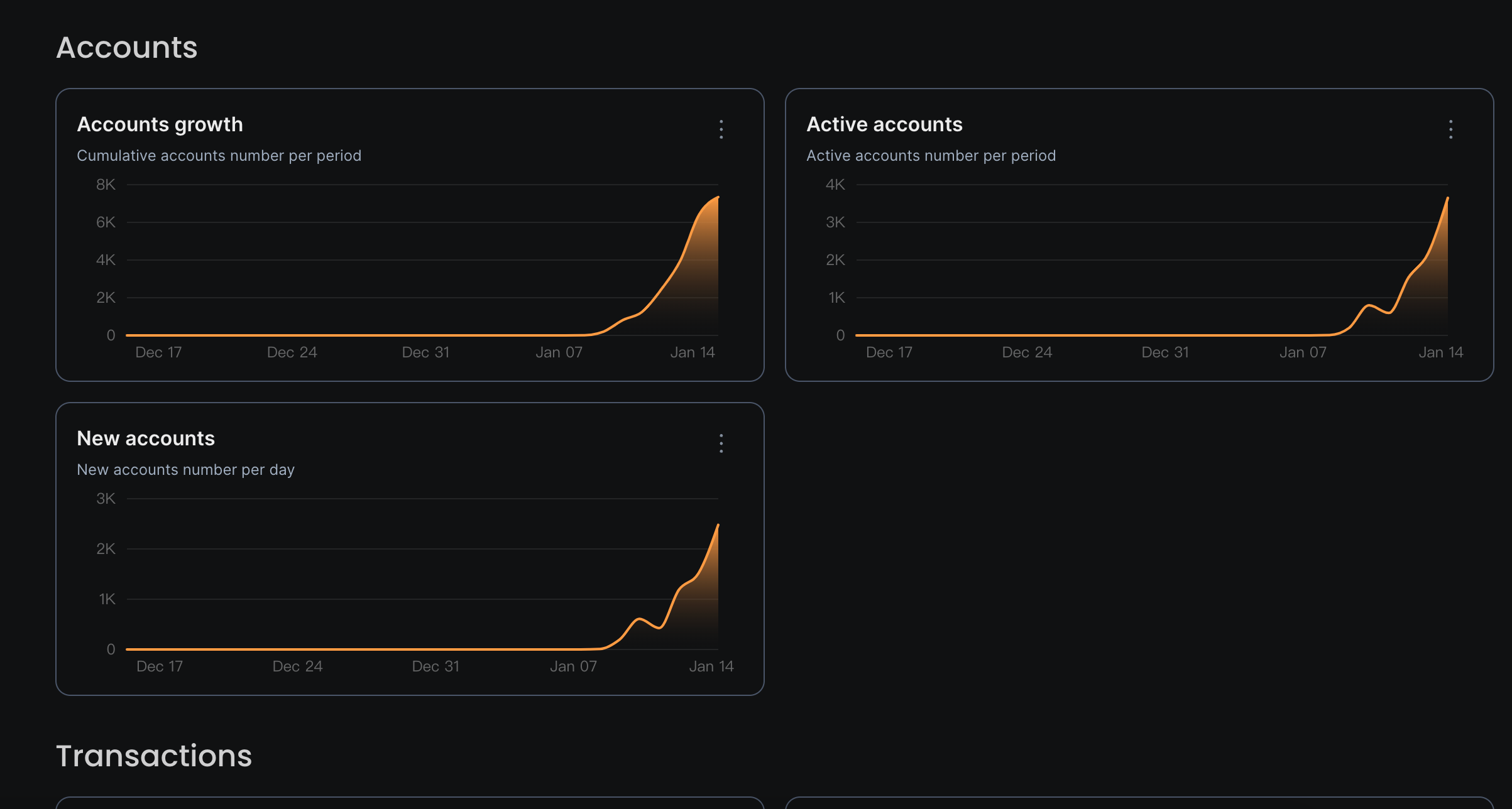
From the data, there are currently over 7000 accounts interacting with the test network, with a total of around 46,000 interaction addresses and approximately 200,000 transactions completed.
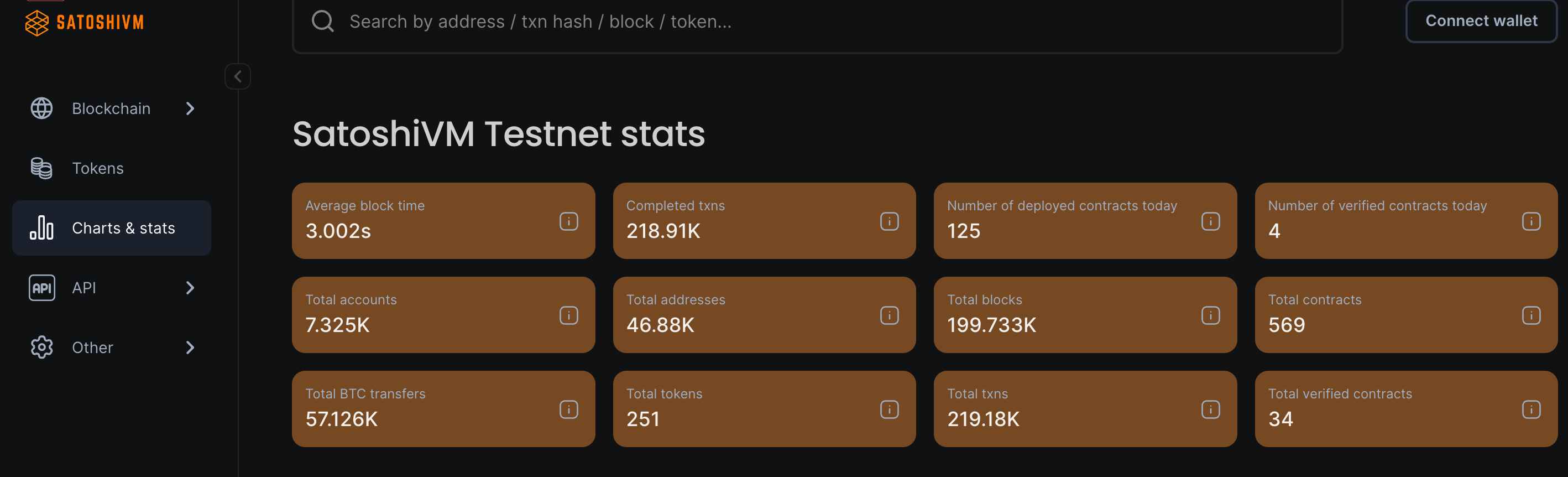
Meanwhile, although the official SatoshiVM team has not explicitly or implicitly indicated any airdrops for interactions, as the project is gradually being widely discussed on Twitter, the significant increase in daily new accounts and active accounts also shows the market's FOMO sentiment towards it.
However, the flip side of the heat is intense competition. The inevitable result is that those who interact win over those who don't, and those who interact more win over those who interact less.
But considering the "zero-cost" nature of the test network, participating in it doesn't have any cost, so it's still a good strategy to participate even with zero cost.
Below are the detailed interaction steps for players who need them for reference (images sourced from Twitter user @FareaNFts):
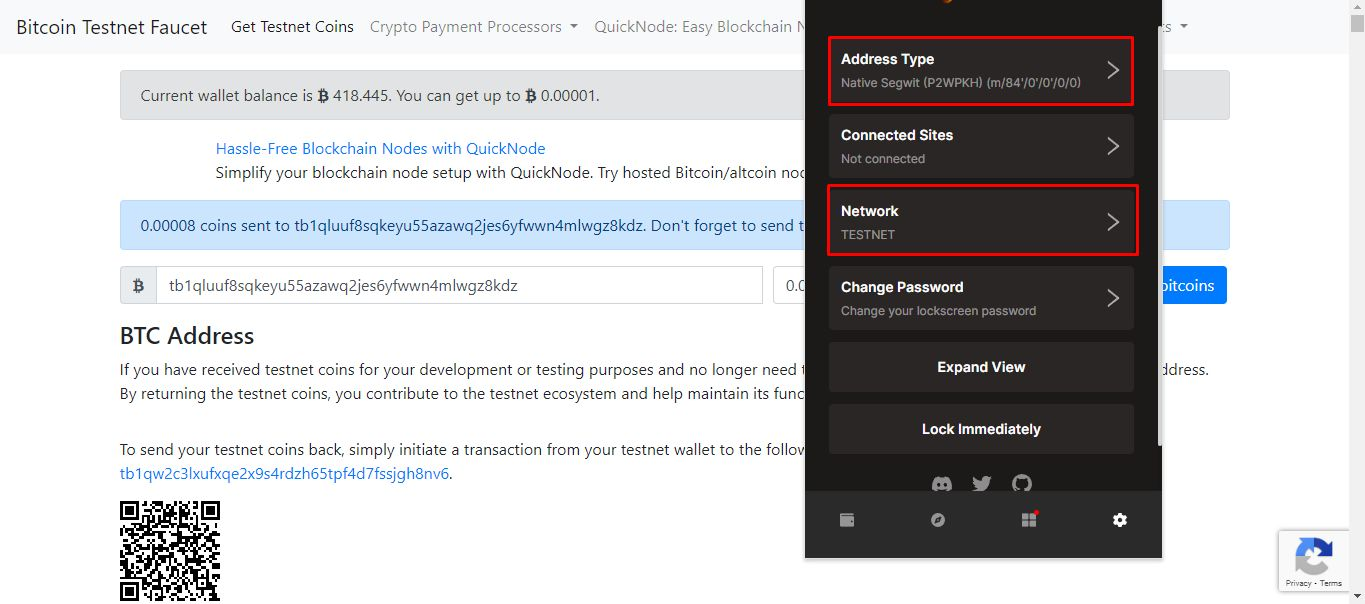
- Download the Unisat wallet and in the wallet's settings option (gear icon), switch the network to the testnet (Testnet)
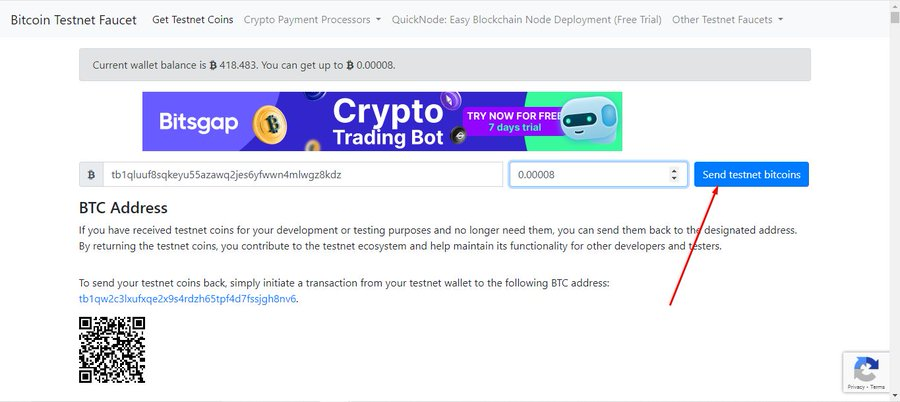
- Claim test tokens tBTC from the faucet, enter the claim amount and your Unisat address:
Faucet URL: http://bitcoinfaucet.uo1.net/send.php
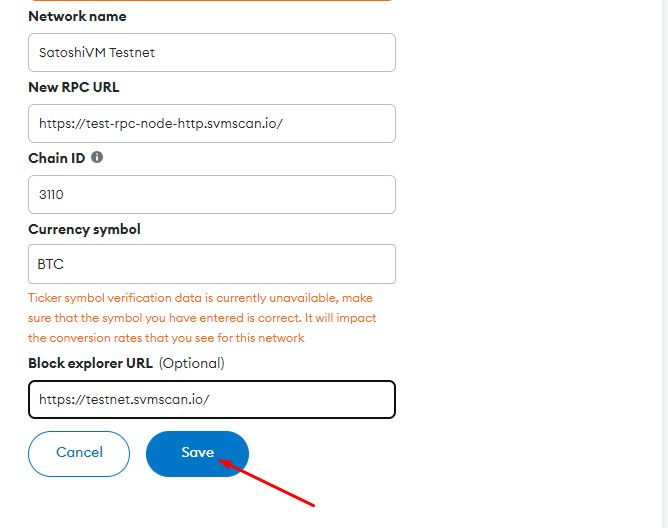
- Add SatoshiVM's network information in Little Fox according to the following rules:
Network Name: SatoshiVM Testnet RPC: https://test-rpc-node-http.svmscan.io Chain ID: 3110 Currency symbol: BTC
- Complete the transfer of BTC on different networks
Visit the website ridge.satoshivm.io to connect the Little Fox and Unisat wallets
Deposit the tBTC received in Unisat into the website and withdraw it using the Little Fox wallet (on the same testnet)
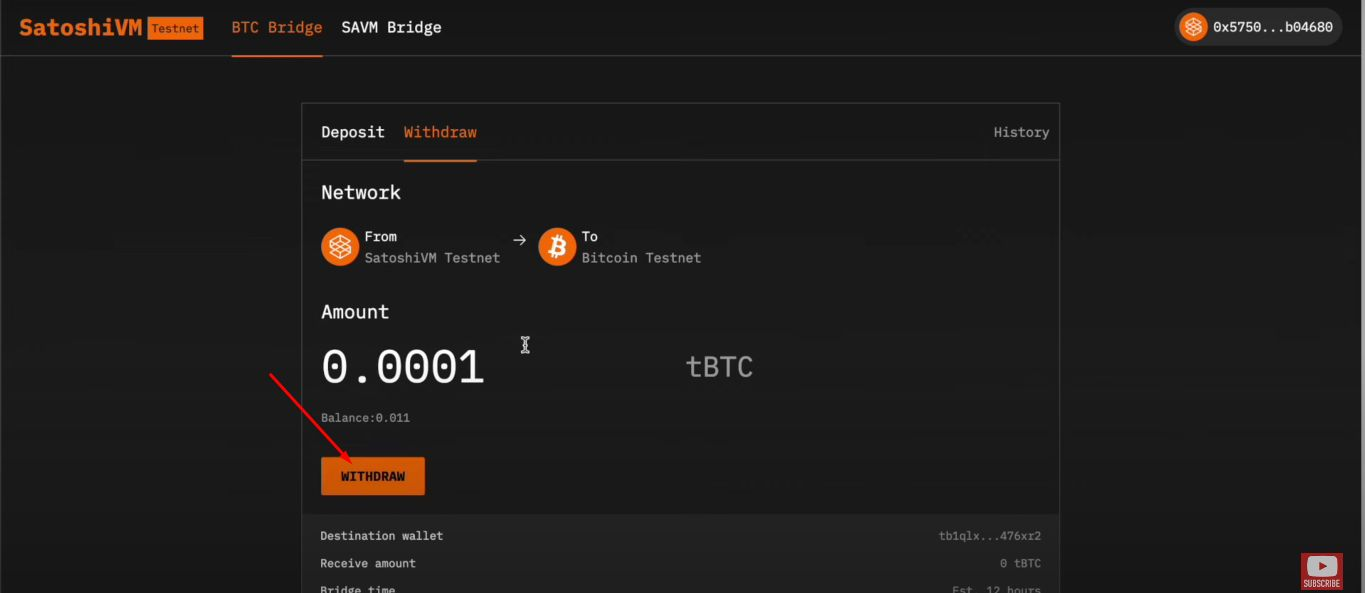
- Transfer SAVM tokens (official tokens of the project)
Go to the "SAVM Bridge" page
Claim "tSAVM" tokens from the faucet
Deposit some tSAVM and confirm the transaction in the MetaMask wallet
Withdraw some tSAVM and confirm the transaction in the MetaMask wallet
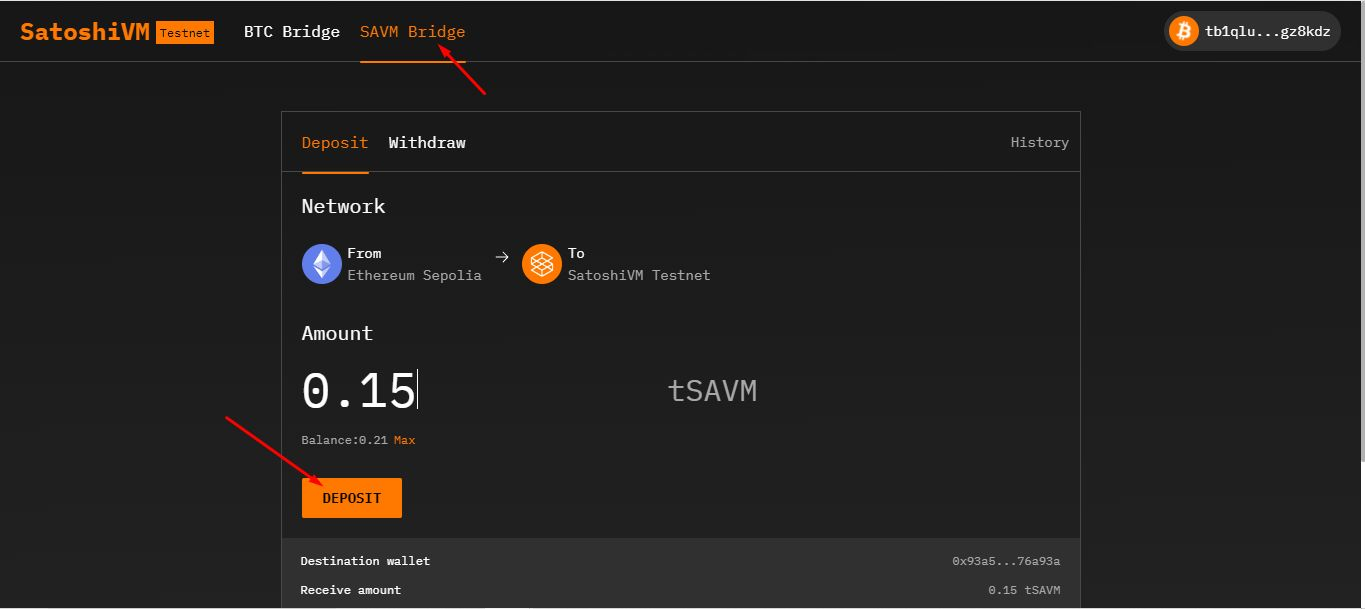
In addition, the mainnet tokens for SAVM will be officially issued on the 19th.
In terms of the rules, SAVM will be supported by another well-known Bitcoin ecosystem project, Bounce, and its corresponding token will be AUCTION. Bounce uses the Initial Liquidity Offering (ILO) issuance method, which means that SAVM will have an initial liquidity pool based on the AMM model for participants to swap;
The prerequisite for participating in the ILO is holding Auction, with a certain probability of being randomly selected to qualify for the transaction, and also the opportunity to continuously receive a share of transaction fees and ETH rewards from this initial liquidity pool. This provides another relatively stable option for players who want to participate in token issuance but are concerned about the exchange risk of AMM.
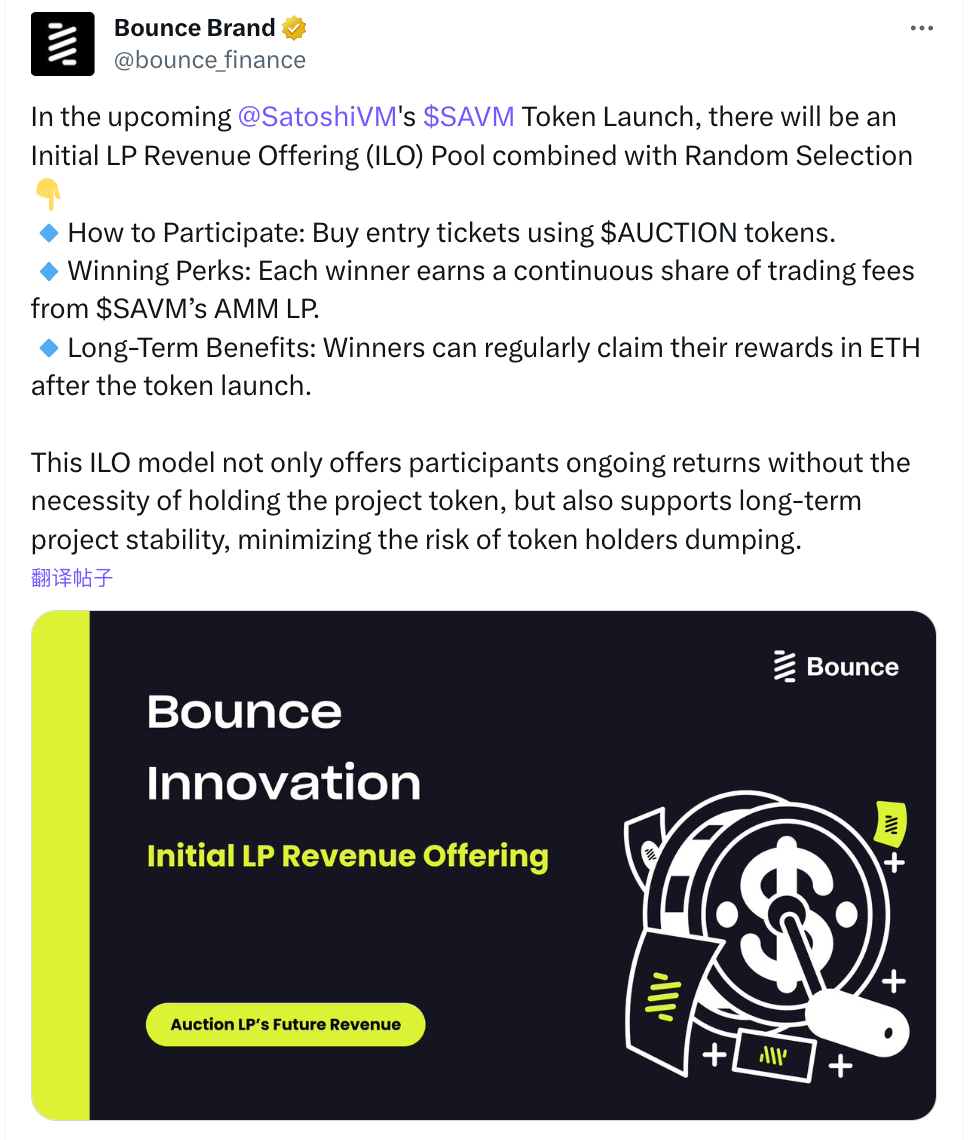
However, it is important to note that holding Auction also entails the risk of token price fluctuations, and whether it is worth the investment is a matter of individual judgment.
Issues to Watch
Finally, although the concept, technology, and narrative of SatoshiVM look promising, during the process of integrating information, the author still noticed some issues worth paying attention to.
First, since it is an L2, is the sorter of L2 centralized or decentralized? Who acts as the validation nodes for L2, and what are the rules for becoming a node? All of this is currently opaque, and it feels more like tokens first, details later.
This is common for meme projects, but for an infrastructure project, it seems a bit rushed.
Second, the project has not publicly disclosed specific team and past information. L2 involves a large number of transactions, and security and stability are prerequisites. The lack of team endorsement in this race becomes a point of concern; although the heat of the Bitcoin ecosystem is largely driven by retail investors, critical infrastructure without a high-end team in charge easily raises doubts.
Third, the project currently does not have substantial information on its Github. The open-source status of L2 itself is unknown.
Finally, the FOMO sentiment surrounding SatoshiVM has led to rampant scams, with "gold standard" users posting phishing links for airdrops with more attention than the official Twitter account, and many blue checkmark accounts in the comments section collaborating to lure users into transferring assets by exploiting the psychology of seeking cheap deals.

During the hot moment in the Bitcoin L2 race, staying cautious and seeking non-consensus opportunities is the more sustainable choice.
免责声明:本文章仅代表作者个人观点,不代表本平台的立场和观点。本文章仅供信息分享,不构成对任何人的任何投资建议。用户与作者之间的任何争议,与本平台无关。如网页中刊载的文章或图片涉及侵权,请提供相关的权利证明和身份证明发送邮件到support@aicoin.com,本平台相关工作人员将会进行核查。


