Author: Jordan, PANews
In the early hours of January 10th, Beijing time, the official X account of the U.S. Securities and Exchange Commission (formerly Twitter) announced that it had approved a spot Bitcoin ETF and allowed it to be listed on all registered securities exchanges in the United States. However, shortly after the announcement, Gary Gensler, the chairman of the U.S. Securities and Exchange Commission, issued a statement saying that the agency's Twitter account had been hacked and unauthorized tweets had been posted. The U.S. Securities and Exchange Commission has not yet approved the listing and trading of spot Bitcoin exchange-traded products.
Due to this incident, the price of Bitcoin experienced a short-term roller coaster, dropping from $47,680 to the $45,000 range, with a decrease of about 2% in the past 24 hours. Its market value also fell below $900 billion, causing over $30 billion to "evaporate."
Passing the Buck to Hackers or Operational Error?
After Gary Gensler's statement, it immediately drew significant attention from the crypto community. Some industry experts believe that the U.S. Securities and Exchange Commission's X account was not attacked, but rather the related content was edited in advance, possibly with an incorrect release time (or released too early). For example, crypto analyst Loma analyzed the U.S. Securities and Exchange Commission's tweets word by word, pointing out that "Compromised" does not mean "hack," and "Unauthorized" does not mean "false."
This suggests that the U.S. Securities and Exchange Commission likely pre-edited the content to be sent later, but a staff member or "intern" (employee) may have mistakenly clicked on the release.
Bloomberg analyst Eric Balchunas tweeted that perhaps someone had prematurely released the pre-edited tweet, as he had heard that they would announce the approval news on Wednesday afternoon from 4-5 pm Eastern Time (Thursday morning from 5-6 am Beijing Time), and the spot Bitcoin ETF was expected to be listed on Thursday.
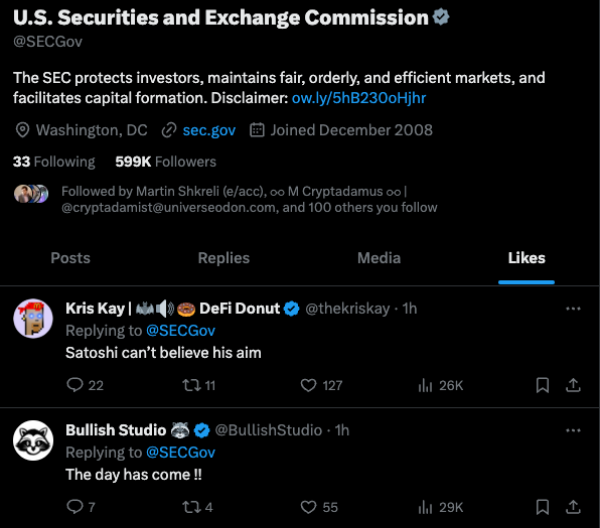
However, some believe that the U.S. Securities and Exchange Commission's account was indeed attacked because as a serious regulatory agency, it would not "carelessly" include Bitcoin symbols in its posts. In addition, community users analyzed the "likes" from the U.S. Securities and Exchange Commission and found that the account interacted with two cryptocurrency-related accounts while posting false announcements, further increasing the possibility of a hacker attack, as shown in the following image:
At the same time, Adam Cochran, a partner at Cinneamhain Ventures, provided another analysis, suggesting that both the hacker and "operational error" scenarios may be valid. He stated that the U.S. Securities and Exchange Commission's social media account was indeed attacked, and the hacker may have found the pre-approved spot Bitcoin ETF content in the drafts and added the Bitcoin symbol image to it.
Adam Cochran added, "The hacker would not be the type to carefully plan and prepare content in the style of a U.S. regulatory agency, nor would they be foolish enough to just post a tweet like a meme, so both the hacker attack and the approval of the spot Bitcoin ETF are real, and the approval announcement should be genuine."
Interestingly, in October, the SEC had tweeted, "Be careful what you read online, the best source for SEC news is the SEC." It's unexpected that the SEC would "facepalm" so soon.
Limited Negative Reaction in the Crypto Community, Market Confidence Unaffected
The crypto community is always optimistic. Just after Gary Gensler, chairman of the U.S. Securities and Exchange Commission, confirmed that the spot Bitcoin ETF had not been approved, crypto digital artist Billy Restey turned Gary Gensler's response tweet into a Bitcoin NFT inscription 53,995,422, and stated, "This tweet is now on the Bitcoin blockchain, and none of us will forget it."
However, this incident seems to have not affected the confidence of the spot Bitcoin ETF issuers. For example, TechCrunch crypto reporter Jacquelyn Melinek revealed on social media that Steven McClurg, co-founder and chief information officer of Valkyrie, one of the ETF issuers, expressed 95% confidence in the approval of the spot Bitcoin ETF this week in a recent Q&A. Additionally, Steven McClurg also predicted that $100 billion would flow into the spot Bitcoin ETF by the end of this year, and he forecasted that the value of Bitcoin would reach $150,000 by the end of 2024, as the spot Bitcoin ETF may cause a "supply shock" and drive up demand.
Conclusion
Undoubtedly, the approval of the spot Bitcoin ETF will have a significant impact on the crypto market. Once approved, it is likely to fuel the next bull market. For example, according to Glassnode data, influenced by the potential approval of the spot Bitcoin ETF, Bitcoin's market value increased from $850 billion to $925 billion on Monday, January 8th, with a daily increase of about $75 billion, marking the fourth highest single-day change in Bitcoin's market value since December 2021.
Not only that, capital flows are quietly changing. Data shows that since 2024, Bitcoin has outperformed MicroStrategy's stock price, with Bitcoin rising by 5.6% and MicroStrategy's stock price falling by 15.6%. Analysts believe that as the potential approval of the spot Bitcoin ETF approaches, investors are withdrawing funds from MicroStrategy stocks and turning to the upcoming ETF.
In summary, hopefully, this U.S. Securities and Exchange Commission's incident will not affect the subsequent approval of the spot Bitcoin ETF, and let us witness history.
免责声明:本文章仅代表作者个人观点,不代表本平台的立场和观点。本文章仅供信息分享,不构成对任何人的任何投资建议。用户与作者之间的任何争议,与本平台无关。如网页中刊载的文章或图片涉及侵权,请提供相关的权利证明和身份证明发送邮件到support@aicoin.com,本平台相关工作人员将会进行核查。


