Source: DataLearner
At the end of November 2022, ChatGPT emerged, attracting global attention with its seemingly intelligent product. Subsequently, the industry and research institutions began to invest heavily in large models. In 2023, known as the first year of large models, many remarkable AI products and models were released.
In 2023, DataLearner collected a large number of large models and published many technical blogs related to large models. As 2023 draws to a close, we conclude this year's technical sharing with the "Most Exciting AI Products of 2023."
Visit the 2023 AI summary webpage: The Most Exciting AI Releases in 2023
The webpage not only presents a summary but also allows you to click on each product name or technology to view details.
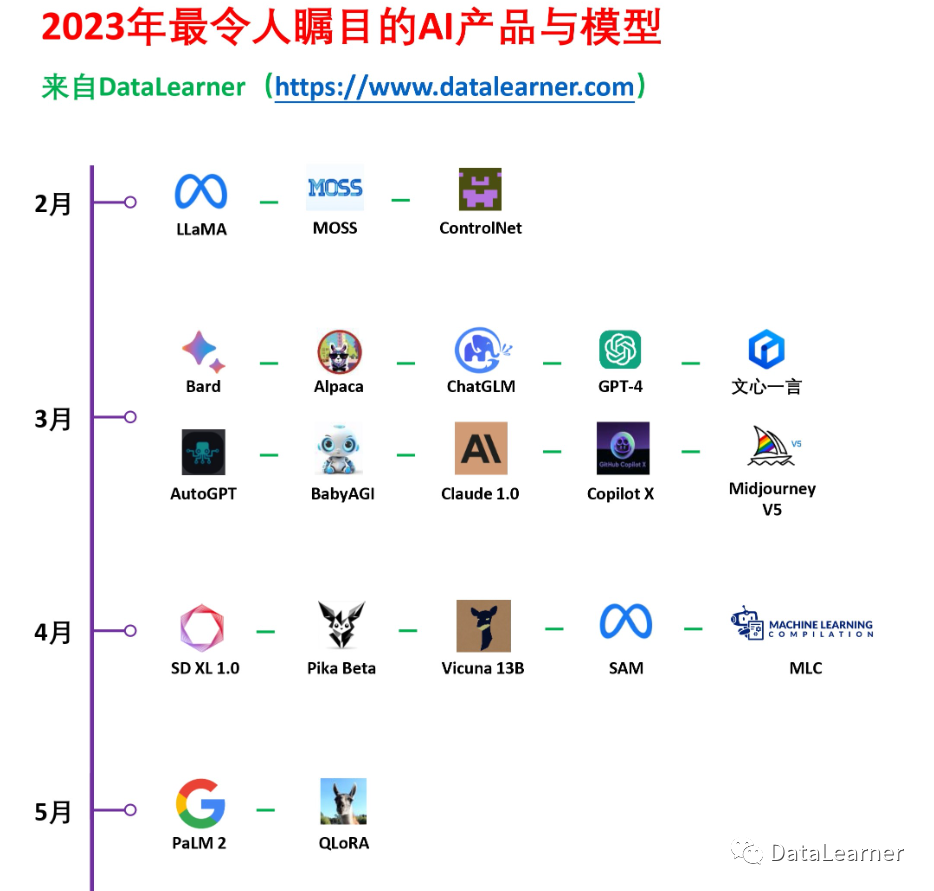
February: MetaAI Strong Debut, LLaMA Opens the Era of Open Source Large Models
LLaMA, as an open-source large language model by MetaAI, has paved the way for the flourishing development of open-source large model ecosystems. Many so-called "open-source large models" since then have originated from LLaMA. In the same month, MOSS released by Fudan University in Shanghai was also one of the earliest open-source large models in China, attracting significant attention. Another important AI-related technology in February was ControlNet, proposed by Stanford University, which can precisely control the generation of diffusion models, significantly improving the quality of diffusion models.
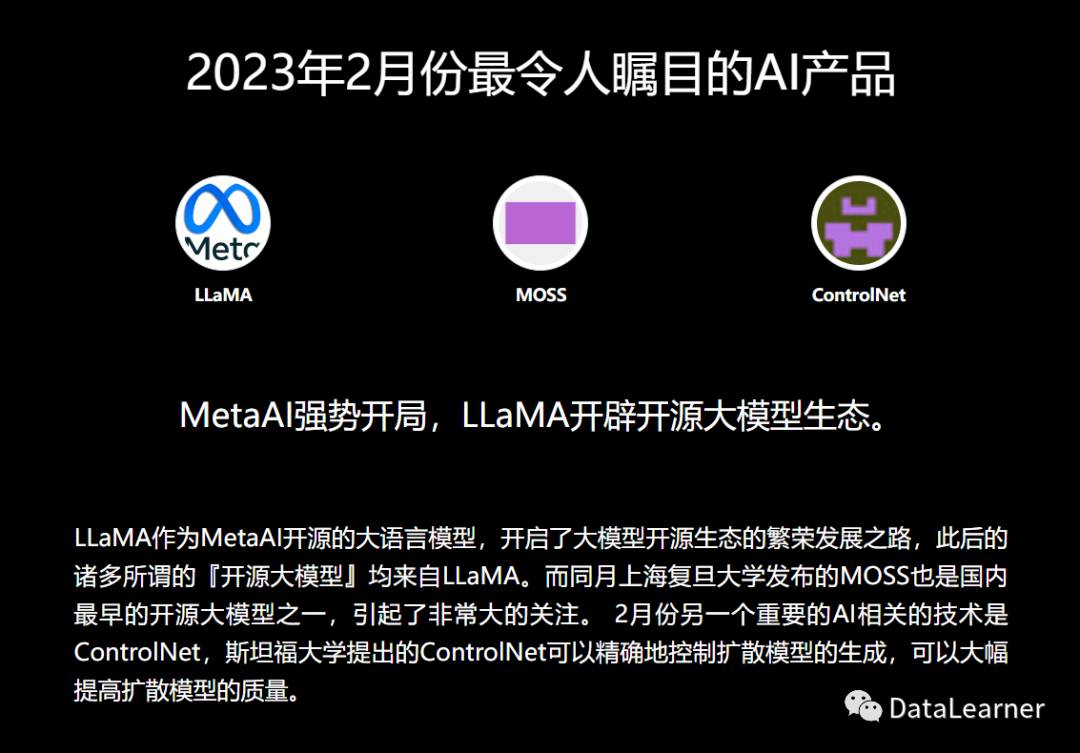
March: GPT-4 Released! Industry Catching Up, Various Models Making Their Debut
In March, the release of GPT-4 directly elevated the capabilities of large models to a new level. Google Bard and Baidu Wenxin Yiyuan were also introduced, although the results were not entirely satisfactory, they were considered pioneers. Stanford's open-source Alpaca method fine-tuned the cost of large models to $600, advancing the open-source ecosystem once again. In the same month, two AI agents, AutoGPT and BabyAGI, were open-sourced, and later OpenAI's products were somewhat related to these open-source projects. In addition to language models, the release of Midjouney V5 also garnered widespread attention, and the viral images of a Chinese couple from the 1990s in May were from this product.
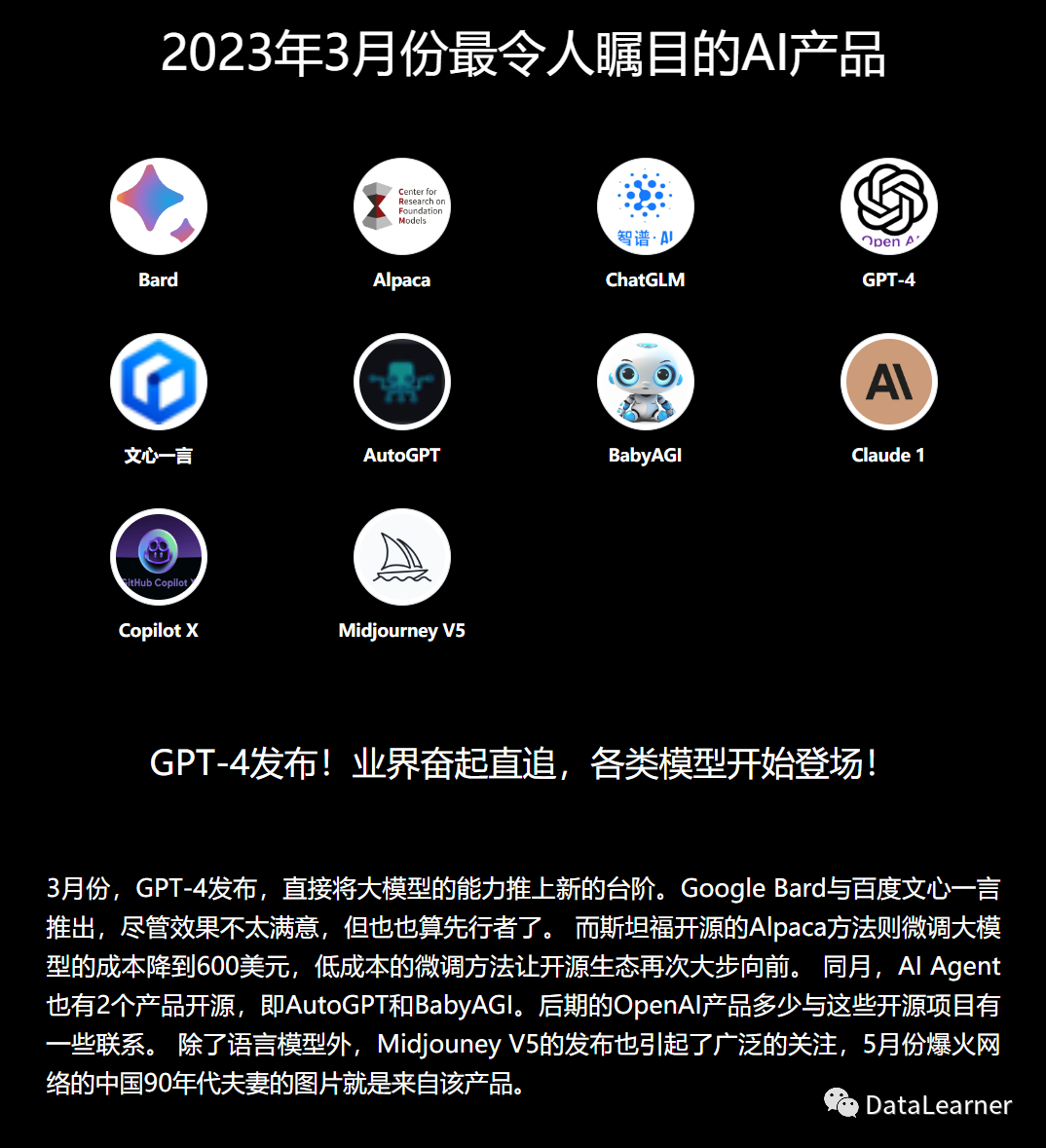
April: SD XL 1.0 Drives the Prosperity of Open Source Text Generation Images
The large model field in April was somewhat quiet, but the open-source release of Stable Diffusion XL (SD XL 1.0) pushed the open-source version of DALL·E to a new level, making it one of the most anticipated releases alongside SD 1.5. UC Berkeley, in collaboration with several research institutions, also released the Vicuna model, further elevating the level of open-source models. Additionally, the release of the large model anonymous arena allowed users to decide which of two unnamed models provided a better response to a given question. Furthermore, the introduction of MLC made it possible to run large models on mobile devices. In the same month, the Pika Beta version was released, and MetaAI open-sourced the large model SAM for segmentation.
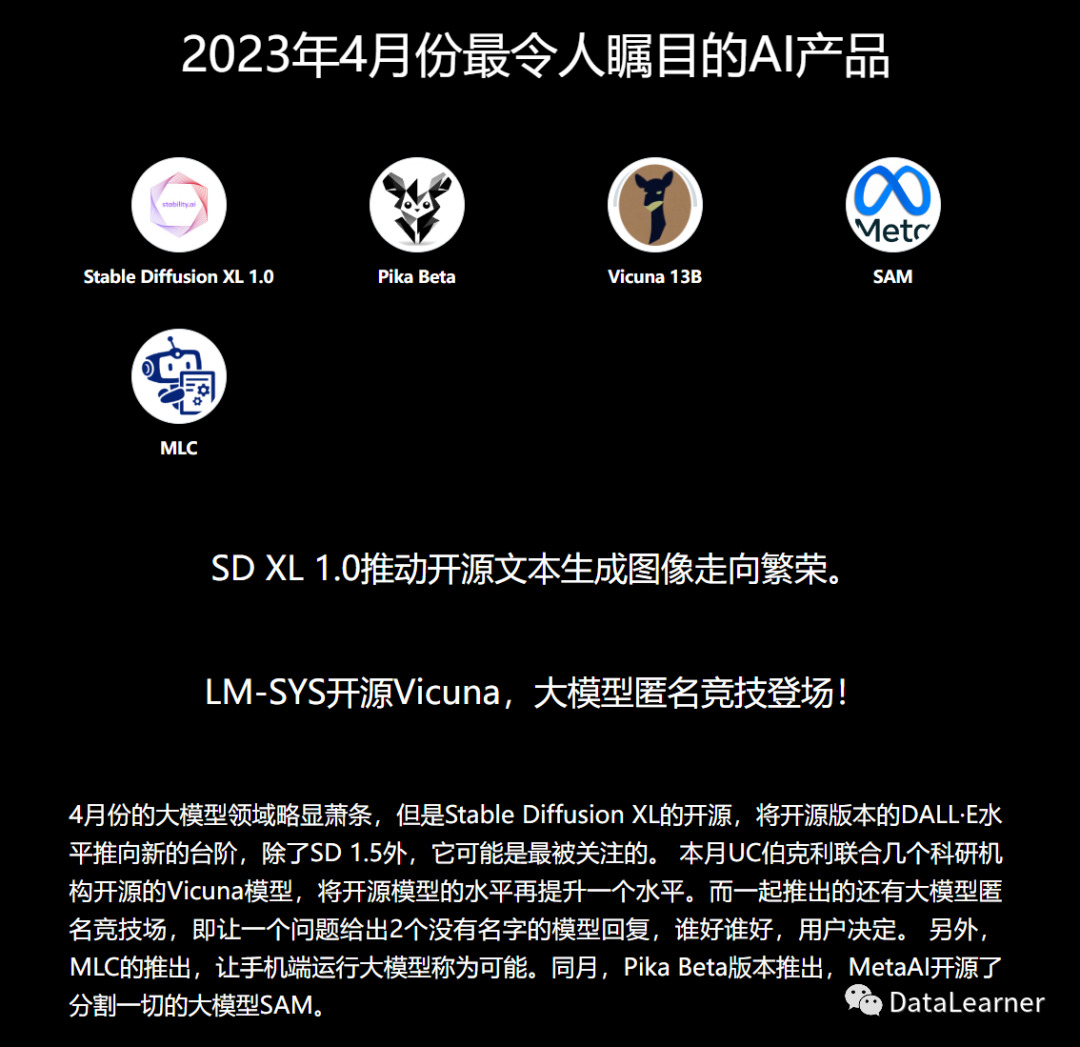
May: Boring Start to the Summer, Google Releases "Not So Good" PaLM2, Attempting to Catch Up with OpenAI
In May, large model technology continued to be relatively quiet, with only Google being diligent in releasing PaLM2, which was deemed "not good enough." QLoRA, released in the same month, supported fine-tuning the 650 billion parameter LLaMA model on a 48GB VRAM graphics card, significantly reducing the cost of fine-tuning.
June: Runway Gen2 Sparks a Wave of Video Generation, Enabling Ordinary People to Create Film Videos
In June, the development of large model technology remained somewhat lackluster, but the release of Runway Gen2 enhanced the playability of large models. The release of WizardLM initiated the road to fame for open-source large models. Microsoft's release of the Phi-1 model aimed to lead the counterattack of small-scale parameter models.
July: A Pleasant Surprise at the End of Summer, MetaAI Open Sources the Second Generation Llama2, GPT-4's Strongest Competitor Claude2 Emerges
In July, Claude2 was released, ranking first in PDF reading comprehension. The release of Llama2 elevated the open-source model to a new level. The release of MetaGPT and AnimateDiff further enriched the open-source ecosystem of AI agents and video generation.
August: Chilling August, MetaAI Continues to Strengthen! Open Source Programming Large Model Code Llama Released
In the chilling August, MetaAI continued to strengthen, releasing the open-source programming large model Code Llama.
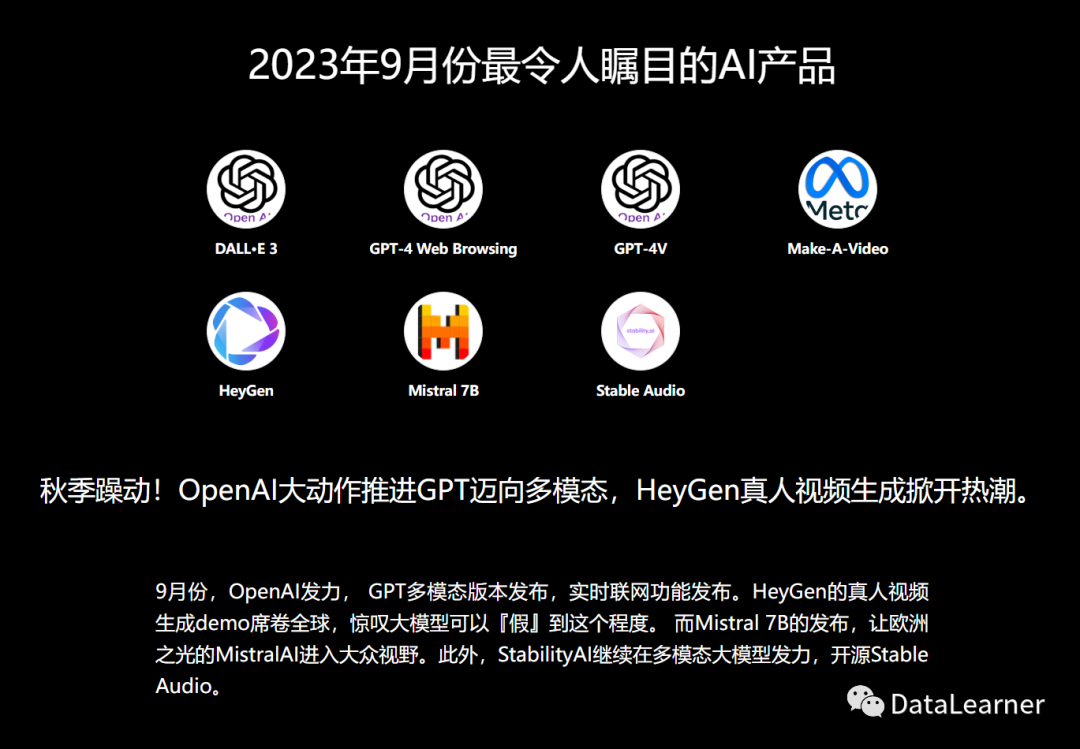
September: Restless Autumn! OpenAI Makes Major Moves to Advance GPT into Multimodal, HeyGen Human Video Generation Sparks a Craze
September: OpenAI makes a move, releasing the multimodal version of GPT and real-time networking capabilities. The real human video generation demo of HeyGen sweeps the globe, marveling at how large models can "fake" to this extent. The release of Mistral 7B brings MistralAI, the pride of Europe, into the public eye. Additionally, StabilityAI continues to focus on multimodal large models and open-sources Stable Audio.
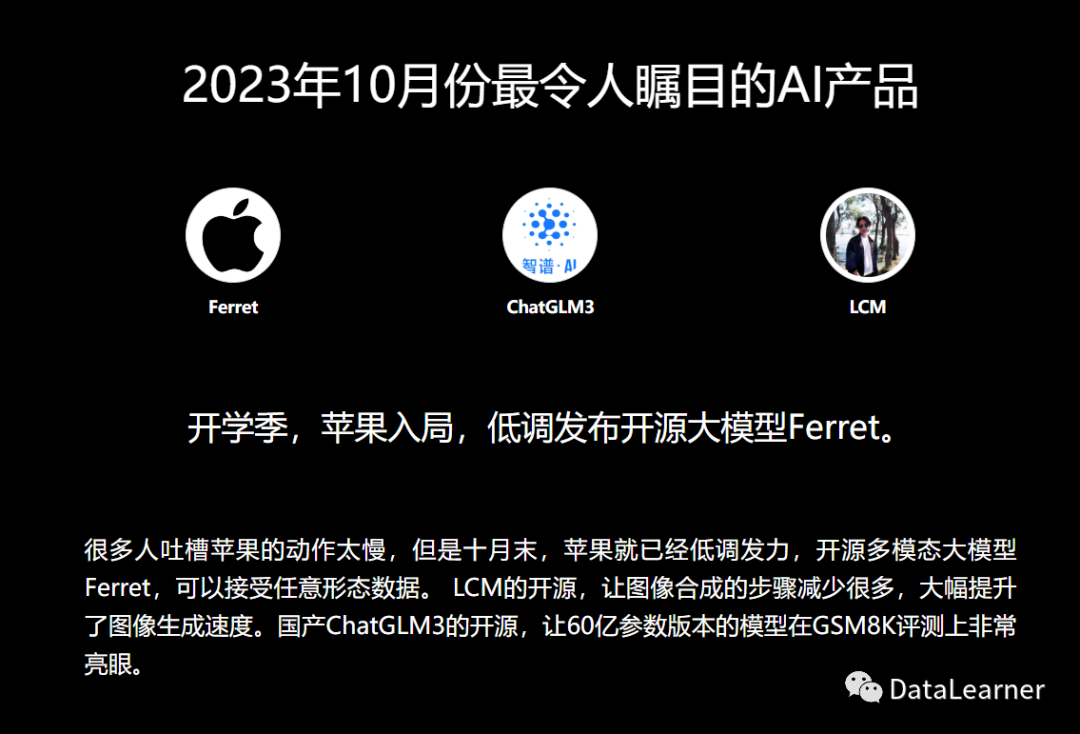
October: Back to School Season, Apple Joins In, Quietly Releasing the Open Source Large Model Ferret
Many people criticized Apple for being too slow, but at the end of October, Apple quietly made a move by open-sourcing the multimodal large model Ferret, capable of accepting data in any form. The open-source release of LCM reduces many steps in image synthesis, significantly improving image generation speed. The open-source release of the domestic ChatGLM3 makes the 6 billion parameter version of the model very impressive in the GSM8K evaluation.
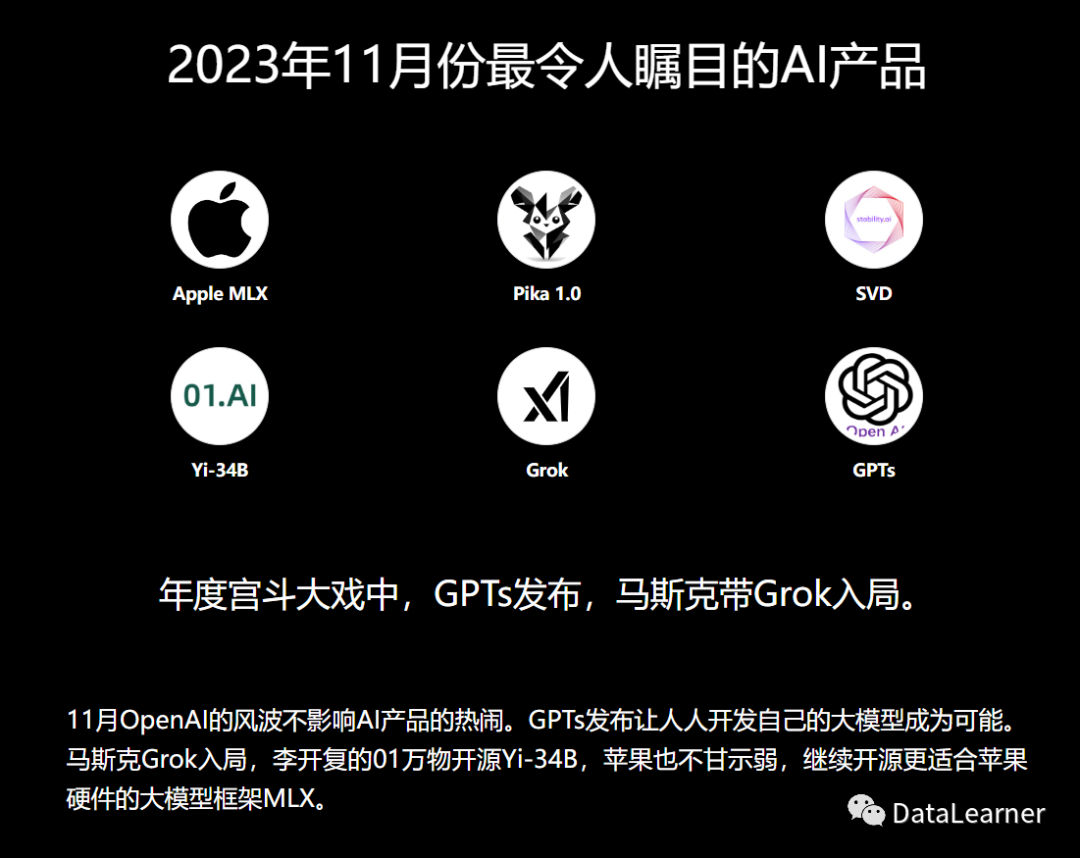
November: In the annual power struggle, GPTs are released, Musk brings Grok into the game
The turbulence at OpenAI in November does not dampen the excitement of AI products. The release of GPTs makes it possible for everyone to develop their own large models. Musk's entry with Grok, Li Kaifu's open-source Yi-34B for the 01 Universe, and Apple's continued open-source of the MLX, a large model framework more suitable for Apple hardware, show their determination.
December: The end of the exciting first year of large models, the exciting MoE large model, and the soaring Midjourney V6
As 2023 comes to a close, Google releases Gemini, with strong multimodal capabilities. The open-source release of a hybrid expert large model by the pride of Europe performs comparably to Gemini. The release of Midjouney V6 takes the quality of image generation to a new level. The AI wave is advancing to a new level!

Conclusion
As 2023 comes to an end, the development of large models has brought new expectations to the entire technology industry. It is important to note that all selections are based on DataLearner's subjective evaluation. Civilized communication is welcome.
Visit the DataLearner large model list to learn more about the AI models released in 2023: Pretrained Models
Additionally, here's a summary image for everyone:
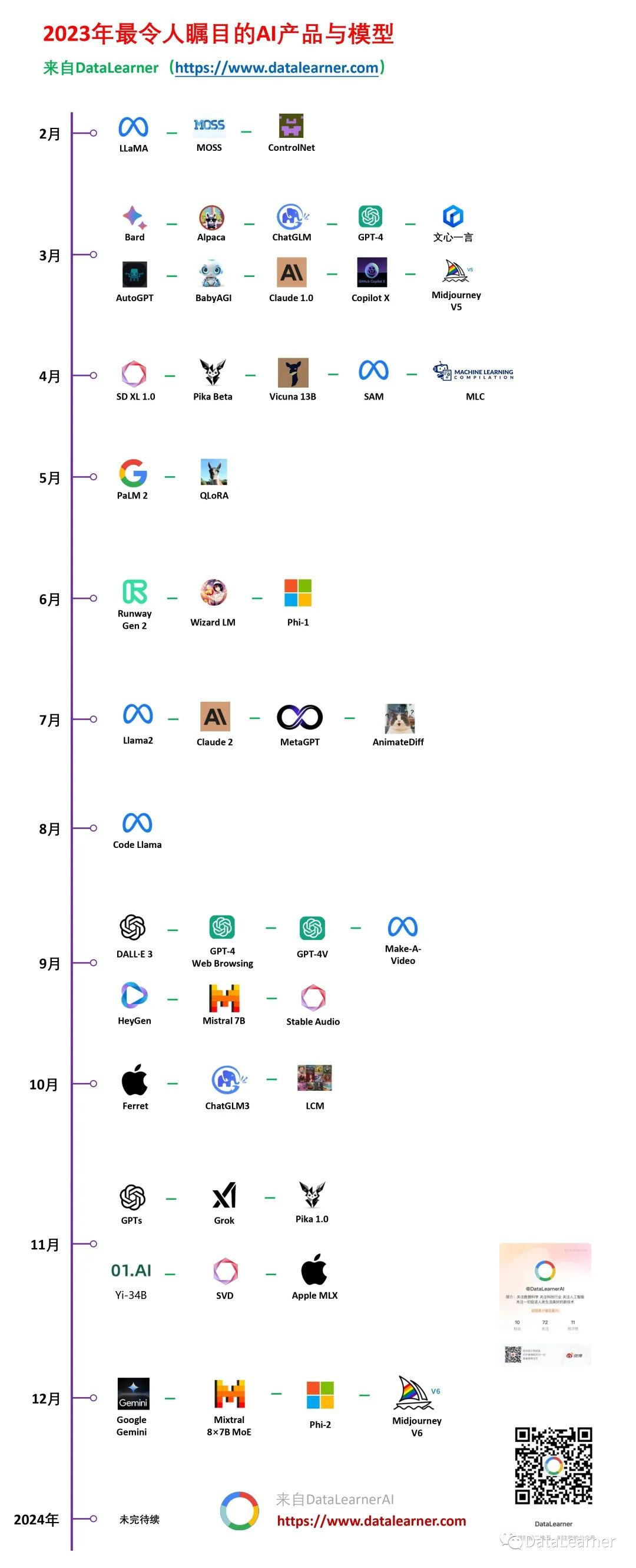
The full article is from the official DataLearnerAI website: DataLearner
免责声明:本文章仅代表作者个人观点,不代表本平台的立场和观点。本文章仅供信息分享,不构成对任何人的任何投资建议。用户与作者之间的任何争议,与本平台无关。如网页中刊载的文章或图片涉及侵权,请提供相关的权利证明和身份证明发送邮件到support@aicoin.com,本平台相关工作人员将会进行核查。


