Original Source: Financial Story Collection

Image Source: Generated by Wujie AI
In the consumer internet field, Chinese and American giants are evenly matched—Elon Musk is fond of liking WeChat, and TikTok also makes Mark Zuckerberg feel uneasy.
But in the industrial internet field, China lags far behind the United States.
This gap is most keenly felt by the players in the Chinese SaaS track.
Globally, the United States has the largest number of SaaS companies, accounting for 53.4% of the total number of companies, while China's share is only 2.6%.
By the end of 2022, the size of the Chinese SaaS market was only 8.3% of the size of the U.S. market, and the market value of the top 10 listed SaaS companies in the two countries differed by 17 times.
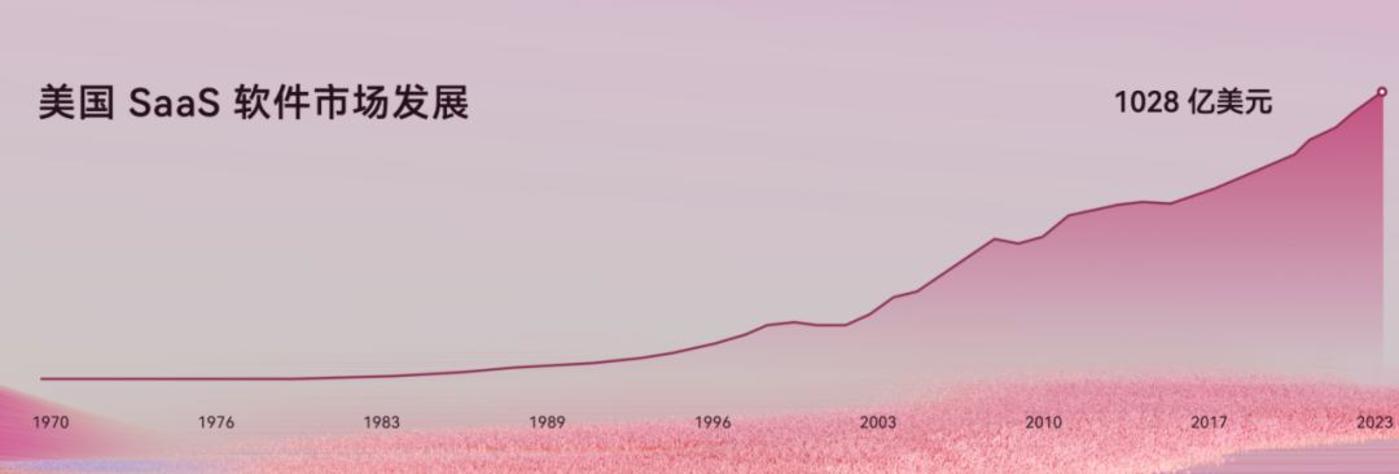
In the face of the obvious gap, Bai Ya, the founder and CEO of Youzan, probably reflected on it. He said, "The SaaS market in the United States is thriving, but in the past two to three years, the enterprise service track in China has been in a typical low period."
Being deeply mired is fate, and breaking out of the low period is the mission.
Bai Ya has placed his bet on AI. Before and after the Spring Festival, he spent nearly four months traveling abroad, "most of the time was spent learning and discussing with everyone I could find who understands AI, trying to figure out what AI can really do and what it can achieve." According to Bai Ya's vision, Youzan aims to become an "intelligent system operator."
Not only Youzan, but other Chinese SaaS players such as Weimob Group, Kingdee International, Kingsoft Office, and Kingsoft Cloud have successively released AI-related products.
In the United States, the CEO of Salesforce, the pioneer of SaaS, Mark Benioff, also regards artificial intelligence as "the most important technology he has encountered in his lifetime, whose power can rival that of nuclear bombs."
Salesforce's annual and 20-year-old Dreamforce conference this year also has AI as its theme.
Why are Chinese and American SaaS players collectively betting on AI? Just like catching up in the consumer internet track, can this move really narrow the huge gap in the Chinese and American SaaS markets?
Boarding the "AI" Ship, Can Chinese SaaS Sail Out of the Low Period?
The urgency of SaaS companies to lay out AI can be seen from the talent grab.
In the AI talent turnover caused by OpenAI, Mark Benioff personally stepped in to recruit talent. He posted on X, "Hurry up and send your resume directly to ceo@salesforce.com!"
In fact, Salesforce, with a market value of over $200 billion, is already an old hand in the AI track.
- First, it is self-developed. As early as 2016, it launched the AI layer Einstein, and this year it launched Einstein GPT. Its latest goal is to incorporate generative artificial intelligence into the entire Salesforce platform.
- Second, it is investment. In March of this year, Salesforce invested $250 million to establish a generative artificial intelligence investment fund. By June, the fund size had been expanded to $500 million.
- Third, it is cooperation. In the field of AI, Salesforce has successively become strategic partners with OpenAI and Google.
In terms of the importance placed on artificial intelligence, Bai Ya is not inferior to Mark Benioff. He asserts, "SaaS systems without intelligent capabilities in the future are not good systems."
In fact, compared to the booming American SaaS companies, Chinese SaaS companies, which are still undergoing turbulent adjustments, are even more in urgent need of using AI as a springboard to emerge from the low period.
There are two obvious differences between Chinese SaaS players and their American counterparts—first, their profitability is not as good as that of their American counterparts, and they are still in the early stage of climbing; second, their revenue scale lags far behind.
In Bai Ya's words, "In China's enterprise service market, marketing and sales are ten times harder than product development, and service operation is ten times harder than marketing and sales."
Bai Ya is not the only one facing difficulties. According to Wang Daiming, author of "SaaS Product Manager," "A certain leading SaaS company in China takes 10 years to recoup customer acquisition costs."
AI happens to be able to demonstrate its capabilities in reducing costs and increasing efficiency, as well as increasing revenue and profits in the SaaS industry.
Currently, the Chinese SaaS industry faces three major difficulties in expanding its business and acquiring customers.
First, lack of expertise. The more powerful the SaaS product, the more complex its functions, leading to higher learning costs for customers, making it difficult to fully realize its value, resulting in limited usage effectiveness and naturally low customer renewal rates.
Taking Youzan's WeChat Mall as an example, it has over 6,000 functions, over 20,000 forms, over 400,000 configuration items, and 10,000 third-party applications.
If the above functions are hidden in the background, many merchants will not know about them and will not have the opportunity to use them. If they are displayed in the foreground, perhaps only 1% of merchants will use them, which may be disruptive to the other 99% of customers.
Second, lack of talent. The SaaS industry mainly serves traditional enterprise customers, and frontline personnel lack professional skills. For example, among Youzan's users are over 2 million frontline shopping guides.
Youzan's approach is to work hard on service delivery, ultimately increasing the renewal rate of its core customer base from about half to nearly 100%. However, this approach relies on a large amount of manpower, which is costly, and the service radius is always limited. "I feel that even if we continue to work hard, the space will not be particularly large," Bai Ya lamented.
Third, lack of direction. Customers lack an overall strategic grasp of digital transformation and are therefore unwilling to invest in SaaS.
AI assistance can help improve the above pain points in one fell swoop.
In a speech, Bai Ya used a simple merchant operation activity as an example to demonstrate the new features of Youzan's AI product, Jia Wo Intelligent.
Its operation interface is very similar to ChatGPT. With just a corresponding command, the intelligent assistant can automatically search for the best solution among over 6,000 functions in Youzan WeChat Mall, and then submit it to the relevant personnel for decision-making, and can optimize the solution in real time based on feedback. "A process that used to take several hours can now be completed in a few minutes," with reduced processes, simple operations, and precise efficiency.
It is worth mentioning that Jia Wo Intelligent can even actively correct unreasonable instructions given by operators, such as setting a discount of 10%, prompting that the intensity is too high and may lead to losses.
This simplified operation can allow customers to easily get started with SaaS products, thereby significantly reducing the sales, delivery, and training costs of SaaS players, while also fully realizing the value of SaaS products and increasing customer renewal rates.
Moreover, intelligence also reduces the application costs and usage thresholds of SaaS products, objectively expected to expand the customer base of the SaaS industry, thereby increasing its revenue scale.
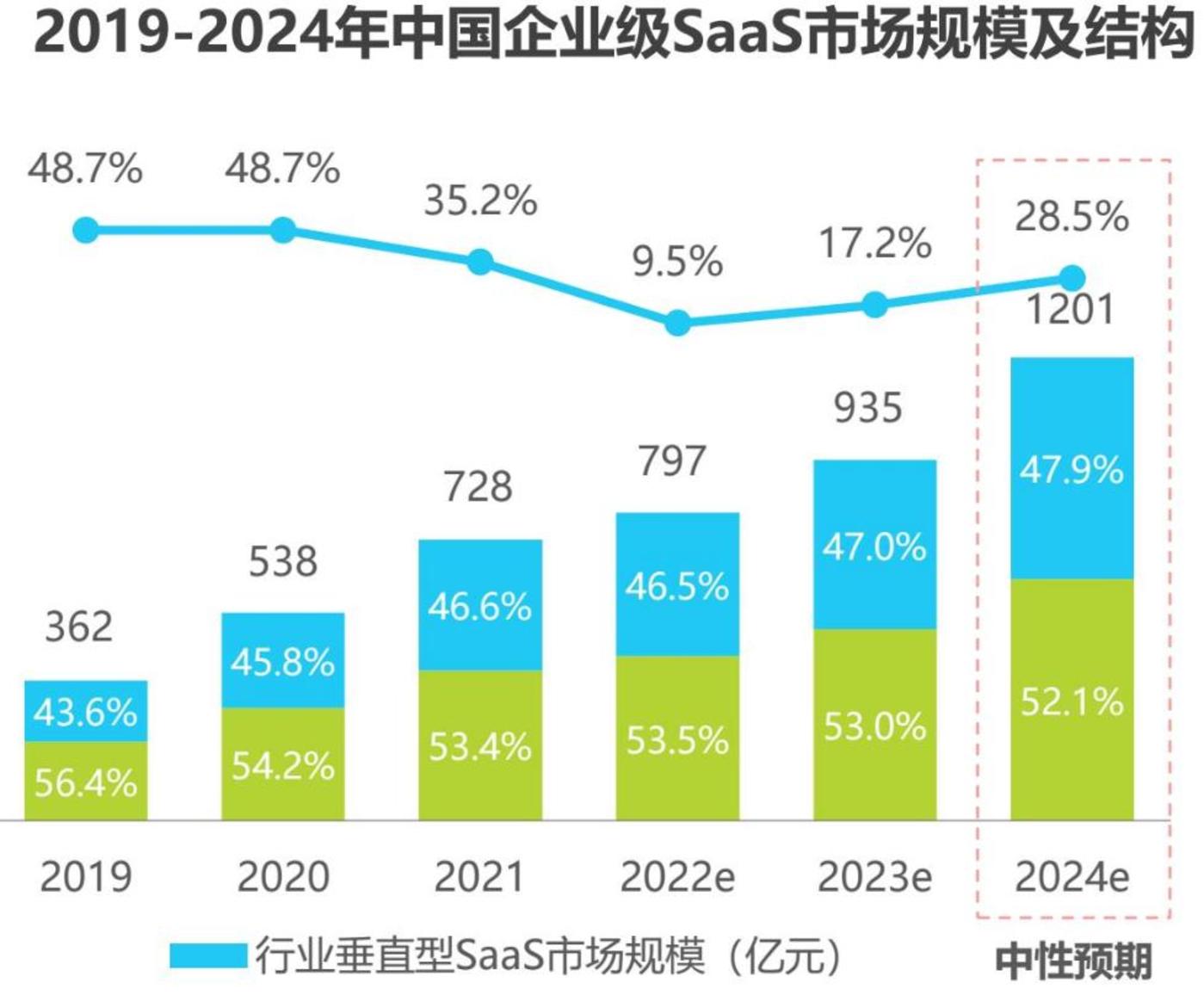
According to Haitong International's calculation, in 2021, the proportion of software revenue to GDP in the United States was about 1.27%, while in the same year, China was only 0.14%; in the past five years, the proportion of software revenue to GDP in China has only increased by 0.04 percentage points, while in the United States, it has increased by 0.15 percentage points.
Intelligence is expected to increase the penetration rate of the Chinese SaaS industry. If it can be on par with the U.S. market, the Chinese SaaS market still has at least 10 times the growth space, with the opportunity to surge from hundreds of billions to trillions.
Challenges Faced by SaaS Players in Embracing AI
Although the prospects are promising, laying out AI in the SaaS industry is not without its challenges.
Whether it is the established players leveraging AI to empower themselves or the disruptive new players starting from scratch to achieve breakthroughs, the question remains: which approach will lead to success?
According to Chen Yu, a partner at Cloud Start Capital, the larger AI opportunities in the SaaS track belong to mature players who have accumulated experience and can quickly seize the opportunities. "In future applications, about 80% will be upgraded versions of current applications after integrating AI large models, and 20% will be new applications developed based on AI large models."
Taking Salesforce as an example, its CEO, Mark Benioff, has ambitious plans for AI. "We are very eager to ensure that Salesforce becomes the number one AI CRM," he said. "AI has become the gospel of the company."
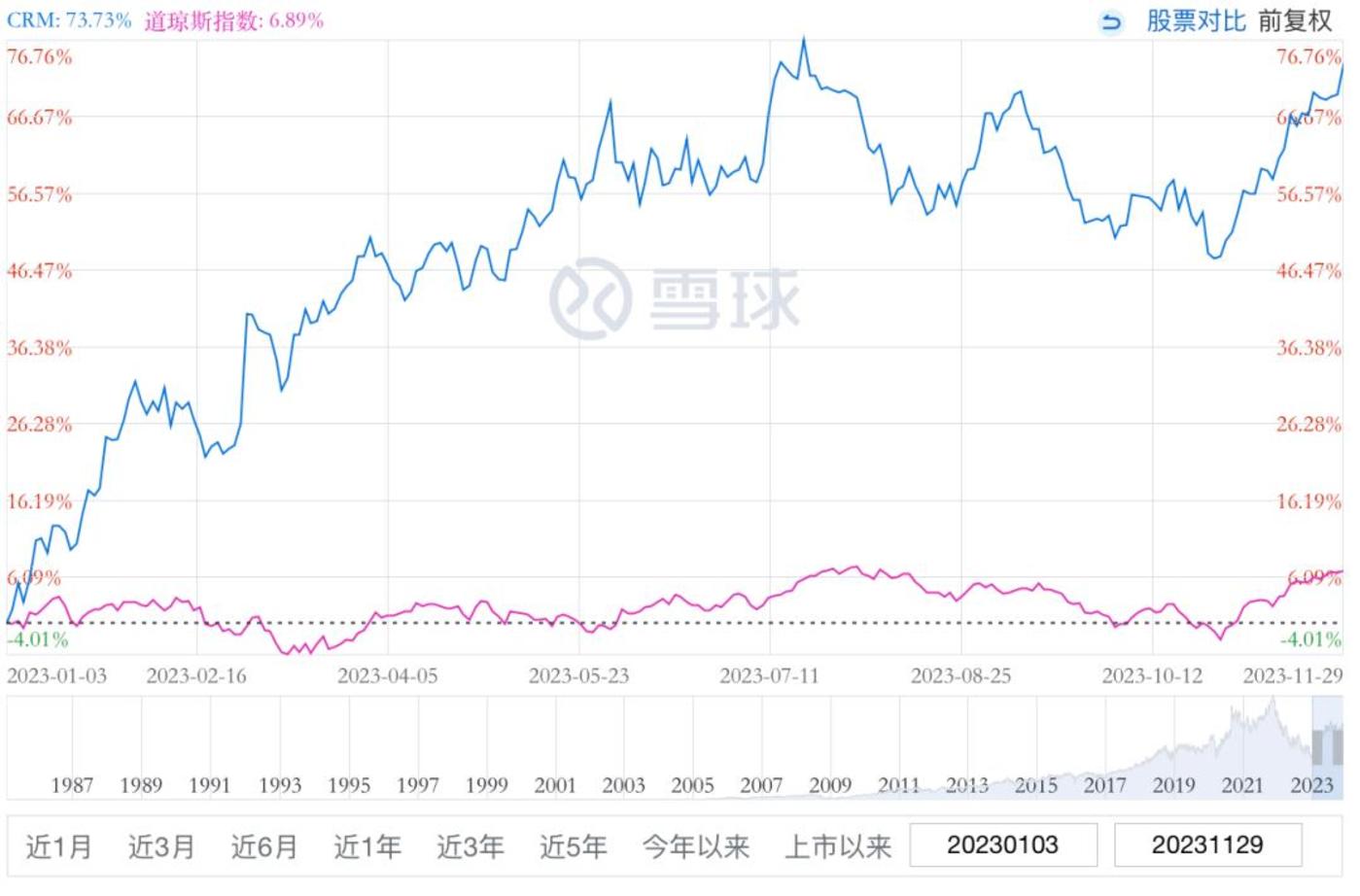
With the increasing deployment of AI products, Salesforce has confidently raised its annual sales guidance, driving its market value to soar—compared to the end of 2022, Salesforce's market value has nearly doubled, making it one of the best-performing stocks in the 2023 Dow Jones Index.
Despite Salesforce's success, the deployment of AI in the SaaS industry is not without its challenges.
Whether it is reviewing Salesforce's experience in deploying AI or analyzing the confidence of Youzan's all-in approach to AI, it is clear that they possess the necessary and leading technological capabilities, industry expertise, and accumulated methods, as well as a large customer base and usage scenarios.
Taking Salesforce as an example, its AI deployment has been ongoing for seven or eight years, progressing step by step from self-development to investment and cooperation.
Similarly, Youzan has made similar efforts. Bai Ya did some calculations, stating, "Youzan's WeChat Mall has over 20,000 functions. It takes 25 person-days to launch each function, and after launch, it takes another 25 person-days for comprehensive maintenance. The comprehensive cost per person per day, including salary, administrative costs, social security, etc., averages around 3,000 yuan." Based on this calculation, Youzan's accumulated investment in product development and design over the past 11 years has reached a staggering 3 billion yuan.
Such high-pressure investment makes it difficult for newcomers to replicate—currently, Chinese venture capital firms are no longer as generous and are tightening their purse strings. With no hope of short-term profitability, new players find it difficult to secure ample investment for long-term research and development.
Furthermore, deploying AI requires talent alignment. Without the aggregation of professional technical talents, intelligent transformation is impossible.
After returning from four months of overseas research, Bai Ya initially devoted half of his energy to AI, and now, 80% of his energy is focused on AI.
At Youzan, every product that takes more than 2 person-days must be carefully reviewed by Bai Ya himself, all "to shift more products and research and development to AI."
Only with the entire team all-in on AI does Youzan have the confidence to transform intelligently.
However, having "AI" alone is far from enough—AI is a tool, and application is the goal. Li Yanhong has emphasized this multiple times, stating, "Without rich applications built on top of the basic model, AI large models are worthless."
Similarly, the deployment of AI in the SaaS industry is not about technological breakthroughs, but about industrial breakthroughs.
Only based on high-quality and highly active industry big data, deep cultivation of frontline professional know-how, can better AI be trained, and diverse industrial scenarios be adapted.
Taking Youzan as an example, over the past 11 years, Youzan has directly served an annual transaction volume of 100 billion yuan, indirectly participated in over 220 billion yuan of business, empowered over 2 million salespeople, and helped merchants reach over 600 million consumers. Youzan provides targeted "delivery" services for each paying customer, as well as a database called the "Customer Success Manual," which has accumulated numerous best practices under the "consumer operation-centric" business model.
These reports, manuals, and practices have accumulated into a vast knowledge base, forming the data foundation for Youzan to upgrade to an intelligent system operation company.
Based on the "feeding" and "training" of this data, Youzan's AI has the ability for heuristic dialogue, precise service, and continuous iteration, moving towards "value" emergence.
The ultimate carrier for the emergence of AI value in SaaS enterprises is still the customer—OpenAI has successively joined forces with Microsoft and Salesforce because, although its C-end users have reached hundreds of millions in scale, it lacks experience and accumulation in serving B-end customers. Therefore, the release of its AI value needs to be landed on the B-end through cooperation with partners.
SaaS enterprises with a large number of B-end corporate customers can gain an advantage.
On one hand, a large number of high-trust customer resources can be efficiently and cost-effectively reused by SaaS enterprises' intelligent new products, allowing their value to be quantified quickly. On the other hand, a large number of customers can quickly test their AI results, and the process of using the product is also a training for AI, which can in turn contribute to the iterative upgrade of the intelligent system. For example, starting from August, Youzan's AI capabilities have gradually landed on the product side.
Therefore, the deployment of AI by SaaS players is the general trend, but it involves challenges in technology development, industry scenarios, and customer scale.
AI for SaaS Customers
The ultimate success of the deployment of AI in the SaaS industry depends on whether it can bring incremental value to customers and whether they are willing to pay for it.
Salesforce CEO Benioff claims that his product Slack, with the support of AI, "feels like waking up," and it can act as a customer's "assistant, partner, and deputy," and "it will also help you manage the company."
This is not just empty talk. For customers, the incremental value of AI-enabled SaaS products lies in cost reduction, efficiency improvement, effective decision-making, and continuous growth.
Intelligence can enable SaaS customers to achieve professionalism and low thresholds.
Unlike C-end products that only satisfy the common needs of the public, enterprise market industries, scales, and demands vary greatly, resulting in SaaS software that provides services with extremely complex functions.
On one hand, this leads to high learning costs for customers and the need for a large number of professional operational personnel. Bai Ya revealed that many of Youzan's customers now set "proficiency in Youzan" as a threshold when recruiting talent.
On the other hand, SaaS products are not only functionally complex but also continuously iterated. If talent cannot be quickly matched, customers may end up underutilizing SaaS products, with many functions lying idle and not realizing their value.
In this regard, Jinshan Office's Zhang Qingyuan once proposed an "80/20 rule." In office software applications, 80% of users only use 20% of the functions, and the remaining 80% of the functions, for which customers pay, are not used or not used well.
With the assistance of intelligence, the threshold for SaaS applications can be significantly reduced, and even frontline grassroots personnel with limited digital skills can easily, fully, and efficiently utilize the full-stack capabilities of SaaS products.
For example, Youzan's sales guides can seek help from AI to provide suggestions on how to improve performance, identify high-value customers, and generate various proactive services, customer relationship maintenance, and personalized promotions. Store managers or regional operations personnel can also use AI to query real-time performance, calculate sales commission for guides, and develop optimization plans, and so on.
These personnel do not need to spend energy familiarizing themselves with over 6,000 functions of Youzan WeChat Mall one by one. AI can instantly access these functions and combine them to provide the best solution.
The reduction of thresholds and the decrease in reliance on professional talents can help SaaS customers reduce costs and improve efficiency.
Secondly, it can also assist in effective decision-making and enhance the organization's flexibility in response.
The incremental value of AI is not only in lowering the threshold at the execution level but also in demonstrating its capabilities at the decision-making level, including marketing graphics, business analysis, business planning, intelligent posters, product generation, store decoration, intelligent tasks, automatic reconciliation, and more.
With the above set of capabilities, headquarters personnel can seek help from AI to scientifically set sales targets, optimize marketing plans, track and alert about subsequent progress, and make timely adjustments to inventory discounts, and so on.
In this way, the company can be targeted in tactical planning, improve the efficiency and scientific nature of decision-making, and enhance the agility of the entire organization.
Intelligent SaaS products can also help customers improve user experience, ultimately bringing new growth opportunities.
Taking the retail industry as an example, with current high traffic costs and high customer acquisition costs, many brands focus on activating existing customers.
Clothing brand "Mystery" excels in this area. In 2023, its average store performance increased by more than 20%, and the average repeat purchase rate of existing customers increased from once a year to about three times a year.
The performance improvement is attributed to "Mystery" identifying high net worth customers and operating them in different segments: focusing on emotional maintenance for full-price customers within 30 days; analyzing the preferences of customers within 60 days and pushing corresponding new products for activation; and using birthday privileges to invite activation for customers over 180 days.
In the personalized and precise one-on-one services mentioned above, AI can demonstrate its capabilities, such as reminding sales guides to take appropriate actions for specific customers, and more.
Ultimately, due to the high professional barriers in the SaaS industry, AI is likely to have difficulty overturning the leading players in the SaaS industry, but under the empowerment of AI, the landscape of the SaaS industry will inevitably be restructured.
In the deployment of AI, SaaS players in China and the United States are actually progressing in sync, with a similar pace, not only in technological innovation but also in the implementation of applications.
Using AI as a springboard, the Chinese SaaS industry may use this opportunity to move out of the period of fluctuation and enter a period of explosive growth, narrowing the gap with the American market.
免责声明:本文章仅代表作者个人观点,不代表本平台的立场和观点。本文章仅供信息分享,不构成对任何人的任何投资建议。用户与作者之间的任何争议,与本平台无关。如网页中刊载的文章或图片涉及侵权,请提供相关的权利证明和身份证明发送邮件到support@aicoin.com,本平台相关工作人员将会进行核查。


