Author: Pedro M. Negron, Junior Research Analyst at IntoTheBlock
Translation: Felix, PANews
Liquid Staking Tokens (LST) allow users to earn rewards from PoS blockchains without locking their assets. This concept has evolved into one of the most important subsectors in the crypto space. As of November 2023, approximately $20 billion has been staked through Ethereum's LST. Due to the massive size of the staking market, many participants have entered the Ethereum ecosystem's liquid staking, with Lido protocol's stETH remaining the leading LST. However, other protocols have also made significant developments, especially after Ethereum's Shapella upgrade in April 2023, which allowed users to withdraw staked tokens.
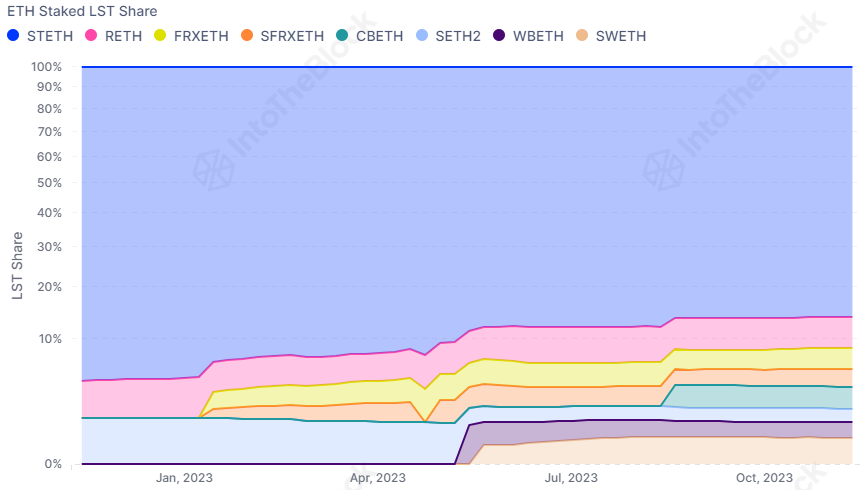
As liquid staking protocols enter the market, many introduce unique mechanisms to gain a competitive edge. Lido has played a leading role in the liquid staking landscape of the Ethereum ecosystem, relying on institutional node operators to capture a significant market share, holding over 90% of the Ethereum liquid staking market before the Shapella upgrade. With the launch of the Shapella fork and increasing investor confidence in holding LST, the market share of new protocols has increased, currently holding approximately 15% of the market share.
Source: IntoTheBlock
New liquid staking protocols are attempting to stand out in various ways. For example, Rocket Pool, whose rETH token holds the second largest market share. Rocket Pool's main feature is its commitment to decentralization. The protocol's primary goal is to nurture a decentralized validator community, ensuring that validator power does not concentrate in the hands of a few individuals or entities.
In addition to decentralization, other innovative approaches include novel token models, such as the dual-token model represented by the Frax protocol. The Frax protocol's tokens are divided into frxETH and sfrxETH. In this model, one token receives significant incentives in the DeFi ecosystem, while holding the other token allows for combined staking rewards from both tokens. Specifically, frxETH is anchored 1:1 with ETH in this model, while sfrxETH is an insurance pool designed to accumulate staking rewards for Frax ETH validators. The exchange rate of sfrxETH to frxETH increases over time as more rewards are added to the insurance pool. (Related reading: Entering the hot tracks of RWA, LSD, Layer2, etc., how far is Frax Finance from "rising to the top five market cap"?)
While Lido and its stETH token dominate the current market, various other tokens show indicators of their stability and long-term potential in the market.
Source: IntoTheBlock
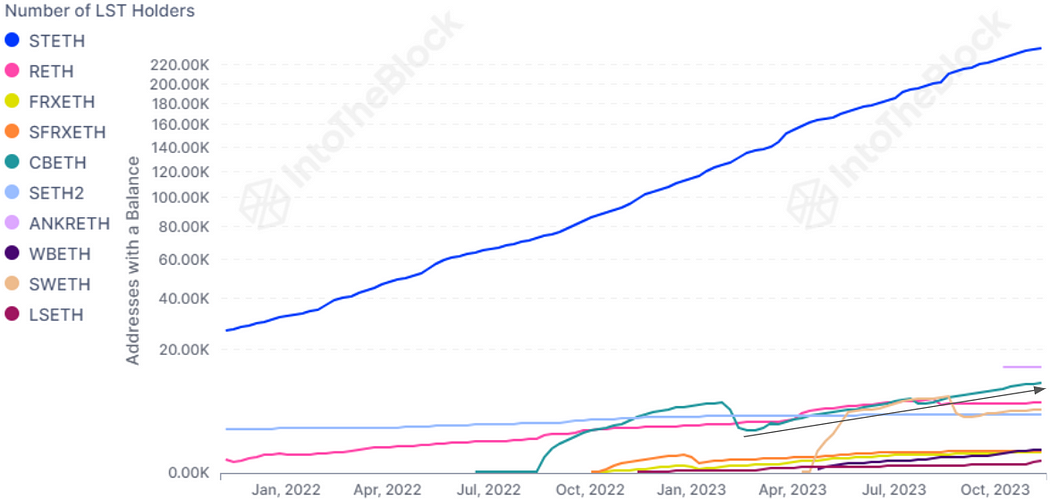
Currently, the amount staked through Lido's stETH is $18.3 billion, and the protocol also has the highest number of holders in the market, with 238,600 unique addresses. Following stETH, the number of unique addresses for ankrETH is 14,900, showing a significant difference in the number of token holders between the two.
In addition to stETH, another noteworthy trend is the increasing number of holders of cbETH, a staking token for Ethereum introduced by Coinbase a year ago. Since its launch, the number of holders of this token has continued to grow, indicating a positive demand for cbETH. While the number of cbETH holders may not be the highest, it has surpassed other competitors, currently having 10,800 unique holders.
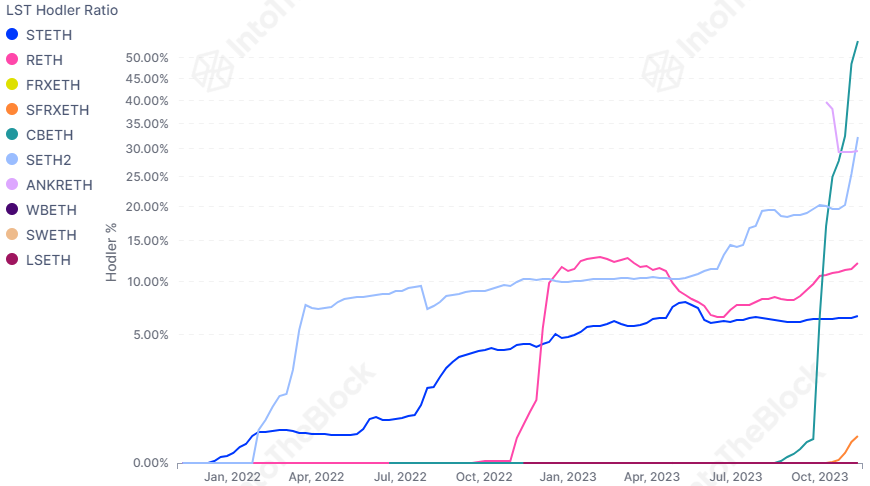
Furthermore, as cbETH expands, another positive sign is that cbETH has the highest proportion of Hodler users among all LST.
Source: IntoTheBlock
Among the addresses holding cbETH, 54.26% have held the token for over a year, demonstrating the holders' commitment. A large number of Hodler addresses is a positive indicator, as it signifies trust in the token and the underlying protocol.
This result may be attributed to the way Coinbase holds the tokens in cold storage. Specifically, if the tokens are held in customer accounts on centralized exchanges, it may indicate a lack of liquidity for the tokens. Even if this is the case, overall, it is still a positive sign. If the demand for the tokens decreases, exchanges will continually reorganize, as the tokens may be sold or destroyed.
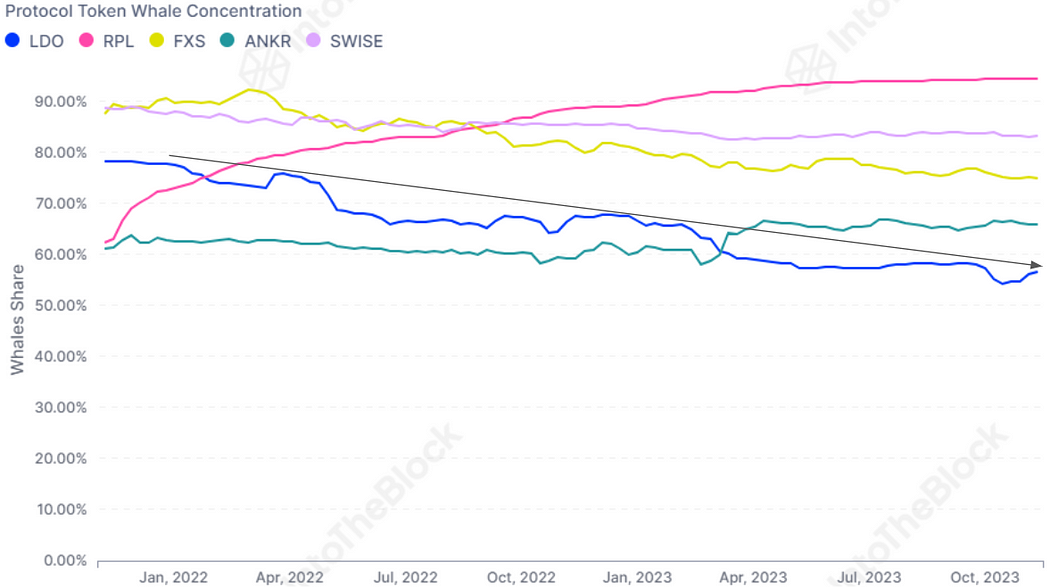
Finally, the concentration of major holders of governance tokens is an important indicator of decentralization. This metric helps identify excessive concentration of holders, which could be detrimental to the ecosystem.
Source: IntoTheBlock
As shown in the above chart, most governance tokens in the LST ecosystem are concentrated among major holders. However, it is worth noting that in Lido's development, the decentralization process is evident. Over the past year, the concentration of whales in the LDO token has decreased by over 10%, from 67.8% to 56.4%.
This trend can also serve as an indicator of token maturity, as lower concentration implies a wider distribution among token holders, indicating a higher level of decentralization and reduced influence of individual holders. It is common for newly launched tokens to exhibit high concentration among major holders. Therefore, considering the adoption rate and scale of Lido's stETH token, the decreasing concentration of major holders of its governance token over time is logical.
In conclusion, the liquid staking market within the Ethereum ecosystem presents a dynamic landscape, with each token having its unique features and user base. While Lido's stETH token has consistently dominated, recent trends indicate increasing protocol diversity and evolving competitive dynamics. Tokens like cbETH, which have garnered significant holder interest, highlight their attractiveness and long-term potential. The proportion of Hodler users and the concentration of major holders are key indicators of token health and ecosystem decentralization. Additionally, the decreasing concentration of whales in governance tokens (such as Lido's LDO) reflects the ongoing maturity of these tokens and a move towards greater decentralization.
Related reading: LSD's five rookies are coming on strong, can Lido still hold its ground?
免责声明:本文章仅代表作者个人观点,不代表本平台的立场和观点。本文章仅供信息分享,不构成对任何人的任何投资建议。用户与作者之间的任何争议,与本平台无关。如网页中刊载的文章或图片涉及侵权,请提供相关的权利证明和身份证明发送邮件到support@aicoin.com,本平台相关工作人员将会进行核查。


