Author: Rhythm Little Worker, BlockBeats
According to BlockBeats news, on October 26th, the cross-chain interoperability protocol LayerZero announced an important news: the launch of the wrapped stETH (wstETH) function for transferring liquidity staking protocol Lido Finance on Ethereum, Avalanche, BNB Chain, and Scroll.
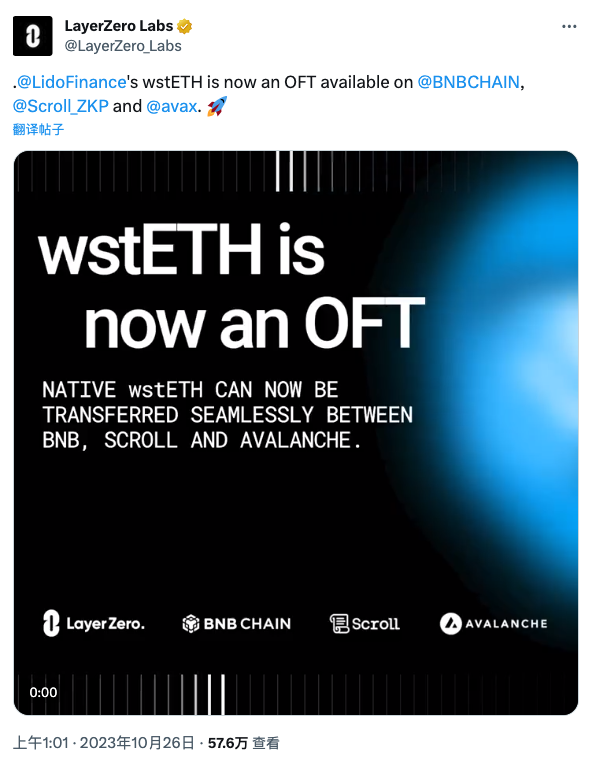
This move by LayerZero quickly attracted industry attention. The reason behind this is the integration of wstETH with LayerZero Omnichain Fungible Token (OFT) standard. Omnichain Fungible Tokens (OFT) is a new cross-chain token standard introduced by LayerZero, which has already been adopted by Avalanche, PancakeSwap, and Trader Joe.
According to LayerZero, the OFT standard provides a more user-friendly and efficient cross-chain transfer solution, serving as a new scalable token standard (similar to ERC-20), allowing tokens to be externally composited in any type of dApp and any DeFi ecosystem. This means that tokens can now have a unified standard across all protocols and blockchains, enabling users to seamlessly exchange across chains and use tokens on any dApp on any chain.
OFT has two versions, v1 and v2, with the main difference between the two being that v2 can support non-EVM chains (such as Aptos, etc.). In addition, there are also OFNT721 and OFNT1155 supporting Omnichain NFT. In addition to Avalanche, PancakeSwap, and Trader Joe, many projects have adopted LayerZero's OFT standard, such as Ethereum layer2 Metis, Multichain stablecoin MIM, CDP protocol TapiocaDAO, Wrapped Bitcoin protocol BTC.b, multi-chain lending protocol Radiant.capital, and so on.
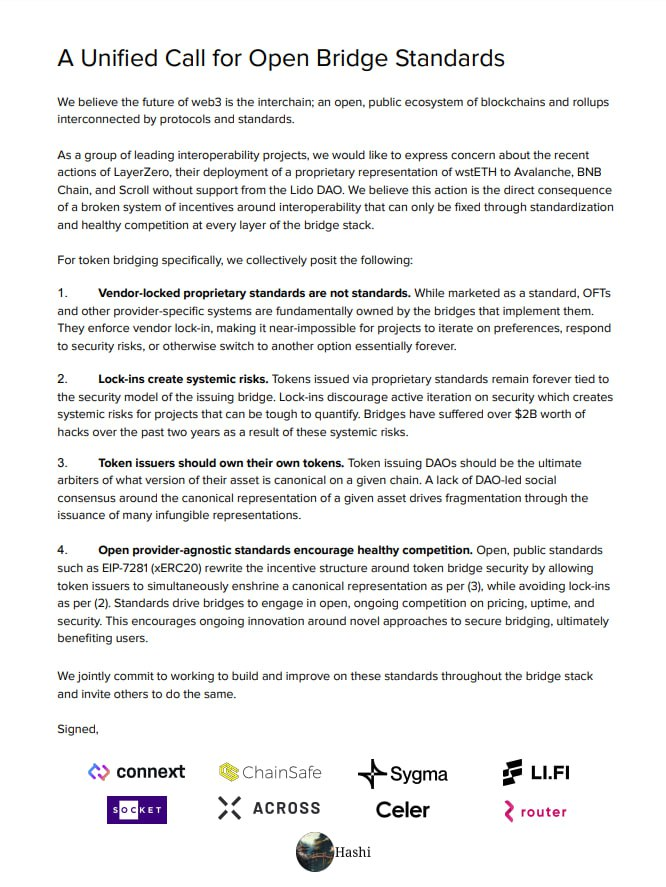
Joint Letter of "Condemnation" by Peers
LayerZero's launch of the wrapped stETH (wstETH) function for transferring Lido Finance on Ethereum, Avalanche, BNB Chain, and Scroll has been met with joint resistance from nine cross-chain projects including Connext, Across, Celer Network, Chain Safe, Sygma, LI.FI, Socket, Router Protocol, and Cross-chain Interoperability Alliance.
In their joint letter, they expressed concern about LayerZero's recent actions: "LayerZero deployed the proprietary standard of wstETH to Avalanche, BNBChain, and Scroll without the support of Lido DAO. We believe that this action is a direct consequence of the collapse of the interoperability incentive system and can only be repaired through healthy competition at every layer through standardization and bridging."
"Vendor-locked proprietary standards are not standards, and locking will cause systemic risks. Token issuers should own their tokens, and open vendor-agnostic standards encourage benign competition." In the joint letter, these projects jointly committed to establishing and improving these standards throughout the entire bridge stack and invited others to do the same.
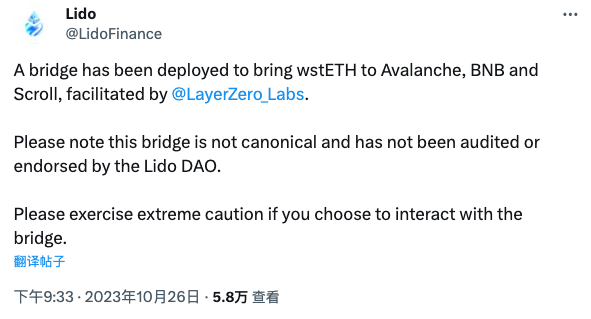
Lido's official statement also warned: "Under the promotion of @LayerZero_Labs, a bridge has been deployed to introduce wstETH to Avalanche, BNB, and Scroll. Please note that this bridge is not standardized and has not been audited or endorsed by Lido DAO. If you choose to interact with the bridge, please be extra cautious. Proposals for Lido DAO to support this bridge must still go through the necessary checks, discussions, and governance processes."
Community's Long-standing Grievances Against LayerZero
Previously, LayerZero Labs completed a $135 million Series A+ financing, with participation from a16z, FTX Ventures, Coinbase, and Binance, among others. It is worth noting that one of the investors is PayPal Ventures, as LayerZero is their first Web3.0 project in their portfolio. Such a star project naturally attracted great community attention, and whether to issue tokens or not has been the most concerning topic for the community. However, LayerZero's attitude towards this has always been ambiguous.
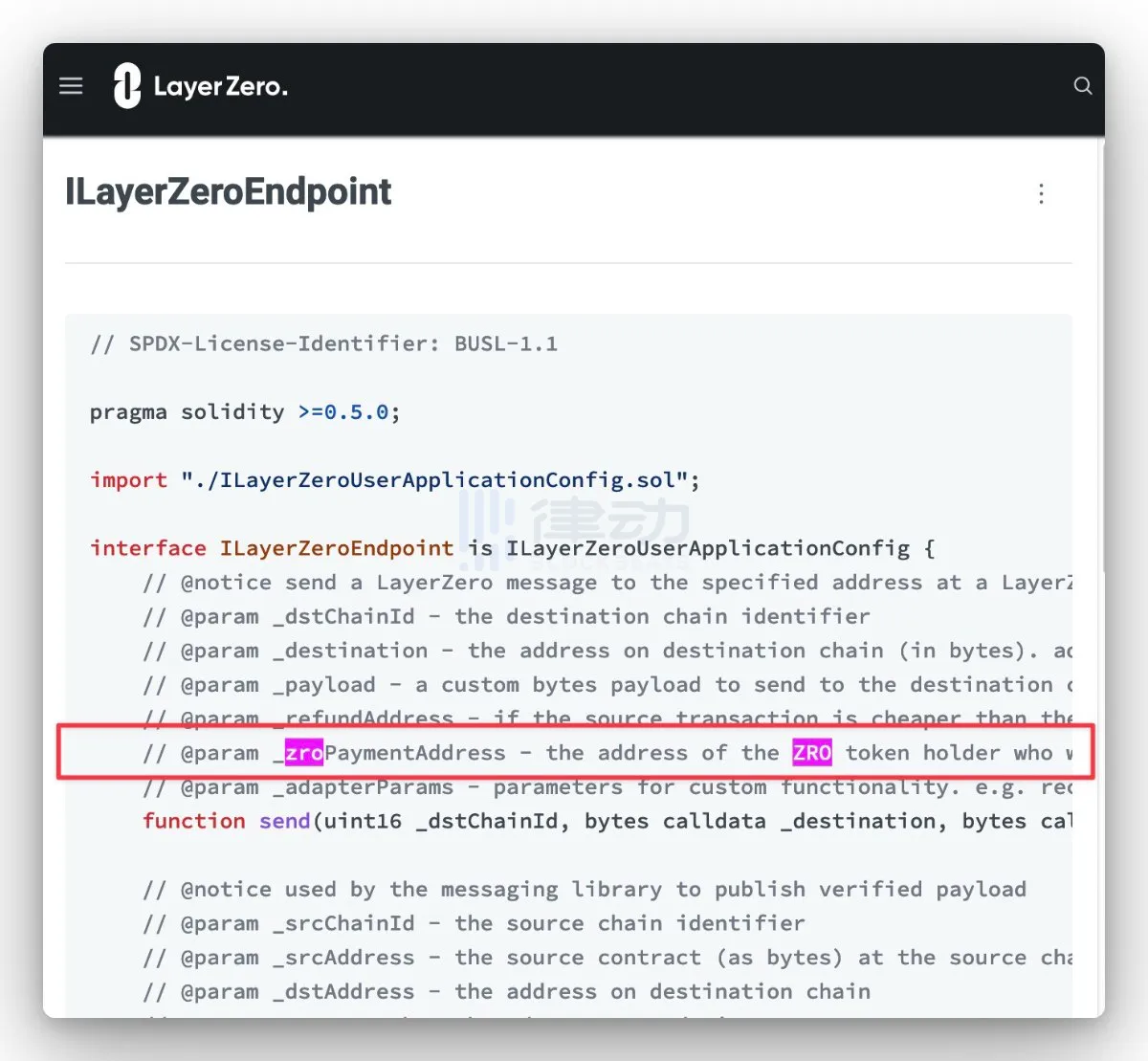
Information about the ZRO token in LayerZero's code snippet
The community's grievances against LayerZero have been evident in the Lido incident. Under the "resistance" and "condemnation" of these cross-chain projects, community discussions have been incited.
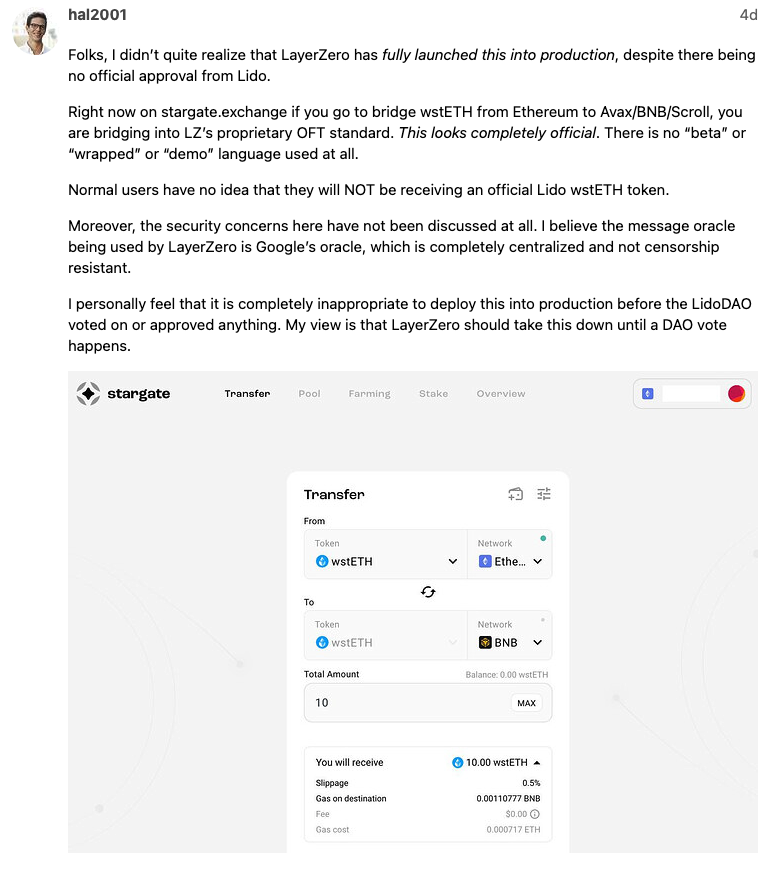
Community member hal2001 stated: "I hardly realized that LayerZero had fully deployed it into production, yet it did not receive official voting and approval from Lido. Now on stargate.exchange, if you bridge wstETH from Ethereum to Avax/BNB/Scroll, you are bridging to LZ's proprietary OFT standard. This looks completely official. There is no use of 'beta' or 'wrapped' or 'demo' language at all.
Ordinary users are unaware that they will not receive the official Lido wstETH tokens. Furthermore, the security issues here have not been discussed at all. I believe that the oracle used by LayerZero is Google's oracle, which is completely centralized and not resistant to censorship. In my opinion, it is completely inappropriate to deploy it into production before it is voted or approved by Lido DAO. My view is that LayerZero should remove it before the DAO vote takes place."
Cryp further pointed out: "Layerzero is really too centralized, in fact, there is almost nothing decentralized at the moment. For example, they are related to Google and Conflux. There is currently no information about how the tokens will be distributed (but considering the amount of funds raised, it is certain that this will be centralized).
There is no transparency about what the team is doing… No blog… Their website does not show their ecosystem… Most importantly, a lot of marketing and ambiguous use of airdrops, I think this is outrageous."
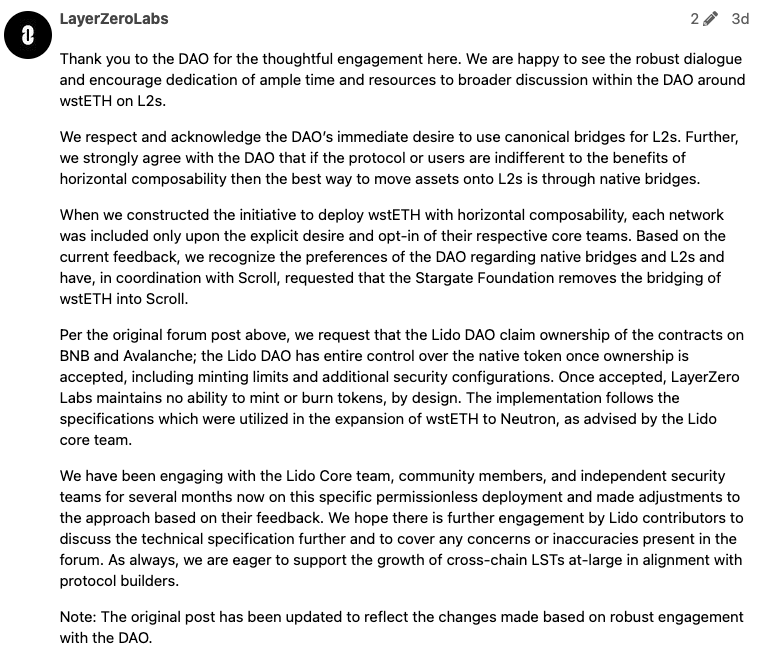
In contrast, the official response from LayerZero seems very official: "Thank you for the active interaction and strong dialogue in the DAO. We encourage broader discussions in the DAO about wstETH on L2. We support the DAO's use of L2's standard bridging and believe the best migration method is native bridging. We are working with the core team to jointly decide, hoping that Lido DAO will manage the BNB and Avalanche contracts. We have long been working with the Lido team, adjusting strategies based on feedback, and look forward to more technical discussions. We always support the growth of cross-chain LST."
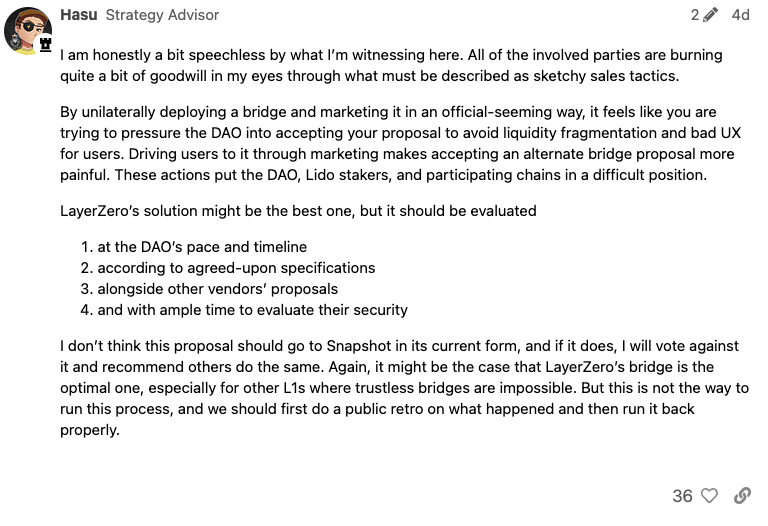
We all know that Stargate is the first protocol built on LayerZero. In this turmoil, Strategy Advisor Hasu stated that although LayerZero's actions are a domineering sales strategy, attempting to force the DAO to accept its proposal, he also believes that LayerZero's solution may be the best and should be evaluated: "LayerZero's bridge may be the best, especially for L1s that cannot achieve trustless bridges. But this is not the way to run the process; we should first openly review what has happened and then run it properly."
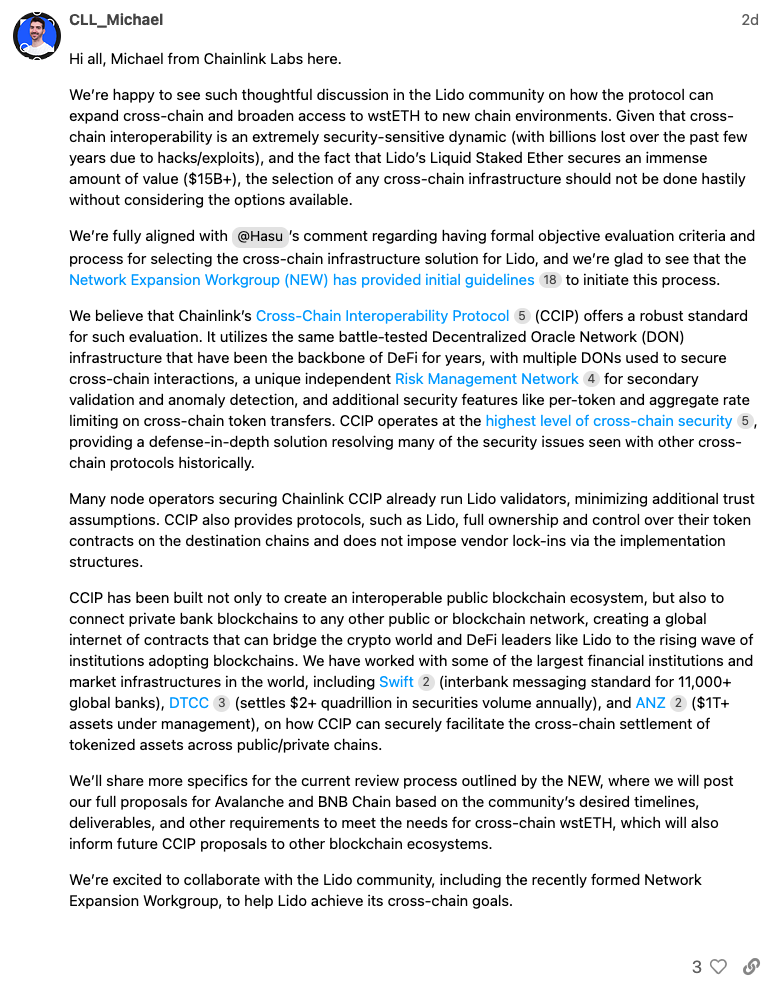
In this cross-chain bridge battle, Chainlink Labs also did not absent itself. Michael from Chainlink Labs also expressed his views, stating that cross-chain interoperability is an extremely sensitive security issue, and in the past, huge losses have been caused by vulnerabilities and hacker attacks. There should be an objective evaluation standard for choosing cross-chain infrastructure, and decisions should not be made hastily.
At the same time, Michael also recommended Chainlink's solution to the community: "Chainlink's Cross-Chain Interoperability Protocol 5 (CCIP) provides a reliable standard for such evaluations. It leverages the same proven decentralized oracle network (DON) infrastructure that has been a pillar of DeFi for many years, using multiple DONs to secure cross-chain interactions, a unique independent risk management network 4 for secondary verification and anomaly detection, and additional security features such as per-token and aggregate rate limits for cross-chain token transfers. CCIP operates at the highest level of cross-chain security 5, providing a comprehensive defense solution that addresses many of the security issues historically present in other cross-chain protocols."
LayerZero's actions have triggered reactions from multiple parties. Although their technology and solutions have been recognized by some experts, how to transparently and fairly deploy and use these solutions remains a point of contention for the entire community.
As Michael pointed out, cross-chain interoperability is indeed a sensitive issue involving significant assets and user trust. Therefore, decisions should be based on thorough research and community consensus, rather than unilateral actions. After all, in the crypto community, there are still many believers and followers of "complete decentralization," and their voices are difficult to ignore.
免责声明:本文章仅代表作者个人观点,不代表本平台的立场和观点。本文章仅供信息分享,不构成对任何人的任何投资建议。用户与作者之间的任何争议,与本平台无关。如网页中刊载的文章或图片涉及侵权,请提供相关的权利证明和身份证明发送邮件到support@aicoin.com,本平台相关工作人员将会进行核查。


