Author: syora.eth
Compiler: MetaCat
Introduction
I attended Token2049 and participated in a roundtable meeting, and I was surprised that even frontline developers did not have a clear definition of the Autonomous World (AW). However, people in the core circle, including myself, seem to share a common dream. So, what is this dream? Upon deeper reflection, let's revisit the concept of the Autonomous World brought by 0xPARC:
"The autonomous world has strict plot boundaries, formal introduction rules, and does not require privileged individuals to maintain the vitality of the world."
In fact, this describes its essence rather than defining it, and now it seems to have evolved into another concept.
Let me clarify from the beginning that this article does not provide a definition of the Autonomous World. The purpose of this article is to provide discussion points when considering what the Autonomous World is. Specifically, I explore individuals' views on the "Autonomous World," the awareness of specific products related to the "Autonomous World," and discuss what the "Autonomous World" is based on its essence.
Through this article, I hope to clarify various positions, stimulate discussion, and provide an opportunity for current builders and newcomers to deepen their understanding of the Autonomous World. If achieved, the author's purpose is fulfilled.
The structure of this article is as follows:
- First, I will explain the research methodology of this article and then present the results.
- Next, I will report on the research results of the definition of Full On-Chain Games (FOCG). This is because the origin of the Autonomous World (AW) is FOCG.
- Then, I will discuss the research results of the definition of AW. This is the main topic, and surprisingly, there is a wide divergence of opinions.
- Next, I will list the characteristics that may become the basis for discussion and examine the definition of AW from these perspectives.
- Finally, I will summarize and discuss future work.
Research Methodology
In my research of existing literature, I included the viewpoints of key blog articles, such as those from 0xPARC and guiltygyoza. Finally, I summarized the referenced articles. Although I tried to include the viewpoints from the blog articles I consulted, some viewpoints may still be subjective. In this sense, any criticism of this article is welcome.
For the research of the core circle, I conducted a survey in a closed Telegram group, which only allows core builders of AW to join. In this group, I not only asked everyone about their definition of AW, but also asked about whether specific projects are considered AW and why. This helps gauge the perspectives of builders on AW.
In summary, I synthesized the opinions of over 20 people to complete this article.
Results
First, I would like to discuss the results of the survey. I surveyed builders, and the results are as follows. Although the respondents to this survey were only 11 people, I specifically targeted those who are seriously involved in AW, so this should be sufficient to grasp the general trend.
First, regarding the question "Do you think there are representative AW projects now?" the results are as follows:
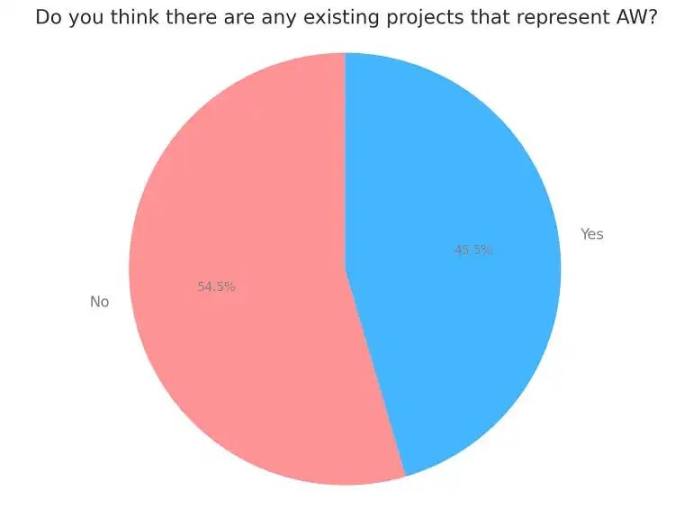
About 45% of the respondents indicated that there are representative AW projects now.
Next, I asked the respondents if they consider some major projects to be AW.
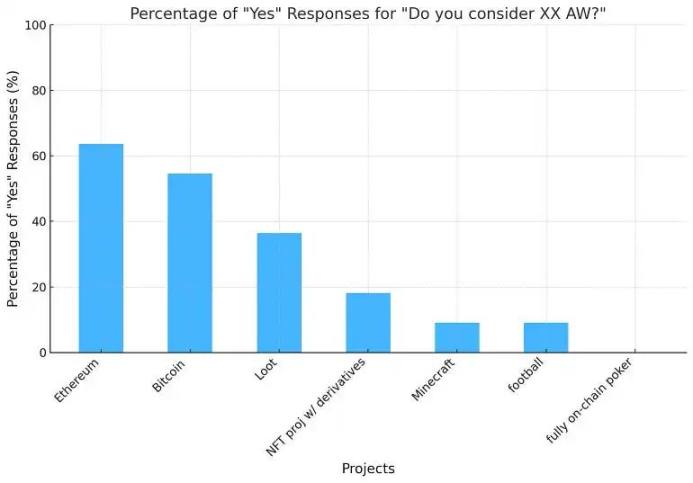
From the chart, it can be seen that Ethereum is considered the closest to AW. Interestingly, the fully on-chain poker, which is considered FOCG by many, has the lowest proportion of being considered AW. Moreover, although about 45% of the respondents answered "yes" to the first question, the proportion considering Ethereum as AW exceeds 60%.
These results are indeed very interesting. Why did such results occur? I believe there are two reasons: one is that the definition of AW varies from person to person, and the other is the possible lack of self-evident, fully realized AW.
To delve deeper into these issues, I would like to first review the definition of FOCG.
Definition of FOCG
The definition of FOCG? That's easy! It's a game where everything is on-chain, right? You might think so, but that's not the case. This is because at least the front end does not need to run on-chain.
The basic points that everyone seems to agree on are as follows:
- The logic/rules are on-chain
- The state is on-chain
Points open to debate include:
- Whether the logic needs to run on-chain, or whether it is sufficient to be verified on-chain
- Whether to include concepts such as the "Autonomous World"
The first point is obviously up for discussion, but the second point needs explanation. That is, when asked about the definition of FOCG, some people mentioned the following requirements:
- It must continue/update and maintain security without developers' maintenance
- The blockchain ensures data reliability, and it has persistence without relying on the client
- Its goal is to achieve permissionless composability and interoperability, and to achieve full ownership, etc.
You can find these concepts in "The Strongest Cryptographic Game Paper," guiltygyoza's "Game 2.0," and "Infinite Game." All of these discussions are about "games," not "worlds," and whether to consider these as the definition of "FOCG" is crucial.
Specifically, the following questions can clarify your position:
Is a simple fully on-chain poker game considered FOCG?
If your answer is yes, then you only require the logic and state of FOCG to be on-chain. If not, it means you have higher requirements for FOCG, requiring it to be crypto-native.
Definition of AW: Are Bitcoin and Ethereum AW?
Some people believe that FOCG and AW are completely identical concepts. As mentioned above, if the requirement for FOCG is to be entirely crypto-native, then it is very close to the concept of AW. However, that's not all. I realized that there is an important distinction between FOCG and AW: whether it is a "world." Perhaps due to the terminology, FOCG is still seen as a game, while AW seems to need to be a world. Additionally, whether it is based on conversation seems to be a good criterion for many people to distinguish between FOCG and AW.
Furthermore, I noticed that most people consider "scalability" and "composability" as the next important elements. This may be more related to the properties that AW should have rather than its definition, but many people see value in this and consider it an inherent quality of AW.
To understand your perspective on "Is Bitcoin AW?" please consider the following question:
Is Bitcoin AW?
Certainly, Bitcoin is crypto-native, but whether it is a "world" is challenging. Additionally, due to its design prioritizing simplicity, it has poor scalability and composability compared to other projects. Those who consider these criteria as elements of AW may not consider Bitcoin as AW.
Another useful starting point for discussion is the following question:
Is Ethereum AW?
Unlike Bitcoin, Ethereum has full scalability and composability. However, some people believe it lacks the concept of a "world." Others believe its world boundaries are blurry, while some believe its shortcomings are due to a lack of sustainable funding models in its scalability. Among the surveyed projects, Ethereum is the closest to AW. Therefore, discussions based on this should be more actively pursued.
Considering the Characteristics of AW
While it is beneficial to think based on projects, discussions based on characteristics are also valuable. The main characteristics required by AW, based on the survey, are as follows. Here, I would like to divide it into three layers.
Inherent properties obtained from using blockchain:
- Censorship resistance
- Decentralization
- Immutability
- Persistence
- Verifiability
- Ownership
- Transparency
Characteristics that can be achieved through positive use of blockchain technology:
- Autonomy
- Composability
- Interoperability
- Permissionlessness
Additionally, as unique properties of the Autonomous World:
- Worldness
Although not mentioned here, people can also consider the boundaries of the world as a characteristic. However, from the discussion by BlockScience (https://medium.com/block-science/disambiguating-autonomy-ca84ac87a0bf), this can also be understood as autonomy and worldness.
Broad AW and Narrow AW
One of the reasons why the discussion about AW is complex is that different people have different requirements for AW. Some emphasize certain characteristics, and if these are met, they will label it as AW. Others believe that it is not AW unless all these characteristics are met. Additionally, some people acknowledge both positions and distinguish between broad AW and narrow AW. We need to unify our understanding here.
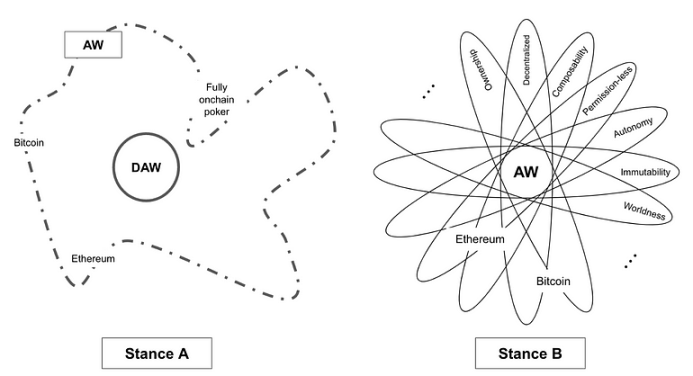
Position A: This position considers the scope of AW entities to be broad. In many cases, Ethereum will be seen as AW. This position has two issues. One is that it is difficult to form a consensus on which characteristics are the core of AW when recognizing the broad scope. One solution may be to keep it as a philosophical concept without providing specific boundaries. Another issue is that the narrow definition of AW requires a different name. Inspired by DAO and believing that true decentralization meets the requirements of narrow AW, I propose the term "Decentralized Autonomous World (DAW)."
Position B: This position only acknowledges the narrow definition of AW as AW. Just as there is no dispute about whether Bitcoin is blockchain, in this case, only universally acknowledged AW is considered as narrow AW, which means AW may not exist yet. In this case, the term "DAW" becomes redundant, but it becomes intriguing for people to casually claim that their projects are AW.
I welcome both of these positions. However, given the frequent deviations in discussions about the "Autonomous World," I hope to form a consensus as much as possible.
Future Work
To reiterate, the purpose of this article is not to provide a definition for AW, but to organize everyone's discussion points. Additionally, I deliberately avoided delving into each characteristic mentioned in this article. The discussion of each characteristic itself may require ten articles, and determining whether these characteristics are met usually involves many gray areas. For example, while decentralization is crucial, I have not seen discussions at the sequencer level in the context of AW. Discussions about decentralized operations seem to be lacking. Furthermore, discussions about "autonomy" and "worldness" will be particularly important.
Another area for future work is to delve deeper into coordinating seemingly conflicting characteristics. This mainly involves immutability and permissionless composability. Especially, the concept of immutability may bring various challenges.
Additionally, considering the narrow definition of AW (for convenience, we will call it DAW), it would be helpful to think about technical approaches that meet all its requirements. Why does DAW not exist at the moment? Is it due to technical limitations? If so, what are these limitations? Will speed or latency be obstacles to meeting all the above characteristics? It turns out that considering technical limitations after setting clear goals is often more beneficial than not doing so.
Conclusion
In this article, I conducted a cognitive survey of the definitions related to FOCG/AW through literature review and a questionnaire. Surprisingly, even the definition of FOCG is very vague, and it is clear that there are two definitions of AW: broad and narrow. Whether we call broad AW AW, narrow AW DAW, or only call narrow AW AW, I hope to form a consensus as soon as possible.
References
0xPARC: Autonomous Worlds (Part 1) https://0xparc.org/blog/autonomous-worlds
guiltygyoza: Autonomous World https://www.guiltygyoza.xyz/2022/12/why-aw
guiltygyoza: Game 2.0 https://www.guiltygyoza.xyz/2022/07/game2
Gubsheep: The Strongest Crypto Gaming Thesis https://gubsheep.substack.com/p/the-strongest-crypto-gaming-thesis
ronan: Infinite Games https://ronan.eth.limo/blog/infinite-games/
stokarz: Attributes of Bitcoin and AW https://twitter.com/stokasz/status/1671509868623044608
Autonomous Worlds Books (AW Bible) https://www.docdroid.net/DlVSLIm/autonomous-worlds-book-pdf
AW Research: Recap of AW Meetup Group Discussion at Token 2049 https://twitter.com/AW_Research/status/1705117840934871310
pe3rapan: On-Chain Games⮕Autonomous Worlds https://twitter.com/pet3rpan_/status/1654168452205268992
免责声明:本文章仅代表作者个人观点,不代表本平台的立场和观点。本文章仅供信息分享,不构成对任何人的任何投资建议。用户与作者之间的任何争议,与本平台无关。如网页中刊载的文章或图片涉及侵权,请提供相关的权利证明和身份证明发送邮件到support@aicoin.com,本平台相关工作人员将会进行核查。

