Source | Hard AI
Many venture capitalists have found that AI startups are adopting a new business model - usage-based pricing, rather than sticking to the traditional user-based pricing (or seat-based pricing).
For example, initially, the generative AI startup Cresta charged users. Now, the company has shifted to charging for every conversation its AI tool helps contact center employees have.
In March of this year, customer service company Intercom released the AI chatbot Fin, pricing it at 99 cents for each customer request it can handle, different from the company's core customer service product which is charged per user.
Research lab and AI startup Hume AI, which aims to analyze people's emotional changes using AI technology, tone, and facial expressions, has also started charging based on minutes, comments, and word count.
Public information shows that usage-based pricing (UBP), also known as consumption-based pricing, allows customers to pay based on the actual usage of the product, and the metrics of usage correspond to how customers derive value from the product.
Currently, UBP pricing is becoming increasingly popular in the Software as a Service (SaaS) field, gradually replacing more traditional subscription and user seat-based pricing models.
Due to UBP directly linking the price customers pay with the value they receive from the product, this pricing method has been evaluated as "the epitome of value-based pricing models."
Karthik Ramakrishnan, a partner at venture capital firm Institutional Venture Partners (IVP), stated that the usage-based pricing model can help AI startups more closely link product pricing with the actual value they provide, with the latter's measure being the time and workload they save for customers.
However, compared to traditional user seat-based pricing, pricing based on usage (also known as pay-per-use) may not lock customers into packages that can generate more predictable revenue streams. C3.ai, a publicly traded company focusing on enterprise AI and AI application development, encountered challenges in revenue and gross margin fluctuation when transitioning to UBP pricing.
Currently, usage-based pricing models can be broadly divided into three types:
Usage-based pricing, also known as metered services, is similar to the model of purchasing electricity or water from public utility companies in real life. This pricing model was initially favored by SaaS and Infrastructure as a Service (IaaS) cloud providers, allowing customers to explore how to use the service in a natural way without the need to subscribe in advance, thereby retaining customers.
The advantage of UBP pricing is that through the transparency of the pricing model, it is easier to directly link the customer's usage cost with the supplier's resource consumption. For users, they can start using the product at a relatively low cost, minimizing adoption resistance. For suppliers, allowing more users to access the product within the same account can foster more new use cases, and even encourage a group of users to share experiences with potential users within the company or external organizations, thereby expanding the total addressable market (TAM).
On the downside, this pricing model relies on the changing needs of customers, which may make it more difficult for suppliers to predict financial data and obtain sustainable recurring revenue, and may even harm the long-term growth of the enterprise. However, data shows that in the past five years, the adoption rate of UBP pricing in the B2B SaaS field has almost doubled, with three-fifths of companies using some form of UBP strategy.
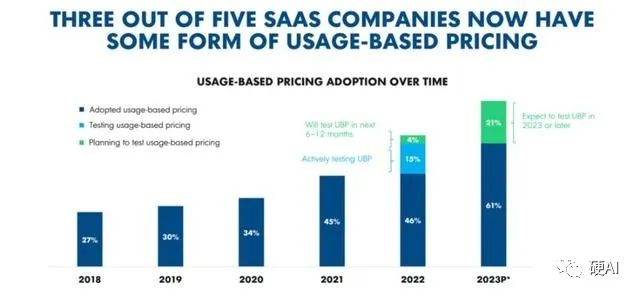
Naomi Pilosof Ionita, a partner at venture capital firm Menlo Ventures, also stated that in addition to the fact that the product is relatively new and requires faster strategies to prove its value to potential customers, if AI startups increase the efficiency of their customers' employees, it may ultimately lead to fewer employees being hired by customers, meaning that the user seats that bring revenue to AI companies under the traditional subscription model will decrease.
For these reasons, AI startups are more willing to try new pricing models.
At the same time, in the current macroeconomic challenges, more and more enterprise customers are laying off employees and cutting expenses, and it takes longer for them to make software purchasing decisions. Usage-based pricing may be more easily accepted by enterprises because it allows customers to adjust their spending flexibly over time.
Some analyses also point out that the rise and gradual popularization of UBP pricing are closely related to the characteristics of technological development:
Automation: Software is increasingly automating manual processes. The more successful the product, the fewer user seats the customer needs, and pricing based on user seats cannot change with the value generated by automation.
Artificial Intelligence: AI takes automation further, ultimately eliminating the need for an entire team to perform tasks, which means that monetization is no longer solely linked to human users of the product.
API: For many of the fastest-growing software companies, the value lies in the API (the ability for software to directly communicate with other software), rather than the UI (user interface), and value can be seen without having users.
免责声明:本文章仅代表作者个人观点,不代表本平台的立场和观点。本文章仅供信息分享,不构成对任何人的任何投资建议。用户与作者之间的任何争议,与本平台无关。如网页中刊载的文章或图片涉及侵权,请提供相关的权利证明和身份证明发送邮件到support@aicoin.com,本平台相关工作人员将会进行核查。


