Layer one or L1 refers to a base blockchain protocol like Bitcoin or Ethereum. These networks operate on a decentralized ledger secured by proof-of-work (PoW) mining or proof-of-stake (PoS) staking. L1 chains such as Bitcoin and Ethereum offer unparalleled security. However, during peak times, both of these chains grapple with sluggish transaction speeds and steep fees.
Developers from several L1 networks are working to improve layer one scaling through methods like increasing block size, sharding, and introducing proof-of-stake consensus. However, substantial layer one upgrades require coordination among node operators and can take years to implement. Some blockchains intend to use L2 protocols as either a temporary or long-term solution.
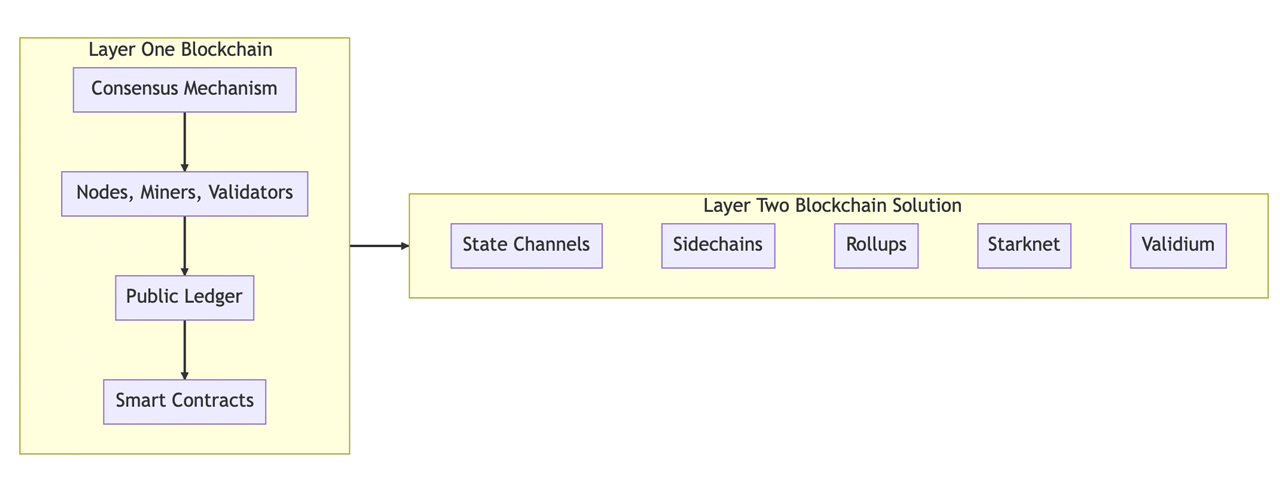
Layer one (L1) blockchains and layer two (L2) networks.
Layer two or L2 solutions take advantage of the security of an existing layer one blockchain while enabling faster and cheaper transactions off-chain. Then the data is summarized and settled on the L1, but that’s not always the case.
Here are some key L2 solutions:
Lightning Network for Bitcoin
Bitcoin’s Lightning Network (LN) is a second-layer scaling solution designed to facilitate faster, low-cost transactions on the Bitcoin blockchain (L1). It operates on top of Bitcoin’s base layer, allowing for instant payments by circumventing the need for block confirmations.
Transactions on the Lightning Network occur off-chain in payment channels between users. Only channel open and close transactions are recorded on the Bitcoin blockchain. Participants can transact multiple times within these channels, reducing congestion and fees on L1.
Critics target LN for its prevalent use of custodial wallets, as these demand users place trust in third parties to handle their money. Moreover, the off-chain method poses a risk: if nodes lack proper backup, it could trigger an irrevocable loss of funds.
Loopring and ZK-Rollups for Ethereum
Loopring uses zero-knowledge rollups (ZK-rollups) to batch hundreds of transactions off-chain and generate a cryptographic proof verifying their validity. This proof is submitted to layer one (Ethereum), avoiding the need to process each transaction on-chain.
Polygon ZKEVM also uses ZK-rollup technology to offer high throughput Ethereum transactions with lower fees. On the risk side, some believe that relying heavily on ZK-rollups can introduce centralization risks as validators and sequencers become key to the system.
ZK-rollups are also complex both in terms of their theoretical underpinnings and implementation. This complexity can lead to potential vulnerabilities if not implemented correctly or thoroughly vetted.
Optimistic Rollups
Optimistic rollups like Optimism and Arbitrum offer similar throughput improvements by processing transactions off-chain. However, they take a different approach than ZK-rollups for settling data on layer one.
While ZK-rollups cryptographically prove validity, Optimistic rollups assume transactions are valid and only settle/dispute transactions on layer one if needed. This requires a separate fraud-proof process.
Optimistic rollups are also complex and just like ZK-rollups the tech can lead to unforeseen vulnerabilities or bugs. Another critique is the delay in withdrawals from an Optimistic rollup back to the main chain.
Starknet and Validium
Starknet leverages Stark proofs to validate transactions off-chain for later settlement on Ethereum. Validium platforms like Boba Network also move contract execution off-chain but don’t settle back to layer one.
Starknet and Validium critiques include complexity, trust assumptions, and computational intensity. Moreover, relying on specific entities for off-chain data storage can lead to centralization, potentially making the system more vulnerable to attacks or manipulation.
No solution offers speed, security, and decentralization in equal measure. Layer two aims for transaction speed without sacrificing the security of layer one. However, some believe decentralization is lost by moving computations off-chain.
Others insist the ideal long-term solution likely combines layers one and two. Meanwhile, numerous crypto enthusiasts remain firmly rooted in the belief that only L1s hold significance in the onward journey.
In summary, layer two platforms offer a different path to scalability by handling transactions off-chain, while some still benefit from the robust security model of layer one. To some this balance of speed and security makes layer two solutions appealing for blockchain adoption.
While some dismiss L2s as a complete waste of time or deem them entirely pointless, the discourse stretches on. Yet, through years of discussion, work continues to enhance both layers to achieve the optimum blend of scalability, security, and decentralization.
免责声明:本文章仅代表作者个人观点,不代表本平台的立场和观点。本文章仅供信息分享,不构成对任何人的任何投资建议。用户与作者之间的任何争议,与本平台无关。如网页中刊载的文章或图片涉及侵权,请提供相关的权利证明和身份证明发送邮件到support@aicoin.com,本平台相关工作人员将会进行核查。


