Author: Chloe, PANews
The Ethereum community has recently expressed concerns about the expanding influence of Lido in the liquid staking market, and criticism has been continuous. The main reason is that community members are worried that Lido's users in the future may manipulate the entire on-chain mechanism. In response to these risks, several staking service providers had previously jointly signed a proposal to constrain the market share.
The proposal is mainly to ensure the decentralized nature of Ethereum and regulate these staking service providers to commit not to occupy more than 22% of the Ethereum staking market share.
However, Lido is unconcerned about this, and in a situation where neither side can "withdraw," what effect will occur?
Demanding Lido to Control Market Share for Decentralized Community
First, let's analyze Lido's current market share. As of September 5th, the total Ethereum staking amount is approximately 29.07 million, with about 890,000 validators, and the staking rate of Ethereum has reached 23.01%.
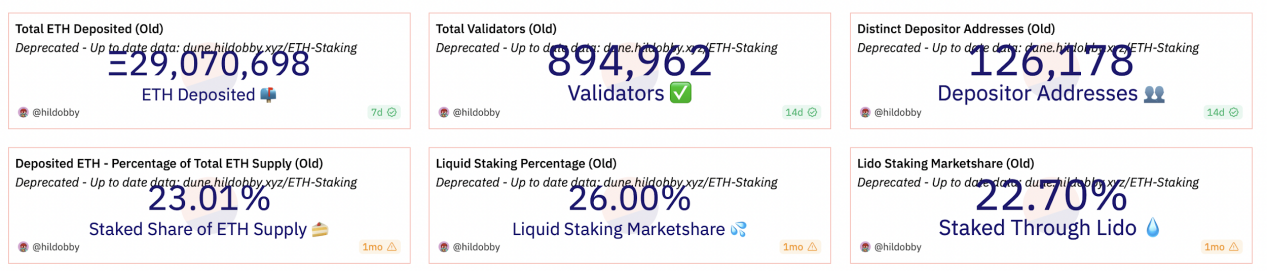
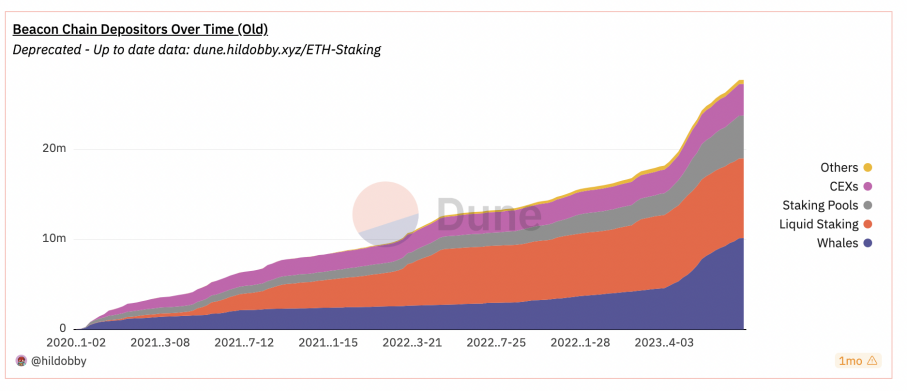
The staking total amount is relatively small in mining pools and CEX, and the liquid staking amount (orange) has surpassed other dynamic staking. Breaking down the sources of liquid staking (see below), it can be seen that Lido has the highest share, even four times more than Coinbase.
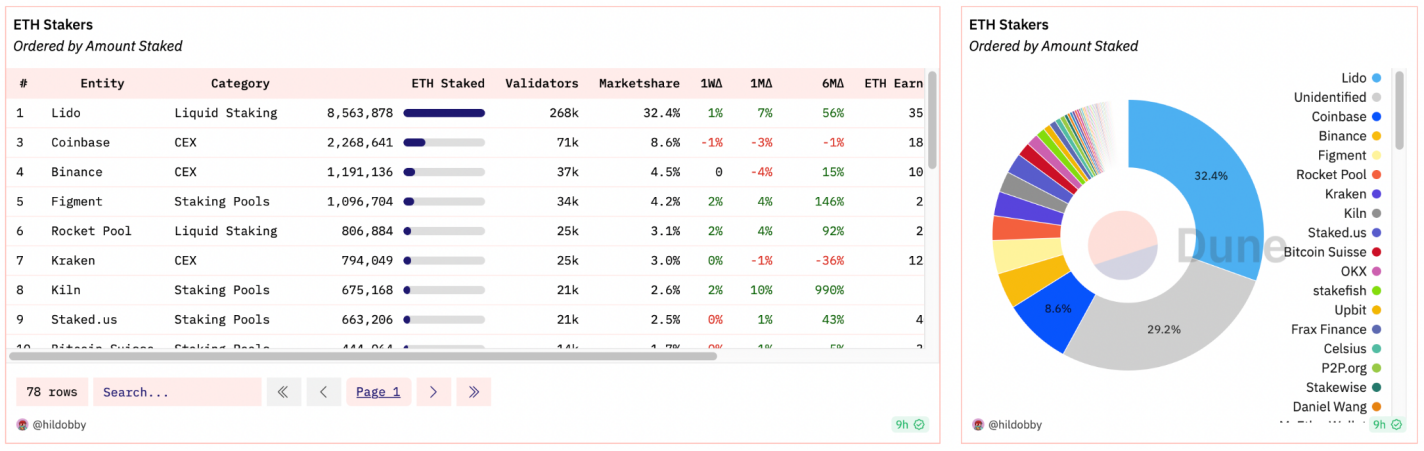
Currently, Lido's TVL remains at a high point and occupies about one-third of Ethereum's staking amount. This whale-like volume has recently sparked conflicts among Ethereum community members, with many believing that Lido is a "ticking time bomb" for the market's centralization. Ethereum's Chief Decentralization Officer, Evan Van Ness, stated in a tweet last week: "Lido may be the biggest threat to Ethereum's decentralization in history."
Ethereum community member and investor Ryan Berckman criticized that through "unrestricted dominance," Lido's existence threatens Ethereum's reputation as a decentralized chain and may sacrifice ETH's long-term valuation. According to CoinGecko's data, Lido now has a market value of approximately $13.5 billion, with its sETH market value at around $14 billion.
As for the aforementioned constraint proposal, it was designed as a countermeasure to Lido's dominant position in the Ethereum liquid staking market. Because none of the projects that signed the "Ethereum staking market share not to exceed 22%" proposal exceed 22%, for Lido, this is just a strategy of small players uniting against whales, and naturally, Lido will not sign. (Note: 22% is because Ethereum needs to achieve 66% consensus for finality.)
However, Ethereum's founder Vitalik Buterin had already proposed that all staking projects should set their own staking limits, suggesting a limit threshold of 15% at the time. At that time, Lido did not accept Vitalik's suggestion and even firmly believed that they were unlikely to monopolize the market, and the share should not easily exceed the range of 30-35%.
Even before this wave of criticism arose, in June, a governance proposal by Lido was voted on for self-imposed market share restrictions. The result clearly showed that 99.81% of participants voted against the proposal, with only 0.19% in favor.
In the face of the continuous emergence of concerns and criticisms in the market, Sacha, a contributor to the Lido ecosystem, published a rebuttal to Ryan Berckman's views. Sacha stated that he and other Lido contributors understand that even if Lido dominates the market share, they recognize the need to take measures, such as introducing dual-governance, expanding the collective of node operators, and opening up permissionless validators, to enhance the ability to resist tail risks.
Regarding the concern about the "reputation of Ethereum as a decentralized chain," Sacha expressed that the market may currently view Lido as a single entity, but in reality, Lido is just a coordinating layer among multiple participants, and LDO governance has been greatly weakened and restricted by stETH holders.
Lido Targeted: Are Other Projects Acting for Self-Interest or for Ethereum's Decentralization Reputation?
However, the main reason for the strong reaction of the research community to Lido is that Ethereum is built on the basis of "maximizing credibility and neutrality," and Lido's monopolistic share directly affects Ethereum's credibility and neutrality. It seems that Lido also seems to repeatedly choose to ignore this point and refuse to take the most direct approach (setting share limits) to restore Ethereum's neutrality, leading to a growing lack of trust in Lido within the entire Ethereum community.
However, whether the community's various criticisms of Lido's dominant position are targeted actions to collectively exclude giants for self-interest or are truly for the reputation of the Ethereum community?
First, I believe it is entirely reasonable to suggest that Lido should make some sacrifices for Ethereum and voluntarily limit its dominant position to below 22%. However, the premise is that these liquid staking service providers must be on the same scale as Lido, or even face the same predicament, in order to be considered the same event. Otherwise, it seems to be purely aimed at toppling Lido.
Furthermore, limiting the market dominance to below 22% "lacks detailed consideration." Solving the dominance issue needs to be designed from the perspective of the core protocol, which means that if the staking limit is set at 22% or below, it would theoretically make it more difficult for subsequent network takeovers, as it cannot be guaranteed that three or more projects will not collude to exceed 66% of Ethereum staking.
Finally, even though Ethereum did not intend to conduct on-chain governance at the outset, the reality is that Lido has essentially become a packaging of Ethereum's governance. If the Ethereum community decides to incorporate this due to Lido's overwhelming strength or decides to fork Lido directly, it will cause massive damage to the property rights of Ethereum developers and users.
Lido is not without any action in response to this. As Sacha mentioned, the platform is implementing a staking router to help "diversify" stakers. Lido will also implement "dual governance," allowing staked ETH holders to have decision-making power in Lido's governance.
Perhaps we should pay less attention to the amount of ETH staked by these operators and focus on the underlying design, as improving decentralization from the ground up is the rightful long-term development approach.
免责声明:本文章仅代表作者个人观点,不代表本平台的立场和观点。本文章仅供信息分享,不构成对任何人的任何投资建议。用户与作者之间的任何争议,与本平台无关。如网页中刊载的文章或图片涉及侵权,请提供相关的权利证明和身份证明发送邮件到support@aicoin.com,本平台相关工作人员将会进行核查。


