Storage is one of the three pillars of the Web3 network. Decentralized storage can truly realize data sovereignty and a sovereign network, otherwise sacrificing centralized efficiency to develop blockchain networks is not meaningful.
Author: Alfred, LD Capital
One of the hottest tracks this year should be the L2 track to enhance blockchain scalability. After successful implementation, faster speed and lower costs will promote the gradual prosperity of Web3 applications. The generation of a large amount of data in the future will lead to an explosive demand for storage. This article will focus on the recent low market heat but huge potential of decentralized storage tracks, with a review of the first-place EthStorage in this year's EDCON Super Demo.
I. Development Process of Network Storage
Consensus, computation, and storage are collectively referred to as the three pillars and underlying infrastructure of Web3. Since data and information generation require storage, storage technology has been developing in exploration and breakthroughs since the birth of computers. This article divides it into four stages.
1. Centralized Storage: Centralized Storage + Centralized Management
Computers initially used paper tape to record data, and later in 1956, IBM manufactured the first hard drive as a storage medium, which entered the familiar storage method we use today.
The devices of centralized storage have been iterating, including hard drives, magnetic tapes, storage cards, SSDs, etc. However, the storage architecture is fixed, and terminal devices can access and request data from storage resources through the network, but all data storage resources are centralized in a central location or server for unified control and management.
2. Cloud Storage: Distributed Storage + Centralized Management
In 2006, Amazon AWS launched and introduced the EC2 and S3 cloud storage services, ushering in a new era for storage. Microsoft, Google, Alibaba, and others followed suit, making it the most widely used storage method today.
Cloud storage applies a distributed storage architecture, using multiple servers to store data, splitting data across multiple servers for backup, reducing single point of failure, and having features such as reducing data redundancy and elastic expansion. However, the servers of cloud storage are all centrally managed by cloud service providers, and the actual control of data does not belong to the users.
3. Traditional Blockchain Storage: Distributed, Full Node Storage + Decentralized Management
Since the birth of Bitcoin, blockchain network storage has become a solution relative to centralized storage and management. Through distributed storage, consensus mechanisms, and transaction verification mechanisms, blockchain ensures data security and immutability, while also meeting the characteristics of decentralized storage and management.
However, the storage costs of blockchain networks such as Bitcoin and Ethereum are high, and the efficiency is low, mainly because the network architecture of these blockchains is not designed from the perspective of storage. Each node needs to store a copy of the data, and the block space is limited. For example, storing a boring ape NFT on the Bitcoin or Ethereum network would cost at least several hundred dollars.
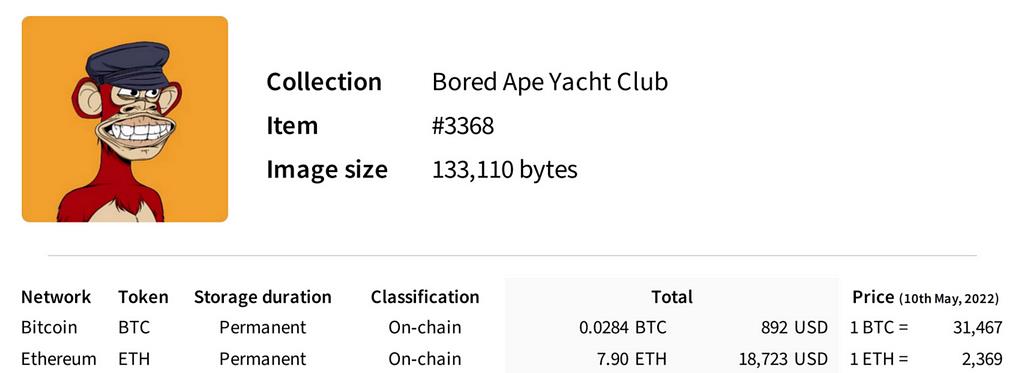
Source: Fundamental Labs
4. Web3 Decentralized Storage: Distributed, Multi-Node Storage + Decentralized Management
Because storing data directly on the blockchain is very expensive, many decentralized storage solutions and projects have emerged in the Web3 space, such as IPFS, Filecoin, Storj, Arweave, Swarm, EthStorage, etc. The goal of these projects is to increase storage space and reduce costs while maintaining decentralized storage and management, using technologies such as data segmentation, multi-node storage, and on-chain proof.
II. ETH Modularization and World Computer
1. ETH Modularization
Since 2021, with the roadmap centered around Rollup, Ethereum's modularization has begun. It splits the various levels of a single all-encompassing chain into different modules or chains for expansion, a direction also referred to as the "Endgame" by Vitalik.
Blockchain represented by Ethereum splits the chain into four key levels:
(1) Execution Layer: Transaction processing, smart contract execution, and computation, etc.
(2) Settlement Layer: Verification of execution results, dispute resolution, and settlement state commitments.
(3) Consensus Layer: Determines the order and validity of transactions, as well as the consistency between nodes.
(4) Data Availability Layer: Ensures data can be used, stored, and verified.
When a blockchain is a single-chain processing all four functions, it faces the "three dilemmas" of blockchain. Modularizing the blockchain can split the four functions into multiple specialized layers to solve different problems.
After Ethereum's modularization, the main chain of Ethereum becomes L1, and many L2s have emerged on top of it, mainly serving as the execution layer of Ethereum. For example, OP Stack's L2 technology has also developed a modular architecture to enhance future scalability. Through the direction of modularization + Rollup, Ethereum will mainly maintain the data availability layer (DA) and consensus layer in the future, becoming the mainstream and most secure foundational layer, while the functions of other layers will be upgraded through other chains and solutions to expand the entire Ethereum ecosystem and improve scalability.
2. World Computer
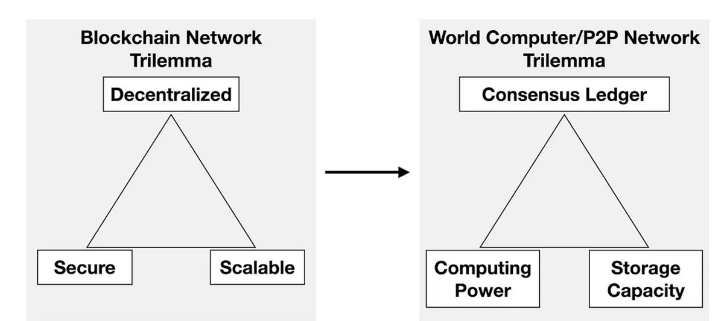
The goal of Ethereum is to build a world supercomputer. Currently, Ethereum has done well in terms of security, but is still making breakthroughs in scalability. Rollup is an important direction to solve scalability, and modularization can to some extent solve the "three dilemmas" of blockchain. However, to become a supercomputer, it also needs to address three dilemmas, namely consensus, computation, and storage. These three dilemmas are also mutually constraining.
Source: "Towards World Supercomputer"
The different priorities of this trilemma will lead to different trade-offs:
Strong Consensus Ledger: Essentially requires repeated storage and computation, so it is not suitable for expanding storage and computation.
Strong Computational Power: When executing a large number of computation and proof tasks, it requires repeated use of consensus, so it is not suitable for large-scale storage.
Strong Storage Capacity: When executing frequent random sampling space proofs, it requires repeated use of consensus, so it is not suitable for computation.
Currently, traditional L2 solutions still face the problem of balancing centralized sequencers and computational efficiency, and cannot provide strong storage capacity. The authors of "Towards World Supercomputer" propose a bottom-up architecture based on partitioning the world computer by function to solve the trilemma of becoming a world computer.
Ultimately, the world supercomputer will be composed of three topologically heterogeneous P2P networks, similar to building a physical computer, connecting the consensus ledger, computing network, and storage network through trustless buses (connectors) such as zero-knowledge proof technology to assemble into a world supercomputer. Additional components can be added according to the specific needs of applications, and appropriate selection and connection of each component will achieve a balance between the trilemma of consensus ledger, computational power, and storage capacity, ultimately ensuring the decentralization, high performance, and security of the world supercomputer. EthStorage plays a role as the storage solution in the architecture of the supercomputer.
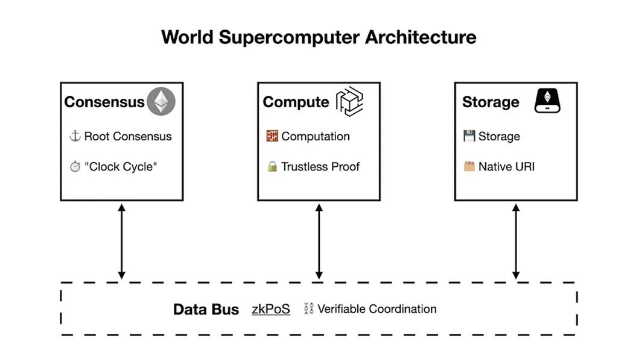
Source: "Towards World Supercomputer"
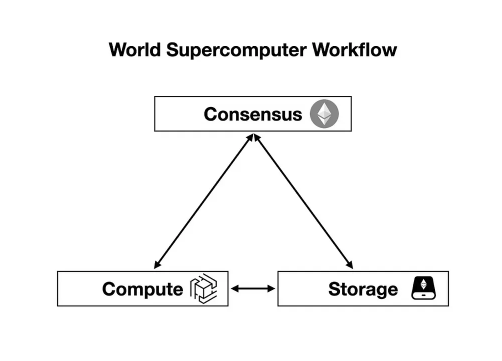
Based on this framework, the transaction process of Ethereum's world supercomputer will be divided into the following steps:
(1) Consensus: Use Ethereum to process and reach transaction consensus.
(2) Computation: The zkOracle network quickly verifies proofs and consensus data passed as a bus by zkPoS, and executes related off-chain computations.
(3) Consensus: In some cases, such as automation and machine learning, the computation network will use proofs to send data and transactions back to Ethereum or EthStorage.
(4) Storage: For storing large amounts of data from Ethereum (e.g., NFT metadata), zkPoS acts as a messenger between Ethereum smart contracts and EthStorage.
Source: "Towards World Supercomputer"
III. ETH Storage
1. Introduction
EthStorage is the first second-layer solution that provides programmable dynamic storage based on Ethereum data availability, which can extend programmable storage to hundreds of TB or even PB levels at 1/100 to 1/1000 times the cost.
The team has twice received support from the Ethereum Foundation's grants to help with research on data availability and the use of Ethereum L1 contracts for L2 dynamic data set storage proofs. They also won first place in the 2023 EDCON Super Demo.
2. Technical Features
(1) Highly Integrated with ETH
The EthStorage client is a superset of the Ethereum client Geth, which means that when running a node for EthStorage, it can still participate in any Ethereum process. A node can be both a validator node for Ethereum and a data node for EthStorage. The Data Provider module of each EthStorage node initiates a connection request with the Data Provider of other EthStorage nodes. Once they are connected, they form a decentralized storage network.
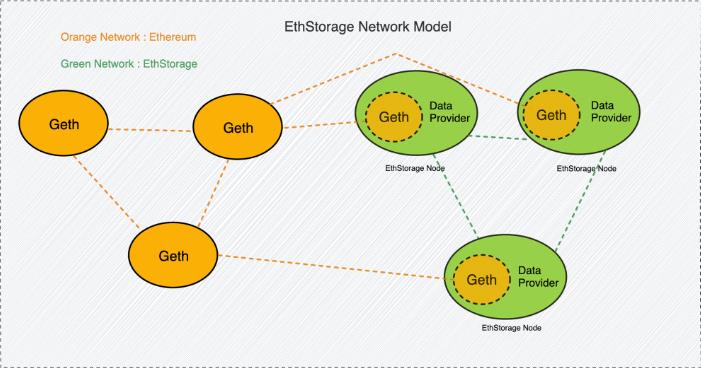
Source: "EthStorage — The First Ethereum Storage L2"
Users of EthStorage can directly use existing wallets to interact with all applications built on top of the storage, whether it's NFTs, decentralized social networks, or decentralized games, to minimize the barrier for users to enter EthStorage. Additionally, the EVM-compatible EthStorage can bring excellent interoperability to smart contracts. For example, if user A wants to set an image for an NFT minted by themselves, using EthStorage, A only needs to execute one Ethereum transaction. When using Arweave, A needs to submit one Arweave transaction and two Ethereum transactions, and cannot achieve synchronous execution like EthStorage.
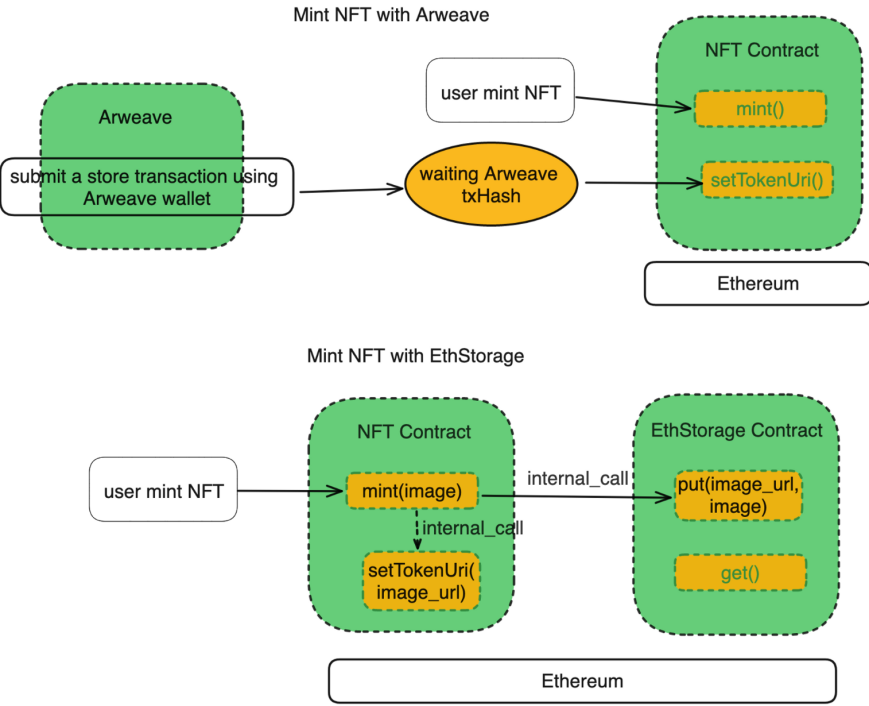
Source: "EthStorage — The First Ethereum Storage L2"
(2) Decentralized Solution Based on DA Layer for L2
EthStorage actually adopts a similar architecture to L2. A storage contract will be deployed on Ethereum as the entry point for data operations in EthStorage. Additionally, the off-chain storage data proofs of data nodes also need to be verified through this contract.
In comparison to current L2 solutions:
Rollup (L2) stores the state tree off-chain, and the commitment on-chain is the root of the state tree. After receiving new data, Rollup also needs to execute transactions off-chain to complete the state transition process and establish a new state tree.
EthStorage stores data off-chain, and the commitment on-chain is the proof of data storage. After receiving requests to update stored data, EthStorage will generate new storage proofs for this data.
This shows that the current direction of scalability for Optimism Rollup or ZK-Rollup is to expand Ethereum's computational capacity, while EthStorage Rollup's direction is to expand Ethereum's data storage capacity.
Additionally, EthStorage is a modular storage layer that can run on any blockchain as long as there is an EVM and a DA to reduce storage costs, even on Layer2. For example, EthStorage is currently considering how to use its technology to implement fraud proofs on Optimism. The corresponding DA layer has also been enabled on Optimism.
(3) Dynamic Storage
From a system design perspective, Filecoin and Arweave are more suitable for static storage, where a large amount of data can be uploaded to decentralized storage but cannot be modified or deleted, only replaced with new data. Thanks to the key-value storage paradigm, EthStorage can support CRUD, i.e., creating new storage data, updating storage data, reading storage data, and deleting storage data. This is easily achievable in centralized storage but currently only EthStorage can do this in decentralized storage.
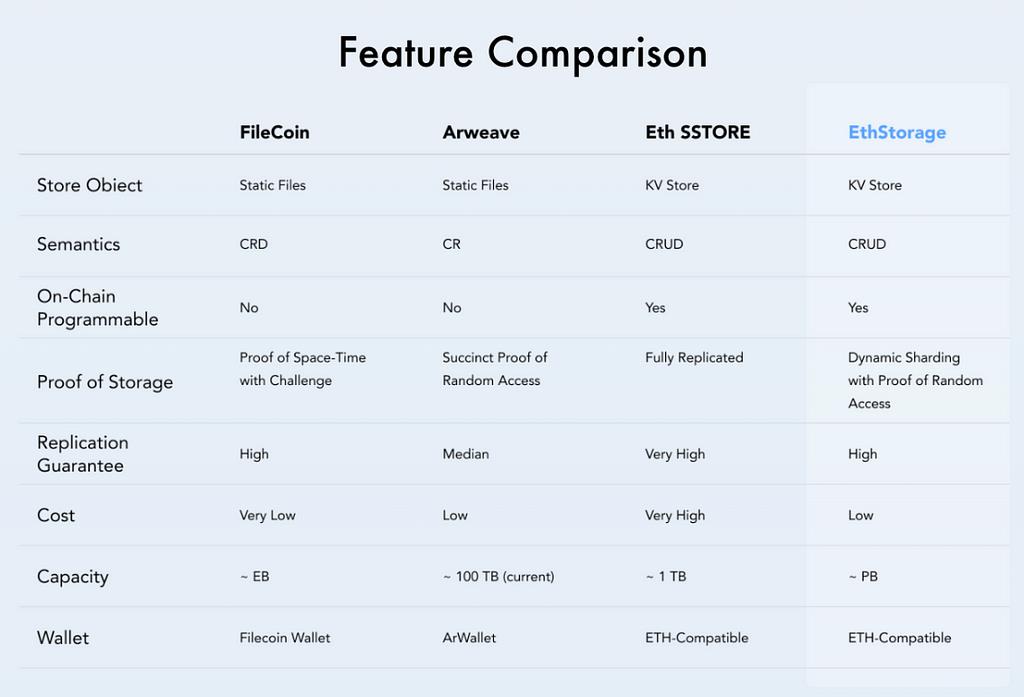
Source: EthStorage Official
(4) Creation of Ethereum Network Access Protocol
In the Web2 internet, browsing web pages, sending emails, downloading files, and other activities all rely on the HTTP protocol, one of the most common protocols on the internet. The HTTP protocol defines how resources are transmitted and exchanged between clients and servers, and URLs identify the location of these resources on the internet. When entering a website address or clicking a link in a web browser, an HTTP request is triggered, using the URL to determine the requested resource. The web browser parses the URL, then communicates with the server using the HTTP protocol to request the specific resource, and displays the resource to the user after the server responds. However, the data of Web2 web pages or internet services is hosted on centralized servers. When the server's subscription expires, the cloud service used by the application will stop, and the application's data will be deleted by the centralized service provider.
The founders of EthStorage have proposed the Web3-based network access protocol — ERC-4804, which has been approved through EIP. ERC-4804, also known as the EVM Call Information Decoding Web3 URL, is an HTTP-style Web3 URL (web3://) for EVM information calls, making it the first network access protocol on Ethereum. Unlike web2, which accesses server resources, the web3:// Access protocol directly renders resources hosted on Ethereum smart contracts, including HTML, CSS, PDF, and other file types.
In simple terms, web3:// (http://web3url.io) is a decentralized version of http://. It adds a decentralized presentation layer to Ethereum, allowing users to directly browse web content hosted on the EVM, such as web pages, images, songs, etc., with the EVM serving as the decentralized backend.
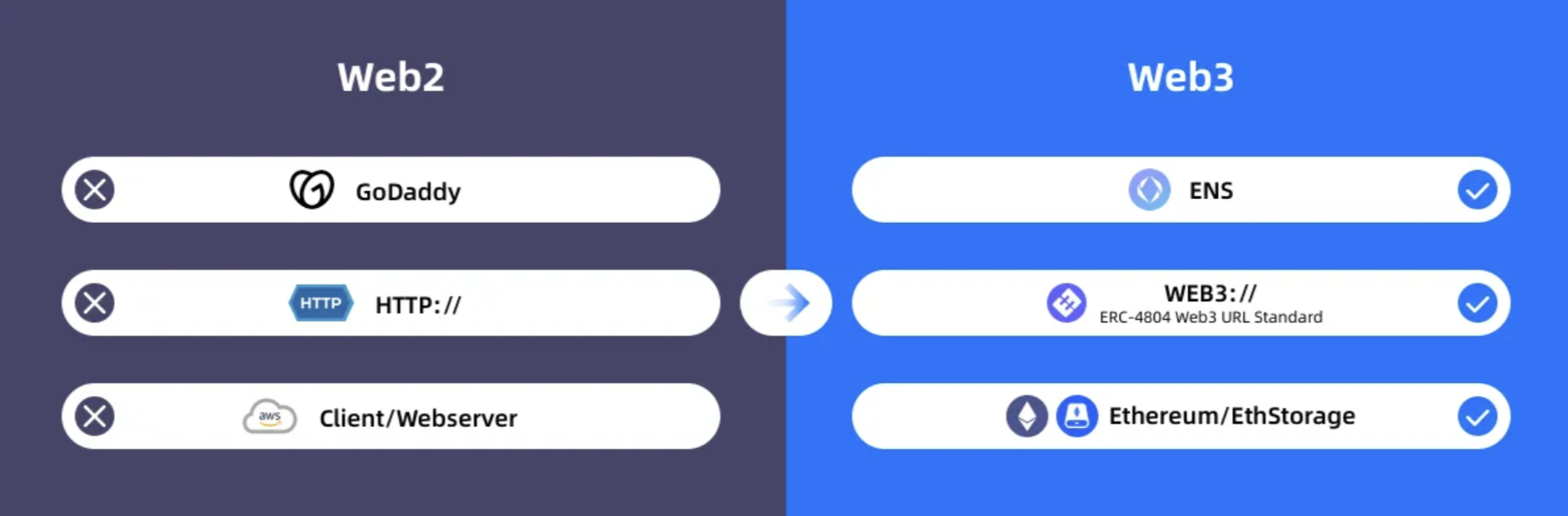
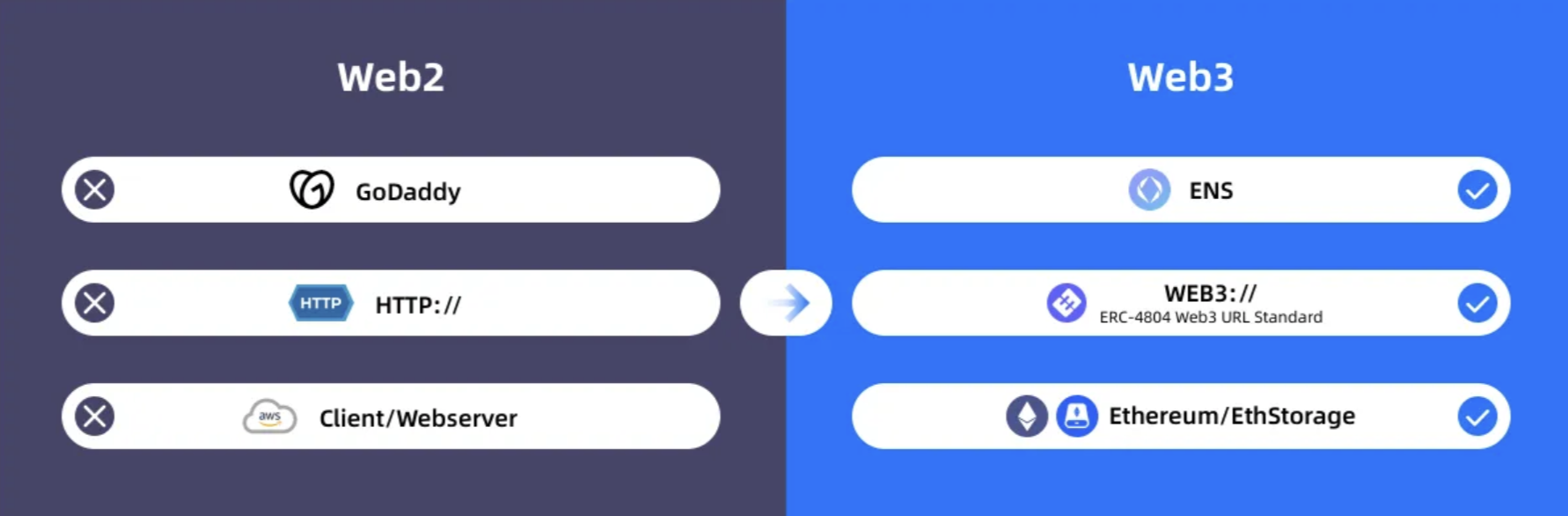
Source: EthStorage Official
3. Current Status and Plans
(1) Product Applications
Through EthStorage, it will be possible to re-enable internet applications using decentralized storage as the underlying layer (many current Dapps still use centralized data storage), such as dynamic NFTs, on-chain music NFTs, personal websites, hostless wallets, Dapps, and DeWeb, among others.
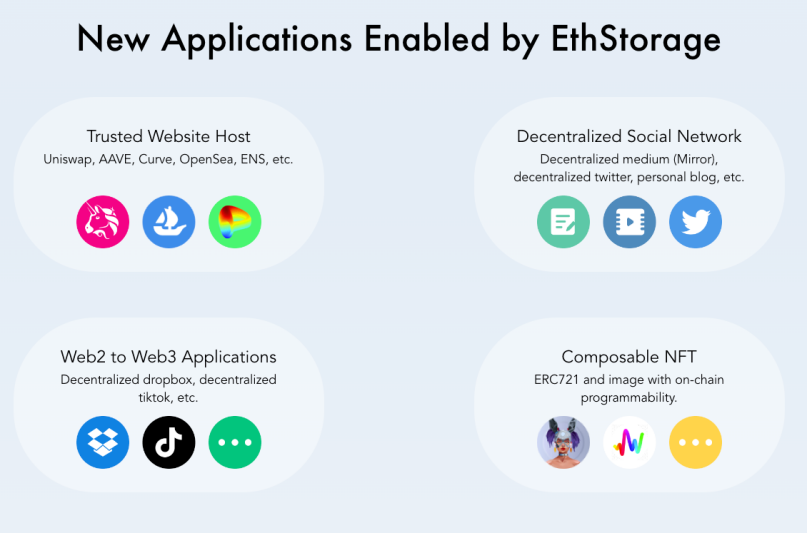
Source: EthStorage Official
Using DeWeb as an example:
We know that Ethereum is a decentralized network, and many decentralized Dapps have emerged on Ethereum. However, these Dapps are not completely decentralized, as many applications' front-ends are still hosted through centralized cloud services. For example, if the front-end web page of Uniswap goes down or the transaction pairs are deleted, or if Tornado.Cash's front-end service is suspended due to suspected money laundering, it's because their front-ends are hosted on centralized servers, making it difficult to resist censorship. However, using EthStorage's solution, web page files and data are hosted in smart contracts, collectively operated and maintained by a decentralized network, greatly increasing resistance to censorship. Through the programmability of smart contracts, DeWeb can be implemented to create many interesting applications, such as De-github, De-blog, and various Dapp front-ends.
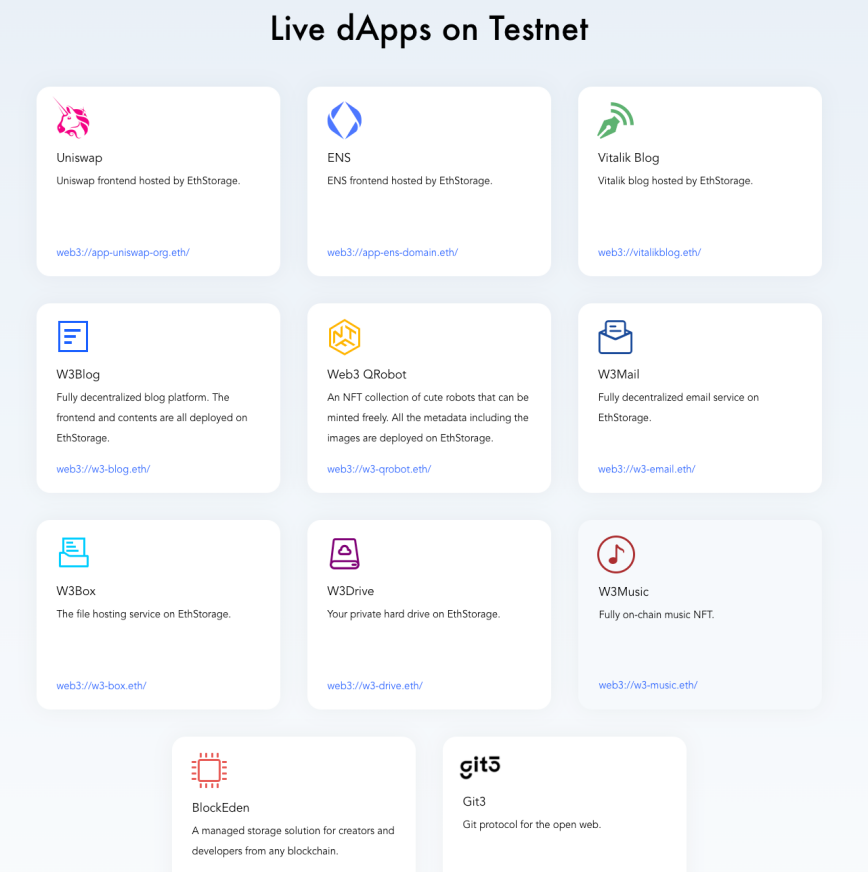
Source: EthStorage Official
Currently, EthStorage has not announced a token plan, but in the test network, testing tokens W3Q can be used for testing and interaction.
(2) Roadmap
According to the roadmap released by EDCON, in 2023, EthStorage will mainly be in the testing network phase and will adapt to the development and testing of the Ethereum Cancun upgrade. In 2024, it may go live on the mainnet, fully integrating Danksharding, CL+EL clients, and Web3 browser access.
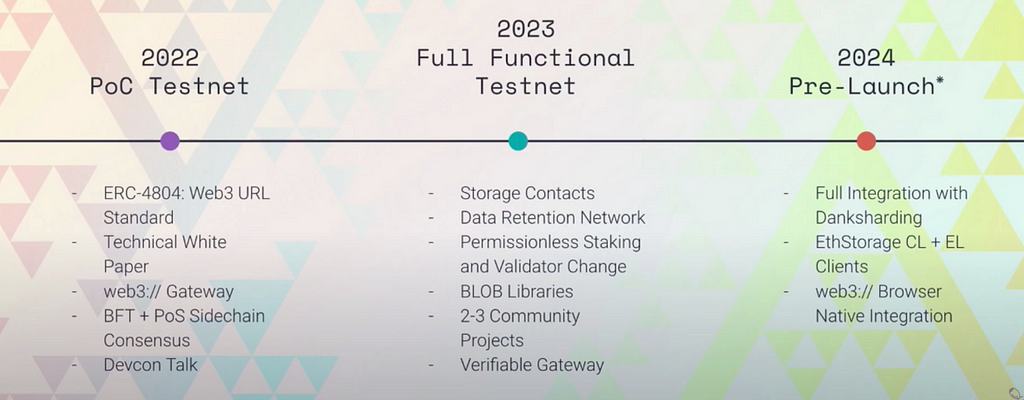
Source: EthStorage Official
IV. Overview of Other Storage Projects
(1) Filecoin:
Filecoin is a decentralized storage network built on top of IPFS with incentives. IPFS uses a distributed hash table (DHT) and is a protocol for storing, addressing, and transmitting data (analogous to the http protocol). Filecoin acts as the incentive layer for IPFS and also serves as an open storage market. Filecoin uses a contract-based model to ensure data persistence and combines zero-knowledge proofs, especially space-time proofs and replication proofs. On March 14, Filecoin announced the official launch of the Virtual Machine (FVM) to support smart contracts and user programmability.
Filecoin's features include a separate chain and incentive system, large static storage space, low costs, and support for the FVM virtual machine after the upgrade.
(2) Arweave: Arweave adopts a "pay once, store forever" model, where a one-time payment covers the cost of permanently storing data, and retrieving that data does not require additional payment. Arweave uses succinct proofs for random access, creating the native data structure of the Blockweave, where each block is linked to a previous block and a history Recall Block. For nodes, the prerequisite for forging a new block is to synchronize a Recall-Block and the latest generated block data.
Arweave's features include a separate chain and incentive system, on-chain storage, permanent storage, and relatively weak interoperability with other chains.
(3) BNB Greenfield: Greenfield focuses on promoting decentralized data management and access, aiming to link data storage and ownership with the DeFi environment of the BNB Smart Chain (BSC) by simplifying data storage and management. The complete BNB Greenfield system can interact with the mature BSC public chain and the BN community users. When users want to create and use data on Greenfield, they can interact with BNB Greenfield dApps and the core infrastructure of BNB Greenfield.
BNB Greenfield's features include being the final piece of Binance's "trinity" ecosystem, strong operability within the ecosystem, the circulation and use of BNB across chains, the adoption of the concept of Amazon S3 "storage buckets," off-chain storage, and on-chain verification.
V. Conclusion
Storage is one of the three pillars of the Web3 network. Decentralized storage can truly achieve data rights and a sovereign network, otherwise sacrificing centralized efficiency for the development of blockchain networks is not meaningful. This track belongs to the underlying infrastructure, has great potential, and is of great significance.
Currently, compared to other tracks, decentralized storage has lower market heat, mainly due to the development stage not being reached and insufficient demand. When the development of L2 makes Dapp applications cheap and fast, the accumulation of a large amount of data and value demands will push the market heat towards decentralized storage.
As an emerging project, EthStorage has a strong foundation in the Ethereum ecosystem, strong interoperability, and can be combined with other L1 and L2 solutions with a DA layer, providing new development directions and solutions. Various decentralized storage projects are also focusing on specific directions and continuing to develop. We look forward to the market shifting towards the era of the storage track.
免责声明:本文章仅代表作者个人观点,不代表本平台的立场和观点。本文章仅供信息分享,不构成对任何人的任何投资建议。用户与作者之间的任何争议,与本平台无关。如网页中刊载的文章或图片涉及侵权,请提供相关的权利证明和身份证明发送邮件到support@aicoin.com,本平台相关工作人员将会进行核查。


