The article analyzes and summarizes on-chain data tools in three parts: product types, business models, and future development directions.
Author: Wendy, IOSG Ventures
TL,DR:
The characteristics of on-chain data make on-chain data analysis tools in strong demand. This article categorizes existing market products into different types based on their focus, such as data-centric or trade-centric types;
Data dashboard products are highly competitive, and differentiation is needed; automated trading tools are popular but require attention to risks. The two types of products have different demands, with some overlapping functions but not completely replacing each other;
The commercialization of data products is a topic worthy of careful discussion. This article briefly describes the pros and cons of commercialization with or without tokens. More detailed discussions can be found in the next part;
Possible future development directions for on-chain tools include developing socialfi and communities, personalized recommendations based on user profiles, and integration with AI. =================================================
Introduction
Whether it is web2 or web3, data has always been a resource similar to oil in the information age, and it is a place where multiple participants mine and compete. On-chain Alpha refers to valuable information on the blockchain that has not been widely disseminated and discovered, and through the analysis of on-chain data, excess returns Alpha can be obtained by taking advantage of the time lag in the market. The decentralized nature of blockchain makes on-chain data a public treasure, but with the enrichment and improvement of multi-chain ecosystems, the diversification of on-chain ecosystems such as NFT, Gamefi, and Socialfi has increased the content of on-chain Alpha, making it more difficult to capture Alpha from the chain. The technical capabilities of ordinary users are difficult to achieve, so there is a great demand for tools for non-technical background users to analyze on-chain data.
For on-chain data, its unique characteristics make data tool products play an irreplaceable and important role:
Information is publicly transparent, and on-chain data is accessible to everyone. For both project parties and investors, it is both an opportunity and a challenge, mutually reinforcing. For project parties, products need to differentiate themselves in competition, while for investors, they need to continuously improve their ability to use tools and analyze data.
High timeliness of information is required, with fast update speeds, 24/7. The timeliness of on-chain data is obvious, and trading opportunities often come and go in an instant; compared to traditional financial data disclosure, the time for on-chain data to be recorded is almost negligible, and new on-chain behavior records are generated around the clock.
Information has multiple dimensions, is diversified, and has strong heterogeneity. On-chain data not only includes transaction operations, but also includes various behaviors such as authorization, staking, as well as cross-chain fund flows, etc.
High technical barriers. Most users do not have knowledge of setting gas fees and MEV and other underlying principles of blockchain, and while the on-chain dark forest provides information, there is still a distance to be covered in turning information into actual operations and profits. Therefore, some automated tools give ordinary players the magic of being "scientists" on the chain.
This article initially categorizes on-chain data analysis tools into two major types based on the following dimensions (i.e., distinguishing whether the final user orientation is data or trade behavior), but many tools actually have both data and trade functions.
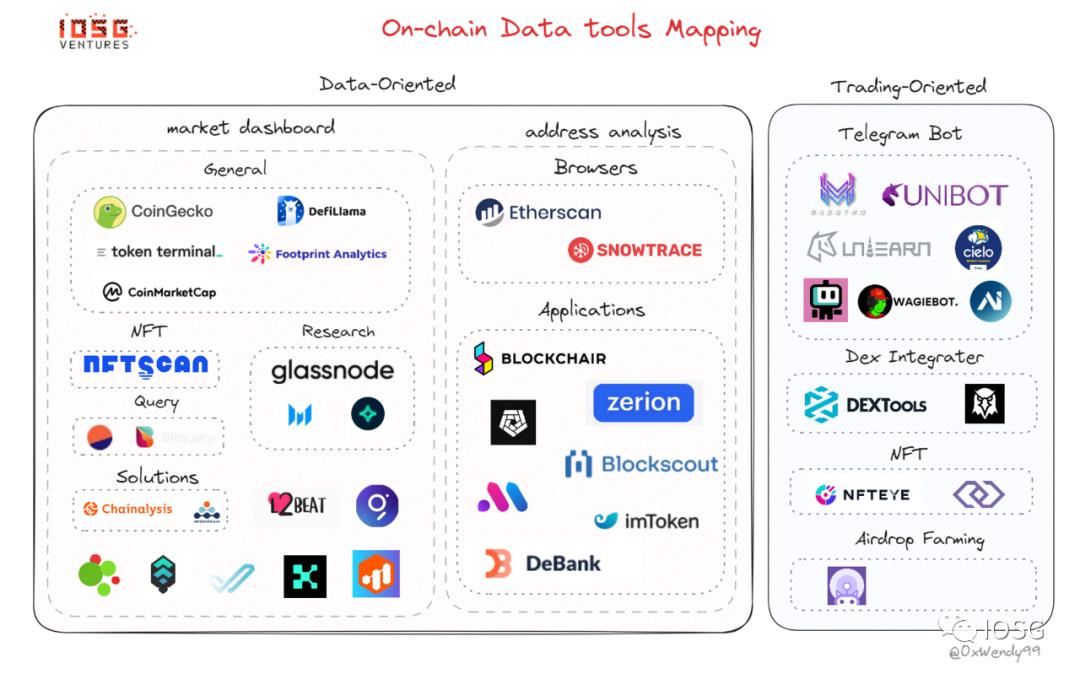
Data-centric
Overall market data dashboard
Similar to the role of financial terminals such as Bloomberg in traditional finance, these tools aim to provide users with an overall view of the market for observation and monitoring, generally focusing on overall data of chains, protocols, and currencies. In the early days of blockchain, data analysis indicators were relatively simple, such as token prices, number of holding addresses, holding time, transaction records, etc. Later, with the rise of defi protocols and the development of various sub-fields such as NFT and gamefi, the dimensions of data have been greatly enriched. Defi protocols commonly use TVL, Marketcap, 24h volume, token holding distribution, and visualizations of token unlocking and release, NFT rarity rankings, floor price distribution, etc. Tokenterminal also provides income fees and estimated market sales-to-earnings ratios, and because it is not closely related to short-term trading, the data delay time is relatively long, while platforms like Nansen have minute-level data delays.
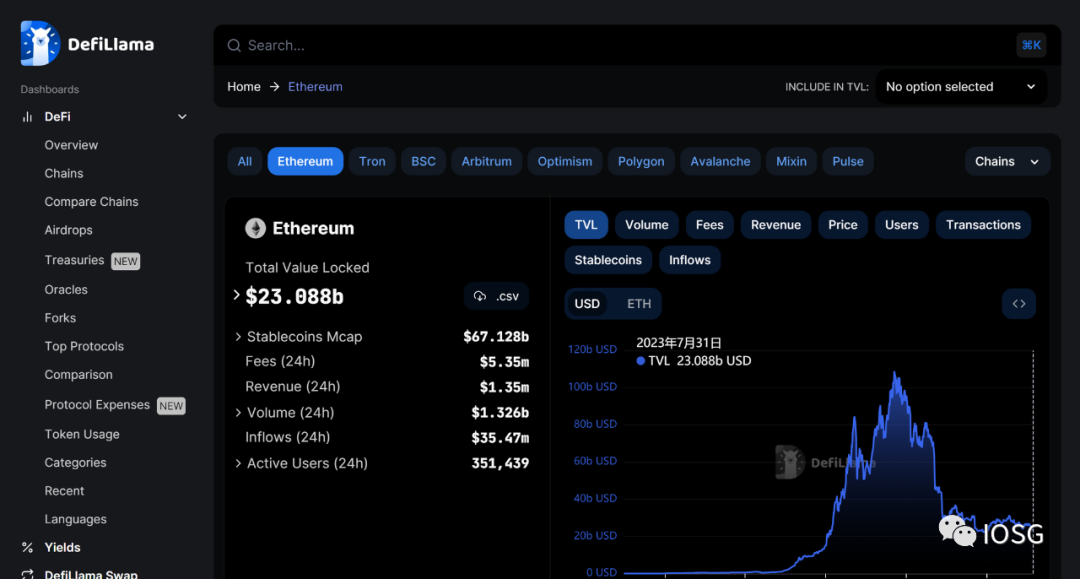
DeFiLlama user interface
Data product internal competition is quite severe, so most teams also seek breakthroughs in differentiation:
Comprehensive research report output: Nansen and Messari produce many research reports, and data product teams generally have analysts responsible for interpreting some data indicators. Research reports are usually part of their products.
Focus on vertical subfields: NFTSCAN focuses on market data for multi-chain NFTs, while L2Beat summarizes and visualizes data for various Layer2 solutions.
SQL query tools: Products like Dune Analytics and Bitquery provide users with the ability to customize SQL query statements, making the product more personalized, but with a certain technical barrier.
Enterprise solutions: Data products such as Chainanalysis and amberdata mainly provide complete blockchain data solutions to B-end users, including exchanges and traditional financial institutions.
In addition, there are products that focus on visualization, such as Crypto Bubbles, and those that integrate with AI, such as DexCheck and KaitoAI. Overall, market data dashboard products are the most common and frequently used on-chain data analysis tools, with different products having different functional focuses, but overall, the competition is quite fierce.
Analysis of projects such as Nansen can be found in previous IOSG articles: link.
Address-level analysis
In addition to providing data support from the scale of the overall market, another main analysis perspective of on-chain data tool products is from the perspective of addresses. Products that focus on address-level analysis mainly include the following categories:
Blockchain browsers represented by Etherscan, as underlying applications, can view various interaction activities of individual addresses, as well as on-chain gas consumption, etc.
Analysis platforms like Debank can view the holding situation, profit and loss, and transaction records of individual addresses. Bubblemaps visualizes the connections between addresses, allowing users to more intuitively discover the relationships between addresses and the flow of funds. Nansen is also famous for this type of analysis. Smart Money tracking can be used to track smart money, increasing the likelihood of profit by observing its trading behavior or following its trades.
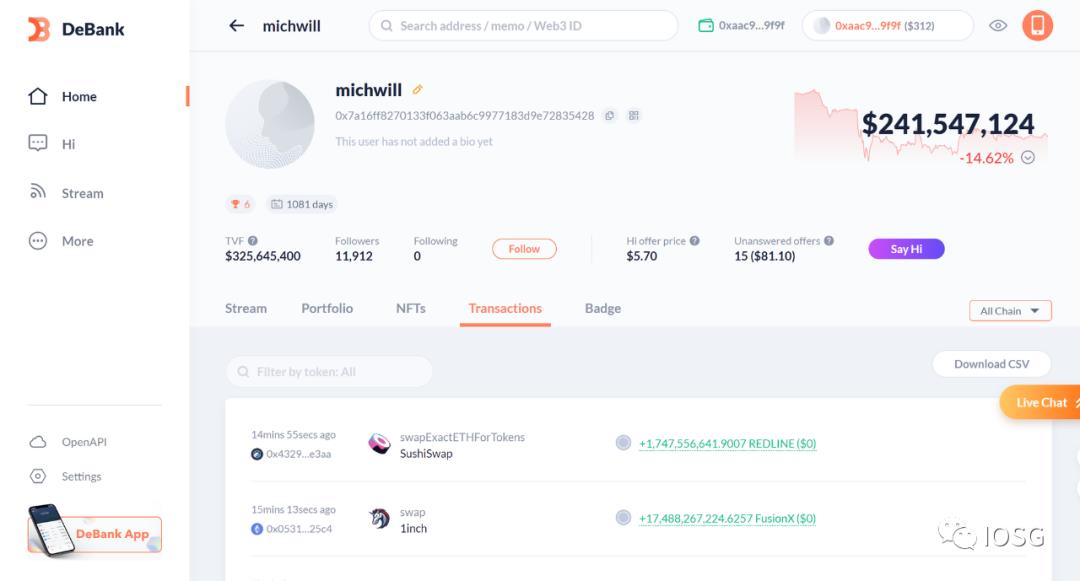
Trade-centric
With the recent popularity of telegram bot tools such as Unibot and Maestro, many bot products' token prices and TVL have seen nearly tenfold growth in the past few weeks, which is particularly prominent in bear markets. Telegram is a chat software with 700 million monthly active users, providing rich APIs for developers to easily access mini-programs. Compared to data terminal products, trade-oriented tools also encompass the user's operational process, which is extremely convenient for users, reducing the complexity and uncertainty from data analysis to trading, but also increasing security risks and capital costs (trading fees and tool usage fees).
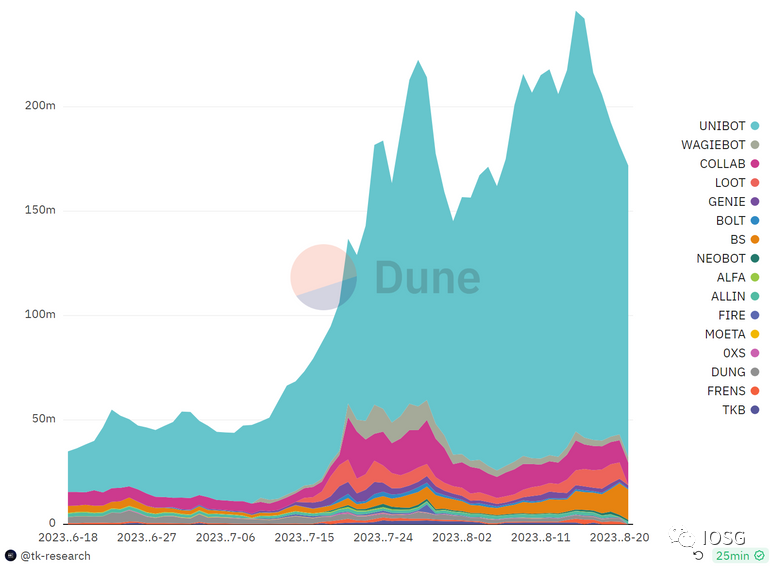
Changes in TVL for multiple Telegram projects
These automated trading tools will use wallet addresses created by agents to trade or interact based on real-time on-chain data, or push on-chain intelligence information in real-time to email, Discord, or Telegram, etc. There is also a type of automated trading tool that is farming-oriented, which interacts in a random manner with specified projects in order to receive airdrop rewards from the project party or to conduct some programmatic arbitrage. For example, common functions of on-chain automated trading tools such as Unibot and Maestro include:
Limit order buying and selling: Similar to centralized exchanges, automated trading tools support limit orders for specific token prices and quantities.
Copy trading: Can replicate the trades of a specified address, generally used to mimic the operations of "smart money" with a high success rate, providing a way for novices and passive investors to profit from the crypto market with minimal effort.
Alerts: Can set up push notifications for specific on-chain movements, such as transfers of amounts greater than a specified amount, and real-time scanning for new token contract deployments on-chain.
Simulated trading: Simulates the profit and loss of trades before actual trading, such as whether it is possible for a trade to fail or incur losses due to gas fee settings or slippage.
Private transactions: Avoids front-running and sandwich attacks, thereby reducing potential losses.
Farming: Interacts with projects in a random manner, simulating user on-chain behavior in new projects to increase the possibility of receiving token airdrops.
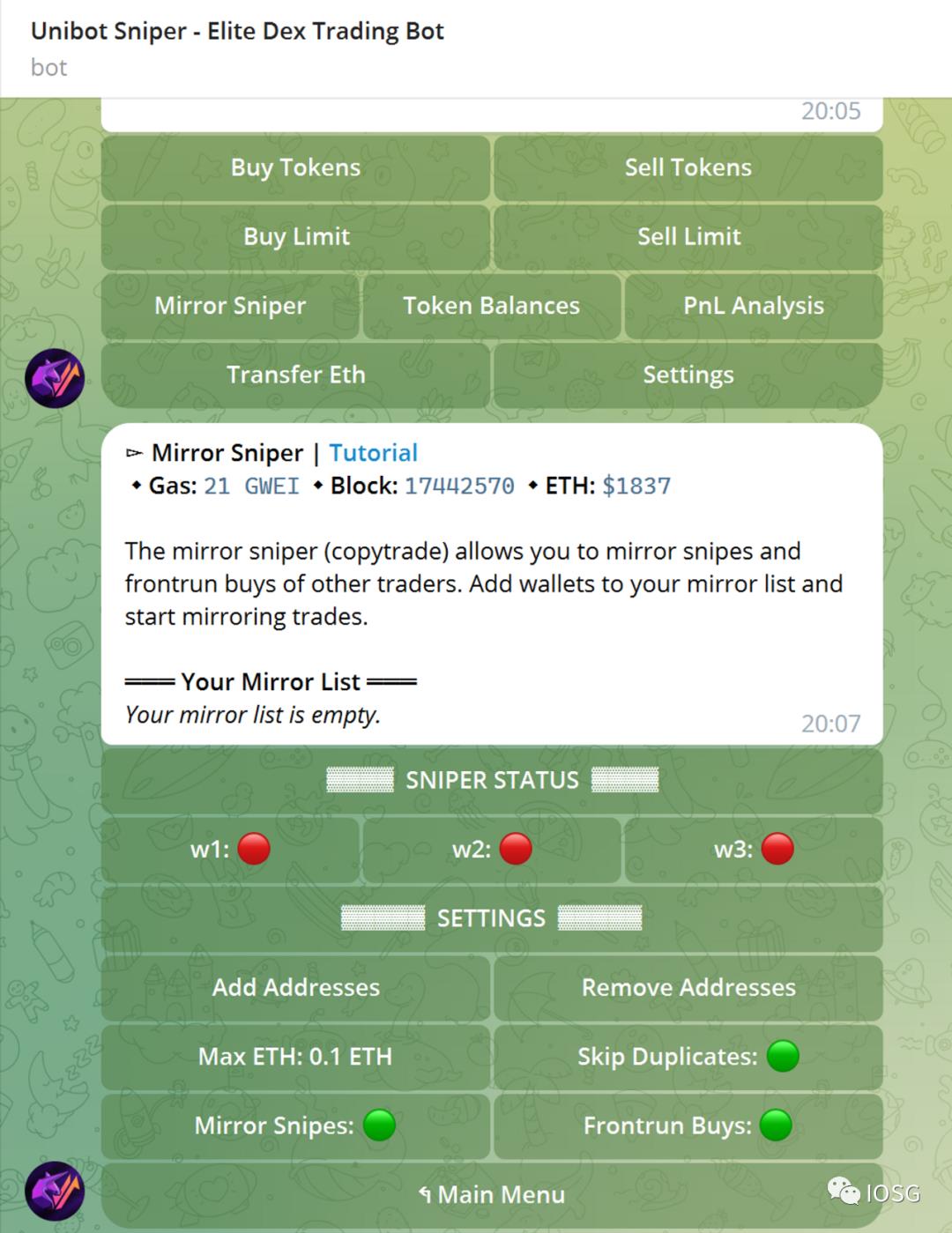
Unibot Sniper feature list
The user's markdown has been translated into English. Here is the translated text:
Rapid Growth of Automated Trading Tool Users
The number of users of on-chain trading telegram bots has recently reached nearly 6,000 daily, with the majority of users coming from the long-running Maestro and the up-and-coming Unibot, which together occupy over 80% of the user share of dex telegram bots.
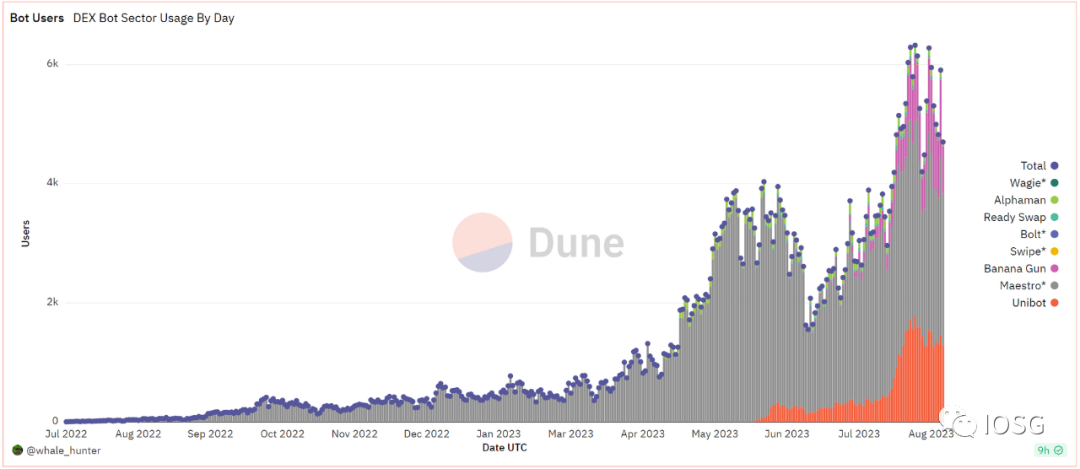
Telegram on-chain bot users
However, the real demand behind the attention bubble brought about by the rise in token prices and market hotspots is worth careful consideration. The two most mainstream functions of Telegram bots—information push and copy trading—are not new demands, and in fact, there are already many centralized exchanges and relatively mature products (as shown in the figure below). Telegram bots are evidently less competitive compared to these types of products; therefore, the overall base of degen players in the crypto field is not large, and they can choose more secure and comprehensive automated trading platforms. Therefore, the author predicts that there are fewer experienced players in the user profile of Telegram-based automated trading bots, and most people only use the information push function. However, from another optimistic perspective, the combination of Telegram, a social app with huge user traffic and crypto-friendly features, and user-friendly bots may become one of the traffic entry points for onboarding new users to Web3.
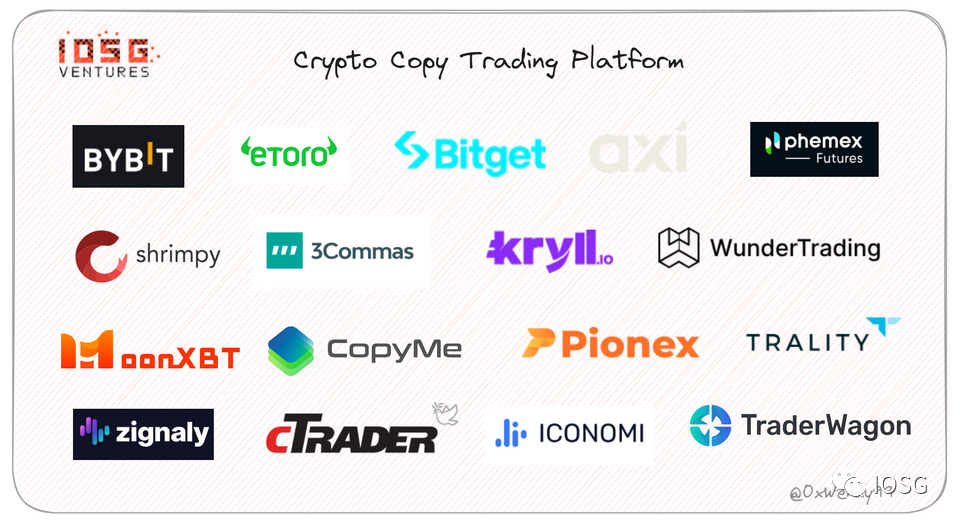
Copy trading platform products
Another product type that overlaps or is more closely related to automated trading tools is decentralized trading platforms such as Dexscreener and Dextools. These products are mainly used to view real-time price changes of token trading pairs and generally integrate dex swaps and basic contract security features on the front end. The Unibot team recently launched the Unibot X trading terminal, which is integrated with the DEX tracking website GeckoTerminal. Users can directly use the wallet address generated by their Telegram account to log in to the UnibotX platform, which includes features such as limit orders for buying and selling, real-time candlestick charts and trade records, and smart money trading. It can be foreseen that DEXs and bots may have closer connections and interactions in the future, thereby enhancing and enriching the user experience of decentralized trading.
Although automated trading tools greatly enhance the technical capabilities of ordinary users, it is worth noting that such tools generally have significant centralization risks. The wallet addresses of most automated trading tools are generated by the tools, and their private keys are completely exposed to the project party. As the saying in the crypto world goes, "Not your key, not your money." If users want to use automated trading tools, they can only transfer funds to addresses controlled by the project party, putting themselves in a weak position in the risk game.
Value Logic of Data Tool Track
Advantages and Disadvantages of the Business Model of Data Tools
In the entire Web3 field, compared to some emerging niche products with difficult-to-prove actual demand, the business logic of this type of tool product sounds less lofty and imaginative, but its market demand is more practical and real. The business model of data tools is relatively mature, similar to the logic of web2 data companies, and has been successfully verified multiple times in the web2 field. Some tool projects have stable cash flow even without issuing their own tokens.
For projects that have not raised funds through tokens or taxes, the sources of project income include:
C-end tool user fees: Similar to Web2 SaaS, basic functions can be used for free, and advanced functions require payment, or free services have certain limits or quantity restrictions, such as only being able to track 10 addresses. Consumer-facing fees can generally be divided into two types: one-time purchase and subscription-based: one-time purchase is similar to lifetime membership, and subscription-based refers to monthly/quarterly or annual payments;
B-end fees: Bundling APIs or developing data systems, fees for developers and enterprises have also been proven to be an effective monetization logic. For example, The Graph provides API services to multiple well-known defi/Gamefi projects, and Debank also has similar business.
Advertising revenue: Once the user base reaches a certain level, the project party can monetize the traffic through embedded advertising.
From the characteristics of on-chain data and the current products, the on-chain data tool track is undoubtedly a track with deterministic opportunities, and it is destined to be a fiercely competitive track. These products require a certain amount of infrastructure and equipment investment in the early stages, and the openness and accessibility of data have also made Web3 on-chain data analysis tools lose their moat in terms of data sources. For example, the competition in the market data dashboard category is already very fierce, and the newly launched Arkham has already made some similar functions of Nansen free, which will inevitably affect the paid tools; but due to the complexity of the data field, whether it is an all-in-one comprehensive platform, or a small and refined product in a niche field, it is still possible to become a leader in the vertical field. Tool products need to have faster product iteration and delivery capabilities, as well as the ability to mine more valuable indicators in massive data, provide more comprehensive functions, and better help users increase the possibility of trading profits, in order to break away from the homogenization of products, establish their own advantages and barriers.
Analysis of the Token Economic Model of Data Tool Products
There is some debate in the industry about whether tool products should build a token economy. The main opposition is that the application scenarios of tokens for data tool products are limited, and it is difficult to maintain token prices after the initial hype. Here, we take Arkham and Unibot, which have already issued tokens, as examples, representing the two types of products mentioned earlier, data-centric and trade-centric, to look at the token economic model design of these products:
Arkham recently issued its own token as a data tool, which caused a lot of hype. Arkham is a comprehensive data analysis platform with multiple functions such as market dashboard, address analysis, market alerts, and intelligence rewards. The ARKM token is the native token of the Arkham Intel Exchange ecosystem, with a total supply of 1 billion tokens, distributed as follows: treasury 50%, investors 20%, team 20%, liquidity 5%, rewards 5%.
ARKM token holders have governance rights and can vote on the strategic direction of Arkham. In addition, ARKM tokens can be used to reward users who contribute to the Arkham ecosystem, such as by submitting intelligence, staking ARKM tokens, building ARKM ecosystem projects, and referring new users.
- The intelligence rewards section provides a new application scenario for its economic model. Intelligence rewards are controlled by smart contracts, and a 2.5% fee is required to post rewards and a 5% fee is required to claim rewards. Settlement using ARKM offers a 20% discount, and locking ARKM can provide up to a 50% discount at settlement (but requires holding the tokens for over 30 days). Users with intelligence information can also initiate auctions or submit intelligence to the platform. Like rewards, auctions have a 15-day lock-up period, after which the winning bidder can withdraw from the auction smart contract, but the auction initiator can withdraw early, but must pay a 10% fee. Intelligence submitted to the platform will be rewarded with ARKM tokens based on different levels. Intelligence bought and sold on the platform will be exclusively held by the buyer for 90 days before being made available to all users, thereby promoting the platform's intelligence and continuous development.
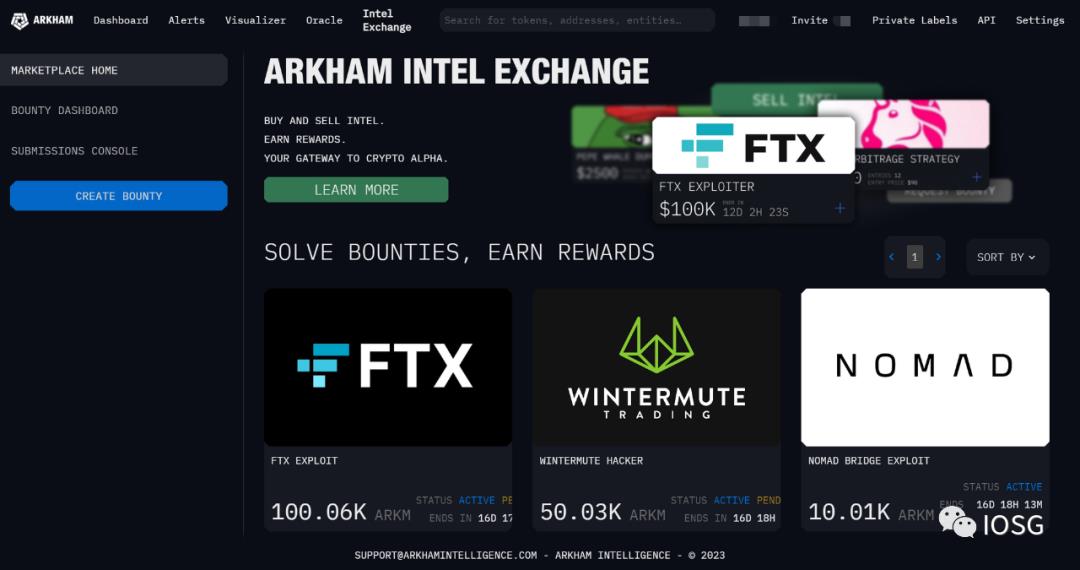
Almost all of Arkham's data-related functions are open and free, and we can see that its ecosystem and token application focus on the intelligence rewards platform, which is also the most controversial feature of this product. Anonymity in cryptocurrency is a highly praised feature, and the intelligence platform of Arkham goes against this by associating on-chain anonymous addresses with off-chain entities.
Compared to Arkham's token model focus on innovative business, Unibot's token model is more traditional and simple. Unibot is an Ethereum-based automated trading bot deployed only on Ethereum, with a TVL of $1.76 billion, providing token exchange, limit orders, copy trading, private transactions, and liquidity provision functions. Users can issue trading instructions through the Telegram chat box without any coding knowledge. Wallet addresses can be generated by Unibot or imported with their own private keys (high risk).
As a leading project in the automated trading tool track, Unibot's revenue has exceeded 4000 ETH, mainly coming from tool fees and token transaction taxes. The token has profit-sharing functionality, and holding 10 $UNIBOT tokens is required to be eligible. Rewards are proportional to the number of tokens held. Token holders will receive 40% of the platform's trading fees and 1% of the UNIBOT token transaction tax (total amount). Rewards are calculated every 2 hours and can be claimed every 24 hours, and any transfer of over 200 tokens every 2 hours will result in the confiscation of the income share. The huge increase in token price has caused FOMO sentiment in the market and attracted new users, leading to rapid growth in the entire automated trading tool track.
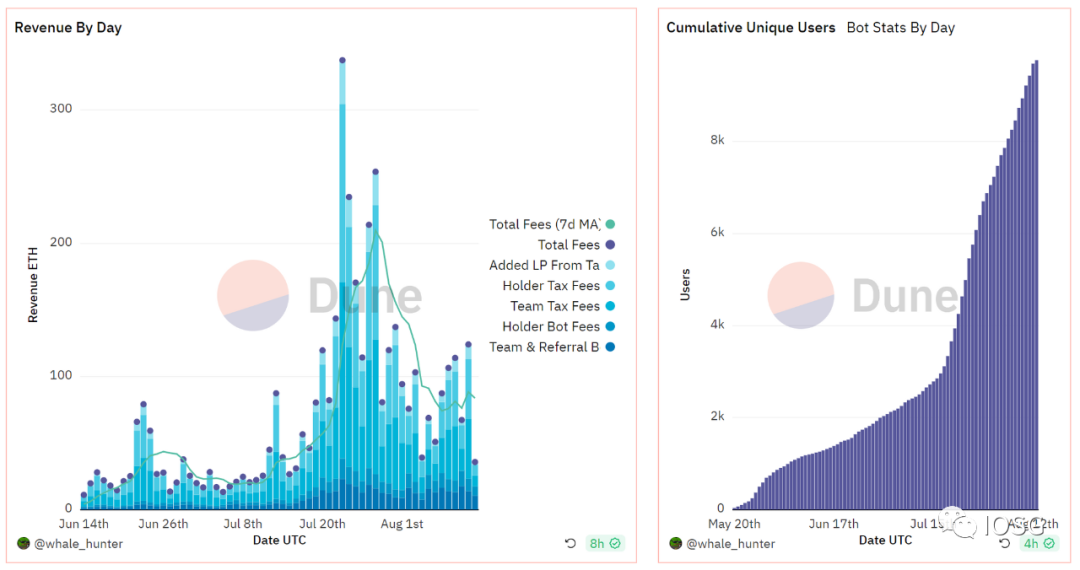
One major risk of Arkham's economic model is that it focuses heavily on innovative business, while the risk of Unibot's token lies mainly in the unsustainability of the current token price growth. Analysis of its revenue structure shows that 80% of its rapidly growing revenue comes from token transaction taxes, which largely depends on market hype and the entry of new users. Once market hype and trading volume start to decline, it is easy to suffer from a double blow of declining volume and price.
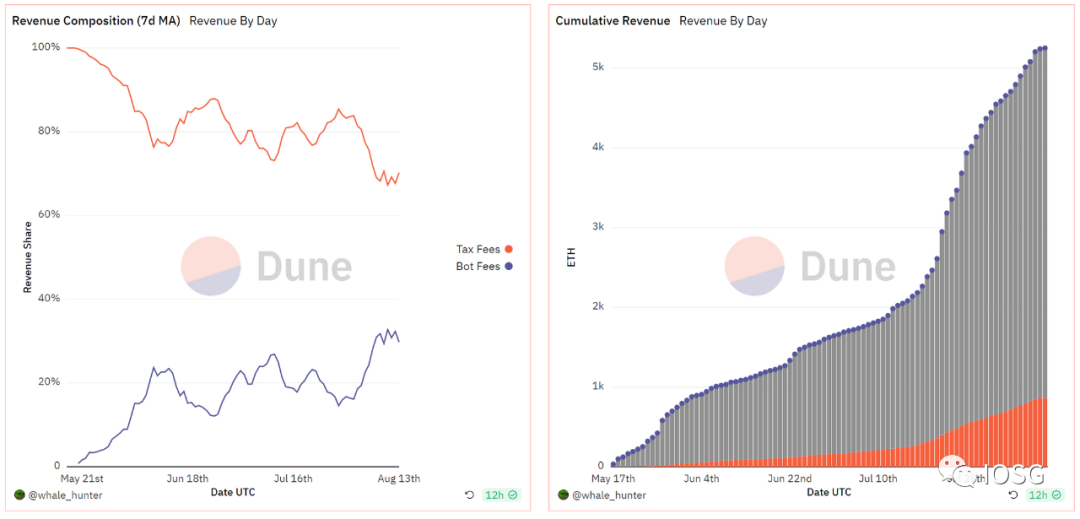
It is clear that the debate about the token model of the tool track is not unfounded, and when designing the economic model, it is important to consider how to enrich the ecosystem and expand the application scenarios of the token. There should also be a balance between short-term and long-term interests, as the short-term wealth effect certainly has a significant driving effect on user growth, but in the long run, it is important to seek a more sustainable development direction.
Possible Future Development Directions
Integration with Socialfi
We know that the basic requirement for social interaction is the need for a sufficient number of users to participate. Socialfi has always faced the challenge of onboarding more users and retaining them. Even Meta's introduction of Threads, strongly tied to Instagram, had poor user stickiness. In the second week after its launch, Threads' daily active users had decreased by 20%, and the average usage time had dropped from the initial 20 minutes to less than 5 minutes. Currently, the main social and UGC platforms in Web3 are web2 applications such as Twitter and Discord, lacking native Web3 social media. Users of data platforms share common interests, and the density of information is relatively high, making it a potential foundation for Socialfi. The difficulty of data-driven socialization on platforms like Xueqiu and Futu is evident.
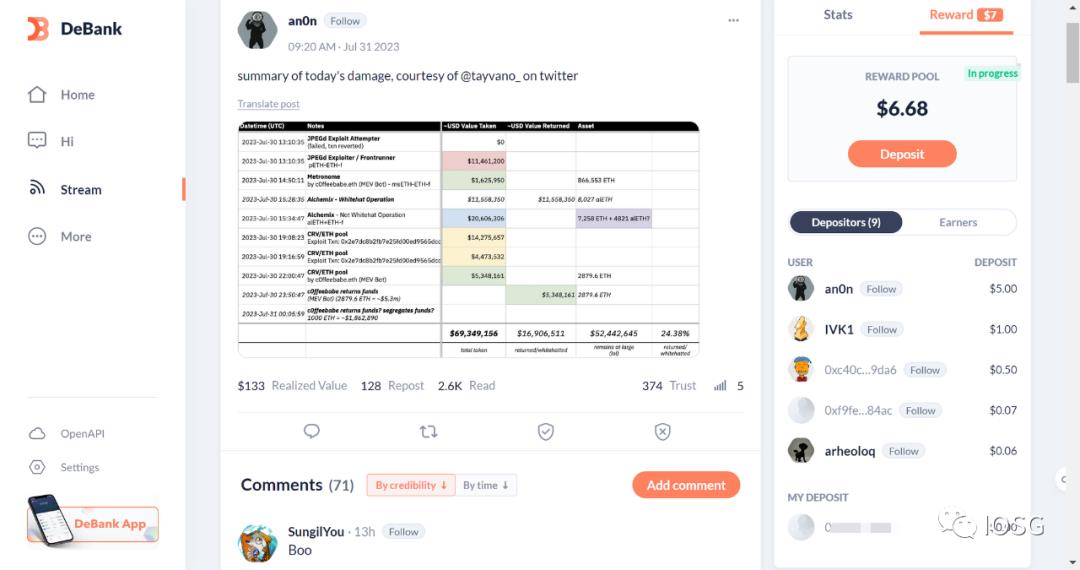
Debank's Stream feature is a reflection of the attempt to develop towards Socialfi. Using wallet addresses as accounts can provide more verifiable information, making KOL opinions more persuasive and conducive to pushing the field towards greater transparency. Users can also reward valuable information, making it an ideal form of creator economy.
Personalized Recommendations
The transparency of on-chain data makes it more logical to analyze individual behaviors and preferences. Currently, Web3's personalized recommendation algorithms and engines are still in their infancy. With the richness of multi-chain ecosystems and applications, the dimensions of user profiles will also increase.
If we compare with top-tier web2 products, recommendation algorithms are already a mature technology. Platforms like Taobao, Douyin, Meituan, and Bilibili all push products or videos that you might like. However, current data products like Dune and trading markets like Opensea are unable to provide personalized recommendations. As data volume increases, the accuracy of recommendations will enter a positive feedback loop, and the characteristics of blockchain data connectivity will make the accuracy of recommendations surpass that of web2. Moreover, with data sovereignty, it becomes possible to choose and fine-tune personalized models. Similar to recommendations in various areas of life in web2, such as clothing, food, housing, and transportation, web3's social, trading, and gaming also have their own application scenarios, and recommendation algorithms can be seamlessly integrated into different fields like building blocks.
Integration with AI
The transparency of on-chain data makes it more logical to analyze individual behaviors and preferences. Currently, Web3's personalized recommendation algorithms and engines are still in their infancy. With the richness of multi-chain ecosystems and applications, the dimensions of user profiles will also increase.
If we compare with top-tier web2 products, recommendation algorithms are already a mature technology. Platforms like Taobao, Douyin, Meituan, and Bilibili all push products or videos that you might like. However, current data products like Dune and trading markets like Opensea are unable to provide personalized recommendations. As data volume increases, the accuracy of recommendations will enter a positive feedback loop, and the characteristics of blockchain data connectivity will make the accuracy of recommendations surpass that of web2. Moreover, with data sovereignty, it becomes possible to choose and fine-tune personalized models. Similar to recommendations in various areas of life in web2, such as clothing, food, housing, and transportation, web3's social, trading, and gaming also have their own application scenarios, and recommendation algorithms can be seamlessly integrated into different fields like building blocks.
Conclusion
This article provides an analysis and summary of on-chain data tools in terms of product types, business models, and future development directions, hoping to inspire and provoke more thoughts for practitioners, institutions, and individual investors in this field. The Web3 industry is still in the early exploration stage, but the data track has already given birth to several well-known unicorns with valuations in the billions. From Defi Summer to NFT Summer, and to the potential emergence of Layer2 Summer or Gamefi Summer in the future, all scenario judgments rely on the use and support of on-chain data analysis tools. Every address and every interaction builds the vast universe of the decentralized world, and this highly potential track will become one of the most important anchor points. In this data-native industry, we are still full of expectations for the Alpha magic of on-chain data.
Due to space limitations, we will continue to discuss the specific practices of data products in commercialization in the next article.
免责声明:本文章仅代表作者个人观点,不代表本平台的立场和观点。本文章仅供信息分享,不构成对任何人的任何投资建议。用户与作者之间的任何争议,与本平台无关。如网页中刊载的文章或图片涉及侵权,请提供相关的权利证明和身份证明发送邮件到support@aicoin.com,本平台相关工作人员将会进行核查。


