Where to find the next real story scene?
Author: Fang Ting
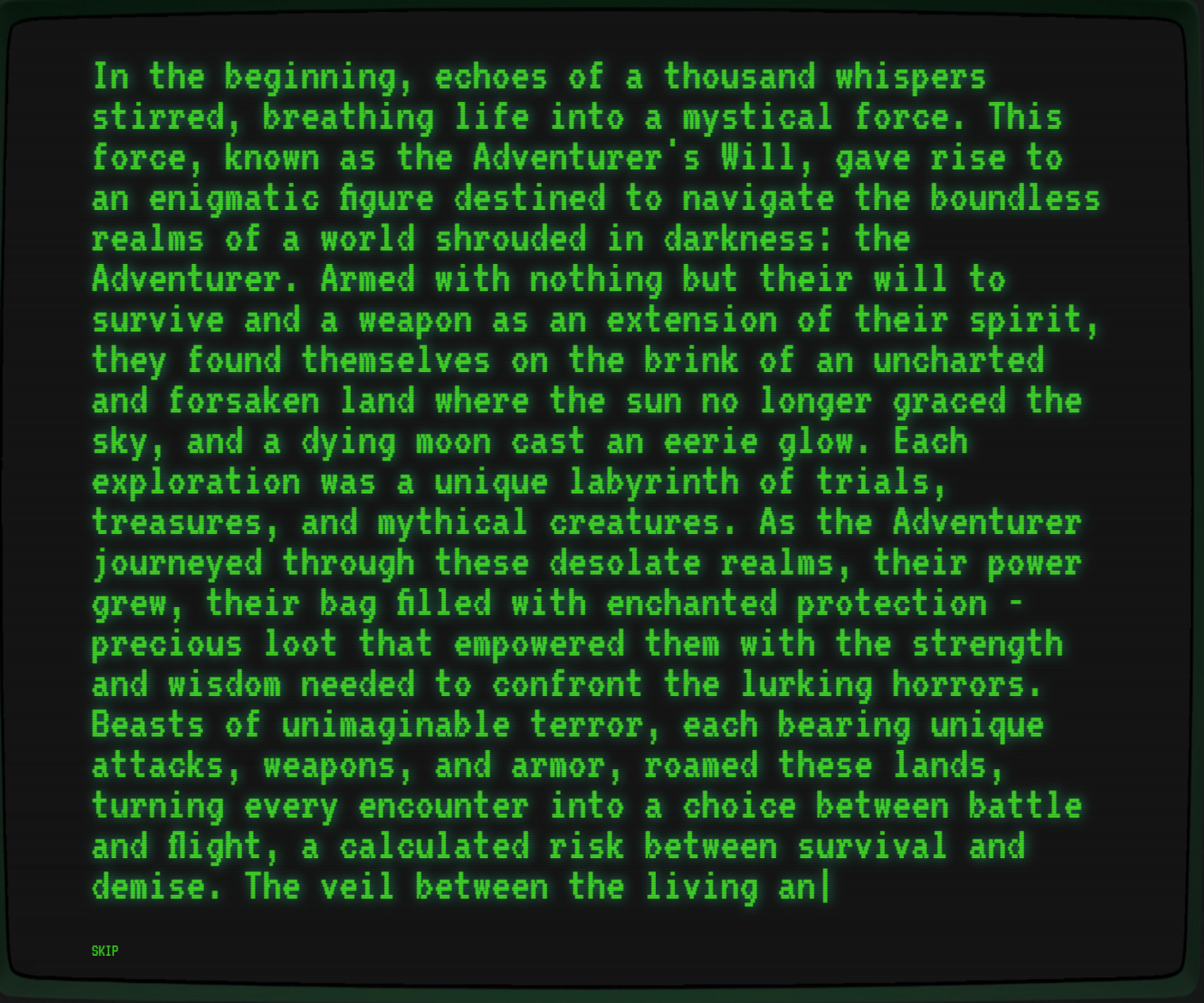
1. Prologue: Loot's "Narrative Device"
"Collaborative storytelling" is originally a more natural state in which stories occur. Before the written history began, the narrator hid behind the story, and the story grew and evolved at an incalculable speed with each telling. In the dynamic narrative history, the plot that eventually solidified formed the narrative world of the tribe in the eyes of the people at that time. It was a primitive world where stories could be combined, without permission, and everyone could participate.
In a tweet, Timshel defined Loot as a "massively-multiplayer collaborative world-building experiment," a kind of collective narrative experiment. In collective storytelling, an important element is the "narrative device."
Creating NFTs is largely creating a "narrative device." Someone once said that Loot is a "perfect writing prompt," and the eight categories and five eras it specifies serve as an extremely simple narrative starting point. This also explains the degeneration from jpg NFT to txt NFT: image-based NFTs do not have much textual depth, mostly just a statement, "worldly, yet carefree" (to borrow Venkatesh's words); while txt NFTs do not even have a statement, leaving more room. In creating narrative devices, rich media is not necessarily more effective; it conveys more forceful information but may not be more inspiring.
What problems might collective storytelling encounter? Is there some kind of "core"? Returning to the real epic: the study of Homer's epic once produced a "fundamental revolution" in the early 20th century, initiated by Milman Parry. He laid the foundation for the study of oral tradition and summarized some recurring formulas and epithets in the oral tradition as a kind of "formula." In parallel, returning to Timshel's definition of Loot, this "world-building experiment," although on the chain, still faces challenges similar to those faced by previous collective storytelling: how to converge storylines; how characters and time do not conflict with each other; what "formula" to use to build expansion packs for similar worlds, and so on.
This could have been a very exciting modern (antique) epic birth story, but at the beginning, the script did not follow the path of writing. Before the problems within the narrative were resolved, the Lootverse had already been fully listed in the real world, entering the speculative market. In the market, story elements first became speculative targets, and then became part of a scene in the story world. "Core stories" have a corresponding asset value. Thus, the next part emerged: the story of the early economy of Loot.
2. Scarcity: The Early Economy of Loot and the Investment Value of Stories
Early Economy of Loot
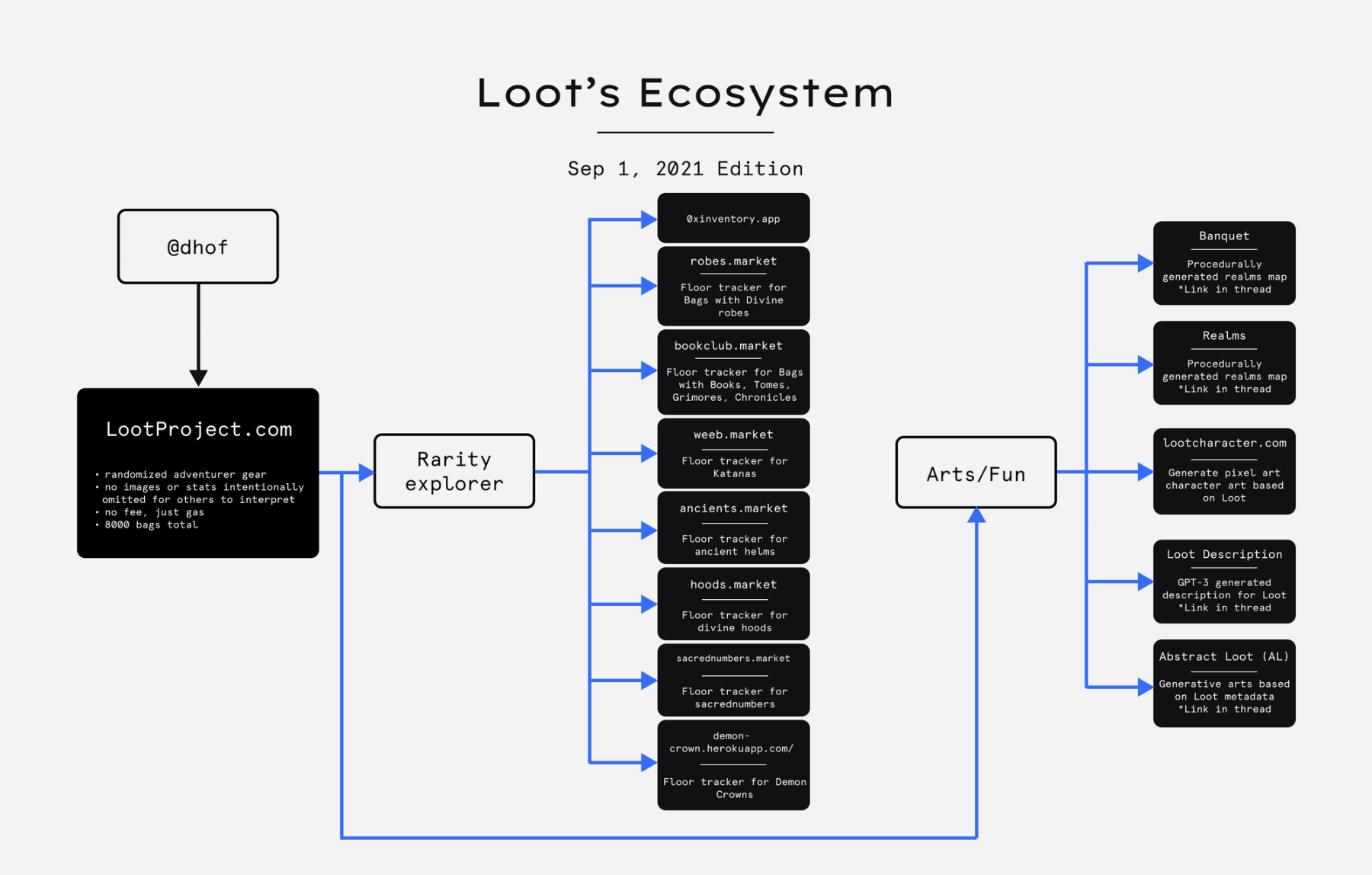
In a chart of the Loot Ecosystem drawn in the early days by dom, we can see that the beginning of the Loot economy was a "rarity explorer." Scarcity, as a kind of "narrative economy," almost decisively determines the operation of the Lootverse: people are more interested in ranking scarcity than the story itself. In other words, the storytelling and IP creation of Loot are a kind of meaning production mechanism in the Loot ecosystem, while ranking and speculation on the scarcity of Loot and its derivatives are a kind of meaning consumption mechanism. And consumption prematurely exceeded production.
Loot does not have its own official token, and core contributors rarely receive returns equivalent to other development teams. However, based on the concept of scarcity, the Loot ecosystem initially produced a large number of derivatives, based on the parts already written into the Loot contract and also based on the imagination of community members in various branches. They were made into various exquisite Google Sheets based on their scarcity, and these extremely rich tables constituted the most important output of the initial few months of the Loot universe. In the initial bubble era of the Loot universe, where scarcity is, the core story is; where the core story is, assets flow. In this prematurely formed closed loop, assets became the ultimate guide for most participants, and the story was just a "middleware." This led to a fundamental difference in the community mentality at the beginning compared to similar fan co-creation/cooperative IP or traditional literary experiments.
Community's Abundance Mindset and Scarcity Mindset
As a deep participant and stakeholder in the Lootverse, Will Papper has a very insightful discussion on this:
When Loot was first launched, builders had an abundance mindset, hoping to get people involved and create a truly powerful ecosystem. This mindset was also present in the early days of Adventure Gold. Then, this abundance mindset at some point turned into a scarcity mindset. I think the turning point was the launch of More Loot.
What do abundance and scarcity mindsets specifically refer to? Taking Synthetic Loot and More Loot (mLoot) as examples, Synthetic Loot is creator-friendly Loot, equivalent to the SBT of the Loot ecosystem, and is not tradable. Meanwhile, More Loot, as a tradable NFT, is an "untimely" inflation that dilutes the interests of community members who already own OG Loot, at a time when the Lootverse does not yet have a solid enough community and story foundation.
Will believes fundamentally that "inflation can keep everyone's interests aligned," and driving community development with an abundance mindset rather than a scarcity mindset. However, manually controlling inflation during the bubble period was disastrous for the extremely sensitive community sentiment at that time. Diluting rewards causes players to exit.
"Empty Houses" of Infrastructure
Looking at why the Lootverse was over-speculated before it matured has nothing to do with "collective storytelling" and is related to Web3's own infatuation with the term "infrastructure": infrastructure here is always more "investible" than applications. Nader recently posted a tweet after ETHCC, evaluating that almost everyone he met was "building infrastructure" and waiting for others to use it. JK commented that this is because infrastructure can generate more wealth—"Though what we really need are applications to prove more crypto use cases."
Loot, as a "decentralized storytelling infrastructure," fell into the same predicament as other infrastructures in the early stages: too much "metadata" and too few "scenes."
What is truly scarce is world-building
Creating enough story scenes and returning to what Will said about the "abundance mindset" of co-creation (rather than scarcity-driven speculative games) presents a completely new challenge for the core Loot community. This challenge was easily bypassed before due to the influx of speculators. But the benefit is that only co-creation pointing to enough story scenes is truly what Timshel and dom initially called "Collaborative world-building." Compared to which equipment and which sect are more "scarce," what is truly scarce is the process of this world-building itself.
The reason this experiment at the collective storytelling level has no precedent is that its success will exponentially increase the complexity of the text, forming a complex landscape that a single story can never achieve. Timshel's AI can create a single story, but it cannot create a universe with the imprint of each community member. The success of the Lootverse may just provide people in the AI era with the shortest path to surpassing "single works" through "collaborative works": the folds within a single story can always be learned and replicated, but the non-replicability of stories formed collectively comes from the embodiment of each person. Stories told without human participation will always tell "past stories" (batch recombination or low-level emergence in existing databases), while in the Lootverse, we are exploring the way of telling "future stories" (emergence of collective creation).
The key question then becomes: Where to find the next real story scene?
3. Lootverse as the Content Layer of AW
Forms of Autonomous World Content
An empty autonomous world is like this: digital physics form the basic rules of this world; game engines give every developer a low enough development cost; and the identities of developers, creators, and players are unified in this world (residents).
Now, our autonomous world lacks only the content layer. The value of the Lootverse lies in providing this autonomous world with almost the only completely native story for the time being. As a "bag of seeds" for the autonomous world, Loot and its derivatives, when decentralized, could produce a new story.
These seeds correspond to different future forms:
1) Text form;
2) Static/dynamic non-interactive media form;
3) Interactive media form.
Among them, the third form is a broad sense of games, and it is also the latest scene of the Lootverse. Betting on another "Game of Thrones" appearing in the Lootverse is dangerous, but betting on many well-experienced games appearing in the Lootverse is quite natural. Full-chain games, as a kind of "collective storytelling," actually change the nature of storytelling, making it fundamentally different from traditional oral literary traditions. Full-chain games make a story have no "ending," and therefore do not need classic plot development; there are no results, only processes. This brings an important feature: "interactivity" is placed at the forefront.
The Most Interactive Form: Full-Chain Games
Interactivity strengthens player engagement and makes the story more memorable and important. In this dimension of interactivity, games are superior to IP-style NFTs, and even more so than pure textual descriptions. Bibliotheca DAO initially viewed full-chain games as "eternally ongoing games" (as can be seen from the naming of "Eternum"), and a game without a "clearance" possesses a thorough narrative seriousness. Interacting in an endless game without a clearance is very much like life itself, which is why Ludens uses the metaphor of "Mars" to describe the autonomous world, and the Topology team refers to it as "On-chain reality."
An interactive Lootverse is currently the easiest imagination for us to realize in an autonomous world. Several full-chain game works have already emerged from the Lootverse, including: The Crypt Game; Bibliotheca DAO's Realms: Eternum, Loot Survivor; and Dope Wars, among others. The Realms series is based on the terrain setting in the Lootverse and is currently one of the most recognized full-chain games derived from Loot.
Interactivity also means that the importance of social interaction in games is elevated to a higher level. The proposition of "decentralization" has never been consistently implemented in the Web3 world, but in the realm of full-chain games, decentralization is a necessary proposition. As a result, full-chain games have introduced a hard new demand for infrastructure, namely, a trustless communication solution. Infrastructure service providers currently offering trustless communication solutions for full-chain games include Web3MQ, among others. Through trustless solutions, we are transitioning from an era where "someone always knows who the werewolf is in this game" to an era where "no one in real life knows who the werewolf is."
LDK and Autonomous World Infrastructure
The first-mover advantage in full-chain game IPs is not the main advantage of the Lootverse. The aspect of the Loot ecosystem that is more compatible with the autonomous world is that it has already formed its own LDK (Lore Development Kit). Like MUD and Dojo are game development engines, LDK is equivalent to a "narrative engine" in collective storytelling (as termed by MovingCastles). In the article "LARGE LORE MODELS: Speculative Tools for Decentralized Narrative-Building" co-authored by dmstfctn, Eva Jager, and Alasdair Milne, it is also referred to as a "Large Lore Model (LLoreM)" collective writing plugin. dmstfctn et al. see LLoreM as a true "autonomous world infrastructure" (for autonomous knowledge commons) and in the article, they see it as the best path to resist the proliferation of legends generated by GPT by blending human will.
Specifically, the meta-timeline provided by Lootverse, the universally usable character roles in Genesis Adventurers, the dungeon maps provided by Crypts & Caverns, and the information provided by Realms on 8,000 maps and their tribal distribution all constitute part of the LDK. Based on composability, the appearance of LDK and components such as Genesis Adventurers and Crypts & Caverns has made world-building no longer a completely disordered, linear parallel process. Low-cost textual creation easily leads to rapid chaos in the story universe, while high-cost game development faces the problem of background map alignment. The appearance of LDK, along with the universal character and map components, is a neutralizing solution to this problem. In the current on-chain world, it is difficult to imagine the possibility of building a sufficiently recognized LDK from scratch. The Loot LDK is currently the best narrative engine available for the full-chain world.
* Reference for trustless communication solutions for full-chain games: https://docs.web3mq.com/docs/Intro/
Appendix One
Appendix One is a relatively relaxed section that connects some purely textual text experiments from the past and present (many of which have failed), and also pays tribute to the early writers who participated in the creation of the Lootverse. During the early full-chain game/autonomous world period, contributors to the Lootverse did the initial meaningful work in this universe with very little or no economic reward:
- Dozens of authors participated in the Lootverse's story writing in the three rounds of the Genesis Scroll writing competition hosted by Open Quill. These works are currently visible on the Loottalk forum.
- The Banners team created a 23-chapter novel, The Painter, based on the creative experiment of Open Quill. This work is currently visible on Royalroad.
- …
Collective writing experiments in history are not uncommon: in the 1980s, a group of writers and artists in Seattle, inspired by "Invisible Cities," created a collective writing project called "Invisible Seattle," visiting the streets and having Seattle write this novel as a whole city. The novel was published after four years, rich and heavy, providing a slice of the times. In the 2000s, there was the Nine Continents in China. In 2021, during the hottest period of Loot, professional writers also started collective writing experiments such as "Realms of Ruins," but they ended in dismal failure due to astonishing resistance from the traditional publishing industry and traditional readers (with the main attack point being the harm of NFTs to the climate). Because of my previous professional learning, I have also participated in several collective writing experiments, including semi-closed writing offline, but most of them ended with irreconcilable opinions or the overall output being less than the sum of its parts.
The pioneering nature of pure text experiments often precedes other art forms, and the efforts and failures in "collective storytelling" often accumulate more. This involves a very internal issue: is the composability of text the same as the composability of development components? Is there a "plug-and-play" "story module"? A continuous "world" often means that every element in it has the potential for linkage, which provides subsequent writers with exponentially more information absorption pressure, and later creators creating is like an outsider writing a local chronicle.
But before the birth of full-chain games, people took advantage of this oldest form of creation when they had Loot, this new form, and didn't know what to do with it. The various unresolved issues contained in this form of creation and the results caused by the issues are summarized by one author as the "Frankenstein's monster of Loot":
But the result was a kind of Frankenstein’s monster that was less than the sum of its parts. You can write a new smart contract that attempts to join the pieces together, but as soon as someone wants to add a new piece to the stack you might have to start over… "Being future-proof is sort of difficult."
Frankenstein is a monster in literary history, but every history of science fiction cannot avoid "Frankenstein." Regardless of whether its ending is disordered, the experimental courage of the Lootverse has forged its own proof on the chain.
Appendix Two
A DC History of the Lootverse
The following timeline is from the Loot community's announcement channel on Discord.
2021/9/1
dom posted the first announcement on Loot Discord.
2021/9/3
Lootproject.com was established.
2021/9/4
Loottalk.com forum was established. It later became the main platform for the publication of textual stories and competitions in the Lootverse.
2021/9/15
Loot Improvement Proposal (LIP) was first published on snapshot.
2021/10/19
Announcement of Loot Alliance as the community representative and Lootproject website manager.
2021/10/29
Announcement of the item level order and attributes directly discovered from the OG Loot contract.
2021/11/10
First Loot Town Square.
2022/2/26
Loot.foundation was launched, serving as the semi-official documentation for Loot.
2022/4/2
Announcement of the launch of Hyperlootproject.com. Two days later, Hyperloot was launched.
2022/4/21
The Genesis Scrolls were announced. As a collection of stories in the Lootverse, it began to solicit authors. Announcement on the Openquill Foundation website.
2022/6/3
Timshel released the Loot Deck, defining Loot as "on-chain scaffolding for a massively-multiplayer collaborative world-building experiment."
2022/6/8
Launch of the Lootverse Ecosystem Grants program.
2023/4/5
Release of the movie trailer for HyperLoot: CC0 Wars.
2023/5/31
Announcement of Loot Survivor.
Finally, thanks to Kaspar's initial article "万字笔墨,从 Dark Forest 与 Loot 一窥链游形态的顶点:全链上游戏" and Tianran's introduction, I had my initial impression of Loot and continued interest in exploring it. I also thank the creators, developers, and players who have been building the Loot ecosystem. I wish the Loot full-chain game ecosystem continues to improve.
免责声明:本文章仅代表作者个人观点,不代表本平台的立场和观点。本文章仅供信息分享,不构成对任何人的任何投资建议。用户与作者之间的任何争议,与本平台无关。如网页中刊载的文章或图片涉及侵权,请提供相关的权利证明和身份证明发送邮件到support@aicoin.com,本平台相关工作人员将会进行核查。


