
Author: Jim, MSX Maitong
Editor: Frank, MSX Maitong
In the past two years, Wall Street has discussed AI, and the most important numbers have always been GPU, data centers, and CapEx.
However, by 2026, another number has started to rapidly enter the market's view: debt.
Once, the most profitable companies in Silicon Valley were accustomed to purchasing GPUs and building data centers with their own cash. Today, as the scale of AI infrastructure continues to reach hundreds of billions and even trillions of dollars, even global cash-generating powerhouses like Alphabet, Amazon, and Meta are increasingly frequenting the bond market.
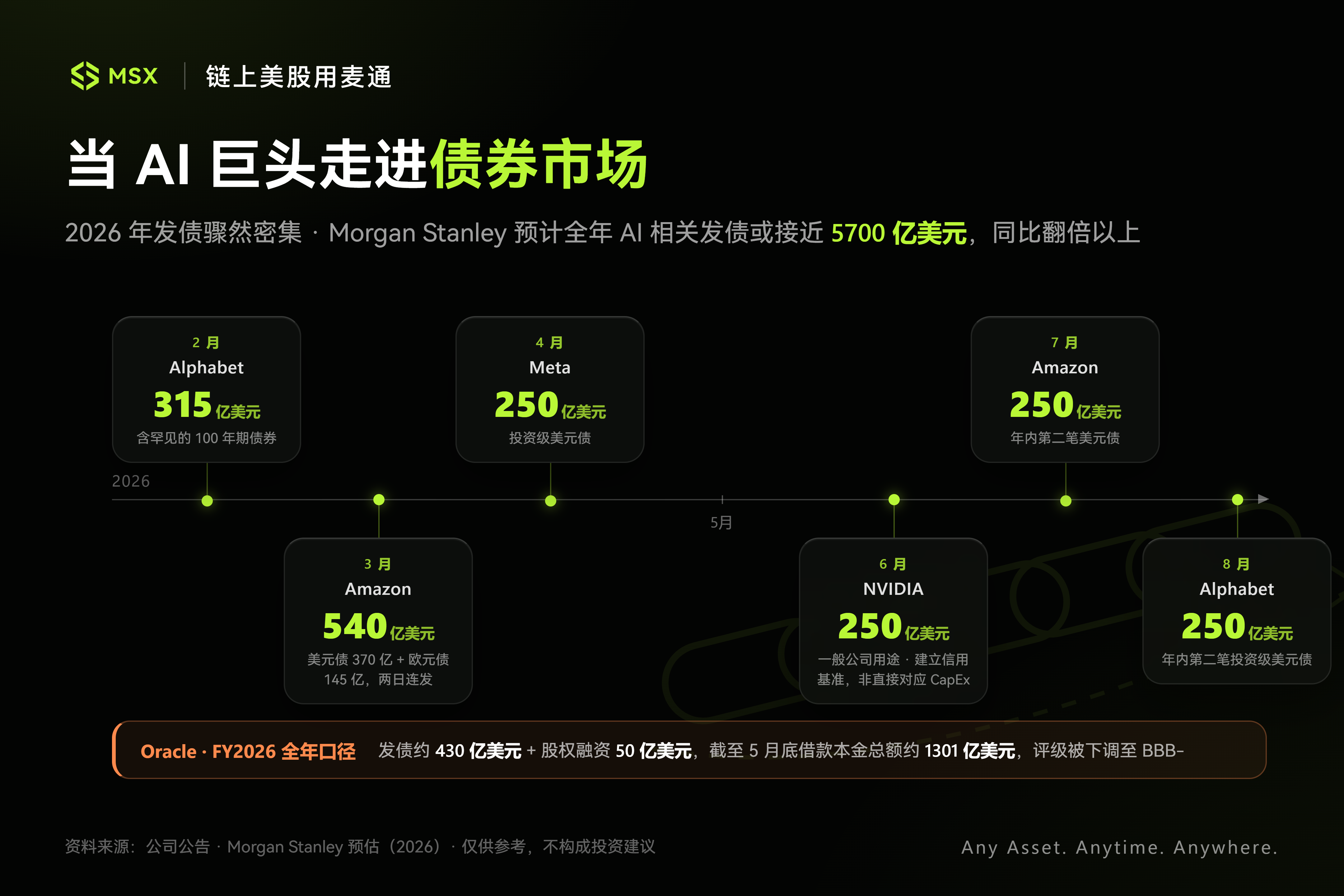
Morgan Stanley estimates that global AI-related debt issuance could approach $570 billion in 2026, more than doubling compared to last year; by the end of May, the scale had already reached about $236 billion, four times that of the same period last year.
At the same time, expenditures related to Alphabet, Amazon, Microsoft, and Meta are expected to reach about $700 billion this year, and by 2027, the capital expenditures of hyperscalers could even exceed $1 trillion.
And the financing methods are continuing to extend.
- On August 10, Nvidia announced a partnership with Apollo, BlackRock, Blackstone, Brookfield, Goldman Sachs, and KKR, hoping to leverage more than $500 billion in third-party capital into AI infrastructure.
- Almost simultaneously, disclosed future lease payment commitments from Microsoft, Meta, Oracle, Amazon, and Alphabet, which have yet to be executed, have reached the trillion-dollar level;
When the world's wealthiest companies begin to change their financing methods, it means that the story of AI is entering a new phase. The question arises, why do these companies, which used to have hundreds of billions of dollars in cash, suddenly like to borrow money?
1. The Scale of Spending in AI is Becoming Increasingly Exaggerated
Alphabet is the best example to understand this change.
From the business perspective, its most recent quarter can be considered strong—Q2 revenue reached $119.8 billion, a year-over-year increase of 24%; Google Cloud revenue reached $24.8 billion, with a staggering year-over-year growth of 82%.
But on the other side, Alphabet's quarterly capital expenditures have reached approximately $44.9 billion, leading to its first-ever negative quarterly free cash flow, with Q2 free cash flow dropping to -$5.9 billion, while Alphabet has also raised its capital expenditure guidance for 2026 to $195 billion–$205 billion.
This is precisely where AI capital expenditures differ most from the traditional software era.
Large tech companies of the software era were essentially cash machines: after completing R&D, the marginal cost of adding each user was limited, and much of the revenue ultimately settled as free cash flow.
In other words, AI is redefining tech companies as "heavier."
GPUs, servers, high-speed networks, data centers, substations, cooling systems, and land all require huge cash investments before actual revenue materializes.
Amazon CEO Andy Jassy once explained that data centers often start incurring construction costs about two years before they officially come online, while revenue must wait until the facilities are fully operational to gradually materialize.
Thus, a natural funding maturity mismatch arises: cash needs to be spent today, but revenue must be slowly recovered over many future years. In this situation, even if a company has substantial cash on hand, relying solely on internal cash flow for financing may not be the most reasonable choice.
In February this year, Alphabet completed about $31.5 billion in global bond financing, including a rare 100-year bond; in August, it completed a $25 billion investment-grade dollar bond issuance. Amazon’s actions are even more aggressive; in March, it financed about $37 billion in the U.S. bond market and issued €14.5 billion in bonds the next day, with the two totaling nearly $54 billion. In July, it issued another $25 billion in U.S. bonds.
Meanwhile, Amazon has raised its capital expenditure plan for 2026 to $220 billion. AWS's latest quarterly revenue grew by 37% year-over-year, marking the fastest growth in over four years, yet its free cash flow over the past 12 months decreased from $18.2 billion a year ago to -$7.6 billion.
Meta is also experiencing the same change. In April this year, Meta completed a $25 billion bond issuance; Q2 revenue still grew by 28%, reaching $60.8 billion, but free cash flow plummeted from $8.55 billion in the same period last year to only $784 million, and its 2026 CapEx guidance has already been raised to $130 billion–$145 billion.
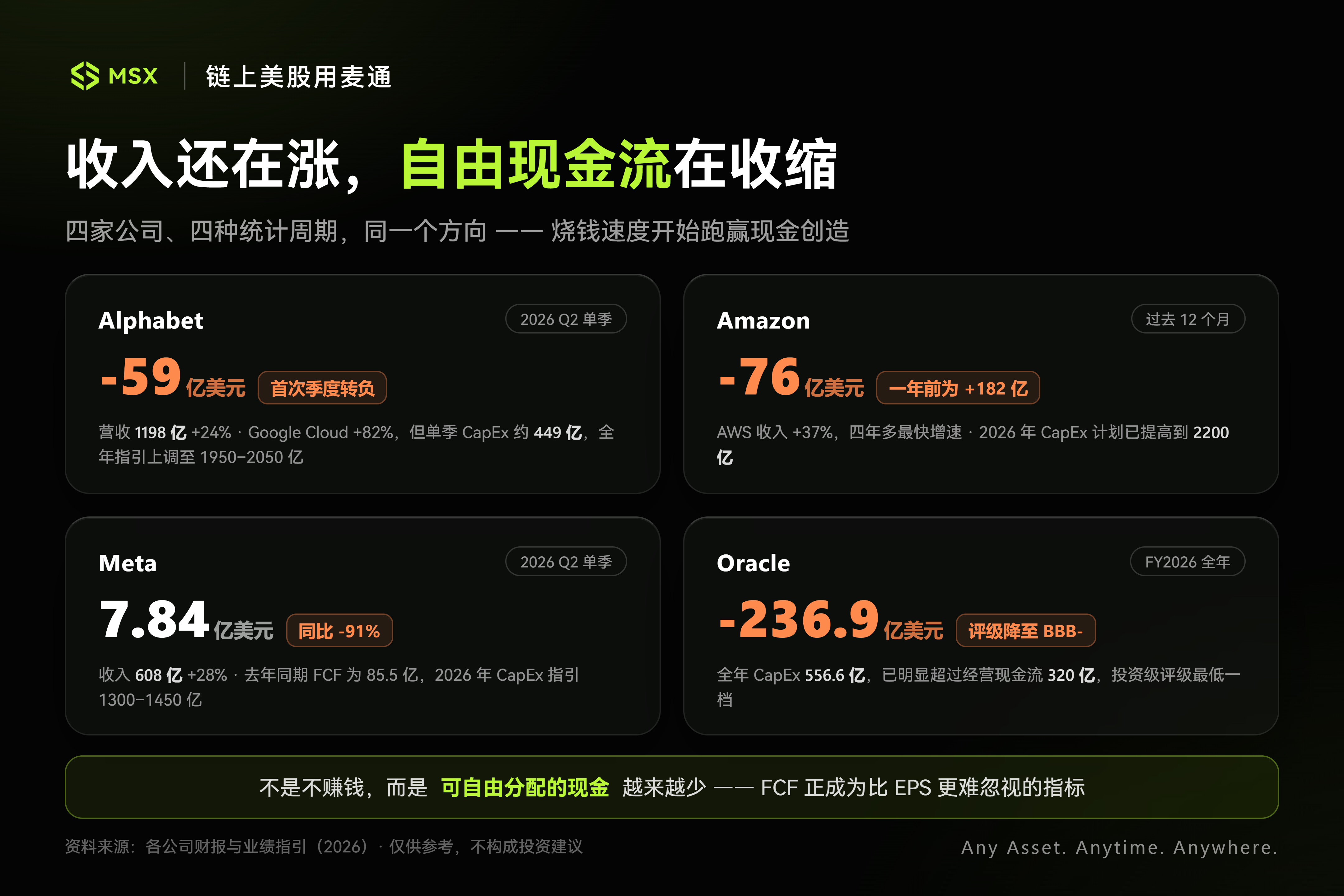
These companies have not suddenly lost their ability to make money, and their profits are still significant. It's just that the cash available for discretionary use is becoming increasingly limited.
This is also why, in the era of AI, free cash flow is becoming a metric that is harder to ignore than mere EPS.
2. Borrowing Money is Not the Same Story for Google and Oracle
However, borrowing debt does not inherently imply danger.
For companies like Alphabet and Amazon, debt is more of a capital structure tool.
They have large core businesses, stable cash flows, and high credit ratings, and in the case of extreme front-loaded capital expenditures, spreading construction costs into the future through long-term bonds is a normal maturity matching.
The real focus should be when capital expenditures consistently exceed their cash-generating capabilities; is financing optimizing the balance sheet, or has it begun to place pressure on the balance sheet?
Oracle is currently one of the most extreme samples.
By the end of the fiscal year 2026, Oracle's annual capital expenditures reached approximately $55.66 billion, while operating cash flow was only about $32 billion, resulting in an annual free cash flow decrease to -$23.69 billion. Meanwhile, the company has completed about $43 billion in debt financing and $5 billion in equity financing in FY2026; as of the end of May, all borrowings have future principal amounts of about $130.1 billion.
On July 9, S&P Global Ratings downgraded Oracle's long-term credit rating from BBB to BBB-—the lowest tier of investment-grade rating, with the next level entering speculative.
Therefore, while both are burning money in AI, Alphabet is more about leveraging its balance sheet, while Oracle has begun to challenge its balance sheet, which is a new framework that must be rebuilt for observing the next stage of the AI market.
Previously, the market focused primarily on how much AI revenue was growing, how many orders were increasing, and how fast cloud business was growing. In the future, several additional questions need to be added, such as how much companies are spending to achieve this growth? How much capital expenditure is required for each additional $1 in revenue? How much free cash flow is left? How much needs to be borrowed? When interest, depreciation, and leasing costs all begin to enter the profit statement, how much profit can ultimately remain?
Ultimately, what truly determines valuation will not only be growth itself, but the capital efficiency of that growth.
3. More Important Than Issuing Bonds: AI is Becoming a Financial Asset
If the bond issuances by Alphabet, Amazon, and Meta are merely changes in financing methods, then Nvidia's latest move has advanced this matter further.
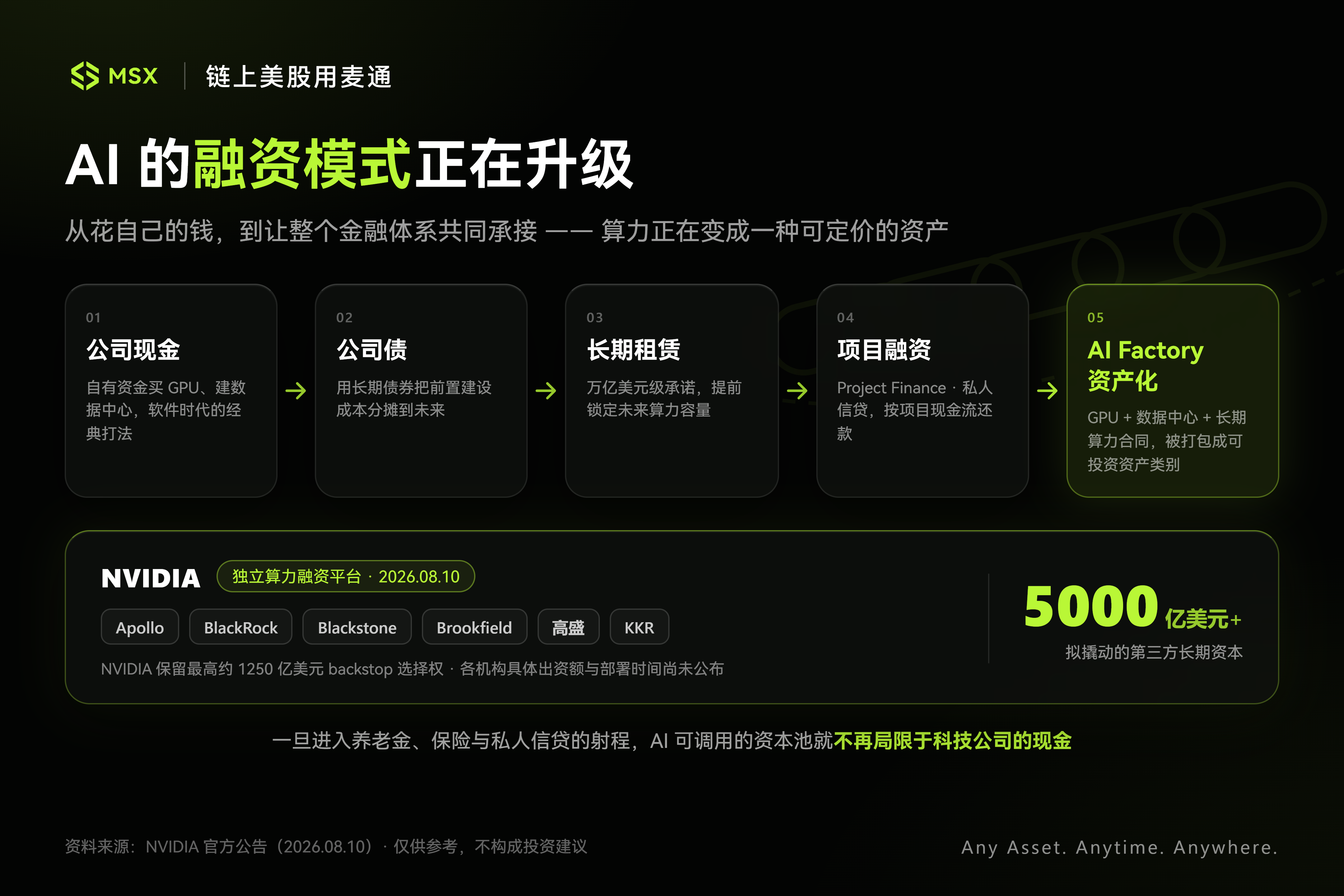
On August 10, Nvidia announced a strategic partnership with Apollo, BlackRock, Blackstone, Brookfield, Goldman Sachs, and KKR, aiming to establish an independent computational financing platform to mobilize over $500 billion in third-party capital into AI infrastructure.
Nvidia itself has the right to provide a backstop of up to approximately 25%, or about $125 billion, for potential deals, but the specific contributions and timing from various institutions have not been disclosed yet.
What is truly worth noting is how Nvidia defines this model. In the official announcement, Nvidia directly describes AI Compute and AI Factory as a new "investable asset class."
The logic is actually not complicated. In the past, if a Neocloud needed to purchase billions of dollars in GPUs, it first needed to raise a significant amount of capital itself. In the future, this structure may increasingly resemble traditional infrastructure financing; for instance, data centers and GPUs become assets, customers long-term rent computational power to generate cash flow, with institutions like Apollo, BlackRock, and KKR providing long-term capital, and projects then repay financing costs with future computational income.
Thus, GPUs are no longer just chips sold once; instead, the entire AI Factory, composed of GPUs, data centers, electricity, and long-term computing contracts, is beginning to be packaged as an infrastructure asset capable of generating long-term cash flow that can be priced and financed by capital markets.
The significance behind this is immense.
Because once AI infrastructure can enter the investment scope of pensions, insurance funds, private credit, infrastructure funds, and asset management institutions, the capital pool that AI can call upon will no longer be limited to the cash of tech companies.
This could allow this round of AI infrastructure construction to last longer than the market anticipates.
However, it will also change the nature of risk. After all, the biggest risk in the first phase of the AI cycle is that AI is not used. But in the latest second phase, the more worrying possibility is that AI is used, but the price of computing power declines too quickly, and revenue growth cannot keep up with debt, depreciation, and financing costs.
Especially when the speed of GPU updates remains extremely fast, today’s asset return models designed for five years or longer must be based on an important assumption that these devices can still maintain sufficiently high utilization and economic value in the coming years.
This is also a new variable that the AI industry will face after financial capital truly begins to enter.
In addition, there is another capital commitment that is easier to overlook.
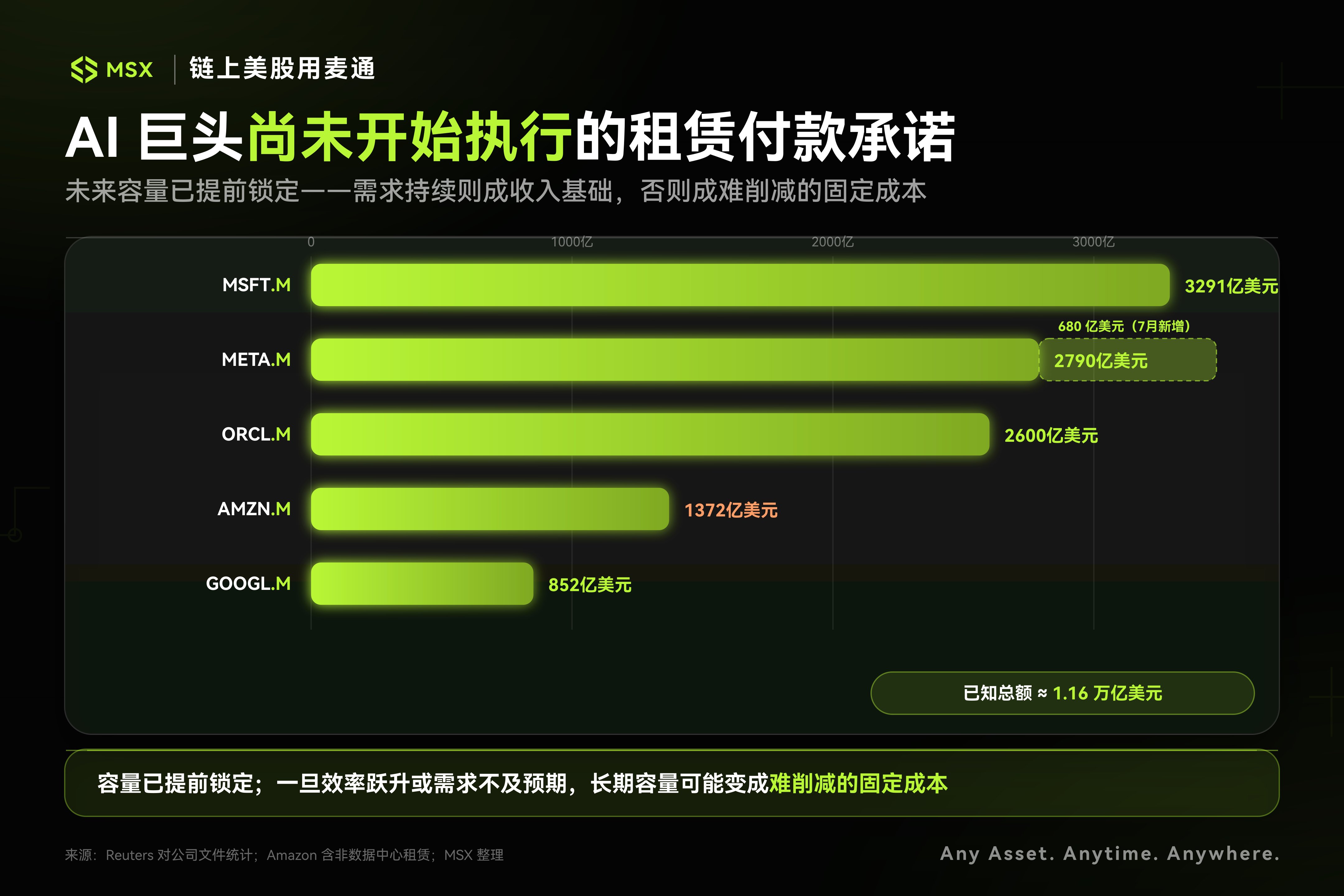
According to statistics from Reuters on company documents, Microsoft, Meta, Oracle, Amazon, and Alphabet have disclosed about $1.09 trillion in future lease payment commitments that have yet to be executed, with Microsoft accounting for about $329.1 billion, Meta approximately $279 billion, Oracle about $260 billion, Amazon around $137.2 billion, and Alphabet about $85.2 billion; Meta also signed a new data center lease agreement worth approximately $68 billion in July, further pushing the known scale up to about $1.16 trillion.
Of course, these numbers should not be simply interpreted as "tech companies owe $1.16 trillion." Many contracts span over a decade and have not yet formally begun execution; thus, they have not all been recorded as lease liabilities on the balance sheet. Amazon's related disclosures also include warehouses, offices, planes, and vehicles, not all of which belong to AI data centers.
But it still reveals an important thing: a significant portion of AI infrastructure investments in the coming years has already been locked in advance. As long as the demand for computational power continues to grow, these commitments will form the basis for future revenue growth. However, if model efficiency rapidly improves, the unit prices of computational power continue to decline, or the pace of corporate AI commercialization is slower than expected, then the long-term capacity locked in today could also turn into fixed costs that are hard to quickly reduce in the future.
And this is precisely the biggest difference between the AI financing cycle and the pure technology cycle.
In Conclusion
It is still difficult to simply explain these changes as negative signals.
On the contrary.
The entry of the bond market, private credit, pensions, insurance funds, and global asset management institutions is likely to further expand the scale of funds available for AI, allowing this round of infrastructure construction to last longer.
As of August 12, U.S. stocks remain not far from historical highs. After the latest earnings report, Amazon's stock rose nearly 9% in after-hours trading due to a 37% growth in AWS; Microsoft also received significant market rewards after proving cloud business growth and cash generation capabilities; at the same time, Alphabet came under pressure after announcing continued increases in CapEx, while Meta faced sell-offs after a 91% drop in free cash flow.
The market has not begun to reject AI investment; it is merely transitioning from purely "demand trading" to a more stringent "capital return trading":
- In the first phase, it was about who dared to spend money;
- In the second phase, it is about who can acquire more computing power at a lower capital cost and ultimately generate sufficient cash flow from every dollar invested;
And when AI transitions from the capital expenditure of tech companies to something that Wall Street can purchase, finance, and price, the real question that this competition needs to answer will eventually become, "Who creates something that can really make money?"
And this may become the true dividing line determining the valuation gap between Google, Amazon, Meta, Oracle, CoreWeave, and even Nvidia in the next year or two.
免责声明:本文章仅代表作者个人观点,不代表本平台的立场和观点。本文章仅供信息分享,不构成对任何人的任何投资建议。用户与作者之间的任何争议,与本平台无关。如网页中刊载的文章或图片涉及侵权,请提供相关的权利证明和身份证明发送邮件到support@aicoin.com,本平台相关工作人员将会进行核查。


