
Author: New Things
The STONKBROKER mechanism is very suitable for scenarios like RWA.
Because there are two main levers.
Yield lever and liquidity lever.
First, let's talk about the yield lever:
Currently, many approaches involve an RWA asset package, which anchors part of the real-world yield, and then Web3 players buy in. This approach isn’t flawed, but what is always missing?
It's not sexy enough, not fun enough.
But what if we use the STONKBROKER approach?
First, NFT holders can receive part of the real-world yield, and additionally, they can receive a system-generated yield based on the narrative of this project.
STONKBROKER relies on system operations (producing various wear and tear) to bring many actual returns to NFT holders.
Just relying on innovation and circulation, STONKBROKER can achieve such a high market value, so what if NFT holders also gain from real-world yield? (Of course, later similar mechanism projects won’t have the innovation premium.)
This is the yield lever.
It adds a layer of on-chain system operational yield.
The result is: NFT holders simultaneously receive "real-world cash flow + on-chain system circulating/trading yield."
Next is the liquidity lever.
Using the previous RWA project asset package approach, relying on real-world assets and yield, issuing an RWA asset package typically lacks liquidity.
But with the STONKBROKER approach:
- You can always exchange NFTs for tokens (or vice versa) at a fixed rate
- Tokens themselves have pools, which are easily manageable
- Each "RWA asset" thus receives real-time market pricing and flexible exit channels
It effectively unifies the liquidity of NFTs and ERC-20 tokens. Real assets truly "flow," dramatically enhancing capital efficiency and making it easier to attract more trading and speculative funds, further amplifying system wear and tear yields.
Further deducing:
If we apply this mechanism directly to a broader interpretation of RWA (such as real estate shares, bonds, private equity, or even carbon credits, without considering the on-chain issue for now), it can be structured as:
- Each RWA asset package corresponds to a batch of NFTs with ERC-6551 wallets
- Use Anvil-style AMM to freely swap NFTs and platform tokens (or RWA tokens)
- All system transactions/activations/loan wear → a part buys more underlying RWA or directly distributes cash/yield tokens to NFT holders
- Further adding modules like lending, options, launchpads, forming a stronger flywheel
The result is that it becomes more fun, yields are greater, liquidity is better, and ordinary players can participate.
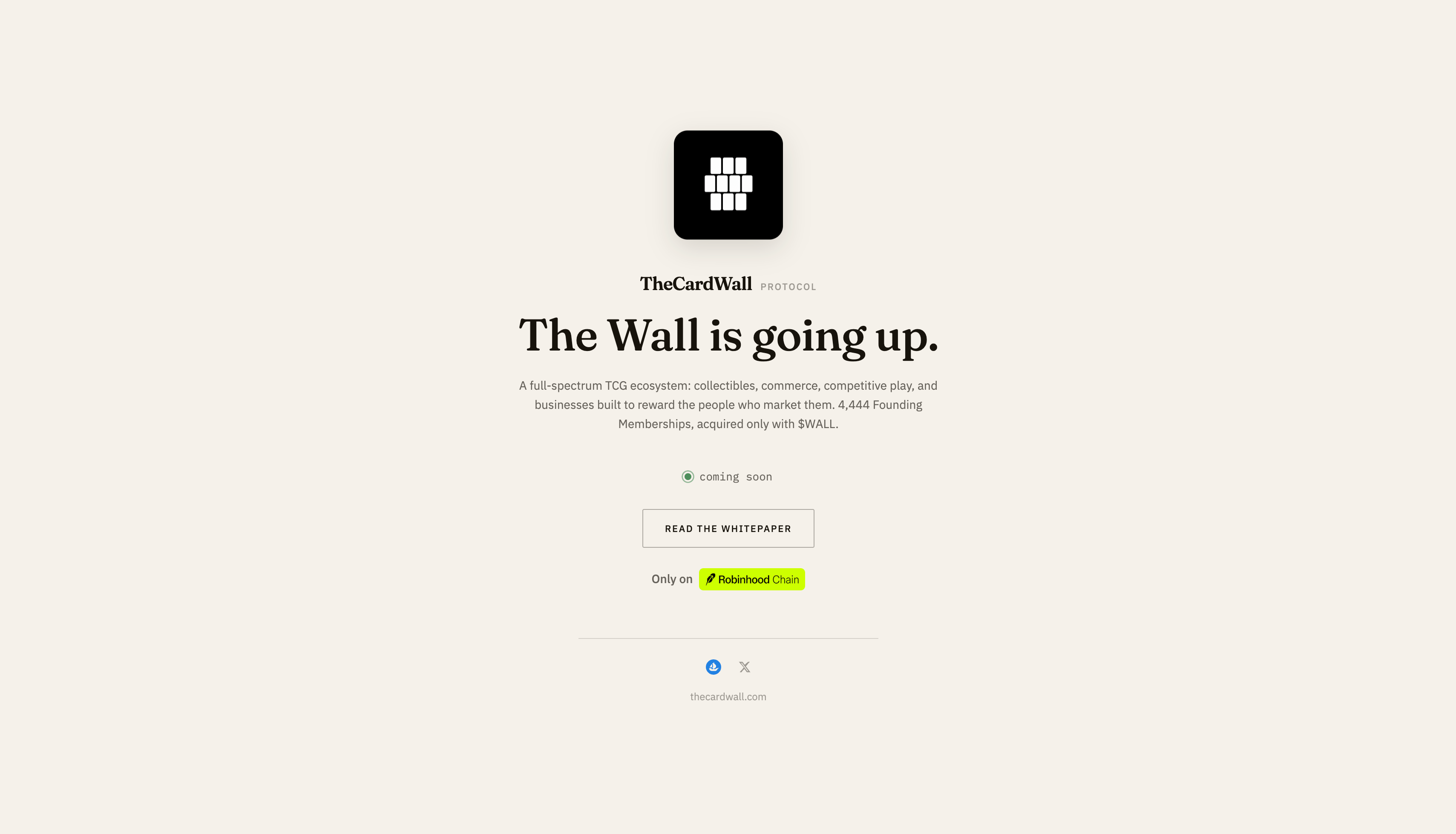
The above content is some additional associations inspired by the project @TheCardWall (this project may not necessarily do it entirely this way), which launched at dawn and focuses on PSA 10 cards (understand them as high-quality cards).
The core is to create a public on-chain vault for physical PSA 10 (perfect grade) trading cards.
The project launched this morning and currently has a 3.3 million valuation. (Not investment advice, DYOR)
免责声明:本文章仅代表作者个人观点,不代表本平台的立场和观点。本文章仅供信息分享,不构成对任何人的任何投资建议。用户与作者之间的任何争议,与本平台无关。如网页中刊载的文章或图片涉及侵权,请提供相关的权利证明和身份证明发送邮件到support@aicoin.com,本平台相关工作人员将会进行核查。


