Author: Ahboyash Reads
Translation: Deep Tide TechFlow
Deep Tide Guide: The KOSPI and KOSDAQ indices in South Korea fell more than 12% for two consecutive days, setting a record for the first time in history for an exchange to trigger a trading halt consecutively. Despite strong performance in the second quarter from Samsung and SK Hynix, market concerns grow over the Chinese chip competition and the decline in demand from major American tech companies, raising questions about whether the gains driven by semiconductor stocks can continue. Behind this plunge, is it a precursor to a global tech stock valuation correction or a structural crisis in the South Korean economy?
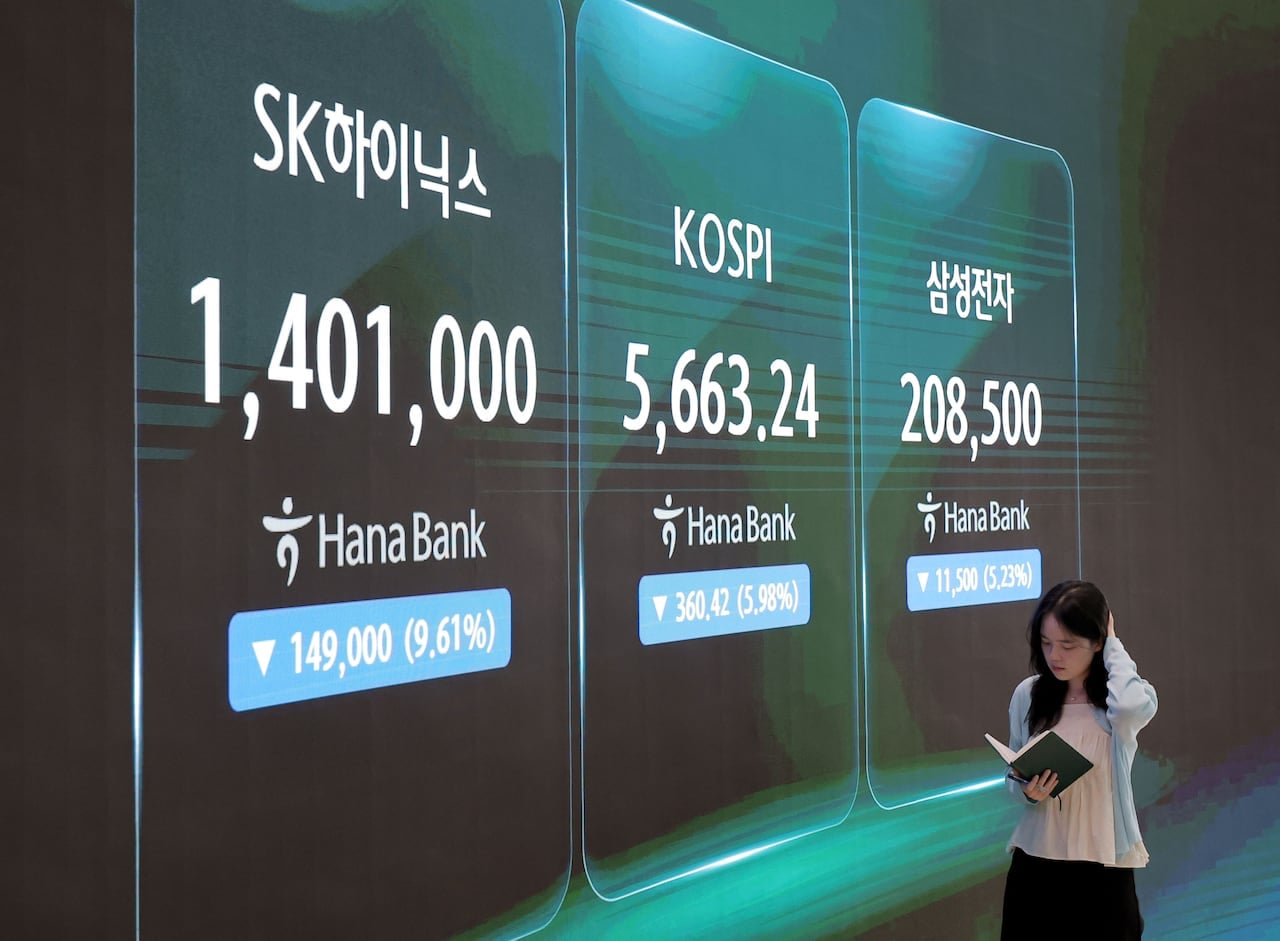
Image: On the afternoon of the 29th, the electronic screen in the trading room of Hana Bank in central Seoul showed that the KOSPI index closed at 5663.24 points, with stock prices of Samsung Electronics and SK Hynix dropping simultaneously. Source: Yonhap News
Authorities Hold Emergency Meeting Overnight, 'F4' Makes Urgent Appearance
As the domestic stock market plunged for the second consecutive day, officials from the economic and financial authorities decided to hold an emergency market situation review meeting on the evening of the 29th.
The Ministry of Economy and Finance announced to the media that an emergency market situation review meeting would be held that evening, chaired by Deputy Prime Minister and Minister of Economy Choo Kyung-ho. Attendees included Deputy Prime Minister Choo Kyung-ho, Bank of Korea Governor Lee Ju-yeol, Financial Services Commission Chairman Lee Bok-hyun, and Financial Supervisory Service Chairman Lee Chan-joon. This meeting is also referred to as the 'F4 (Finance 4) Meeting', signifying a gathering of heads of economic and financial authorities including macroeconomics, monetary policy, and financial policy.
Frequent Trading Halts: Unprecedented
The KOSPI index plummeted 10.84% the previous day and fell again by 5.98%, closing at 5663.24 points. The KOSDAQ index dropped 7.72% the previous day and then declined by 6.12%, closing at 662.68 points.
The Korea Exchange (KRX) initiated temporary halting mechanisms for sell orders (selling halts) for both the KOSPI and KOSDAQ markets during trading hours. This was the second consecutive day after the previous day. It is said that such a situation is unprecedented.
According to data from the Korea Exchange, the main board market has never experienced a situation where the trading halt mechanism was triggered for two consecutive days. In the KOSDAQ market, the halt mechanism was triggered twice within a few consecutive days—once during the global financial crisis in 2008 and again during the U.S. credit rating downgrade in 2011.
Is Semiconductor Prosperity Peaking? 'Good Performance' Can't Hide Worries
The market drop on that day was due to growing concerns about whether the profit improvement trends of semiconductor companies like Samsung Electronics and SK Hynix, which led the stock market, could be sustained. SK Hynix reported that its second-quarter sales reached 79.3187 trillion Korean won, a year-on-year increase of 256.8%, with operating profit growing 557.2% to 60.5426 trillion Korean won. Despite announcing strong performance, concerns about the continuing catch-up of Chinese companies and the declining demand from major American tech companies have intensified.
免责声明:本文章仅代表作者个人观点,不代表本平台的立场和观点。本文章仅供信息分享,不构成对任何人的任何投资建议。用户与作者之间的任何争议,与本平台无关。如网页中刊载的文章或图片涉及侵权,请提供相关的权利证明和身份证明发送邮件到support@aicoin.com,本平台相关工作人员将会进行核查。


