Written by: Dou Wan Liao
July 13, 2026, Seoul.
The Korean Composite Index KOSPI plummeted 8.95% in a single day, marking the 7th circuit breaker this year. SK Hynix, seen as the "national fortune stock" by Koreans, fell sharply by 15.37%, an unprecedented drop in nearly twenty years. Samsung Electronics also dropped over 10%.
More than 1.2 million leveraged accounts received margin call notifications, and brokerage systems automatically liquidated between 320,000 to 460,000 accounts. The heart-wrenching part is that among those who faced liquidation, 62% were young people aged 20 to 30, with some losing their wedding home deposit and others borrowing money to trade stocks...
A young man in his twenties in Busan, having lost money believing in a stock YouTuber's recommendation, went and stabbed that blogger with a knife.
These words used to describe the aftermath of a major drop in the cryptocurrency market, but now, they are repeating in the markets of Korea, the United States, and Japan after the decline of tech stocks.
The major rises and falls are merely superficial; the real change is in the pricing mechanism, where narratives overshadow valuations, leverage amplifies emotions, and social media pushes consensus toward extremes rapidly.
Global stock markets, especially tech stocks, are becoming increasingly similar to the cryptocurrency market.
Returning to the Origin Family
“Welcome back to your origin family.”
After the crash, cryptocurrency traders who transitioned to the stock market began writing about their losses; such comments can be seen everywhere in the comment sections.

The so-called “origin family” refers to cryptocurrencies. From the second half of 2025 to early 2026, a grand spectacle of "leaving the origin family" unfolded in the cryptocurrency market.
A group of key opinion leaders (KOLs) and seasoned players who have been struggling in the cryptocurrency market for years began to lose faith in it. Bitcoin stagnated, trading volumes dwindled, and meme coins took repeated hits, leading many to feel "this circle is no longer interesting," shifting their focus to U.S. stocks.
This choice seems quite reasonable.
Stocks have income, profits, financial reports, and SEC regulation. Compared to cryptocurrency projects that lack cash flow and rely entirely on consensus pricing, U.S. stocks at least resemble a more mature and safer asset.
The cryptocurrency traders not only took liquidity but also carried over their trading methods.
In the cryptocurrency market, they were accustomed to chasing new narratives, seeking high elasticity targets, using leverage, and rapidly changing positions based on social media sentiment. Upon entering the stock market, this approach changed little; the trading objects simply shifted from tokens to AI, storage chips, and leveraged ETFs, repeatedly yielding significant results.
Storage stocks quickly became the new collective consensus.
The logic is not complex: AI servers require more high-bandwidth memory, HBM is in short supply, prices for storage rise, making Micron, Samsung Electronics, and SK Hynix the most direct "shovel sellers," with Sun's remark "always lacking storage" resonating deeply.
Many cryptocurrency KOLs transformed, starting to discuss U.S. stocks, storage cycles, and AI capital expenditures. Doubling down on products like SK Hynix was also seen as “a more efficient” betting tool than ordinary stocks.
Until the market reversed in July.
Bitcoin Became a "Low Volatility Asset"
How long does it take for a peak to drop by half?
Bitcoin took 268 days, while silver took 169 days for a similar level of pullback.
In contrast, SanDisk dropped about 55% in just 36 days, while SK Hynix fell about 53% in only 34 days.
Though both experienced "halving," Bitcoin took nearly nine months, while storage stocks took just over a month.
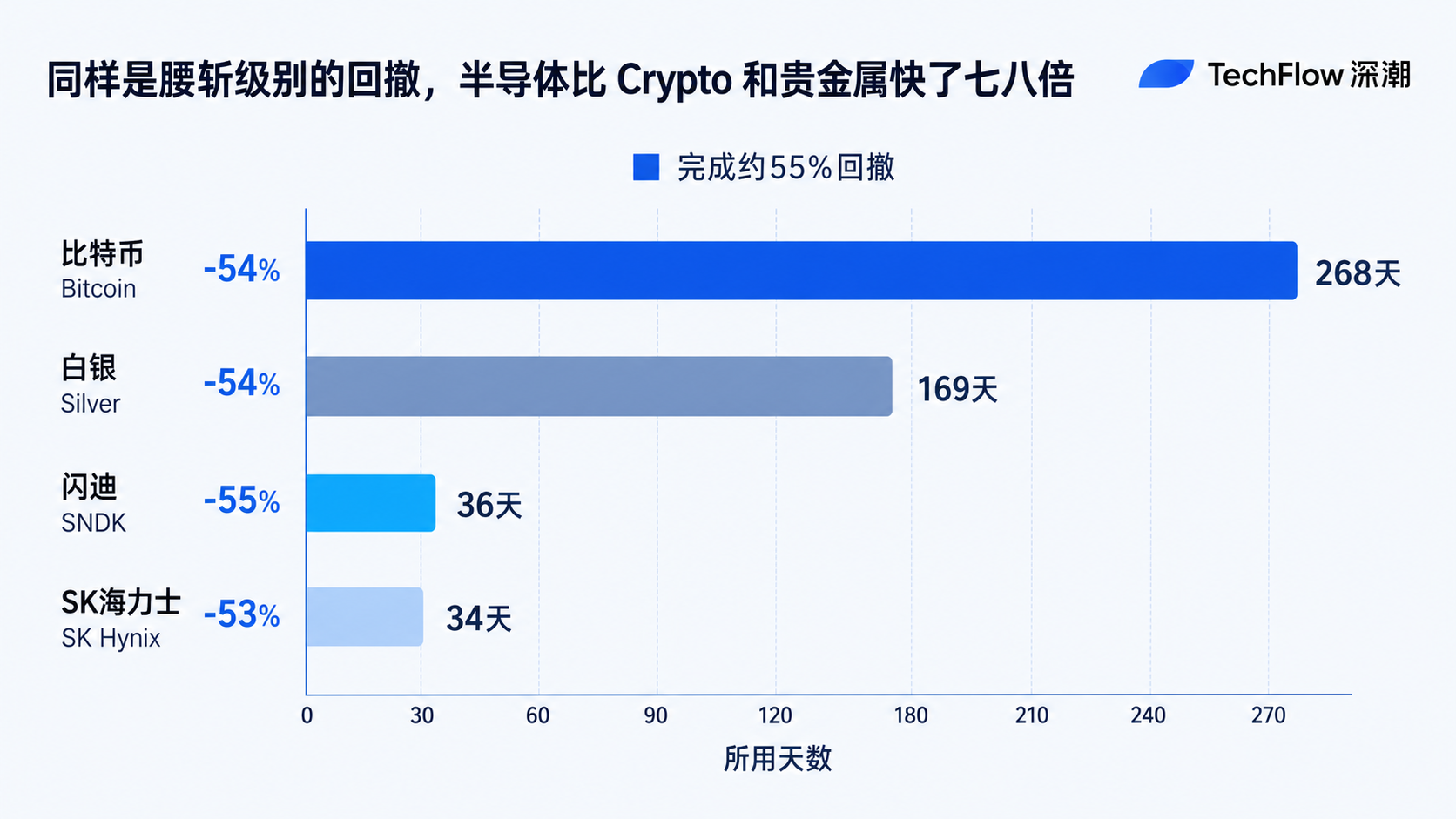
This is the paradox of this market cycle: in the past, investors worried that Bitcoin would soar or plummet within days, while stocks adjusted gradually based on profits and valuations; now, some tech stocks are completing a full cycle of bubble bursting in a shorter time than cryptocurrencies.
It is counterintuitive; compared to some tech stocks, Bitcoin is becoming relatively stable.
Charles Schwab's statistics show that Bitcoin's historical volatility in 2025 is around 42%, with a maximum drawdown of about 32%; during the same period, Tesla's volatility is about 63%, with a maximum drawdown of 48%, and NVIDIA's volatility is around 50%, with a maximum drawdown of 37%.
Bitcoin remains a high-risk asset; it is just that some large tech stocks are more volatile.
Bitwise even predicted in its 2026 outlook that Bitcoin's overall volatility might continue to be lower than NVIDIA's.
Thus, the current situation is quite absurd: Bitcoin is increasingly resembling tech stocks, while tech stocks are increasingly resembling Bitcoin.
When Narratives Become Valuation Anchors
There is an old saying in the cryptocurrency world: trading crypto is about trading narratives.
In 2026, global tech stocks are making this statement a reality.
AI is certainly not a mirage; NVIDIA, Microsoft, Google, and major cloud computing companies have real revenues and are investing real money into building data centers.
However, the gap between “AI will indeed create value” and “any company associated with AI is worth buying at any price” is a long one.
During the hottest market phases, this gap was directly overlooked by the market.
AI servers, optical modules, storage chips, data centers, power equipment, and even nuclear energy companies can see their stock prices soar as long as they can be included in the AI industry chain. Business plans are still in development, orders are yet to be finalized, but the market will price them according to the best outcomes several years down the line.
The story in Korea is “AI semiconductors are tied to national fortune.” As KOSPI continues to reach new highs, more and more families are opening stock accounts for their underage children, treating popular stocks like Samsung Electronics and SK Hynix as long-term gifts.
A-shares have shown a similar concentration. In the first half of 2026, the TMT sector reached a market capitalization of 41.78 trillion yuan, accounting for about 31.45% of the total A-share market value; on certain trading days, the tech sector's trading volume approached half of the entire market.
The U.S. market has long been priced around a few large tech companies. As the index's gains increasingly rely on a handful of companies, when funds, options, and retail investors flock to the same group of stocks, what seems like a diversified investment portfolio is actually betting on the same AI story.
This resembles the cryptocurrency market of the past; the massive rise of Dogecoin in 2021 was not due to a technological breakthrough but because Musk tweeted about it. Similarly, the surge in tech stocks in 2026 was not because all companies had skyrocketing performance, but because ChatGPT made everyone believe that “AI will rewrite everything.”
The speed at which narratives can dominate the market is also aided by changes in communication methods.
In the past, stock information primarily came from financial reports, research papers, and institutional roadshows. Today, an increasing number of people's investment decisions come from YouTube, X, short videos, and paid communities.
Complex company analyses are condensed into a few sentences: Time will prove that computational power and optical modules, AI computing power will never be enough...
Social media algorithms do not reward caution; getting rich overnight is always the key to engagement: some doubled their money overnight through options, while workers achieved financial freedom by heavily investing in storage stocks, and some made years' worth of salary in just months using leveraged ETFs.
K-lines are the best publicity; many mothers and older women started to invest their savings, with some even selling their homes to trade stocks, just like a few years ago when a group of students dropped out to go all in on Web3...
Leveraged Mania
The most terrifying aspect of the cryptocurrency market is not volatility, but the deadly combination of leverage and volatility, which is being perfectly replicated in the global stock market of 2026.
On May 27, 2026, the Korean exchange approved the launch of 16 double-leveraged ETFs linked to individual stocks, specifically targeting Samsung Electronics and SK Hynix.
Retail investors went wild. From approval until mid-July, Korean retail investors cumulatively net bought 14 trillion won (about 64 billion yuan) of single-stock leveraged ETFs, while foreign investors bought only about 2 trillion won during the same period.
These ETFs have several fatal design flaws.
Such products readjust their positions daily. The more volatile the market, the more pronounced the loss in net value. Assuming a stock drops 10% and then rises 11.1%, the price can return to its original point; however, the corresponding 2x leveraged product would first drop 20% and then rise 22.2%, ultimately still suffering a loss of about 2.2%.
In a rapid decline, the problem becomes even more severe.
To maintain the target leverage, products need to passively reduce their risk exposure after a downturn. Selling further depresses the underlying price, and a price drop triggers more liquidations, stop-losses, and margin pressures.
Goldman Sachs later pointed out that this wave of products “quickly de-leveraging” was the main cause of KOSPI's intraday abnormal fluctuations, with 62% of net selling by institutions coming from ETF-related liquidations.
Two months later, Korean regulators urgently halted the launch of all new individual stock leveraged ETFs, significantly raising the minimum margin from 10 million won to 30 million won, and only accepting cash.
But it was too late, with 2.3 trillion won in forced liquidations, the wealth of hundreds of thousands of households vanished into thin air.
Even in the deepest U.S. stock market, it is experiencing the backlash of leverage.
JPMorgan analysts recently noted that there is still “room for de-leveraging” in the U.S. stock market, requiring three months to recover to levels before April.
The scale of leveraged ETFs linked to storage chip stocks versus their underlying market capitalization is three times the average level of all stock ETFs. Even the overall leveraged stock index ETFs are relatively high compared to their own historical levels.
A Regression
“The stock market becoming like the cryptocurrency market” does not mean that stocks are now completely the same as cryptocurrencies.
Behind stocks are still companies, assets, revenues, and cash flows, along with financial disclosures, audits, and regulations. Even when market sentiment fades, a genuinely profitable company still has calculable value.
The real change is at the trading level.
In the past, people purchased a company’s future profits; now, more and more people are trading the heat of a theme.
The stock market becoming like the cryptocurrency market is essentially a revolution of de-rationalization.
Traditional stock markets look at PE ratios, cash flows; the cryptocurrency-like stock market looks at narratives and imagination; traditional stock market volatility of 20% is considered high, while in the cryptocurrency-like stock market, individual stocks fluctuating 10% to 15% in a single day is the norm.
Traditional stock leverage is obtained through margin trading, whereas the cryptocurrency-like stock market uses ETFs, derivatives, and quantitative strategies; traditional stock market information comes from research reports and financial reports, while the cryptocurrency-like stock market information comes from Twitter, YouTubers, and communities; traditional stock markets have institutions rationally pricing, while in cryptocurrency-like stock markets, institutions behave like retail, engaging in quantitative buying and selling...
Ironically, Bitcoin is now trying hard to become like stocks, through ETFs, institutionalization, and decreasing volatility, gradually being accepted by mainstream finance.
This is an absurd crossroads.
Those who transitioned from the cryptocurrency world to the stock market ultimately find that they have not left their “origin family”; it is a mechanism that keeps repeating: grand narratives, crowded positions, easily obtainable leverage, and everyone believing they can exit before others.
The phrase written by Korean retail investors on trading forums is worth remembering by everyone: I want to go back to the days before stock trading and have my money returned to me.
But markets never offer refunds.
免责声明:本文章仅代表作者个人观点,不代表本平台的立场和观点。本文章仅供信息分享,不构成对任何人的任何投资建议。用户与作者之间的任何争议,与本平台无关。如网页中刊载的文章或图片涉及侵权,请提供相关的权利证明和身份证明发送邮件到support@aicoin.com,本平台相关工作人员将会进行核查。


