After looking at the future once: The rise, decline, and end of BitMEX.
Written by: KarenZ, Foresight News
In 2018, BitMEX rented the entire 45th floor of the Cheung Kong Center in Hong Kong for HKD 4.52 million per month.
Just a few months prior, BitMEX was operating in a logistics and warehousing area across Victoria Harbour, with a sparse office setup. At that time, according to a report by Bloomberg, the old office had a monthly rent of about HKD 25 per square foot. After moving into the Cheung Kong Center, the office area expanded to around 20,000 square feet, with a monthly rent reaching HKD 225 per square foot, setting a record for office rents in Hong Kong at the time.

Cheung Kong Center in Central. Image source: Hong Kong 01
Arthur Hayes was a trader laid off by Citigroup. Thus, he moved into a building housing Goldman Sachs, Barclays, and Bank of America with a crypto company challenging the banking system.
That was the moment BitMEX was closest to its peak. In November 2018, the platform's daily trading volume was close to 2 million bitcoins; by May 2019, the daily trading volume reached USD 11 billion. With leverage up to 100 times and perpetual bitcoin trading with no market closure, it was rewriting the global derivatives market.
However, the office that once embodied BitMEX’s ambition ultimately only witnessed its most glorious years. According to Hong Kong 01 reported, during the pandemic, in 2022, BitMEX subleased the entire floor to the shared office operator The Great Room with a year left on the original lease.

The Great Room rented the space at a monthly rent of HKD 3.2 million earlier. Image source: Hong Kong 01
After BitMEX left, the 45th floor entered another chapter unrelated to it in its leasing history. The Great Room was originally contracted until 2028 but exited about a year later. The landlord, Cheung Kong Property Holdings, took over the space, and despite lowering the rent twice, was still unable to find a tenant. Eventually, it reused the existing renovation and switched to a shared office model for leasing, with flexible desks starting at HKD 4,000 per month.
BitMEX's own end came four years later. On July 23, 2026, BitMEX announced it would close the exchange and cease new account registration. Starting August 26, the platform would enter a "reducing positions only" phase and begin addressing open positions. The final closure was set for September 23. BitMEX stated that based on the reserves and liabilities reported by the platform, the company's assets exceeded customer liabilities, and there had been no loss of user funds due to hacking during its more than eleven years of operation. These were BitMEX's statements about its financial and security situation.
Arthur Hayes later wrote a farewell message: "Thank you to my partners, the employees of BitMEX, and most importantly—our customers. It’s been an amazing journey, and we’ve accomplished something special together. I am extremely proud of everything we have created and for how we can responsibly close in our own way. To hell with traditional finance (TradFi), to hell with banks, to hell with the authorities. Satoshi lives on!”
In contrast, the perpetual contracts created by BitMEX did not exit with it. This product has already become a core tool for global crypto trading. Less than two months before BitMEX announced its closure, the CFTC approved bitcoin perpetual contracts to enter the US regulated market.
Products moved into the mainstream, but the platform that invented them became history. Why, exactly, did BitMEX, which once defined the crypto derivatives market, come to an end?
Invention: Those abandoned by the banks decide to challenge the banks
In 2008, after graduating from Wharton School, Arthur Hayes came to Hong Kong, working in stock derivatives trading at Deutsche Bank and Citigroup.
That year, the global financial crisis erupted. Banks began layoffs and cut risks, and the once bustling trading floors gradually lost their vigor. What fascinated Arthur Hayes was precisely the speed, competition, and the excitement brought by the flow of money. In 2013, he was laid off by Citigroup. It was during that time that he noticed bitcoin.
The bitcoin market at that time was very primitive: exchanges often crashed, there were huge price differences between regions, and investors mainly engaged in spot buying and selling. Traditional finance had futures, options, and mature risk-hedging tools, while the crypto market resembled an unpaved financial wasteland.
Ordinary people saw danger; Arthur Hayes saw a market gap.
In 2014, he partnered with Ben Delo and Samuel Reed to establish the Bitcoin Mercantile Exchange, abbreviated as BitMEX. Arthur Hayes understood trading and market structure; Ben Delo excelled at developing trading systems; Samuel Reed was familiar with bitcoin technology. The three did not set up another ordinary spot trading exchange but aimed to bring leverage and derivatives used by professional institutions to global crypto traders.

The original trading interface shot in Dubrovnik, Croatia on November 24, 2014, when BitMEX officially launched. Image source:BitMEX

The original BitMEX launch on November 24, 2014, photographed in Hong Kong. Image source:BitMEX
The product that truly changed BitMEX's fate did not appear until 2016.
Traditional futures have expiry dates, and traders must close their positions before expiration or transfer their positions to the next contract. But since bitcoin trades 24 hours a day, seven days a week, why must its most important derivatives artificially end every few months?
BitMEX's answer was the XBTUSD perpetual swap.
It resembles futures but has no fixed expiry date. To prevent the contract price from deviating significantly from the bitcoin spot price for an extended period, longs and shorts periodically exchange a funding fee: when the contract price is above the spot, longs usually pay shorts; when it is below the spot, the reverse occurs.
The theoretical concept of perpetual futures existed previously, but it wasn't until May 2016 that BitMEX first made it a mainstream product in the crypto market and pushed leverage to 100 times in one go.
In the market where trading never stops, BitMEX created a contract that never expires, thereby opening the most insane decade for crypto derivatives.
Rising to the top: Installing perpetual leverage on bitcoin
According to Arthur Hayes's later recollection, the launch of XBTUSD was not smooth. The initial funding rate relied on the external market's borrowing rates for dollars and bitcoins, which could not quickly absorb the one-sided demand to go long in a bull market, causing the contract price to continue to be above spot. Complaints from users were constant, and there were even internal opinions at BitMEX to terminate the product. The team then changed to calculating the funding rate based on the premium index of the past 8 hours’ price difference, and the perpetual contract gradually returned to near the spot price.
Once the product operated normally, the network effect of the exchange began to take effect.
The more traders there are, the deeper the order book; the deeper the order book, the more willing big funds are to enter; greater trading volume attracts more market makers and users. The 100 times leverage added the most dangerous yet enticing fuel to this mechanism.
In theory, a trader only needs to put up USD 1 in margin to control a position worth USD 100. If the price moves in the right direction by 1%, the principal could double quickly; if it fluctuates less than 1% in the opposite direction, the position could also be liquidated.
Perpetual contracts are, of course, not just tools for amplifying bets. Traders holding spot can use it to hedge short-term price risks; market makers can hedge their inventory exposure, while arbitrageurs seek price differentials between spot, perpetual prices, and funding rates. However, due to the constantly changing funding cost, it may not be suitable for all hedging scenarios; if one wants to lock in the price on a specific date, delivery contracts are often more direct.
BitMEX compressed the distance between getting rich and going to zero into a single candlestick.
By 2017, according to Bloomberg citing BitMEX data at the time, the company achieved approximately USD 83 million in revenue in 2017; in the previous 12 months up to the end of January 2018, the platform received orders with a nominal value exceeding USD 200 billion. On June 27, 2019, BitMEX again set a record: the XBTUSD open interest surpassed USD 1 billion, with a daily trading volume exceeding USD 13 billion, and the platform's total daily trading volume exceeded USD 16 billion.
A few days later, Hayes publicly debated bitcoin with “Dr. Doom” Nouriel Roubini in Taipei. The two clashed on stage while the crypto industry in the audience regarded this debate as the decisive battle between traditional finance and crypto finance.
At that time, Hayes had enough confidence to mock the banks. Wall Street required business hours, identity verification, and layers of intermediaries, while BitMEX allowed users from around the world to trade bitcoin with high leverage at any time.
Stalling: Growth shortcuts turned into debt, everyone learned BitMEX
BitMEX's early growth came not only from perpetual contracts but also from the way it almost eliminated the barriers to account opening.
The criminal prosecution documents submitted later by the U.S. Department of Justice record that BitMEX's website explicitly stated on its promotional page in 2015 that "users do not need to provide real names or undergo advanced identity verification. Before August 2020, individual users generally only needed to verify their email; they did not have to submit names, ID documents, or address proof to deposit and trade."
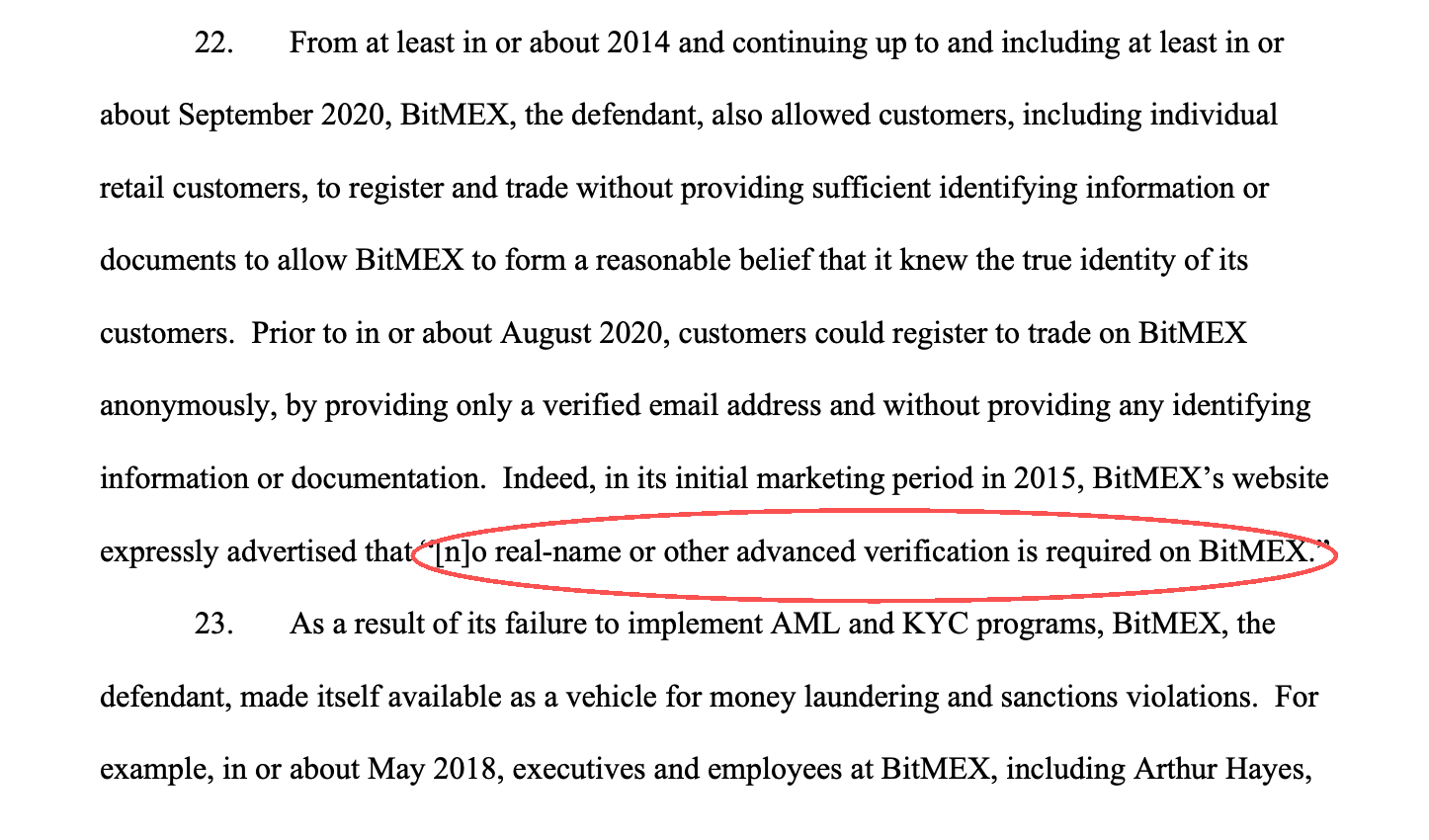
This set of rules was very suitable for the crypto market at that time. Traditional financial accounts might take several days to complete the review, but BitMEX compressed registration, depositing bitcoin, and establishing high leverage positions to an extremely short time.
Traders saw freedom and efficiency, while the platform achieved rapid growth; regarding who was behind the accounts and whether they came from restricted areas, that was left for later handling.
This was a shortcut, but also a regulatory debt postponed.
It should be noted that BitMEX later made up for the identity verification. In August 2020, the company announced the launch of a user verification program; starting September 15 of that year, new users had to complete identity verification to deposit and trade. By December 4, all users must complete verification to deposit, trade, or withdraw.
However, before the verification program was fully completed, regulatory accountability had already arrived. On October 1, 2020, the Commodity Futures Trading Commission (CFTC) filed a civil lawsuit against the five companies operating BitMEX as well as Arthur Hayes, Ben Delo, and Samuel Reed. The court subsequently agreed to order determining that from at least November 2014 to October 1, 2020, BitMEX provided leveraged crypto derivatives to traders, including U.S. customers, without obtaining the necessary registration and without establishing compliant customer identification, KYC, and anti-money laundering systems.
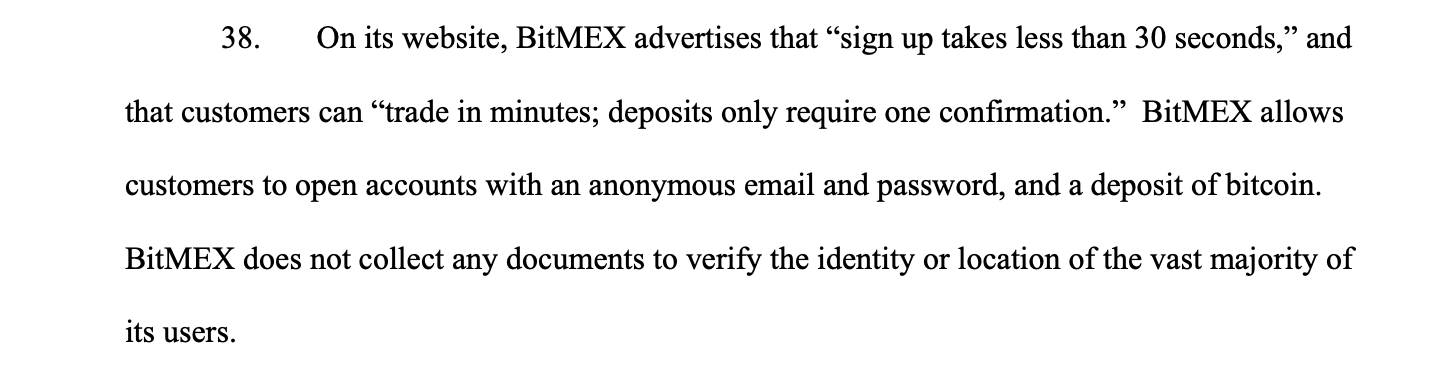
CFTC indictment PDF page 13
On August 10, 2021, the Federal Court for the Southern District of New York approved a consent order, imposing a USD 100 million civil fine on the relevant BitMEX entities. This fine had a set-off arrangement with the penalty announced the same day by the Financial Crimes Enforcement Network (FinCEN). According to FinCEN's explanation, the overall settlement between the CFTC and FinCEN required BitMEX to immediately pay USD 80 million, with another USD 20 million deferred contingent on completing transaction backtracking and compliance corrections.
Hayes and Delo pleaded guilty in February 2022 for failing to establish and maintain an effective anti-money laundering system and agreed to pay a USD 10 million criminal fine. In May of the same year, the CFTC requested Arthur Hayes, Benjamin Delo, and Samuel Reed to each pay a USD 10 million civil fine. Hayes was later sentenced to two years probation, including six months of home detention.
On July 10, 2024, BitMEX's operating entity HDR Global Trading Limited pleaded guilty to the charge of violating the Bank Secrecy Act, admitting to willfully failing to establish, implement, and maintain adequate anti-money laundering systems. In January 2025, the company was fined USD 100 million and subjected to judicial oversight for the subsequent two years. This was a criminal judgment independent of the civil settlement in 2021.
However, BitMEX's legal situation then underwent a turnaround. In March 2025, U.S. President Trump granted clemency to HDR Global Trading Limited, as well as Arthur Hayes, Benjamin Delo, Samuel Reed, and Gregory Dwyer.
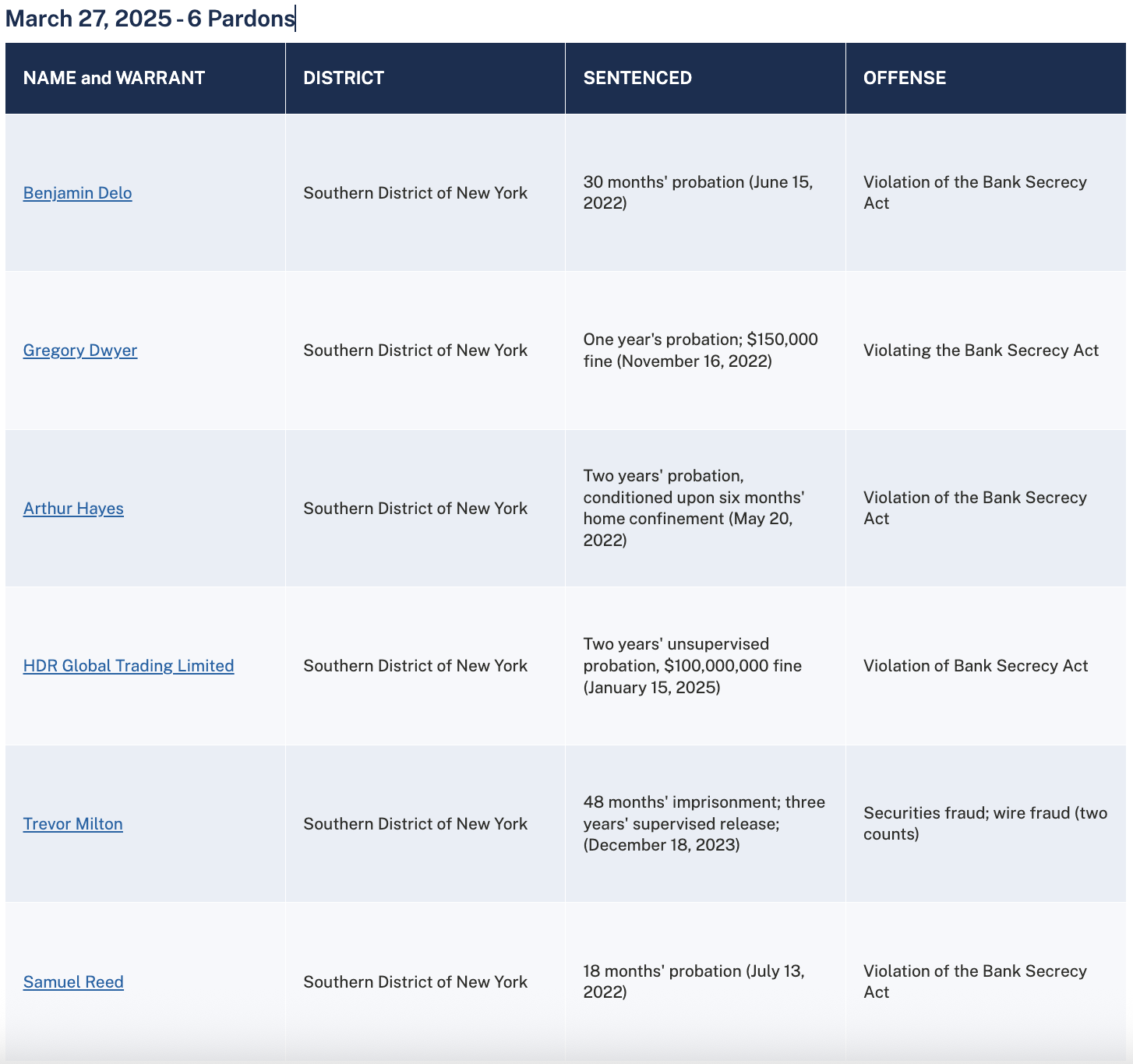
On March 27, 2025, Trump granted clemency to the entity operating BitMEX and the four associated individuals. Image source: U.S. Department of Justice
The clemency ended the penalties resulting from relevant criminal convictions, but it did not mean that all previous regulatory penalties were wiped out. Fines and settlements already paid would not be automatically refunded, and civil penalties imposed by the CFTC and FinCEN would not be revoked due to presidential clemency.
In other words, BitMEX could not recover the operational costs it incurred previously. From the outbreak of the case in 2020 to the clemency obtained in 2025, BitMEX experienced the founders exiting management, rising compliance costs, brand damage, and loss of market share. Within five years, competitors had taken over the market it once occupied. While the legal situation could change, the missed competitive window was hard to reopen.
What was even more troublesome was that while BitMEX was repaying its regulatory debt, another change had occurred: everyone had learned BitMEX. Its product advantages were rapidly disappearing.
Perpetual contracts were not technically exclusive forever. Once their funding rates, mark prices, and liquidation mechanisms were validated by the market, other exchanges could launch similar products and compete for liquidity by leveraging their own spot users, asset variety, and funding channels.
In September 2019, Binance launched its futures business. By December of that year, a CryptoCompare report showed that its monthly trading volume for bitcoin perpetual contracts had reached USD 29.4 billion. Of course, BitMEX's similar products still led with USD 53.1 billion, but the gap between the two was rapidly narrowing.
By 2020, the market gave a clearer answer. CoinGecko statistical data showed that the top nine platforms' annual transaction volume of bitcoin perpetual contracts reached USD 3.5 trillion, a year-on-year increase of 531%. However, under this statistical caliber, BitMEX's transaction share dropped from 44% in January to 9% in December; Binance replaced it as the market leader, maintaining a market share between 30% and 40%; Huobi, which launched its perpetual contracts business in 2020, accounted for 22% by the end of the year.
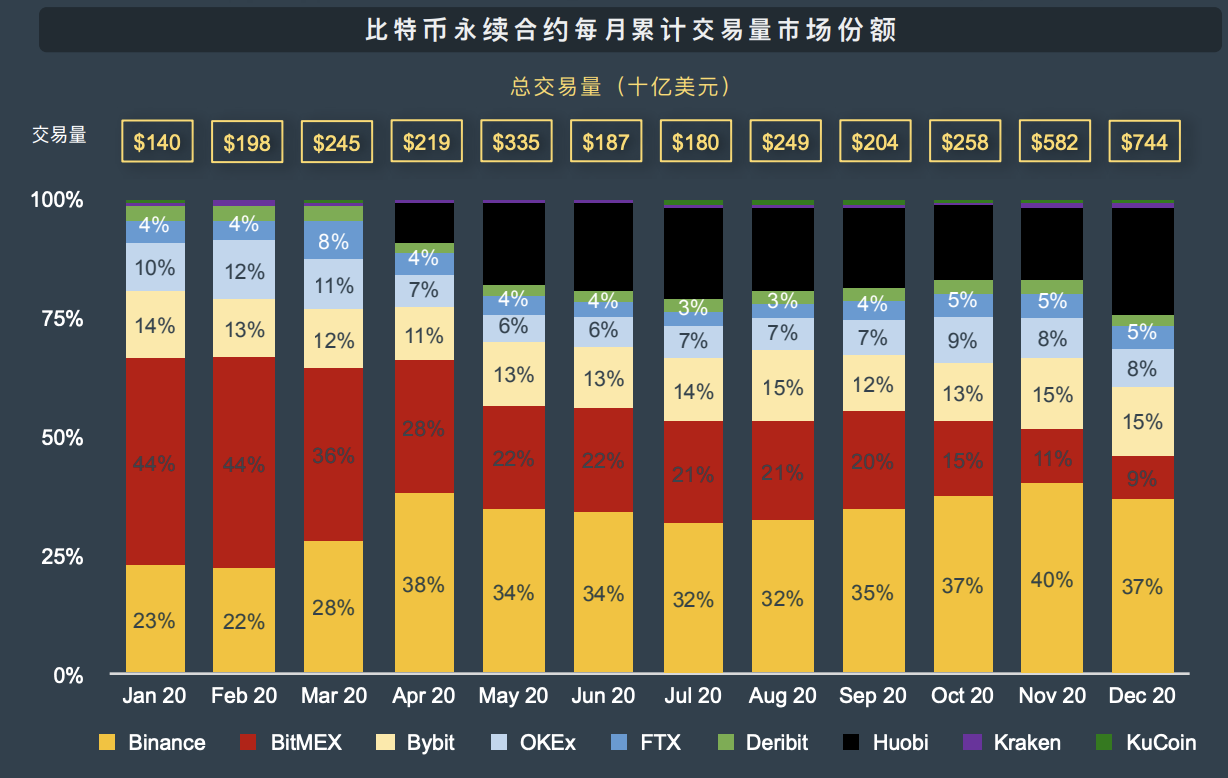
Source: CoinGecko
An asymmetry formed: perpetual contracts became the industry standard, with the differences brought by innovation gradually disappearing; while the compliance costs left by early low-threshold expansion still remained on BitMEX's own balance sheet.
Competitors imitated its products, and BitMEX was left with its own bill.
Divergence: BitMEX trapped in an old cycle, Hayes betting on the next round
In October 2020, the U.S. Department of Justice and the CFTC filed lawsuits against BitMEX and relevant officials. A week later, on October 8, Arthur Hayes and Samuel Reed left their CEO and CTO positions, respectively, and Ben Delo also exited the executive management of the parent company 100x Group.
From then on, the three founders no longer managed the day-to-day operations of BitMEX.
BitMEX did not immediately decline. On the contrary, the new management tried to rebuild the exchange through compliance and expansion.
In April 2021, BitMEX proposed the "Beyond Derivatives" strategy, planning to expand from a single derivatives platform to five business lines: spot, brokerage, custody, information products, and Academy.
Subsequently, BitMEX launched its spot market in May 2022 and opened trading for its platform token BMEX in November that year. It even planned to acquire a nearly 270-year-old German private bank, Bankhaus von der Heydt, hoping to establish a regulated crypto finance gateway in Europe.
However, the battle for comprehensive exchanges was more intense than that for professional derivatives markets. Platforms needed to compete for projects, market makers, user entry points, and global licenses, while also continuously subsidizing trades and attracting new users. According to Finanz-Szene, BitMEX's acquisition of the German bank ultimately did not materialize.
Additionally, BitMEX underwent multiple rounds of layoffs in 2022 and then abandoned the "Beyond Derivatives" strategy, refocusing on derivatives again.
It took a reluctant circle: leaving derivatives because focusing solely on them was no longer sufficient; returning to derivatives because becoming an integrated exchange was even more challenging.
By the time it returned to the derivatives arena, the competition had already filled the field it had once occupied. These competitors adopted the perpetual contract mechanisms validated by BitMEX while possessing more spot users, richer assets, and deeper liquidity.
After BitMEX returned to derivatives, the situation did not stabilize. More than two years later, news of its seeking to sell emerged. According to CoinDesk in February 2025 disclosed, BitMEX had already commissioned the investment bank Broadhaven Capital Partners to find buyers by the end of 2024.
During the same period (May 2025), the crypto options platform Deribit was acquired by Coinbase for approximately USD 2.9 billion (the transaction was completed in August). Deribit, relying on its invaluable options liquidity, became an important piece for large compliant exchanges; whereas BitMEX did not disclose finding a buyer.
By the end of June 2026, CoinDesk reported that BitMEX CEO Stephan Lutz had resigned, along with the CFO and head of growth leaving the company. Less than a month later, BitMEX announced its closure.
On the other hand, Arthur Hayes took a different path.
In October 2020, after stepping down as CEO, Arthur Hayes gradually shifted from exchange operator to macro writer and investor. He continued to follow the direction of funds through long articles, analyzing the liquidity from the Federal Reserve, yen arbitrage trades, to the cycles of bitcoin, stablecoins, and altcoins.
Meanwhile, he brought his family office Maelstrom to the forefront, with investments covering early equity, tokens, secondary markets, and private equity. In 2025, Maelstrom planned to raise at least USD 250 million for a newly established private equity fund aimed at acquiring medium-sized crypto infrastructure and service firms.
Arthur Hayes used to build trading platforms and design market mechanisms himself; now, he resembles more of a capital allocator, searching for projects that might constitute the next generation of markets. The questions he focuses on remain unchanged: where will the funds flow, and what kind of infrastructure can accommodate the next round of cycles?
When BitMEX emphasized its pioneering 100 times leverage perpetual contracts anew in the closure announcement, this divergence had become quite clear: one is still seeking how the next market will form, while the other can only conclude its history with the inventions left behind from the last round.
Finale: BitMEX arrives at its expiry date
In May 2026, the U.S. Commodity Futures Trading Commission took a historic step by opening a door to crypto asset perpetual contracts and approved the launch of BTCPERP on KalshiEX the same day. CFTC Chairman Michael Selig stated that the U.S. would continue to lead this new financial field of crypto asset perpetual contracts.
Previously, the U.S. had not provided a clear, viable regulatory entrance for crypto perpetual contracts. As a result, trading demand flowed to offshore platforms, with liquidity and risks pushed out of the U.S. regulatory view.
This policy change left BitMEX with a somewhat ironic ending. BitMEX's downfall cannot be attributed to a single mistake. Regulatory debts interrupted the growth cycle; competitors copied the product and took users away with stronger traffic and ecosystems; the company repeatedly adjusted between diversification and returning to derivatives and failed to create a second XBTUSD.
It did not misjudge the future; it simply saw the future correctly only once.
This may be the most ironic ending for BitMEX: a trading platform famous for high leverage ultimately liquidated itself in an orderly manner.
References:
https://www.bloomberg.com/news/features/2018-02-01/bored-with-banking-this-former-citi-trader-went-full-crypto
https://www.bitmex.com/blog/decade-of-bitmex
https://www.bitmex.com/blog/bitmex-technology-scaling-part-2-the-road-to-100x
https://www.bitmex.com/blog/adapt-or-die
免责声明:本文章仅代表作者个人观点,不代表本平台的立场和观点。本文章仅供信息分享,不构成对任何人的任何投资建议。用户与作者之间的任何争议,与本平台无关。如网页中刊载的文章或图片涉及侵权,请提供相关的权利证明和身份证明发送邮件到support@aicoin.com,本平台相关工作人员将会进行核查。


