Author: Zhou, ChainCatcher
Recently, Crypto.com announced that it has received a $400 million strategic investment from Citadel Securities, valuing the company at $20 billion. The funds will be used to expand its business in tokenized securities, derivatives, and other asset classes.
This is another significant investment from Citadel in the cryptocurrency space in the past year. In February 2025, one of the largest market makers in the U.S. stock market was reported to plan to enter the crypto market, and has already invested in Ripple through its affiliated fund and in Kraken directly.
If we only look at the investment moves, Citadel seems to be quickly embracing the crypto market. But on the other hand, it has expressed a fairly clear regulatory stance before the SEC's crypto working group. It argues that tokenized U.S. stocks should be considered securities, and DeFi protocols trading such assets should not be given broad regulatory exemptions simply because they use on-chain technology.
This makes Citadel's crypto strategy appear somewhat contradictory. It is investing in crypto trading venues while opposing some DeFi trading models that sidestep traditional securities market rules.
Yet this seemingly contradictory stance directly points to the type of crypto that Citadel desires.
What Citadel has purchased in the crypto market
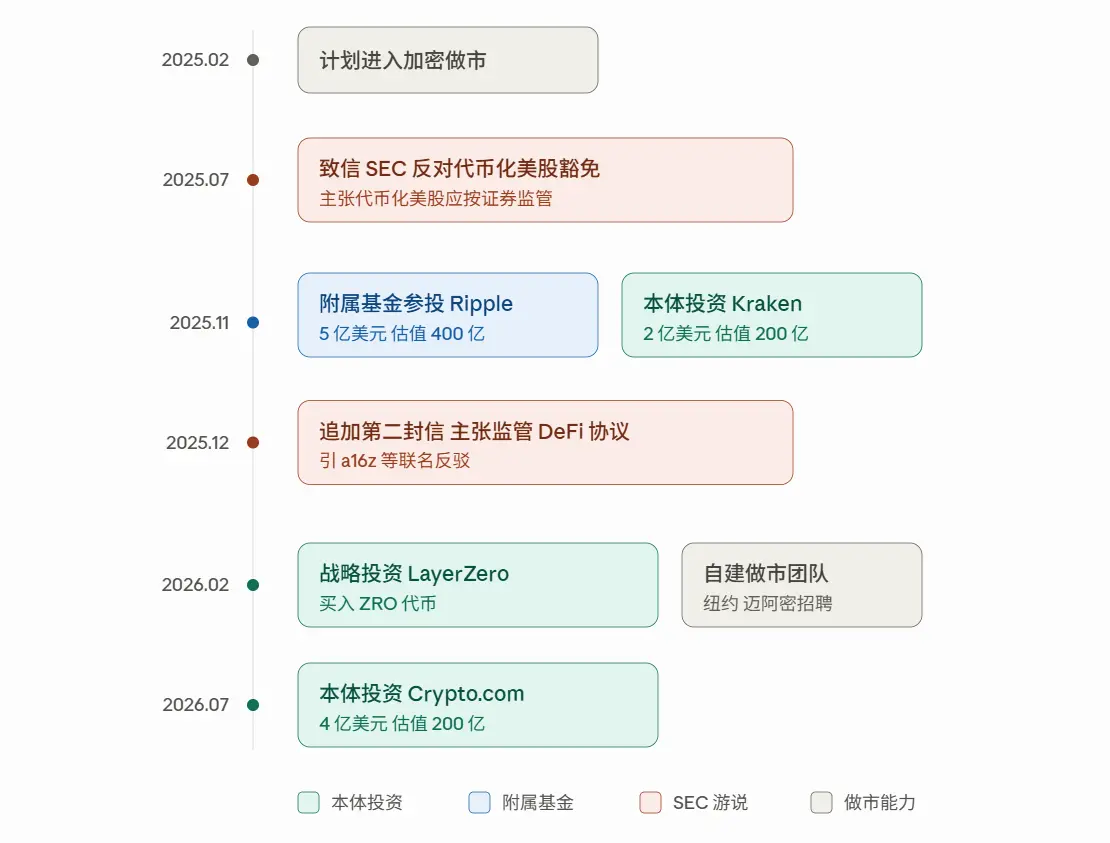
Citadel Securities has not been in the crypto market for long. In February 2025, according to Bloomberg, this market maker plans to join the market maker list of platforms such as Coinbase, Binance, and Crypto.com, and may initially form a market-making team outside the United States.
In the following year, its actions intensified.
In November 2025, Ripple completed a $500 million financing round with a valuation of $40 billion, with Citadel Securities' affiliated fund participating as the lead investor. In the same month, Citadel Securities invested $200 million in the crypto exchange Kraken, which had a valuation of $20 billion. In July 2026, it invested $400 million in Crypto.com.
The investment in Ripple was made by the affiliated fund, while the investments in Kraken and Crypto.com were made by Citadel Securities itself. The targets of these three investments are not the same, but they all fall on the more infrastructure-oriented side of the crypto market, that is, trading platforms, payment settlement, and institutional liquidity gateways.
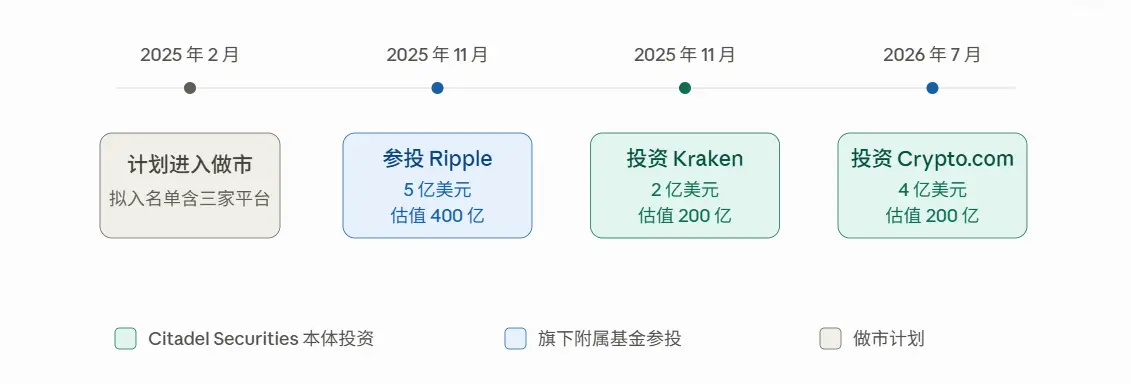
Putting the amounts back into the context of Citadel Securities' scale illustrates their significance. According to a report from Bloomberg in March, Citadel Securities generated a record net trading revenue of $12.2 billion in 2025. The $400 million investment in Crypto.com represents about 3.3% of that figure, while the $200 million investment in Kraken is approximately 1.6%.
This kind of expenditure is more akin to a strategic positioning rather than a directional bet.
Apart from investments, Citadel Securities is also building its own crypto market-making capabilities. According to previous public information, starting from February 2026, Citadel Securities has been recruiting for crypto quantitative development and research positions in New York and Miami to build a low-latency trading system for the crypto market.
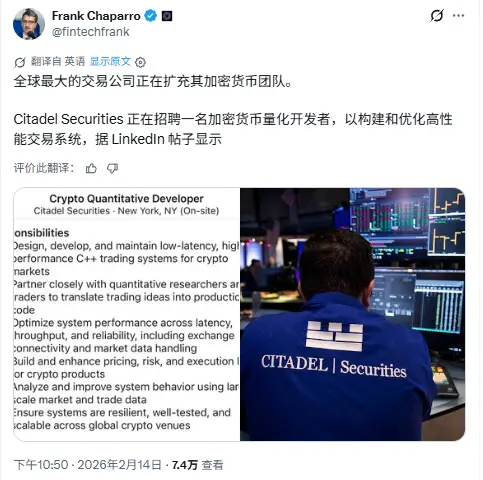
In other words, the trading platform positions it bought will ultimately serve its market-making desk.
Citadel Securities' involvement in institutional-level trading venues extends beyond investing in others; it is also one of the supporters of the crypto exchange EDX Markets.
It is reported that EDX Markets, supported by Charles Schwab, Citadel Securities, and Fidelity, in April applied to the U.S. Office of the Comptroller of the Currency for a national trust bank license to provide digital asset custody, asset management, and trading settlement. Its subsidiary EDXM International also plans to launch Korean won perpetual contracts products.
What is more telling of intention is its layout in the underlying infrastructure.
In February 2026, the cross-chain protocol developer LayerZero launched a Layer 1 blockchain named Zero, positioning itself as institutional-level financial infrastructure aimed at trading, clearing, settling, and tokenization scenarios. Citadel Securities made a strategic investment by purchasing its native token ZRO.
According to LayerZero, Citadel Securities' role in this collaboration is to contribute expertise in market structure and assess Zero's applications in trading, clearing, and settlement processes. Alongside it, U.S. securities settlement core institution DTCC, NYSE parent company ICE, Google Cloud, Ark Invest, and Tether appear behind this chain.
It is worth mentioning that it is not common for Citadel Securities to directly purchase tokens; its previous investments in Kraken and Ripple were made in equity forms. In the same period, BlackRock, Citadel Securities, and Apollo successively disclosed plans to purchase DeFi governance tokens.
CoinFund founder Brukhman commented that each entity is buying the token of the protocol it intends to use as infrastructure, which is essentially vendor binding rather than asset allocation. For many years, traditional financial institutions' exposure to crypto has been limited to equities and venture capital, and direct holding of tokens has been rare, breaking the norm this time.
It opposes the detachment of securities from regulation after being tokenized
Looking only at investment actions, Citadel Securities appears to be embracing crypto. But its statements at the regulatory level point in another direction.
In July 2025, Citadel Securities sent a letter to the SEC's crypto working group. According to the public letter's content, it argues that tokenized U.S. stocks should clearly comply with securities regulation, opposing broad exemptions for such products, characterizing related demands as self-serving regulatory arbitrage, and asserting that such practices do not constitute true innovation.
It is concerned that tokenized assets will divert liquidity from traditional markets, emphasizing that regulation should focus on market liquidity and investor protection.
Six months later, its stance tightened further.
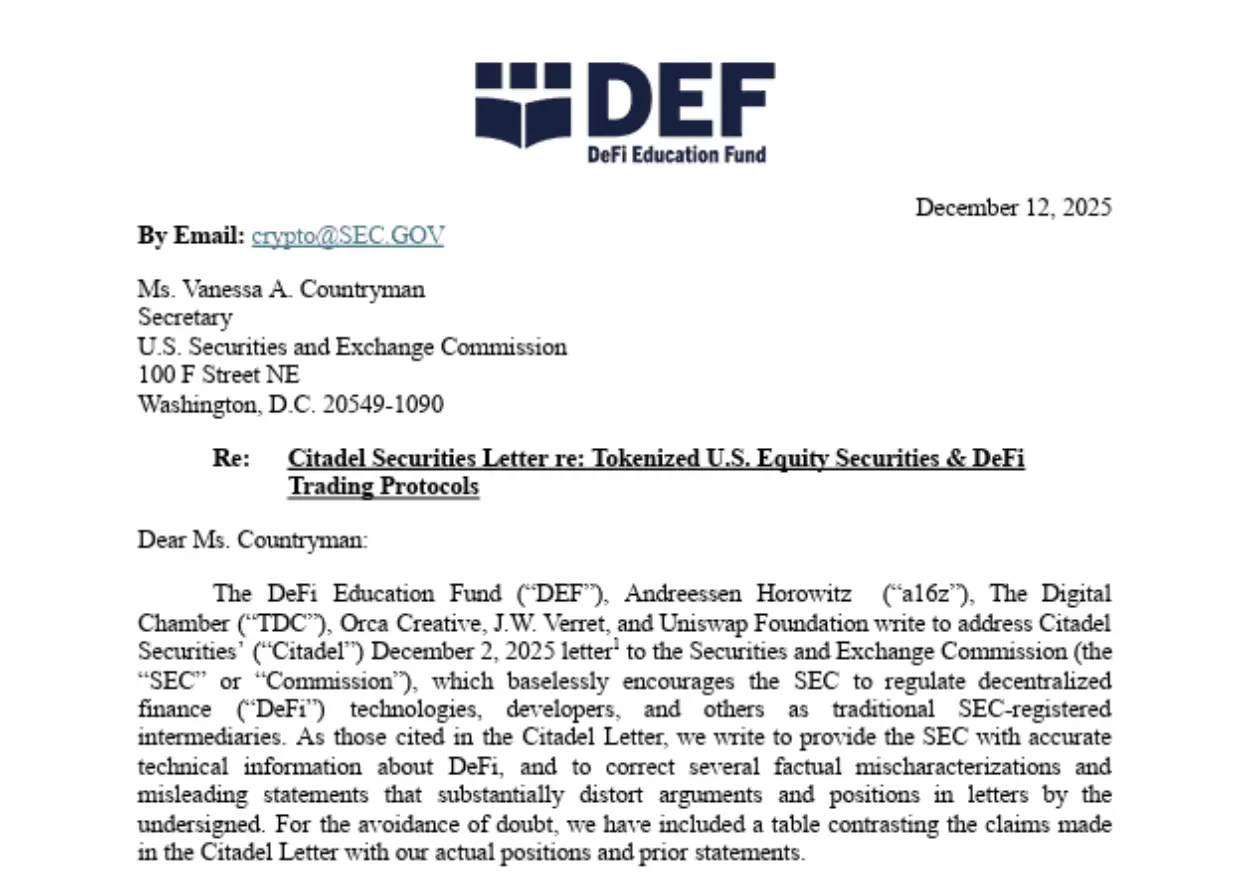
In December 2025, Citadel Securities submitted a lengthy 13-page letter to the SEC. According to the letter, it demanded that DeFi protocols trading tokenized U.S. stocks be included in the regulatory framework for exchanges and brokers, arguing that the same security should not be subject to two sets of rules due to differences in technical packaging or trading venues.
This letter immediately triggered a collective backlash from the DeFi camp. The DeFi Education Fund, a16z, the Digital Chamber of Commerce, Orca Creative, lawyer J.W. Verret, and the Uniswap Foundation jointly wrote to the SEC, refuting that Citadel Securities was trying to misclassify non-custodial software, developers, and on-chain infrastructure as traditional securities intermediaries, arguing that excessive regulatory expansion under the traditional intermediary framework could hinder open financial innovation.
DeFi Education Fund spokesperson Jennifer Rosenthal pointed out in response that the commercial logic behind this dispute lies in the fact that, for Citadel, questioning the existence of a technology that threatens its business and significant market share is quite convenient.
The controversy continued thereafter. In April 2026, the Blockchain Association submitted an opinion letter to the SEC in response to Citadel's call for intensified regulation, emphasizing that DeFi protocol developers do not fall under brokers or exchange operators, while also urging the SEC to advance an innovative exemption mechanism for on-chain assets.
The core of the disagreement lies in Citadel Securities emphasizing that the same security should be subject to the same rules, while the DeFi camp stresses that different technical architectures should not simply apply old intermediary regulations.
It is noteworthy that between the two letters, Citadel Securities made its investments in Ripple and Kraken. Investments were advancing while lobbying efforts were simultaneously ramping up.
More than one player is positioning itself in the crypto market structure
Citadel Securities' choices are not isolated cases. In recent months, Wall Street institutions have been increasingly specific about their entry into the crypto market, gradually focusing on trading entry points and market structure.
In March 2026, NYSE parent company ICE announced a strategic investment in crypto exchange OKX, valuing it at $25 billion, and secured a board seat. The two parties plan to establish a joint venture to provide tokenized NYSE stocks and ICE futures to OKX's 120 million users, pending approval from U.S. regulators.
Almost simultaneously, Nasdaq announced a partnership with Kraken's parent company Payward to develop a system for the issuance and distribution of tokenized stocks.
These types of布局 essentially fall within trading venues and market infrastructure, betting on who will build the structure of the crypto market.
At the same time, some are directing funds toward crypto asset exposure. In October 2025, Jane Street disclosed through a 13G filing that it held approximately 5% of each of the shares in three Bitcoin mining companies: Hut 8, Bitfarms, and Cipher Mining, all of which were passive trading positions. Almost simultaneously, Citadel founder Ken Griffin disclosed to the SEC that he personally held approximately 4.5% of Solana treasury company DeFi Development Corp.
Mining company stocks and treasury company stocks are aimed at the price elasticity of crypto assets. Citadel Securities is taking another path, investing from Kraken, Crypto.com to LayerZero, always focusing on the venues and structure itself.
As traditional exchanges, settlement institutions, and market makers converge on on-chain market structures, the ownership issue of tokenized securities is being defined ahead of time.
Conclusion
Returning to the investment in Crypto.com. For a market maker with annual trading revenue exceeding $12 billion, the $400 million price tag is not high, but it secures a position in the tokenized securities space.
On one hand, it sends a letter to the SEC asserting that tokenized securities must be regulated, while on the other hand, it acquires a platform ready to engage in tokenized securities business. Putting these two actions together outlines the type of crypto market that Citadel Securities envisions.
It does not oppose asset tokenization itself; what it truly cares about is that the rules after tokenization are still dominated by the traditional framework, and it has its own position at both ends of the rules and trading.
免责声明:本文章仅代表作者个人观点,不代表本平台的立场和观点。本文章仅供信息分享,不构成对任何人的任何投资建议。用户与作者之间的任何争议,与本平台无关。如网页中刊载的文章或图片涉及侵权,请提供相关的权利证明和身份证明发送邮件到support@aicoin.com,本平台相关工作人员将会进行核查。


