OUSD may not be the last straw that breaks Circle, but it clearly outlines the next phase of the game's rules in the industry: whoever controls the distribution channels controls the pricing power.
Author: Web3 Little Pig
Introduction
On June 30, 2026, the independent entity Open Standard, together with over 140 institutions including Visa, Mastercard, American Express, Stripe, BlackRock, BNY, Standard Chartered, Coinbase, Ripple, Google, Shopify, announced the launch of the dollar stablecoin Open USD (OUSD).
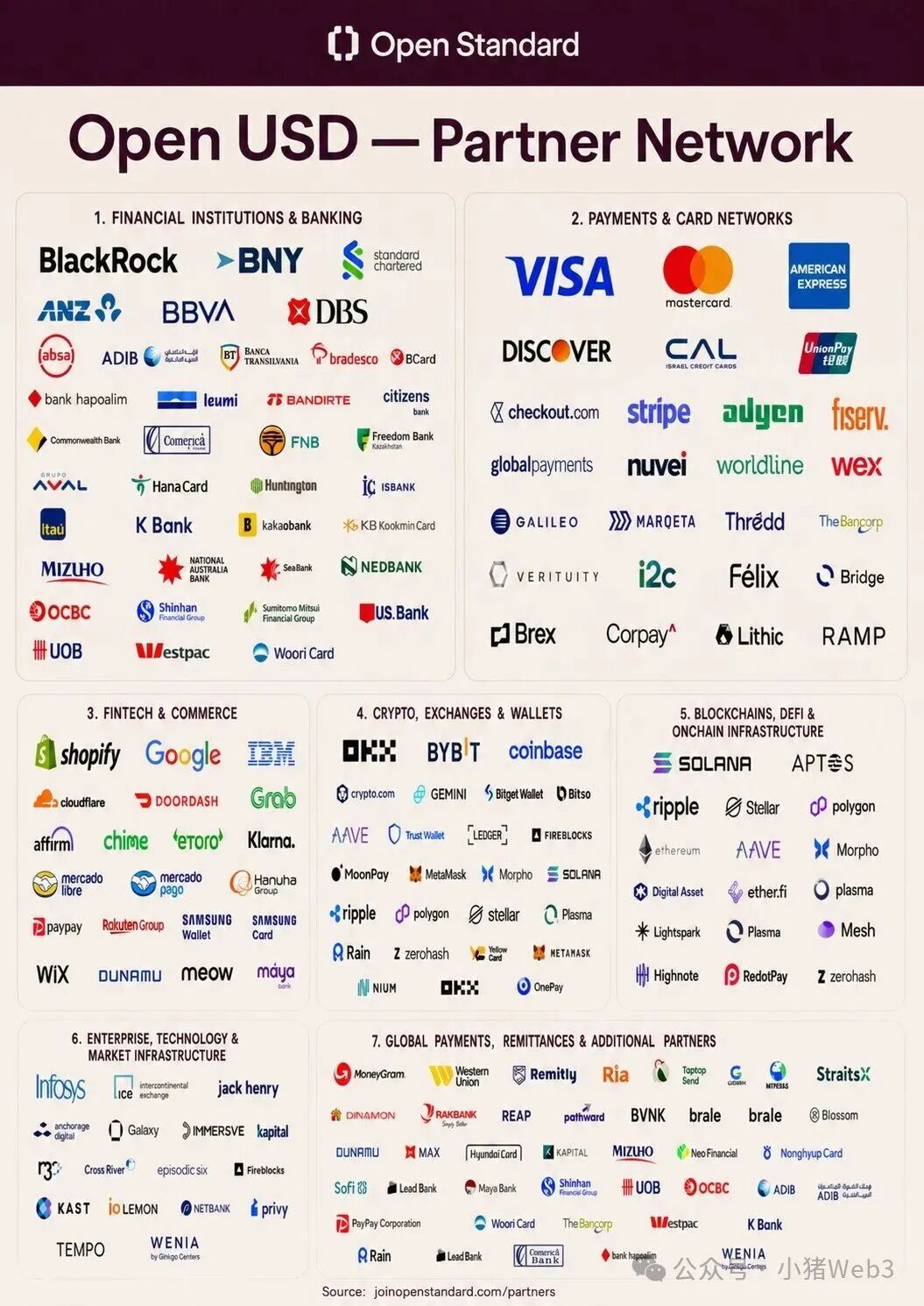
According to an official announcement from Open Standard, the design of OUSD is based on three principles:
- No fee for minting and redeeming, unlimited supply cap — significantly lowering the threshold for high-frequency, large-scale usage by institutions;
- Reserve earnings nearly fully returned to partners — after deducting a small management fee, the interest generated from government bonds/cash reserves will no longer be exclusive to the issuer;
- Independent company + partner board governance — Open Standard as the operator avoids a single issuer controlling the roadmap, revenue model, and governance rights.
On the day the news was announced, Circle's stock price plummeted by 17.5%, with a market value evaporating by about $3.6 billion — a stablecoin that hasn't officially launched yet has caused a severe blow to the world's second-largest stablecoin simply through a partner list; what exactly is the market afraid of?
Who owns the reserve earnings
To understand why OUSD triggered such a strong market reaction, one must first comprehend a long-avoided question in the stablecoin industry: who should the reserve earnings belong to, the issuer, or the distribution channels that control user access?
Circle's revenue for the full year of 2025 is approximately $2.75 billion, with reserve interest income accounting for over 95% of total revenue in the fourth quarter, essentially rendering it a company that "survives solely on interest rates." But this income cannot be entirely retained by Circle — the distribution of USDC heavily relies on Coinbase; according to Circle's prospectus, Coinbase retains 100% of the reserve earnings from USDC on its platform, while revenue generated outside the platform is split 50/50; in 2024 alone, Circle paid Coinbase a whopping $908 million in distribution fees, making up about 54% of its total revenue. What's more challenging is that this agreement cannot be unilaterally terminated by Circle and automatically renews every three years — as the issuer, Circle does not hold the initiative in negotiations with its largest distributor.
In other words, the reserve earnings ostensibly belong to the issuer, but in reality, they have long been a "toll" that must be paid to the channels. OUSD's approach is to openly display this unspoken rule: since this money will eventually need to be paid out, it’s better to treat it as a "budget" for acquiring the distribution network from the outset, offering incentives to platforms like Stripe, Visa, and Shopify that control merchant networks and transaction access, thereby allowing OUSD to take the position of "default settlement asset."
It is important to clarify: the revenue-sharing recipients of OUSD are the corporate partners involved in distribution, not ordinary token holders. This is not OUSD's choice but a regulatory red line — the U.S. GENIUS Act explicitly prohibits the issuance of payment-based stablecoins from paying interest to token holders.
Hence, what the market truly fears is Circle/USDC losing bargaining power to OUSD in the distribution channel, rather than "consortium-based stablecoins." Moreover, the "140+ institution list" of OUSD, when examined calmly, shows significant inflation.
The truth behind the "140+ institution list"
Currently, Zach Abrams, the temporary leader of Open Standard, is the co-founder of Bridge, a stablecoin infrastructure platform under Stripe. In late 2024, Stripe purchased Bridge for $1.1 billion.
Bridge was originally a company that provided stablecoin cross-border infrastructure, having already serviced a large number of clients engaged in cross-border payments, remittances, and corporate settlements before being acquired by Stripe. Many of the 140+ names listed in the OUSD announcement are existing clients of Bridge/Stripe who were already using Bridge's infrastructure for their business, and now their names have been conveniently included in the "OUSD Alliance." However, whether they have explicitly committed to making OUSD their default settlement asset is another matter — the depth of commitment varies significantly.
Even more embarrassingly, several companies on the list have outright denied their involvement. Samsung Electronics publicly stated that it has never had formal discussions with the project and does not know what role it is expected to play; Shinhan Financial clarified that no formal agreement has been reached to join the OUSD Alliance; Upbit directly stated that it has only "expressed a willingness to consider participating in the expansion of the Open Standard ecosystem in the future," which is entirely different from "participating in the issuance of OUSD."
Lorenzo Valente, Director of Digital Asset Research at ARK Invest, characterized the list very accurately — he said the announcement is more like a "giant letter of intent" rather than a prepared competitive product list ready to wrestle with existing giants. "These partners are actually just giving a platform to their competitors: Stripe has its own Bridge and technology stack; Coinbase is already tied closely with USDC; banks are busy creating their own deposit tokens; card organizations traditionally support any coin and will not only back one. "
A significant portion of that 140+ list consists of "intent" rather than "commitment," and there are even cases where entities were named but denied involvement; many of the institutions on the list are essentially "betting on both sides" or even "betting on multiple sides":
Example of "betting on both sides" — Coinbase. Coinbase is Circle's most important distribution channel and partner, and their existing distribution agreement will expire this August, at which point the parties will renegotiate cooperation terms; however, neither party can unilaterally terminate the cooperation without exceptional circumstances. Yet Coinbase also appears on the list and promises to provide underlying support for OUSD on the Base chain;
Example of "betting on multiple sides" — Visa. Back in March 2021, Visa reached a partnership agreement with Circle, allowing businesses to issue Visa corporate cards through Circle and integrating USDC's settlement functionality. Moreover, Visa was also an early design partner for the Arc blockchain launched by Circle. Before joining the OUSD Alliance, Visa was already an anchor validation node for Stripe's Tempo blockchain. On July 16, 2026, Visa even launched its own Visa Stablecoin Platform (VSP), an enterprise-level infrastructure platform for banks, fintech, and crypto companies that it leads and controls. The platform initially supports OUSD while being compatible with USDC and USDG (Paxos).
Being on the OUSD list does not mean these organizations will truly stake their resources and priorities. Thus, this inflated momentum should not be taken as evidence that OUSD has already established network effects.
The era of distribution dominance
As mentioned earlier, Visa is "betting on multiple sides" — regardless of who ultimately emerges, Visa must ensure it is the pipeline that no one can bypass. In short, Visa does not care who wins; it just wants to collect rent.
In the current stablecoin ecosystem, exchanges remain the largest distribution channels, and this "I want to collect rent, not occupy land" strategy has already been implemented across various exchanges. Industry insiders have stated, "You should assume that any exchange holding a large amount of USDC has an agreement with Circle."

Coinbase — As previously mentioned, due to the profit-sharing agreement, Circle paid Coinbase $908 million in 2024, accounting for over half of its total revenue.
Binance — Circle also disclosed this transaction in its prospectus: it paid Binance a one-time advance of $60.25 million, followed by monthly ongoing incentives tied to the amount of USDC held on the Binance platform, specifically at a fixed rate linked to SOFR (Secured Overnight Financing Rate), which can reach double-digit percentages.
Of course, the most controversial agreement is the "Aligned Quote Asset v2" (AQAv2) agreement reached in May 2026 between perpetual contract exchange Hyperliquid, Coinbase, and Circle. Circle is responsible for minting and redeeming USDC and providing cross-chain infrastructure, while Coinbase is responsible for deploying funds for USDC reserves on the Hyperliquid platform, and Hyperliquid only needs to designate USDC as its official quoted asset on its platform, while doing nothing else, to directly take away up to 90% of the reserve earnings. Due to management fees and operational costs, 90% is nearly full reimbursement, even though the OUSD profit-sharing agreement has not been released, it is not expected to exceed 90%.
Currently, approximately $6 billion of USDC is circulating on the Hyperliquid platform, accounting for 8% of the total USDC circulation; this profit-sharing arrangement could transfer approximately $135 million to $160 million in earnings from the Circle/Coinbase ecosystem to Hyperliquid annually, potentially reaching $300 million to $500 million per year in the long run if the scale continues to grow.
Circle might already be the stablecoin issuer that shares the highest proportion of earnings with platform partners in the market; however, its posture is passive, one-on-one, with amounts and proportions subject to negotiation based on the other party's leverage. Hyperliquid can secure 90% due to being one of the fastest-growing channels with the strongest bargaining power; regular exchanges may not achieve such high percentages.
What OUSD is essentially doing is turning Circle's "privately negotiate for discounts based on the other party's leverage" approach into a standardized version that is "pre-written in the alliance agreement, with everyone sharing according to the same rules."
Assuming that the largest distribution channels for stablecoins in the future reside within card organizations, it is believed that Visa can also negotiate a high revenue share from USDC reserves with Circle — which is Visa's strategy.
However, if distribution channels do not hold advantages, considering the liquidity depth, brand trust, and compliance first-mover advantages of USDC, it should possess stronger bargaining power than OUSD. If it were simply the case that the more profit-sharing a stablecoin issuer has, the more successful it is, then success would have gone to others long ago, such as Paxos/USDG.
The most affected are Paxos/USDG
In 2024, Paxos, together with Robinhood, Kraken, Anchorage Digital, Galaxy Digital, Bullish, and Nuvei, initiated USDG, regulated by the Monetary Authority of Singapore (MAS), with a core selling point almost identical to OUSD — nearly all reserve earnings returned to the participating entities that promote usage, and any organization can join the network to share earnings. It has now expanded to the EU (MiCA compliant), adding 19 members, with Mastercard and Fiserv joining later.
The participating institutions are large and powerful, and the profit-sharing is very attractive, but it has never been transformed into real scale and liquidity. USDG currently has a market cap of about $3 billion, accounting for 1% of the nearly $300 billion stablecoin market, while USDT and USDC together still account for nearly 80% of the market share.

OUSD's advantage over USDG lies in the much larger and more significant number of partners, and Stripe itself is a giant that holds merchant networks and transaction access.
Of course, alliance governance is also a differentiating point; USDG is issued by Paxos Digital Singapore (Singapore's main payment institution license) and Paxos Issuance Europe (MiCA compliant entity), with core functions such as minting, redemption, reserve management, and compliance held entirely by Paxos, while Robinhood, Kraken, and others are merely distribution partners. In contrast, OUSD's governance rights are distributed.
However, multi-party alliances can suffer from slow decision-making, inconsistent incentives, and long-term insufficient execution, and there are very few successful historical cases. Ironically, Circle once operated under an alliance-based stablecoin governance structure: the Centre Consortium (the early structure of Circle and Coinbase collaboratively governing USDC), which later disbanded due to issues with incentive distribution and control, ultimately leading Circle to choose to centralize the governance rights of USDC.
Does Circle have a moat?
I believe Circle does have a moat, but it is not the type that is "impenetrable under any attack," rather it resembles a situation where "currently no one has truly breached it, but there are those chiseling away at the walls."
The liquidity depth and network effects are real. USDC currently circulates around $75 billion, holding a market share of about 25%; this scale itself is a barrier — with deep liquidity, extensive integration, and a rich variety of trading pairs, new players must first overcome the "cold start problem," even if they have numerous cooperative partners supporting them. USDG's operation over two years only reached 4% of USDC; this is the most direct evidence: having an alliance and revenue sharing does not translate into real liquidity migration.
Brand trust is tangible. Institutions and corporate clients choose USDC largely based on the psychological account that "Circle is the most compliant, transparent, and has the least probability of issues"; this accumulation of trust requires time, and cannot be easily seized away in a short period.
Compliance first-mover advantages are real and continue to widen. Circle was the first to obtain a BitLicense in New York, the first to achieve MiCA compliance among stablecoin issuers, and just recently secured a national trust bank license approved by OCC on July 10, upgrading the asset custody component to a federally licensed one. The implementation details of the GENIUS Act have yet to materialize, yet Circle has already aligned its structure with the highest standards ahead of time; this accumulation of "putting regulatory relationships in order first" cannot be quickly matched with money, and as a newly formed alliance entity, OUSD needs to go through the entire process from scratch.
Conclusion
Returning to the initial question — what is the market truly afraid of? The answer is not "how disruptive the product design of OUSD is," but rather that this announcement has laid the unspoken rule of the stablecoin industry out in the open: reserve earnings will eventually have to yield to the party that controls the distribution channel, and Circle has already been doing this in its one-on-one negotiations with Coinbase, Binance, and Hyperliquid, albeit in a more passive and covert manner.
When broken down, OUSD's true impact has been significantly amplified by market sentiment — among the 140+ names, only a few have made real commitments, the vast majority of institutions are merely betting on both sides. Internally, the alliance is not a solid block either; the true distribution channels and the allocation of power may not be as amicable as the apparent "shared governance" narrative suggests.
For Circle, the moat has not collapsed overnight. The liquidity depth, brand trust, and compliance first-mover advantages remain substantive barriers that cannot be genuinely breached by any new player in the short term. However, the recent turmoil has exposed a real issue: Circle's moat can safeguard "survival" but cannot maintain "pricing power" — reserve earnings are continuously being sliced by channels, and the profit-sharing proportion will only increase as the leverage of the channel parties grows; this trend will not reverse based on whether OUSD ultimately succeeds or fails.
OUSD may not be the last straw that breaks Circle, but it clearly delineates the next phase of the industry's rules of play: whoever controls the distribution channel controls the pricing power, and the issuer, whether Circle, Paxos, or any future entrant, can only passively respond under this rule.
免责声明:本文章仅代表作者个人观点,不代表本平台的立场和观点。本文章仅供信息分享,不构成对任何人的任何投资建议。用户与作者之间的任何争议,与本平台无关。如网页中刊载的文章或图片涉及侵权,请提供相关的权利证明和身份证明发送邮件到support@aicoin.com,本平台相关工作人员将会进行核查。


