Written by: Rita
Guide to Trends
In the past few weeks, AI-related stocks have undergone a severe sell-off. The South Korean stock market has dropped 25% from its peak, the Philadelphia Semiconductor Index has fallen 20%, and individual stocks like Samsung and Micron have declined between 20% and 50%.
What the market really needs to worry about, and is worried about, may be two things.
The core driving force behind this decline is technical factors and position clearing; the fundamentals have not deteriorated. New supply in the semiconductor industry won't be released until 2028, earnings remain strong, and technical indicators are approaching oversold conditions. Prices will ultimately revert to profitability, and the likelihood of stock prices recovering upward is greater.
Divergence Between Stock Prices and Earnings
J.P. Morgan presented a set of key comparisons in its report: the relative price trends of the semiconductor sector versus the relative earnings trends, with the gap continuing to widen.
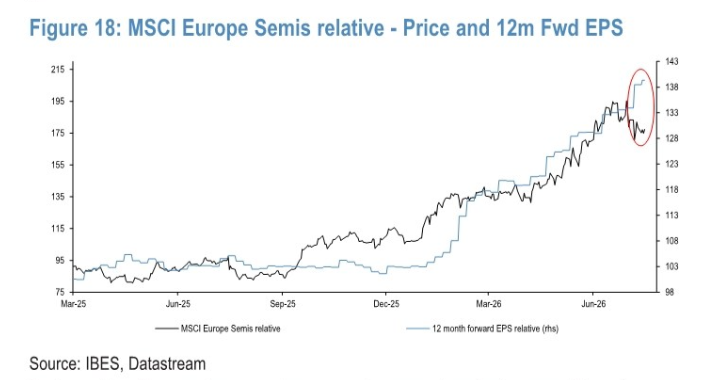
Stock prices continue to decline, but the market consensus earnings expectations have not been adjusted downward in sync. This valuation divergence is difficult to maintain over the long term, and the probable direction for subsequent correction is for prices to align with fundamentals.
The supply-demand pattern also supports this judgment. The tight balance of DRAM and NAND will continue until 2028. Demand for AI servers continues to grow, combined with HBM prioritizing wafer capacity, traditional memory chip supply remains constrained. Current DRAM spot prices are still high, without the significant declines that the market fears. Micron has recently raised its earnings guidance, believing that the supply-demand tightness will last at least until 2027.
J.P. Morgan's tech team maintains a bullish stance on semiconductors, with three core underlying logics remaining unchanged: the central position of semiconductors in the tech supply chain, the continuous increase in chip deployment per vehicle and machine, and the continued improvement in corporate earnings and free cash flow. The sustainability of the upward cycle of capital expenditures in data centers is underestimated by the market.
On the technical side, the Philadelphia Semiconductor Index RSI has quickly approached oversold territory, with the momentum gains accumulated this year basically reversed, and previous crowded trading positions have been fully cleared. Institutions judge that once the oversold signal is confirmed, a rebound window will open, suggesting that investors gradually position themselves in the summer.
Nature of the Decline: Structural, Not Systemic
While stocks in the AI industry chain have seen severe declines, the MSCI global index has only dropped 1% to 2% from its historical peak, a detail that is easily overlooked.
The weighted sectors are in a unilateral decline, but the overall market resilience remains, indicating that this round of decline is a structural reallocation. J.P. Morgan points out that during the disintegration phase of momentum markets, volatility will spike in the short term, but this does not represent a bearish trend for the overall market.
The South Korean market needs to be viewed separately. The rapid expansion of domestic single-stock leveraged ETFs has amplified the index's volatility. The difference between the volatility of the Korean stock market and the U.S. VIX has been widening, indicating that local adjustments are mixed with disturbances arising from domestic tools, and should not be directly extrapolated to other global markets.
Inflation Peaks, Rotation Window Opens
J.P. Morgan has continuously anticipated a decline in inflation, and the latest economic data verifies this logic. The annualized CPI in the U.S. dropped from 8.2% in May to 2.8% in June, with month-on-month inflation in the Eurozone also cooling down. Brent crude oil fell approximately 25% quarter-on-quarter, and the transmission effect of declining oil prices has already manifested in inflation data.
The report emphasizes the differences between the current environment and that of 2022. Current wage growth is slowing, and corporate pricing power is marginally weakening; more critically, long-term inflation expectations are stabilizing. The U.S. 5-year, 5-year forward inflation rate has remained below 2.60% during the geopolitical conflicts, retaining policy space for the Federal Reserve.
Institutions judge that the market-implied expectation for a 90 basis point rate hike in June may be the peak of the current tightening expectations, and subsequent pricing will gradually correct.
Proportion of Earnings Reports Exceeding Expectations Rising, Positive Stock Price Feedback
The second quarter earnings season has kicked off strongly, with the proportion of companies that exceeded expectations at 97%, higher than the long-term average of 76%. More importantly, the market has given positive stock price feedback to these exceeding earnings.
Among S&P 500 constituents, companies that exceeded earnings expectations saw an average increase of 1.6% on the day of their earnings reports, generating an excess return of 1.7% relative to the overall market. The corresponding data for the European Stoxx 600 is 2.1% and 1.9%.
In the earnings forecast phase, J.P. Morgan specifically pointed out two high-growth sectors: semiconductors and banks. TSMC's order demand is stable, providing positive signals for capacity planning through 2027. Bank net interest income is resilient, and investment banking revenue is performing impressively. As remaining companies gradually disclose their results, the strong performance trend is expected to continue.
Asset Classes and Industry Allocation Thoughts: Increase Equity Allocation, Semiconductors as Preferred Independent Selection for AI Sector
The report provides a clear allocation plan. In the asset class segment, equity allocation is raised from a benchmark of 60% to 65%, bond allocation is neutral, and cash holdings are reduced. Regionally, the allocation ratio for the Eurozone is increased from 8.7% to 11%, while the U.S. and Japan remain neutral, and the UK market is underweighted. On the industry level, mining, capital goods, semiconductors, automobiles, insurance, and banks are recommended, while energy, utilities, media, software, and telecommunications are underweighted.
The AI sector needs to be strictly differentiated internally. Semiconductors have significant allocation value, earnings remain stable, and new capacity cannot be released in the short term; the current technical pullback provides a layout window. In contrast, sectors such as software, business services, and media are long-term suppressed by AI substitution, and institutions classify them as the "AI Erosion Group."
Regarding geopolitical conflicts, the situation in Iran is a secondary influencing variable. J.P. Morgan has observed that the impact of geopolitical shocks on the market is continually diminishing, and the "buy the dip" strategy established since the end of March remains effective. The two major premises for this strategy have not changed: inflation expectations are stable, and central banks do not need to passively tighten monetary policy.
Trends Perspective
The core value of J.P. Morgan's report lies in its precise definition of the nature of this round of decline.
According to strategist Mislav Matejka, the root of the correction in the AI sector is the technical clearing of chips, not a fundamental turning point. The severe divergence between semiconductor stock prices and earnings is currently the market's most critical pricing error. Individual stocks have generally retreated 20% to 50%, but earnings expectations have not been adjusted, and the logic of supply constraints has not changed. Once this gap is repaired, the direction is likely for stock prices to return upward.
However, J.P. Morgan's optimistic stance has clear premises. Semiconductors and software are two completely different logical lines; the former is supported by real supply-demand barriers, while the latter's value is continually being eroded by AI.
This judgment forms an interesting divergence with Goldman Sachs. Goldman believes that software vendors can maintain value based on the "orchestration layer," while J.P. Morgan judges that the downward pressure on application-layer software is long-term. Although the two institutions have differing views on the software industry, they are in strong agreement that the fundamentals of semiconductors have not deteriorated.
Disclaimer
This article is a compilation and interpretation of a third-party broker research report (J.P. Morgan, July 20, 2026) by Guide to Trends. The ratings, target prices, earnings forecasts, and related judgments quoted in the text represent the views of the broker's analysts and only reflect their institutional perspective, and do not represent the views of Guide to Trends, nor do they constitute any investment advice.
The market has risks, and decisions should be made independently. This article should not serve as the basis for buying or selling any securities.
免责声明:本文章仅代表作者个人观点,不代表本平台的立场和观点。本文章仅供信息分享,不构成对任何人的任何投资建议。用户与作者之间的任何争议,与本平台无关。如网页中刊载的文章或图片涉及侵权,请提供相关的权利证明和身份证明发送邮件到support@aicoin.com,本平台相关工作人员将会进行核查。


