
Author: Wall Street Insights
NVIDIA is making Japan the core pivot of its global physical AI landscape.
NVIDIA CEO Jensen Huang appeared in Tokyo this week, engaging in a series of partnership signings and business meetings. According to reports, NVIDIA announced on Thursday that it has reached a collaboration with Japanese robotics giants Fanuc and Yaskawa Electric to jointly advance robotics and AI technology development.
Meanwhile, NVIDIA also announced an expansion of its collaboration with Toyota, covering autonomous driving, factory simulation, and urban intelligence, among other fields. Huang stated at a media event in Tokyo, "With AI, robots will become intelligent, adaptable, and accessible."
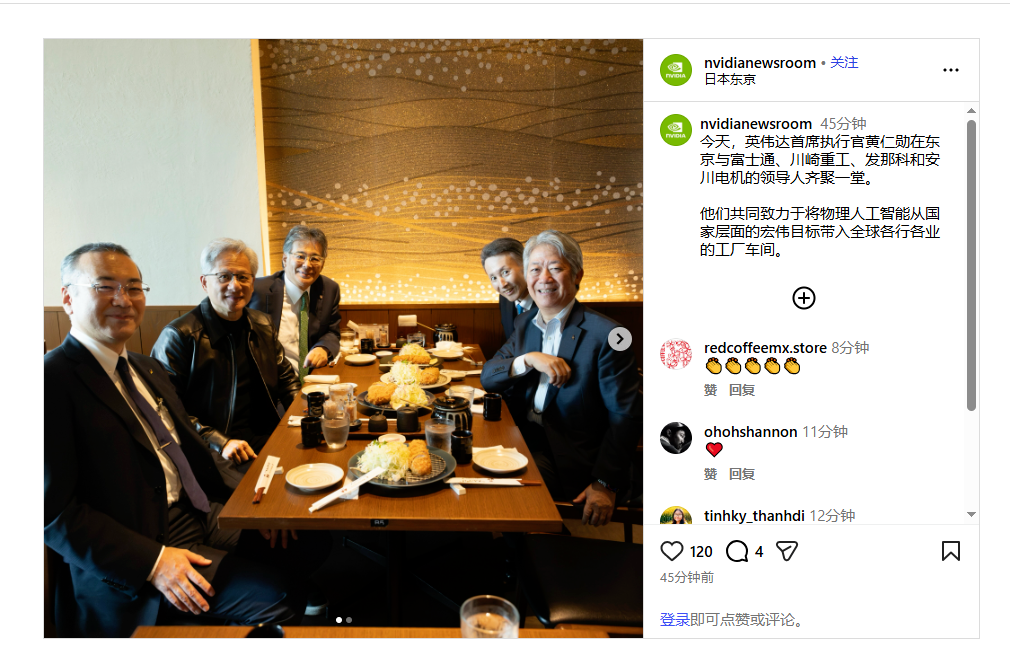
The strategic intent of this trip to Japan is clear: NVIDIA is systematically binding Japan's manufacturing foundation, semiconductor supply chain, and its AI full-stack technology.
In an interview, Huang dismissed concerns about an AI investment bubble, stating, "We are far from an AI bubble, and the demand is extremely strong," while emphasizing, "We need to build infrastructure for at least ten years." He also mentioned that NVIDIA will announce a partnership plan related to sovereign AI in Japan later this week.
Additionally, it is noteworthy that this visit was accompanied by a historically significant reunion—Huang shared the stage in Akihabara with Shoichiro Irimajiri, former president of Sega, who helped save NVIDIA during its near-bankruptcy 30 years ago, adding an emotional depth to this business trip.
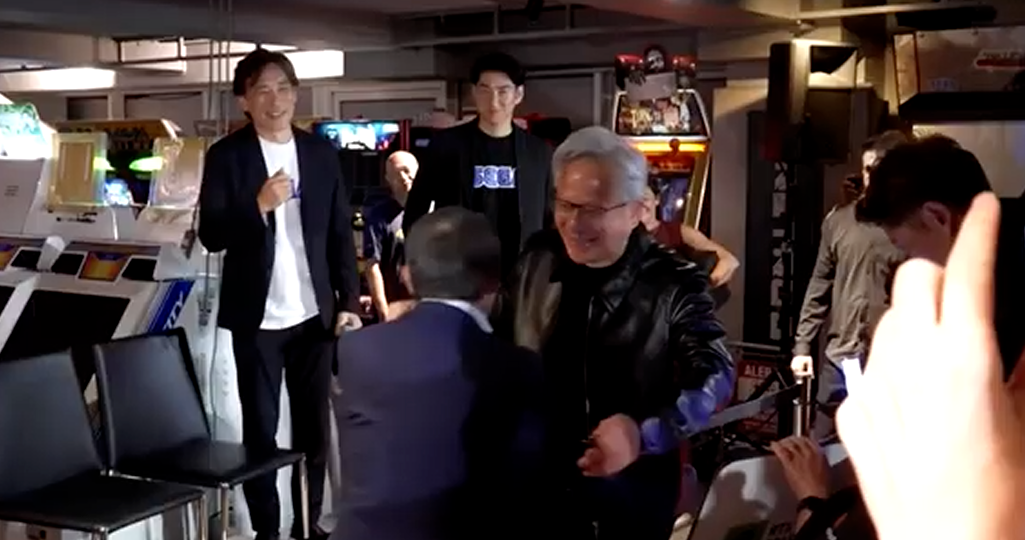
(Video screenshot: Huang embracing former Sega president)
Reunion in Akihabara: 30 Years of "Life-Saving Gratitude"
Aside from business meetings, the most emotional moment of Huang's trip occurred at the former Sega game center site in Akihabara, Tokyo.
According to Sega, Huang attended an event hosted by Sega on July 15, where he shared the stage with Irimajiri after many years. Huang expressed emotionally at the event: "Without everything Sega has done, without everything Irimajiri has done, NVIDIA would not have survived to this day."
This connection dates back to around 1996. At that time, the newly established NVIDIA was on the verge of bankruptcy after a technical misstep led to the complete failure of a project to develop graphics chips for Sega's next-generation console.
Huang proactively confessed the failure to then Sega Vice President Irimajiri, who chose not to hold anyone accountable and instead facilitated a $5 million investment into the "starving" startup. Huang recalled:
"I told Irimajiri that if they invested this money in us, they might lose everything; but if they didn’t invest, we would go out of business... After considering for a few days, he told me: We will invest."
Thanks to this funding, NVIDIA downsized by 60% and started anew, launching the RIVA 128 in 1997, and later solidifying its market position in the GPU field with products like RIVA TNT and GeForce 256.
Dramatically, after going public in 1999 at an estimated valuation of about $300 million, Sega quickly chose to cash out, selling its shares for around $15 million. Today, NVIDIA’s market value has surpassed $50 trillion.
During this reunion, both parties announced the continuation of their collaboration—future works from Sega will support NVIDIA's recently launched RTX Spark platform, including the upcoming "VIRTUA FIGHTER CROSSROADS." The partnership between NVIDIA and Sega began 30 years ago when NVIDIA’s NV1 chip provided graphics support for the first PC version of "Virtua Fighter," one of the world’s earliest 3D fighting games.
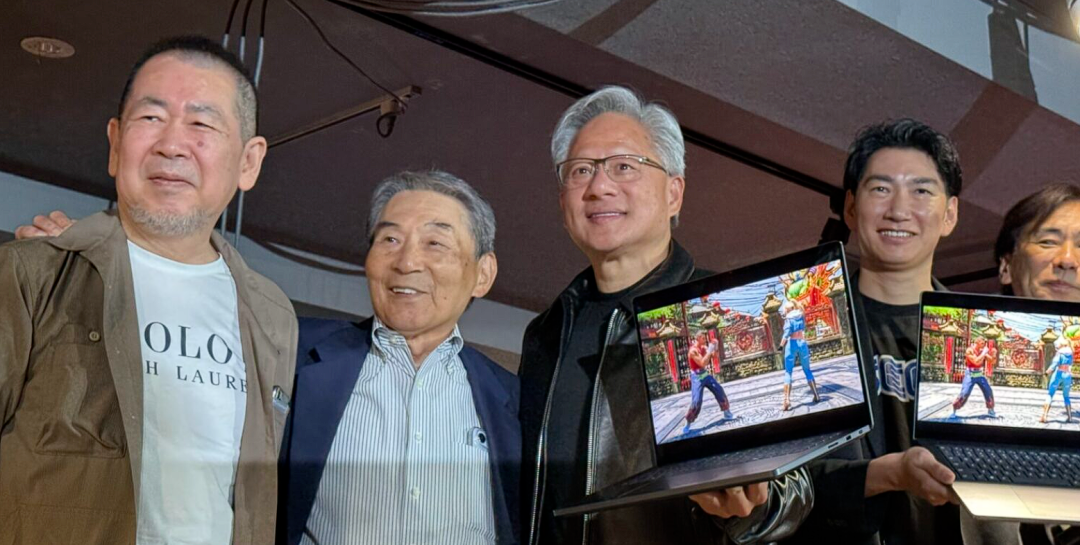
(Image source: NVIDIA official website)
Izakaya Dinner: Engaging the Core of Japan's Semiconductor Supply Chain
The night before the official collaboration announcement, Huang conducted a low-key yet meaningful dinner to engage collectively with key nodes in Japan's AI supply chain.
According to Singapore's Strait Times, on the evening of July 15, Huang appeared at an izakaya in Kanda, Tokyo, dining with executives from major Japanese supply chain companies for approximately two hours.
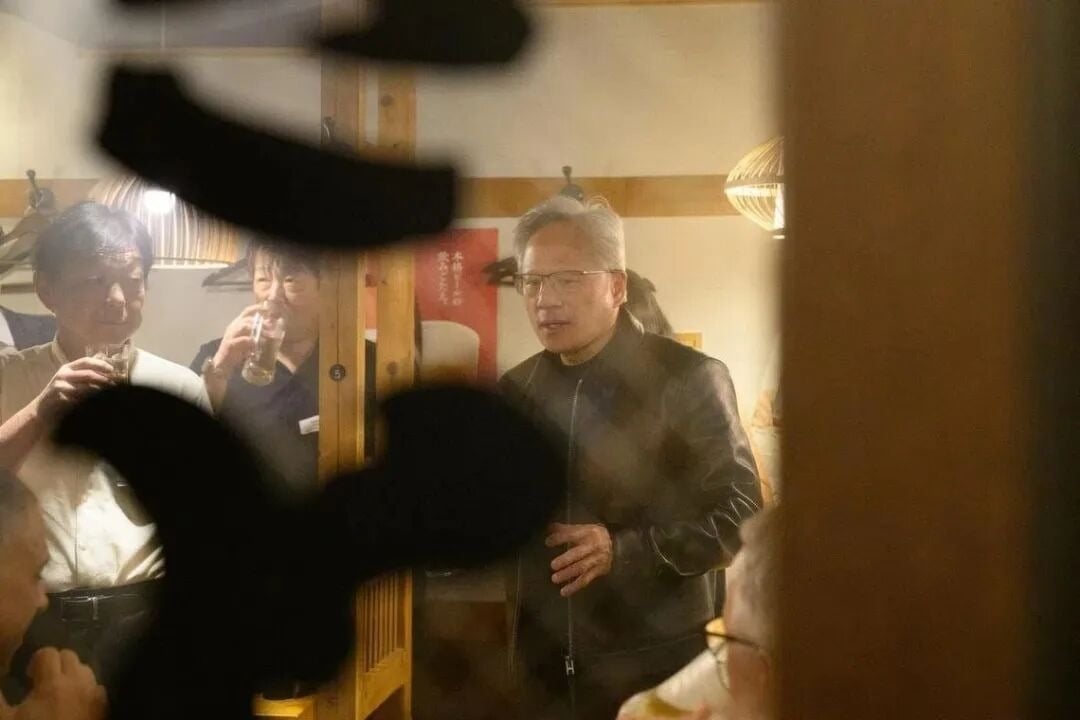
(Image source: Singapore Strait Times)
Attendees included:
CEO of advanced flash chip manufacturer Kioxia, leaders from global leading silicon wafer supplier Shin-Etsu Chemical, heads of chip equipment manufacturer Tokyo Electron, executives from advanced chip packaging film supplier Ajinomoto, as well as leaders from fiber optic cable manufacturer Sumitomo Electric Industries and advanced capacitor producer Taiyo Yuden. Yuki Kusumi from Panasonic Holdings was also present.
It is said that Huang and his party enjoyed skewers, beef tripe hot pot, and Japanese whiskey.
The gathering practically outlines the panorama of the Japanese hardware supply chain that NVIDIA’s next-generation AI system relies on. According to attendees, discussions included topics such as "everyone together promoting the prosperity of industries such as semiconductors and ensuring stock prices keep rising."
Outside the izakaya, a crowd of people holding smartphones gathered, hoping to catch a glimpse of the AI era icon referred to on social media as "kawajan-san" (Mr. Leather Jacket). Reports indicate that a 57-year-old visitor from Taiwan, Chang Hui-Yu, stated outside the Sega event, "I think he is the most influential person on Earth."
Betting on Physical AI: Japanese Manufacturing as a "Natural Ally"
The core strategic narrative of Huang's visit is positioning Japan as a key battlefield for global physical AI development.
According to Japan's Kyodo News, Huang stated in an interview in Tokyo, "This is a historic moment for Japan, as Japan has always excelled in precision manufacturing and mass production."
He believes that AI can help Japan address the severe labor shortage issue, "by automating, AI, and robotics technology, we can enhance the capabilities of the existing workforce and improve the overall productivity of the nation."
On the specific cooperation front, NVIDIA's collaboration with Fanuc and Yaskawa Electric directly targets the intelligent upgrade of industrial robotics. The partnership with Toyota is even more comprehensive:
Toyota is developing next-generation vehicles with L2++ capabilities based on NVIDIA's DRIVE AGX platform and DriveOS operating system; at the same time, it is utilizing NVIDIA Megatron-LM to train AI models for code assistants compliant with MISRA standards to accelerate vehicle software engineering; and leveraging NVIDIA Omniverse and Isaac Sim frameworks to advance factory digital twins and robotics simulation.
Toyota's subsidiary Woven by Toyota has also developed a multi-modal vision language model for urban transport intelligence based on NVIDIA's H100 GPU.
NVIDIA Vice President Rishi Dhall stated, "Physical AI will bring intelligence to every mobile machine, from cars, robots, and trucks to the cities and factories they operate in."
Full-Stack Layout: From Healthcare and Finance to Quantum Computing
In addition to robotics and automobiles, NVIDIA's collaborative landscape in Japan extends into several key industries, presenting a systemic full-stack penetration trend.
In the medical and life sciences sector, many Japanese pharmaceutical giants are leveraging NVIDIA's BioNeMo platform to accelerate AI drug discovery, including Eisai, Astellas, Daiichi Sankyo, and Ono Pharmaceuticals. Canon launched Japan's first NVIDIA-accelerated photon counting CT system, while Fujifilm commercialized Japan's first full-body CT system equipped with NVIDIA Blackwell. Kawasaki Heavy Industries plans to use NVIDIA Holoscan IGX, Isaac GR00T, and Cosmos platforms to develop surgical assistance robots and hospital transportation robots. In the financial sector, Mizuho Bank plans to build Japan's largest local AI factory for the financial industry, starting with NVIDIA DGX B200 systems; Sumitomo Mitsui Financial Group's Japan Research Institute (JRI) has deployed an AI factory that utilizes NVIDIA Nemotron open models to convert financial data into intelligence; and Rakuten Bank will use NVIDIA Agent Toolkit to develop trading foundational models. In the field of quantum computing, the RIKEN Institute has begun operating two supercomputers powered by NVIDIA GB200: RIKYU, which has deployed 1,600 NVIDIA Blackwell GPUs to support the development of open foundation models; and the quantum-HPC system ROQUO, which integrates 540 Blackwell GPUs to closely connect with RIKEN's quantum computers. Mitsubishi Chemical, Mizuho Bank, Keio University, and AIST have collaborated with NVIDIA to achieve a 13.4 times acceleration compared to pure CPU nodes in molecular spectral analysis workflows.
Furthermore, reports indicate that markets speculate NVIDIA may announce a partnership with Japan's "physical AI model national team" Noetra. Noetra, established by SoftBank, brings together 44 Japanese companies, including Honda and NEC, with the Japanese government providing a financial subsidy of 1 trillion yen for the initiative.
免责声明:本文章仅代表作者个人观点,不代表本平台的立场和观点。本文章仅供信息分享,不构成对任何人的任何投资建议。用户与作者之间的任何争议,与本平台无关。如网页中刊载的文章或图片涉及侵权,请提供相关的权利证明和身份证明发送邮件到support@aicoin.com,本平台相关工作人员将会进行核查。


