Author: Claude, Deep Tide TechFlow
Deep Tide Introduction: On July 14, five major banks—JPMorgan Chase, Goldman Sachs, Bank of America, Citigroup, and Wells Fargo—released their Q2 earnings reports, all exceeding expectations. Goldman Sachs reported EPS of $20.98, nearly double last year’s, and its stock price surged nearly 8% to reach a historic high; JPMorgan Chase’s net profit of $21.2 billion set a quarterly record. The severe market fluctuations caused by geopolitical conflicts have actually allowed trading desks to rake in substantial profits, while SpaceX's largest IPO ever ($86 billion) injected huge fees into investment banking. However, "exceeding expectations" does not necessarily equal "stock price growth," as Citigroup's performance beat expectations but fell by 4.5%, and JPMorgan Chase initially dropped by 2% before reversing. Morgan Stanley will release its earnings on July 15, with market expectations for EPS to increase by over 30% year-on-year.
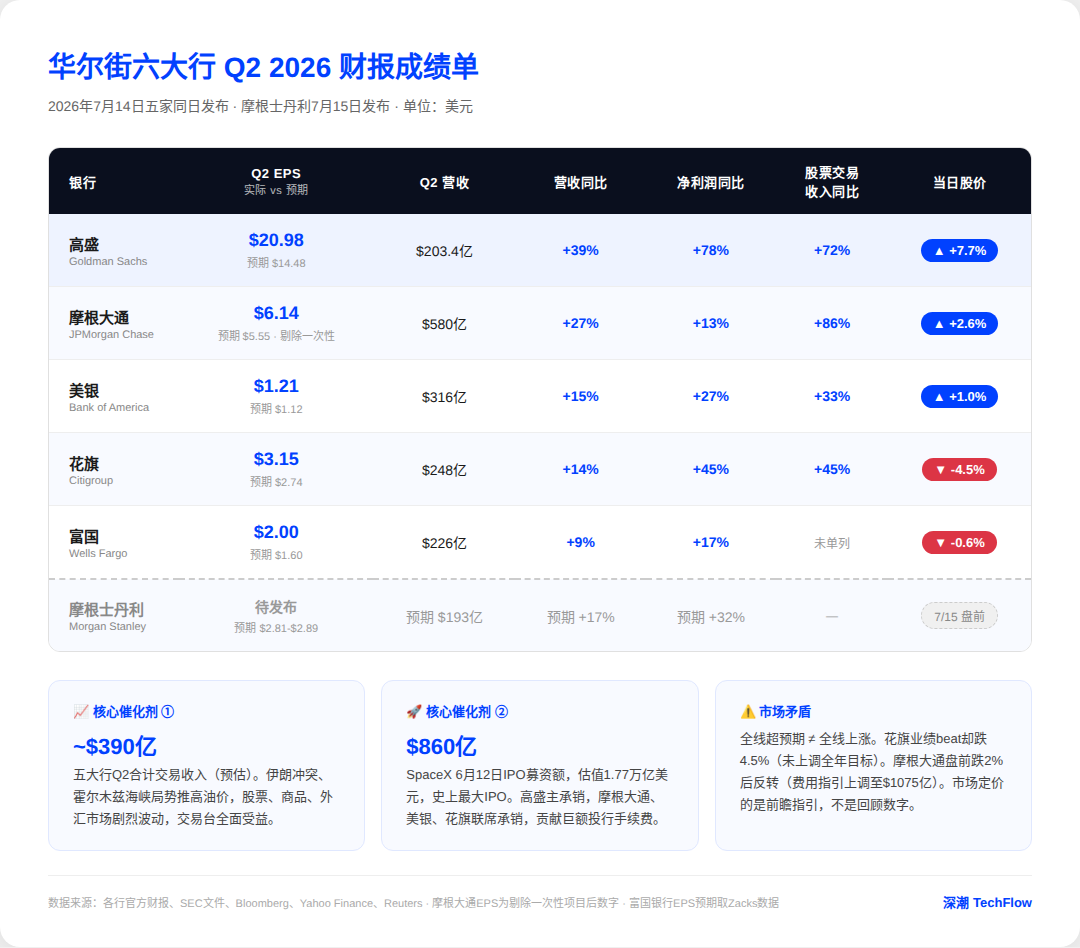
The five major Wall Street banks submitted their reports on July 14, with results increasingly dramatic one after another.
Goldman Sachs achieved the strongest quarterly performance in its history. JPMorgan Chase's net profit set a historical record. Bank of America, Citigroup, and Wells Fargo also all exceeded market expectations. However, stock price trends showed significant divergence: Goldman Sachs gained nearly 8%, hitting a historic high, while Citigroup instead dropped by 4.5%. In June, SpaceX went public, raising $86 billion and obtaining a valuation of $1.77 trillion, making it the largest IPO in history—nearly every major bank benefited greatly from this through hefty fees.
Goldman Sachs' profits double set a record, stock price rises nearly 8%
Goldman Sachs reported Q2 EPS of $20.98, almost double last year's $10.91, far exceeding analysts’ expectations of $14.48. Net revenue reached $20.34 billion, a 39% year-on-year increase. Net profit was $6.63 billion, compared to $3.72 billion in the same period last year.
According to Bloomberg, Goldman Sachs’ stock trading department generated $7.42 billion in revenue, a 72% year-on-year increase, breaking the record previously set by any bank for the third consecutive quarter. Derivatives, cash products, and bulk brokerage all saw strong growth. Investment banking fees reached $3.4 billion, up 55% year-on-year, with equity underwriting surging 130% and debt underwriting growing 75%. According to Barron's, Goldman Sachs served as the lead underwriter for the SpaceX IPO in June. Bloomberg reported that the firm participated in announced merger and acquisition transactions exceeding $1 trillion in the first half of the year.
The asset and wealth management division generated $4.6 billion in revenue, up 20% year-on-year. Assets under management soared to $4.04 trillion, up from $3.29 trillion a year ago. Goldman Sachs' board raised the quarterly dividend by 11% to $5 per share, returning $5.36 billion to shareholders through buybacks and dividends during the quarter.
CEO David Solomon stated in a press release that clients are entrusting the most strategically significant transactions to Goldman Sachs, which often drive interlinked business chains.
According to Schaeffer's Investment Research, Goldman Sachs' stock rose around 8% that day, reaching a historic high during trading, marking the largest single-day gain since April 2025. The cumulative increase for the year is around 27%.
JPMorgan Chase's net profit of $21.2 billion sets a quarterly record, but guidance on costs dampens pre-market
JPMorgan Chase's Q2 net profit was $21.2 billion, or $7.70 per share, marking the highest quarterly profit in the company’s history. However, this includes $4.6 billion in earnings from Visa holdings and $1 billion from other equity investments. Excluding one-time items, net profit was $16.9 billion, or $6.14 per share, up 13% year-on-year. The tangible common equity return (ROTCE) was 23%.
Revenue stood at $58 billion, a 27% year-on-year increase, with all lines of business reporting record results. Stock trading revenue was $6 billion, soaring 86% year-on-year. Fixed income trading revenue was $6.1 billion, up 6% year-on-year. The two combined for $12.1 billion, surpassing the trading revenue record the bank had just set in Q1 2026. Investment banking fees reached $3.3 billion, a 30% increase, the highest since 2021.
Management raised its annual net interest income guidance to approximately $105.5 billion (up from $103 billion), but simultaneously raised its adjusted annual expense expectation to about $107.5 billion. The latter was the primary cause for the approximately 2% drop in pre-market stock price. According to FX Leaders, JPMorgan Chase ultimately closed up about 2% to $341, achieving an intraday reversal.
CEO Jamie Dimon was cautious in his remarks, stating that the U.S. economy shows "significant resilience," with AI capital expenditures and fiscal stimulus as tailwinds, but he warned that geopolitical instability, persistent inflation, sovereign debt expansion, and high asset valuations "move beneath the surface like tectonic plates."
Bank of America EPS rises 34%, Citigroup records strongest revenue in a decade but faces selloff
Bank of America's Q2 EPS was $1.21, a 34% year-on-year increase, outperforming market expectations of $1.12. Revenue reached $31.6 billion, a 15% year-on-year increase. Net profit was $9.1 billion, up 27% year-on-year. Sales trading revenue increased by 33% year-on-year, investment banking fees rose by 50% year-on-year, and asset management fees grew by 20% year-on-year. The efficiency ratio (the ratio of costs to revenues) improved to 59%. CEO Brian Moynihan stated that both consumers and businesses have shown resilience.
Citigroup’s Q2 EPS was $3.15, exceeding the expectations of all 20 analysts surveyed (the consensus estimate was $2.74). According to Bloomberg, revenue was $24.8 billion, a ten-year high, and net profit was $5.8 billion, up 45% year-on-year. Stock trading revenue reached $2.3 billion, a 45% increase, and investment banking fees were $1.55 billion, a 44% increase year-on-year.
However, Citigroup's stock fell about 4.5% that day. According to Investing.com, market discontent focused on management's failure to raise its full-year return rate targets (keeping the ROTCE at 10%-11%), while it has already run to 13.1% year-to-date. CEO Jane Fraser stated that the company chose to reinvest excess earnings back into the business rather than sacrificing long-term growth for attractive short-term figures. CFO Gonzalo Luchetti admitted that Citigroup had not moved quickly enough in its equity business layout, and catching up to competitors will be a gradual process.
Wells Fargo's Q2 revenue was $22.62 billion, a year-on-year increase of 8.6%. EPS was $2.00, up 25% year-on-year. Net interest income was $12.3 billion, a 5% increase year-on-year. The stock closed slightly down 0.56%.
Two catalysts: Geopolitical fluctuations feed trading desks, SpaceX IPO nourishes investment banking
The driving forces behind this round of exceeding earnings expectations are highly concentrated on two things.
The first is market volatility. The ongoing U.S.-Iran conflict, coupled with the situation in the Strait of Hormuz, has driven up oil prices and caused severe fluctuations in the equity, commodities, and foreign exchange markets. This environment is extremely favorable for bank trading departments. Goldman Sachs' stock trading revenue increased by 72% year-on-year, JPMorgan Chase's increased by 86%, Citigroup's by 45%, and Bank of America's by 33% year-on-year. According to Bloomberg, the combined trading revenue of the five major banks in Q2 approached $39 billion.
The second is the SpaceX IPO. On June 12, SpaceX went public, raising $86 billion and achieving a valuation of $1.77 trillion, making it the largest IPO in history. Goldman Sachs acted as the lead underwriter, while JPMorgan Chase, Bank of America, and Citigroup served as the main co-managers. According to indmoney, aside from underwriting fees, each bank also benefited from subsequent debt financing arrangements and new wealth management clients. According to A.O. Shearman merger law firm data, the global M&A transaction volume in the first half of 2026 reached $28 trillion, the highest since 2021. Goldman Sachs is also a joint advisor for Anthropic's planned IPO in the second half of the year.
Morgan Stanley will release its earnings today, with expectations raised by peers
Morgan Stanley will release its Q2 earnings report before the market opens on July 15 (today).
According to Zacks data, the consensus expectation for EPS is around $2.89 (a 4% increase in the past week), representing a year-on-year growth of about 35.7%. Revenue expectation is approximately $19.34 billion, a year-on-year increase of about 16.9%. Yesterday (July 14), Morgan Stanley’s stock rose about 4% under the influence of peers exceeding expectations, but its own earnings report has yet to be released.
In the last quarter, Morgan Stanley's EPS of $3.43 greatly surpassed expectations, with revenue of $20.6 billion, a 16% year-on-year increase, and stock trading revenue of $5.2 billion, a 25% year-on-year increase. The wealth management division added $118 billion in new assets. Taking peer performance as a reference, the market expects Morgan Stanley to likely exceed expectations, but the expectations themselves have already been raised. Oppenheimer analyst Chris Kotowski downgraded the rating to "underperform" on June 30, being one of the few bearish voices currently.
免责声明:本文章仅代表作者个人观点,不代表本平台的立场和观点。本文章仅供信息分享,不构成对任何人的任何投资建议。用户与作者之间的任何争议,与本平台无关。如网页中刊载的文章或图片涉及侵权,请提供相关的权利证明和身份证明发送邮件到support@aicoin.com,本平台相关工作人员将会进行核查。


