USDC shrinking, Robinhood launching a chain, Strategy selling coins, what new variables are they being repriced by?
Written by: Frank, MSX Maitong
In the past few weeks, three notable clues have emerged in the intersection of US stocks and crypto.
Circle (CRCL.M) is still digesting the pressure brought by the decline in USDC circulation and the cooling of on-chain DeFi; Robinhood (HOOD.M) has regained market favor with its self-built public chain and has further transmitted competitive pressure to Coinbase (COIN.M); Strategy (MSTR.M) has begun to sell bitcoin substantially, breaking the market's long-standing one-way perception of it being "buy-only".
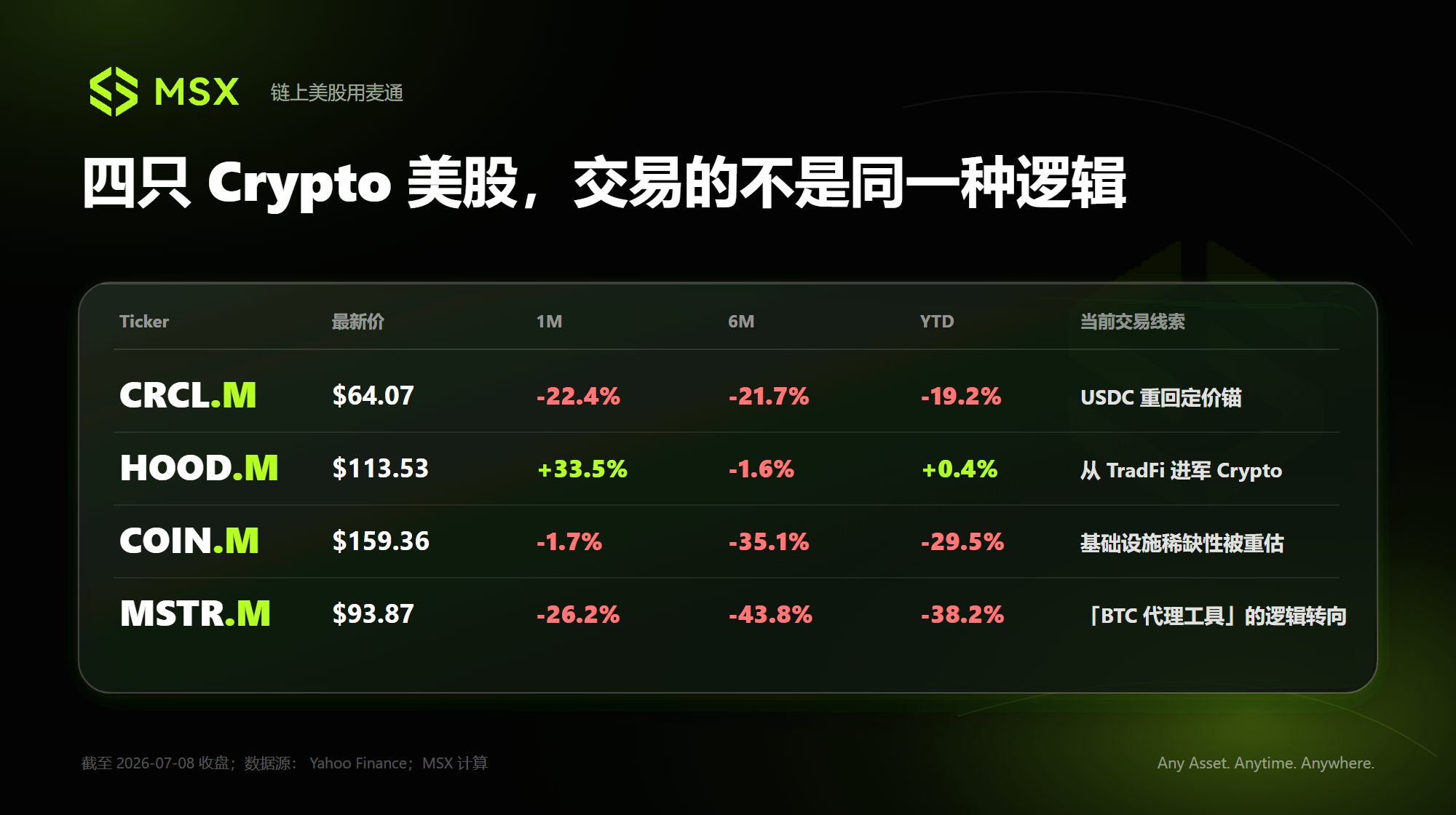
As of the close on July 8, CRCL.M, HOOD.M, COIN.M, and MSTR.M were reported at $64.07, $113.53, $159.36, and $93.87 respectively, on the surface, they all lie in the intersection of US stocks and crypto, but the core variables affecting stock prices have shown significant differentiation:
- Circle's focus is shifting back to USDC circulation and DeFi sentiment;
- The competition between Robinhood and Coinbase is gradually extending from trading platforms to asset issuance, user entrances, and on-chain settlement;
- Strategy is no longer just facing the ups and downs of bitcoin prices but is balancing mNAV, financing costs, and cash expenditures;
In other words, the market is trading different things for them.
1. Circle: Bubble clearance, USDC is returning to be the pricing anchor for CRCL
The most noteworthy change for Circle currently is that the relationship between CRCL.M stock price and USDC is gradually shifting from a phase of decoupling since its listing to a resonance based on fundamentals.
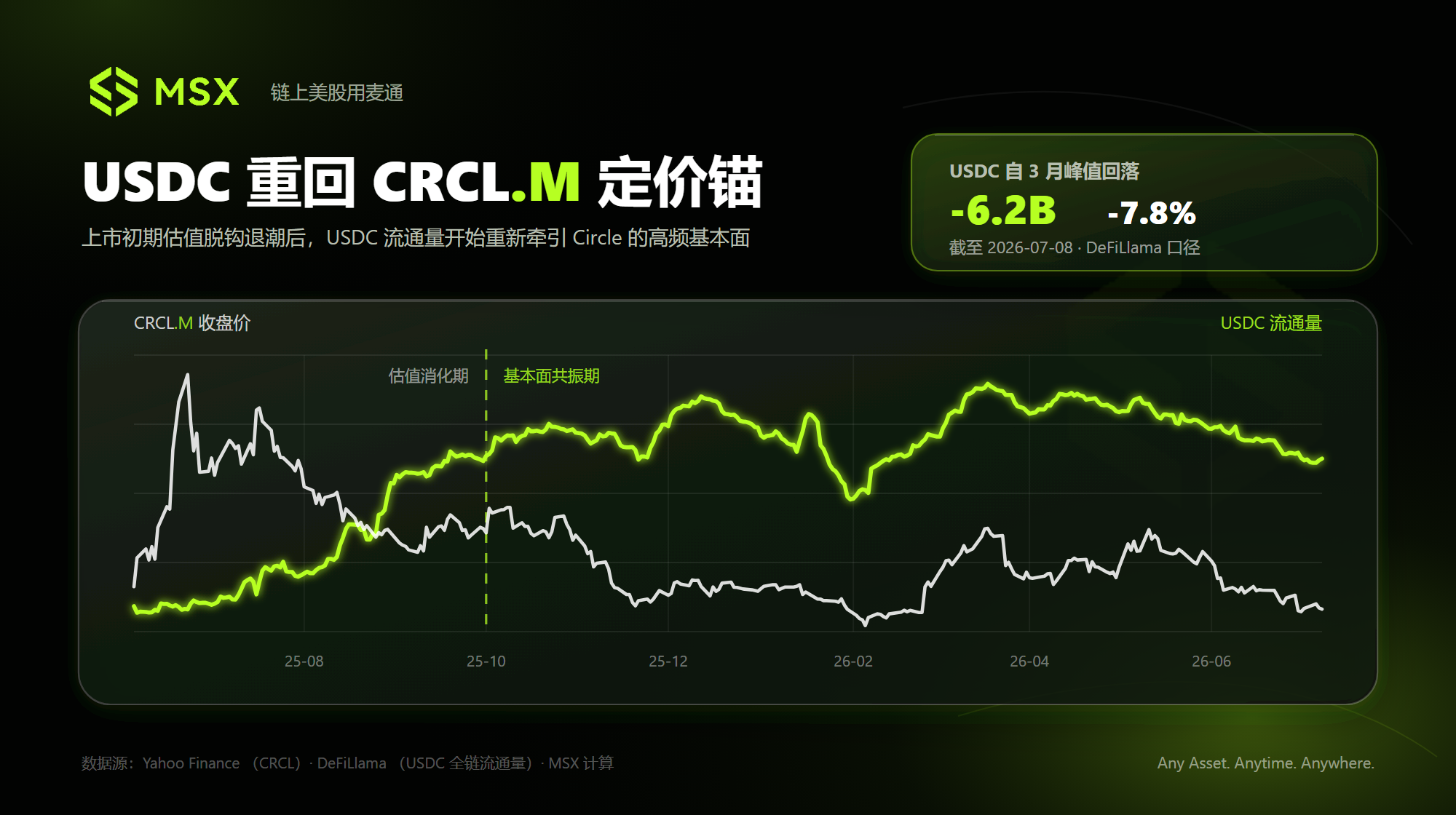
MSX Maitong has outlined the comparison curve of CRCL.M stock price and USDC circulation since Circle's listing, clearly showing that the two have undergone two different pricing phases.
The first phase was the valuation digestion period after Circle's listing, roughly from June 2025 until the end of the year.
At that time, CRCL.M, as the first large stablecoin issuer in US stocks, saw its stock price rise to a historical high closing price of $263.45, driven by factors such as scarcity, low circulation, and IPO sentiment, significantly outpacing changes in USDC fundamentals.
However, as the premium from the low circulation and the IPO sentiment gradually retreated, a continued valuation return began, during which USDC circulation continued to grow, making the two curves move in opposite directions at this stage, significantly lowering the correlation coefficient over the entire cycle.
The second phase began from late 2025 to early 2026. The valuation bubble from the early listing gradually cleared, and the marginal pricing of CRCL began to realign with USDC circulation and Circle's operational data, significantly enhancing the directional resonance of the two curves:
- From late January to early February, USDC circulation rapidly fell, while CRCL tested phase low points during the same period;
- From February to mid-March, USDC resumed expansion and rose to a phase peak of approximately $79.6 billion, with CRCL also showing a significant rebound;
- After late March, USDC's growth stopped and gradually turned into net contraction, and CRCL subsequently re-entered a downward channel;
- By July 6, USDC circulation had dropped to about $73.7 billion, decreasing by about $5.9 billion from the March peak, a decline of about 7.4%.
The fundamental reason behind this is that USDC is the most core balance sheet variable in Circle's current revenue model. For example, in Q1 2026, its reserve revenue reached $653 million, accounting for about 94% of total revenue and reserve income, with a year-on-year growth of 17%.
This growth primarily came from an average USDC circulation increase of 39% year-on-year, partially offsetting a 66 basis point decline in reserve yield.
After all, during the same period, Circle's other income was only about $42 million...
This also means that Circle's current profit logic can still be roughly simplified to "average USDC circulation × reserve asset yield - distribution costs - operating expenses".
Of course, reserve income does not equate to shareholder profit, Circle still needs to pay substantial fees to Coinbase, trading platforms, and other distribution channels, but this is enough to illustrate the sensitivity of USDC scale to operational results.
On this basis, continuing to track will reveal that USDC circulation itself is closely related to the crypto market, especially to risk appetite and funding demand in DeFi, which is why the cooling of DeFi translates directly to USDC—because the vast majority of USDC's demand comes from on-chain lending protocols, perpetual contracts, liquidity pools, and institutional on-chain settlements.
The common characteristic of these scenarios is that funds do not merely pass through USDC temporarily but need to remain in the protocol or account in the form of USDC for the long term.
Therefore, when DeFi activity rises, funds enter lending, trading, and liquidity protocols, and the stock demand for USDC often increases simultaneously; conversely, when confidence in DeFi is damaged, investors redeem funds, reduce leverage, and exit on-chain yield strategies, USDC may then be transferred back to exchanges, exchanged for other stablecoins, or redeemed directly for dollars.
The KelpDAO/rsETH incident in April this year was a typical stress test. In this attack, rsETH without adequate backing was used to secure loans on protocols like Aave, rapidly spreading risk along the collateral, lending pools, and yield strategies.
Within 48 hours after the incident, the entire DeFi total value locked (TVL) dropped from approximately $99.497 billion to $86.286 billion, a decrease of around $13.21 billion, translating to a decline of about 13.3%.
Aave's TVL fell from about $26.4 billion to $17.9 billion, with many users trying to withdraw stablecoins, creating sustained net outflow pressure on on-chain funds, timing-wise, this also corresponds to a node where USDC gradually shrank after reaching approximately $79.6 billion in its phase peak, while CRCL also weakened after rebounding in March.
However, in theory, CRCL stock prices will also be influenced by interest rate expectations, market risk appetite, earnings guidance, and valuation levels, USDC cannot explain all fluctuations, it is just that after the IPO scarcity premium gradually fades, it indeed gets closer to Circle's most important high-frequency fundamental indicators.
So, how should we judge the turning point for CRCL's stock price moving forward?
From a trading perspective, simply seeing a weekly increase in USDC issues is insufficient to confirm that CRCL has reversed, as short-term increases can come from single institutional reallocations, trading platforms supplementing liquidity, or temporary settlement demands. What is more worthy of attention is whether the following three signals can resonate continuously:
- Is DeFi activity recovering: Focus on observing whether the TVL, lending demand, stablecoin deposits, and protocol revenues of key protocols such as Aave/Sky, Morpho, Pendle, and Lido are rising in synchrony. Only when funds re-enter the protocols and generate real collateral, trading, and yield demand will it form a sustainable stock demand for USDC;
- USDC shifts from a weekly issuance to a continuous net issuance: Circle discloses changes in USDC issuance, redemption, and circulation weekly; in contrast, continuous net increases for two to four weeks are more meaningful and can reduce the noise from short-term fund adjustments;
- Circle's profit expectations are no longer offset by decreasing interest rates and distribution costs: Even if USDC resumes growth, if the Federal Reserve rapidly cuts rates, or if Circle cedes more reserve income to compete for Hyperliquid, exchanges, and other channels, the contribution of USDC's increase to shareholder profit may also fall short of expectations; thus, it is necessary to monitor whether reserve yield, distribution costs, and income profitability after deducting distribution costs stabilize;
In short, when DeFi TVL, stablecoin lending demand, and protocol revenues begin to synchronize and USDC experiences several weeks of consecutive net issuance recovery, the fundamentals of CRCL.M may emerge as a tradable upward turning point.
In addition, Circle is also promoting USDC to become a core quote and settlement asset for on-chain trading platforms like Hyperliquid while expanding CPN cross-border payments, Arc public chains, and AI Agent payment infrastructure.
These layouts will determine whether Circle can gradually break away from the single valuation framework of "relying on US Treasury reserves to earn interest differentials, distribution dependent on Coinbase/Base's breath".
But at least in the short term, the resonance between DeFi activity and USDC's weekly net issuance remains the most direct signal for assessing the turning point in CRCL's fundamentals.
2. Robinhood Chain: Squeezing Coinbase, not just another L2
On July 1, Robinhood officially launched the mainnet of Robinhood Chain.
This is an Ethereum L2 built on Arbitrum technology, but Robinhood's goals are clearly not just to create another general public chain, but to gradually connect its brokerage business, stock tokens, wallets, lending, perpetual contracts, and AI trading capabilities to a set of on-chain issuance and settlement systems it controls.
The new generation of Robinhood stock tokens can now be traded 24/7 on Robinhood Chain, can enter lending pools, or be used as collateral for other DeFi transactions, and its wallet has connected to on-chain trading platforms like Uniswap and Lighter, while Robinhood Earn offers stablecoin lending services through Morpho.
The capital markets quickly responded, and Robinhood's stock price rose by 8.35% on July 1, closing at $113.53 on July 8, an increase of about 13% from June 30.
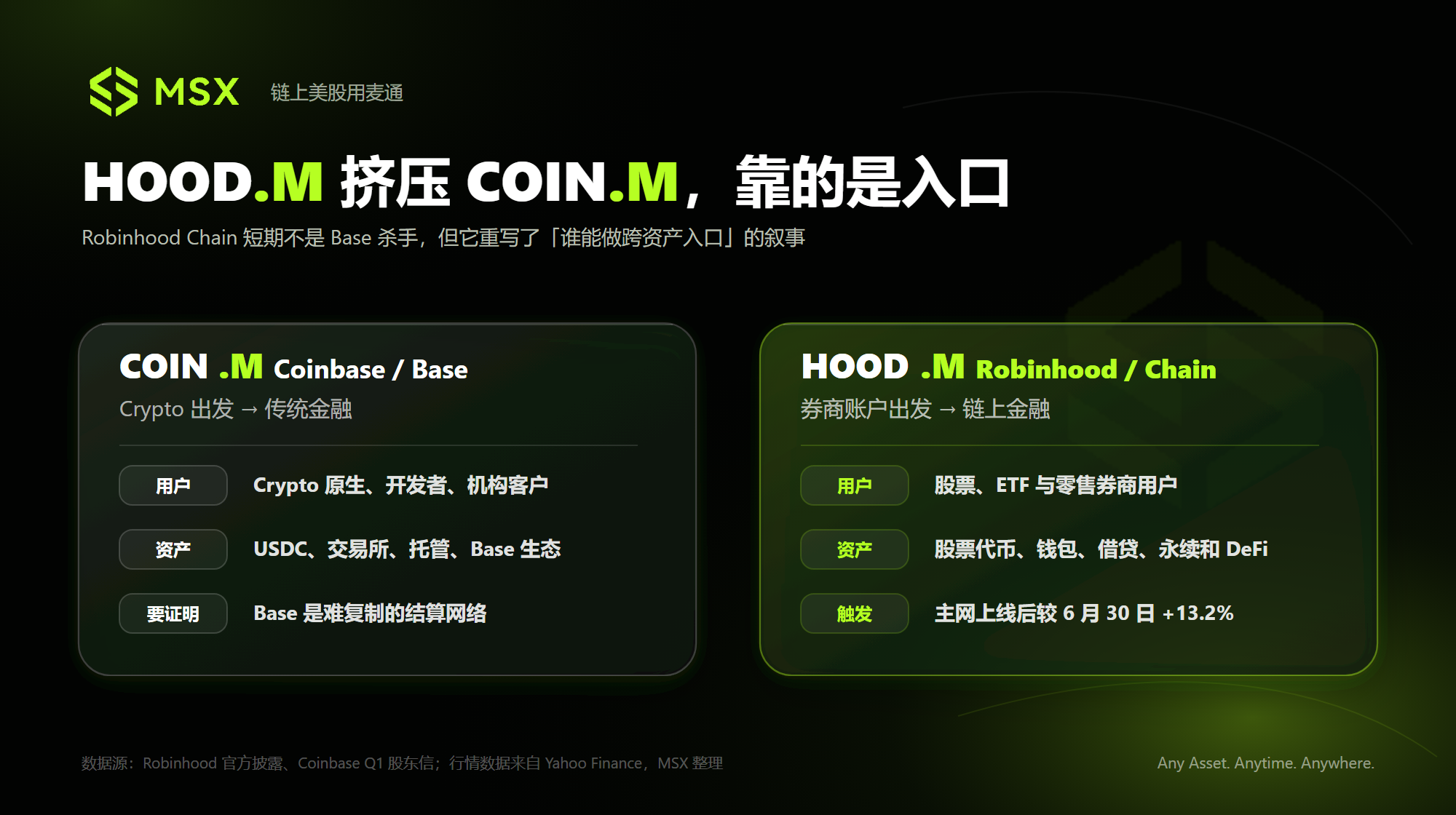
However, careful comparison reveals that the differences between the two chains, compared to Coinbase's Base, do not primarily lie in the underlying technology or TPS, but in the different user bases and distribution entrances they control:
- Base is more aligned with native crypto users, aiming to become a universal on-chain operating system for developers, stablecoin payments, and AI Agents;
- Robinhood Chain starts from traditional brokerage users, attempting to bring traditional assets like stocks and ETFs directly into on-chain trading and DeFi;
Realistically speaking, Robinhood Chain cannot yet be deemed a "Base killer" in the short term.
According to statistics disclosed by Coinbase based on Artemis data, Base accounted for about 62% of the adjusted global stablecoin trading volume in Q1 2026, and over 90% of the on-chain AI Agent stablecoin trading volume occurred on Base during the same period.
Coinbase also has evident advantages in stablecoin distribution, holding an average of approximately $19 billion USDC within its products, accounting for more than a quarter of USDC's total circulation, and capturing about 50% of the economic gains from USDC over the past year.
This means that Base currently possesses not just on-chain traffic but also a network effect formed by Coinbase's exchange, custody, institutional clients, and USDC distribution, making it temporarily difficult for Robinhood Chain to directly shake Base's existing advantages in terms of stablecoin balance, developer ecosystem, or on-chain liquidity.
However, Robinhood poses a deeper threat to Coinbase, which does not lie in immediately taking away Base's TVL in the short term.
It is more about demonstrating that a publicly traded brokerage with tens of millions of retail users, a broker dealer license, and securities asset access can also build its own wallets, public chain, and on-chain financial products, keeping users, assets, order flow, and fees as much within its system as possible.
If Coinbase is taking a path of "expanding from Crypto to traditional finance," then Robinhood Chain represents a completely opposite trajectory—entering Crypto and on-chain finance from the US stock and brokerage system.
From this perspective, Coinbase controls native crypto users, stablecoins, and on-chain infrastructure; Robinhood controls traditional investors, securities accounts, and stock assets, when both platforms eventually move towards a complete system of "accounts + assets + trading + wallets + public chains," the competition will shift from simply vying for developers or TVL on a single chain to who can become the next generation of cross-asset financial entry point.
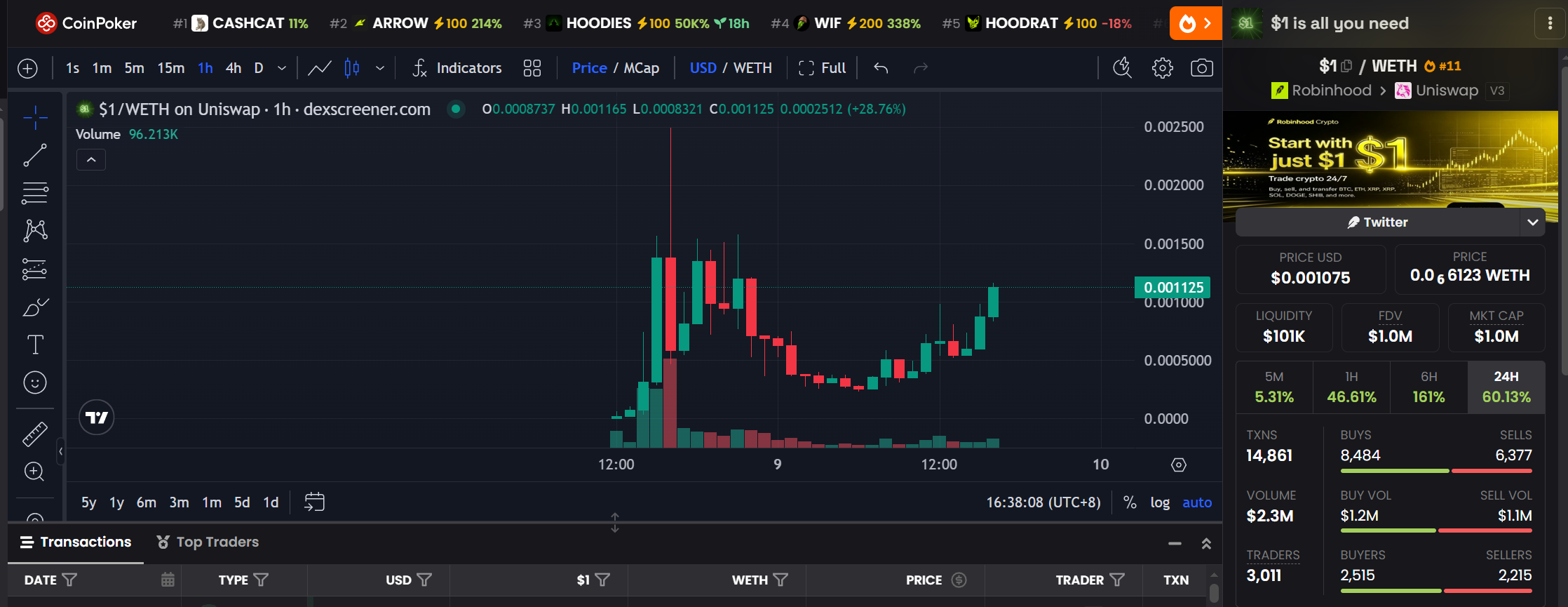
A particularly interesting observation sample is that after Robinhood Chain's mainnet launch, a wave of meme token speculation emerged similar to the meme wave seen on Base back in the day, for instance "$1", whose name evokes Robinhood's long-standing brand memory of "low-threshold investment" available for just $1.
As the speculation around related tokens heated up quickly, there was even a notable number of Robinhood users originally trading US stocks asking how to enter and purchase memes on-chain.
These memes are naturally not directly related to the stock tokens officially launched by Robinhood, but for a new chain, they are undoubtedly the most efficient cold-start tool, capable of rapidly attracting on-chain native funds, traders, and developers into the new ecosystem.
From this perspective, the meme craze at least indicates that Robinhood Chain not only can accommodate traditional assets but also possesses the potential to attract crypto-native funds and speculative traffic, possibly becoming the most differentiated incremental source in this round of on-chain traffic growth.
Of course, Robinhood Chain's business closure has not yet fully formed. According to Robinhood's official disclosure, Robinhood Chain currently operates independently from its main brokerage accounts and crypto accounts, and is not yet a settlement network fully connected to existing brokerage accounts, funds, and order systems.
But the changes have already occurred irreversibly.
In the past, Coinbase enjoyed the scarcity premium of being "the purest crypto infrastructure platform in the US stock market," but as Robinhood builds its own on-chain settlement network, this scarcity is gradually being diluted, making Coinbase no longer the only public company capable of packaging traditional financial assets, stablecoins, trading, and public chains together.
Therefore, Robinhood Chain's recent impact on Coinbase may not immediately reflect in Base's TVL or Coinbase's current revenues; rather, the more concerning aspect is that the long-term valuation narrative and infrastructure scarcity of COIN.M are being reexamined.
3. Strategy's Giant Wheel Turns: From "Buy Buy Buy" to "Starting to Sell Coins"
Another piece of news that is changing market perceptions comes from MicroStrategy (now Strategy).
Strictly speaking, this is not the first time Strategy has sold bitcoin. In early June, the company sold 32 BTC, but the continuous sale of 3588 bitcoins from June 29 to July 5 truly holds symbolic significance from a capital management perspective:
- From June 29 to 30, they sold 1363 BTC at an average price of about $59,256, raising approximately $80.8 million;
- From July 1 to 5, they sold 2225 BTC at an average price of about $60,773, raising approximately $135.2 million;
The two transactions collectively raised about $216 million, and the relevant funds were used to pay preferred dividends and replenish the consumed dollar reserves. As of July 5, Strategy still held 843,775 BTC, with an average holding cost of about $75,476; dollar reserves remained at $2.55 billion.
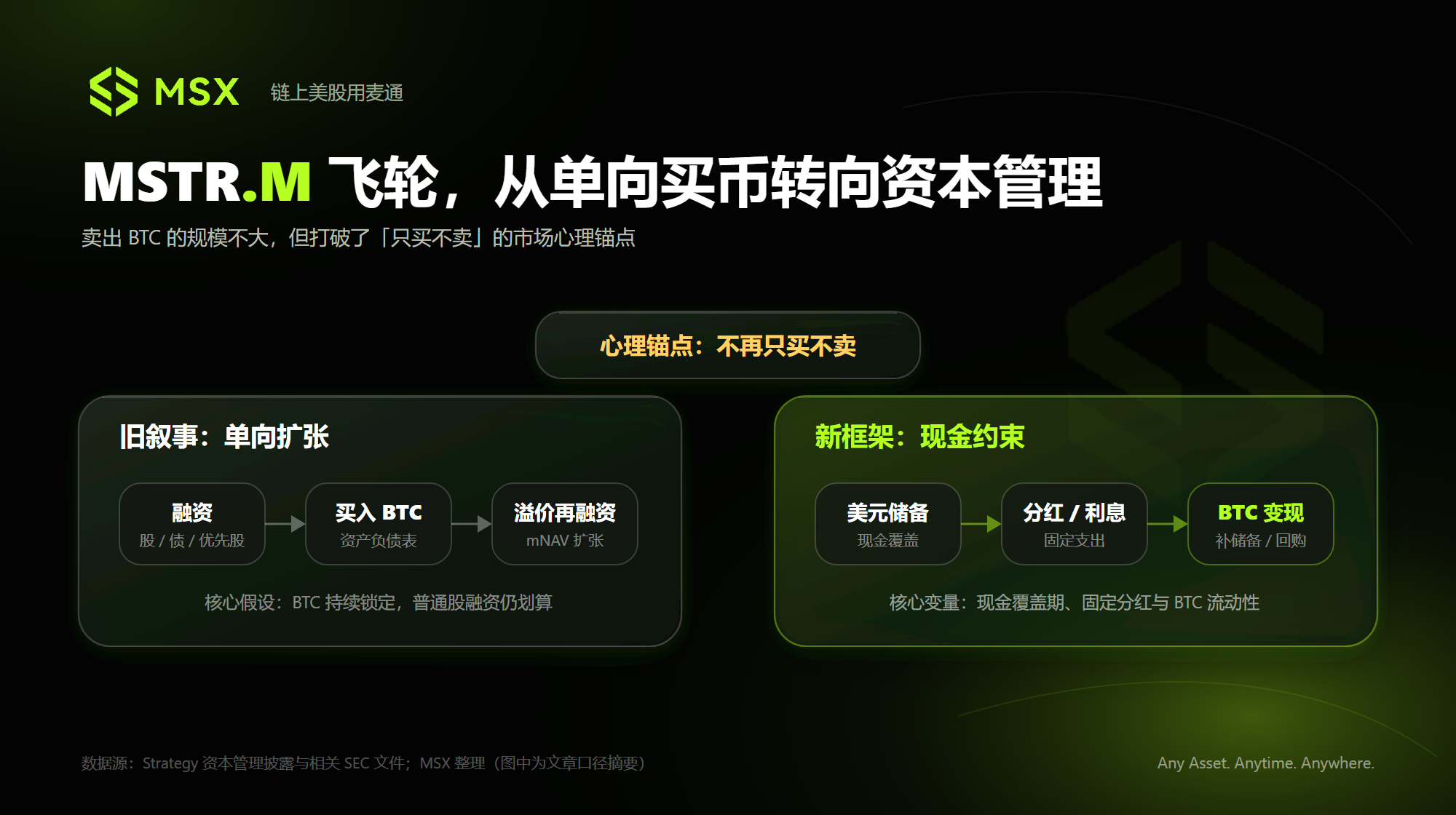
In terms of scale, this round of sales only accounts for approximately 0.42% of the bitcoin holdings prior to sale, which clearly does not indicate that Strategy has begun to systematically short bitcoin, but it does break an important market psychological anchor—Strategy's bitcoin is no longer just permanently locked on the balance sheet as reserves; it can also be actively sold to pay for the real costs of capital structure.
So why now?
In recent years, Strategy's business model can be simplified into a one-way financing flywheel, namely "issue common stock, convertible bonds, or preferred shares → raise funds to buy bitcoin → BTC price increase drives net assets and stock price up → continue financing to buy coins based on valuation premium."
Therefore, the most critical variable is MSTR's premium relative to its net bitcoin assets, commonly known as mNAV in the market.
This also means:
- When MSTR's mNAV is significantly above 1x, the company can issue stock at a price higher than the net asset value of bitcoin, using the raised funds to buy BTC, as long as the issuance price is high enough, this operation can increase the corresponding number of bitcoins per share and achieve what is referred to as "enrichment";
- But when mNAV shrinks close to 1x, the effectiveness of continuing to issue common stock rapidly diminishes, and the financing amount obtained by the company may be insufficient to compensate for the dilution caused by the new shares.
In essence, when financing through common stock is no longer favorable, the optimal direction of capital allocation may reverse, opting to sell BTC to replenish cash.
This was the core change in Strategy's new capital management framework launched on June 29. This framework includes dollar reserve policies, STRC dividend policies, a maximum of $1 billion in preferred security repurchase authorization, a maximum of $1 billion in MSTR common stock repurchase authorization, and a bitcoin monetization plan, clearly stating the transition from past "one-way capital issuance" to active capital management involving issuing and repurchasing in parallel.
However, as of June 28, Strategy had about $2.55 billion in dollar reserves, while current annual estimates for preferred dividends and debt interest expense are about $1.76 billion, corresponding to about 17.4 months of cash coverage.
If we also consider the board's authorization and a $1.25 billion bitcoin monetization quota available to replenish dollar reserves, the total liquidity coverage ability is approximately $3.8 billion, equivalent to around 25.9 months of current dividend and interest expenses.
This indicates that Strategy currently does not face an imminent redemption crisis.
But the problem lies in the fact that as the scale of preferred stock and debt expands, the company's fixed cash expenditures are rapidly increasing, combined with the fact that bitcoin itself does not generate interest or operating cash flow, while preferred dividends and debt interest need to be continuously paid in dollars, this will inevitably tap into dollar reserves and potentially lead to bitcoin sales.
For common stock shareholders, this means that the pricing logic of MSTR is becoming more complex.
In the past, many investors viewed MSTR as a high-leverage bitcoin proxy: when BTC rises, MSTR achieves larger gains through financial leverage and valuation premium; when BTC falls, it experiences more severe pullbacks.
But under the new capital structure, MSTR no longer only bears the price fluctuations of bitcoin but also has to account for preferred dividends, debt interests, and dollar liquidity reserves.
Based on this logic, while the direct economic impact of selling 3588 BTC this time is limited, the narrative significance is substantial.
This also represents a significant turning point in MSTR.M's underlying investment logic.
In Conclusion
Overall, the recent intersection of crypto and US stocks is witnessing several new variables worth paying attention to.
From the resonance between USDC circulation and CRCL, to Robinhood's self-built public chain potentially squeezing the Coinbase ecosystem, and Strategy starting to sell bitcoin, these changes reflect not just single events but adjustments in the business models, competitive landscape, and capital operations of related companies.
For investors, the pricing logic of these assets is also becoming more complex, requiring continuous attention to stablecoin scale, on-chain activity, user and asset migration, financing costs, and capital structure, in addition to the fluctuations of the crypto market itself.
These changes may not yet form final conclusions, but they are already sufficient to become clues worth tracking in the next stage.
免责声明:本文章仅代表作者个人观点,不代表本平台的立场和观点。本文章仅供信息分享,不构成对任何人的任何投资建议。用户与作者之间的任何争议,与本平台无关。如网页中刊载的文章或图片涉及侵权,请提供相关的权利证明和身份证明发送邮件到support@aicoin.com,本平台相关工作人员将会进行核查。


