De-globalization, electrification, and currency devaluation are three major demand engines accelerating, while the AI sector is severely overvalued compared to physical hard assets.
Written by: Zhang Yaqi, Wall Street Insight
The inherent logic of the commodity supercycle is being verified by a historical cycle that spans several decades.
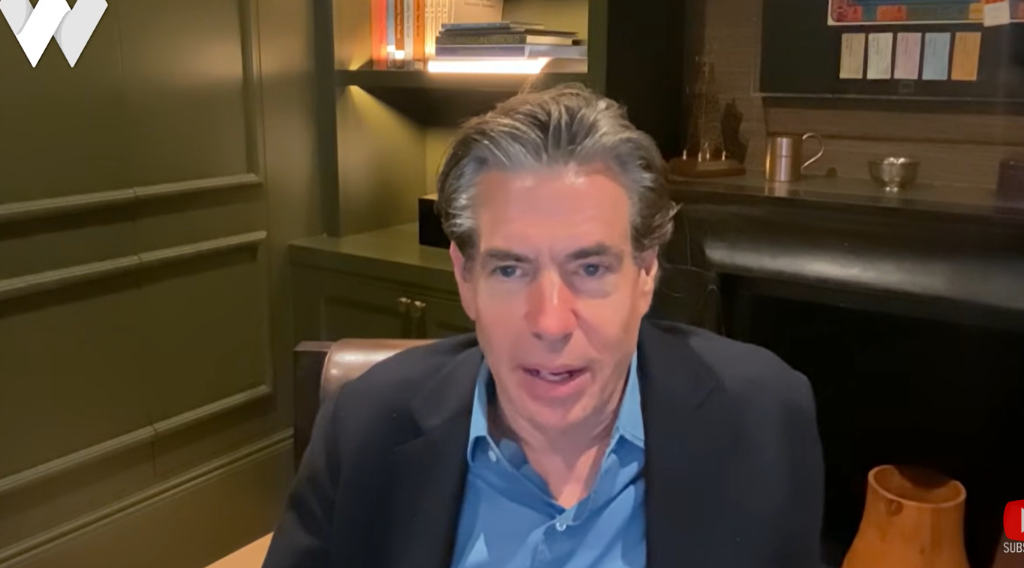
Jeff Currie, Senior Advisor at the Carlyle Group and former Global Head of Commodity Research at Goldman Sachs, recently stated that the current commodity supercycle, which began in October 2020, is far from over. He assesses that the AI technology sector, represented by NVIDIA, is severely overvalued relative to its market capitalization, while energy and physical hard assets are undervalued; the energy sector accounts for about 3% of the S&P 500 and should rebound to 10% to 15%. This portion of space will ultimately come from the AI sector.
Currie refers to this structural shift as "the revenge of the old economy." He points out that the three major demand-driven forces—de-globalization, electrification, and currency devaluation—began to take shape in 2020, and each is now accelerating. The current pace of capital expenditure from large-scale data center operators is reminiscent of the over-expansion seen in mining and oil companies in 2014, quietly planting the seeds for the next round of capital misallocation.
Historical Cycle: Repeats Approximately Every 12 Years
Currie analyzes the current landscape within a longer historical framework. He believes "the revenge of the old economy" is not an isolated incident, but a structural rule that cycles approximately every 12 years—mass construction in the 1950s, price suppression in the 1960s, capital chasing "the magnificent 50" and other new economic assets; investment in the old economy stagnates, ultimately triggering the commodity supercycle in the 1970s.
"The commodity supercycle of the 1970s was not caused by the Arab oil embargo—that was just the trigger; the real seed was planted in the early 1960s when investment stopped," Currie said.
This logic was first clearly validated during the collapse of the internet bubble in 2002, when Currie proposed the concept of "the revenge of the old economy" at Goldman Sachs. He initially thought it was an isolated phenomenon, but now he is convinced it is a repetition of a systematic rule.
The supply-side characteristics of the current cycle are also clearly identifiable: refining margins are almost on par with crude oil prices, a rare phenomenon rooted in long-term underinvestment in refining capacity, compounded by damage to Russian refineries; both copper mines and oil fields also lack effective investment. Currie points out, "The reason oil prices can't rise is because refining capacity is insufficient, not because there isn't enough crude oil itself."
Three Major Demand Engines Continued Acceleration
Currie summarizes the demand-side logic of this supercycle into three main lines, emphasizing that these lines have not weakened since their introduction in 2020, but rather have accelerated under the current circumstances.
In terms of de-globalization, from the expansion of defense spending, the repatriation of critical mineral industries, to the shift in supply chains from a "just-in-time" model to a "just-in-case" backup inventory model, this trend has been evident since the trade friction in 2018 and is currently being significantly accelerated, with each item heavily reliant on commodity inputs.
Regarding electrification, Currie deliberately corrects a historically misread backdrop— the rise of renewable energy and nuclear power originated from the energy security crisis of the 1970s, rather than climate issues. The term "energy transition" was introduced by Jimmy Carter in the 1970s, focusing on energy security. He believes that regardless of the narrative framework used, the underlying logic of electrification remains unchanged, and the overlay of demand from data centers significantly reinforces this logic.
On currency devaluation, Currie believes that large-scale fiscal redistribution has accumulated massive debts, and the essence of this is the continuous dilution of the purchasing power of fiat currency. He points out that the fiat currency system was only formally established in 1971, which is merely a very short experiment in human history. As gold prices continue to rise, the proportion of gold in the reserves of central banks naturally increases, and the global monetary system is quietly drifting towards a quasi-gold standard state.
How Investors Should Allocate Commodity Exposure
For portfolio allocation, Currie suggests that institutional investors set their commodity exposure at around 3%, reasoning that its high volatility means even a small position can provide significant exposure; if investors have a higher tolerance for volatility, they may appropriately increase this during the supercycle phase. He specifically alerts that purely quantitative models, based on the negative correlation between commodities and stocks, would suggest allocating 20% to 30%, but he believes that this ratio is too high.
In terms of investment tool selection, Currie emphasizes the critical impact of futures curve shape on actual returns—something often overlooked by retail investors. He points out that when commodities are scarce, the futures curve exhibits a "backwardation" structure (near-term contracts are more expensive than long-term contracts), and that rolling over positions by buying relatively cheap long-term contracts and selling more expensive near-term contracts can contribute around 30% of returns from this "rolling yield." "The oil price itself is only part of the equation; the shape of the curve is equally critical."
Using the Russia-Ukraine conflict as a benchmark, he notes that although current oil prices are actually lower than they were then, investors who continued to roll over their positions have achieved cumulative returns of 30% to 40%, thanks to this mechanism. In contrast, under a contango structure (where long-term contracts are more expensive than near-term contracts), rolling over will incur losses each time, which is the fundamental reason retail investors who purchased the USO fund in 2009 and 2020 still recorded losses despite a surge in oil prices.
Building Next Generation Commodity Investment Products
Currie is currently working to construct the next generation of commodity investment products, planning to achieve this through actively managed ETF structures or total return swap contracts, with the core goal of allowing investors to maintain long positions without having to handle the cumbersome futures rollover operations themselves.
He believes that the existing mainstream products—including the Goldman Sachs Commodity Index (GSCI) and Bloomberg Commodity Index—are designs from decades ago, long overdue for systematic updates. "Anyone who has worked on a commodity trading desk for ten years can construct an index that outperforms the Goldman Sachs Commodity Index by 10%," he says. The focus of new product design is on how to preserve and capture the scarcity premium, as well as how to optimize the rollover mechanism.
Currie also admits that his role has fundamentally changed: during his 27 years at Goldman Sachs, his job was to tell the world how much commodities were worth; now he has founded 1947 Oil & Gas, which engages in oil and gas production in the Gulf of Mexico, and personally holds these assets. "This is a completely different perspective on the conversation," he says.
免责声明:本文章仅代表作者个人观点,不代表本平台的立场和观点。本文章仅供信息分享,不构成对任何人的任何投资建议。用户与作者之间的任何争议,与本平台无关。如网页中刊载的文章或图片涉及侵权,请提供相关的权利证明和身份证明发送邮件到support@aicoin.com,本平台相关工作人员将会进行核查。


