Author: Gu Yu, ChainCatcher
On July 8, 2026, Seb Audet, CEO of the DeFi portfolio tracker Zapper, posted a brief yet heavy announcement on X: After nearly seven years of operation, Zapper will officially shut down all functionalities on August 3, including the official website zapper.xyz, mobile app, and API services. This project, which once had 2 million monthly active users and processed over 13 billion dollars in transactions, has come to an end.
Audet wrote in the announcement: "We evaluated various options and made every effort to advance some of them, but ultimately realized that an orderly shutdown was the best choice." He expressed gratitude to all users, investors, advisors, employees, and community members, admitting that Zapper's mission was to make DeFi more accessible. Although it did not achieve this mission in the originally hoped-for manner, he believes the team did help quite a number of people make the on-chain economy significantly easier to use.
Unlike the vast majority of projects that shut down, Zapper was a product frequently used by many DeFi users, having high market adoption and user stickiness. Its closure feels even more poignant than those other projects that relied entirely on narratives and had few users from the start.
"This is really a collective memory of the first generation of DeFi enthusiasts. Back in the day, many people would open Zapper every day to check their assets, look at LPs, see returns, but this project did not seize its best moment and fell into decline with a bit of arrogance," said well-known KOL Feng Mi on X.
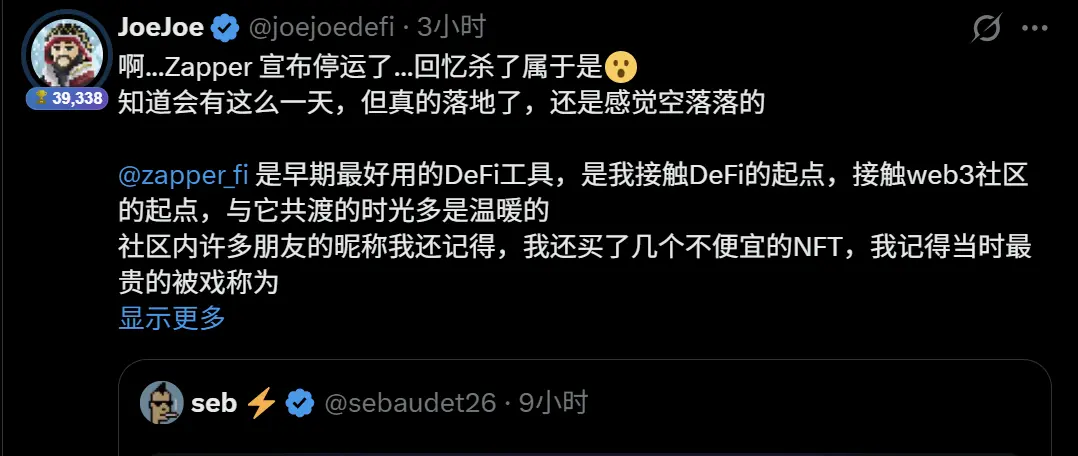
"Nostalgia," "sad," "the best product," "used every day"—such fondly reminiscent comments are frequently seen in the tweet's comment section.
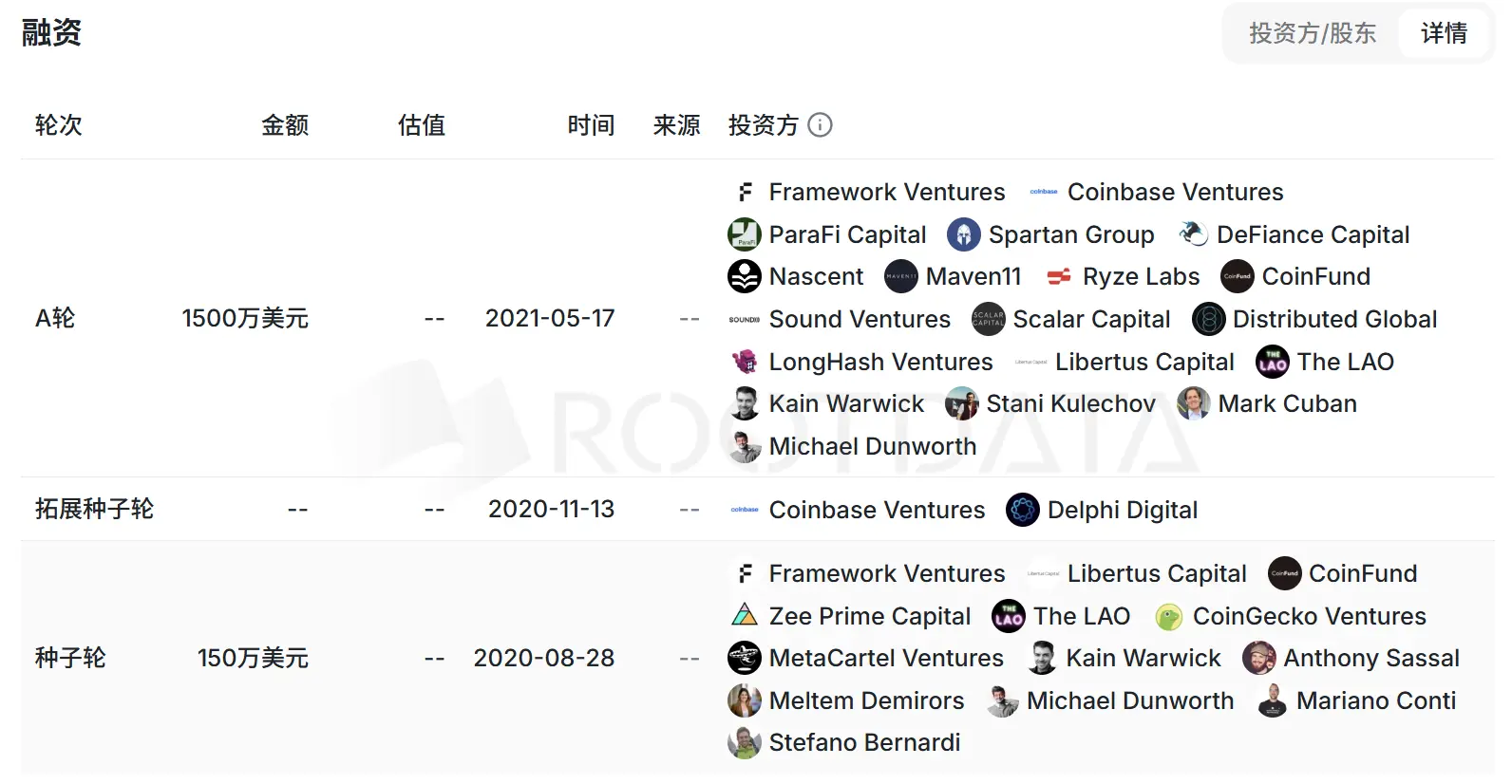
The story of Zapper began in 2019. That year, the project won at Kyber's DeFi hackathon and completed a 1.5 million dollar seed round in early 2020, with investors including Framework Ventures, MetaCartel Ventures, and ParaFi Capital. What truly brought Zapper into the mainstream was its 15 million dollar Series A financing in May 2021, led by Framework Ventures, with notable investors such as Mark Cuban and Sound Ventures, owned by Ashton Kutcher.
Zapper was formed from the merger of two products, DeFi Snap and DeFi Zap. Its core function was asset inventory tracking—users could connect their wallets and monitor their assets in the DeFi space in real time.
At that time, various Layer 1 and Layer 2 solutions were flourishing, and users often needed to participate in DeFi protocols or purchase NFTs or tokens across different public chains, resulting in very dispersed asset distribution. As a result, asset aggregators represented by Zapper, Debank, and Zerion quickly gained a large number of users.
With continuous integration of major public chains and DeFi protocols, Zapper gradually expanded its functionalities to include asset exchange trading, NFT queries, and asset bridge migration. The platform covered over 450 DeFi protocols and more than 7,000 tokens, spanning across 14 networks. Its most distinctive "Zap" feature allowed users to complete complex multi-step DeFi operations with a single transaction, including yield farming, providing liquidity, and cross-protocol strategies.
In fact, Zapper was likely the pioneer of the popular point system based on on-chain interaction behaviors. In September 2021, Zapper launched a point system based on actions such as check-ins, cross-chain interactions, and trading, where different point levels could be exchanged for corresponding NFTs, with over 100,000 addresses participating in interactions and minting NFTs, drawing significant trading interest due to the anticipated airdrop.
According to Opensea, the total trading volume of this NFT series surpassed 1,200 ETH, approximately 5 million dollars based on the ETH price at the time. However, due to the weakening narrative surrounding DeFi and NFTs, Zapper did not launch related activities thereafter. Currently, the price of this NFT series has completely dropped to zero.
The ceiling for a purely dashboard product is limited. Zapper subsequently undertook a series of transformation attempts.
In October 2023, Zapper launched the on-chain social application Chainchat, where users had to buy "shares" for the corresponding channel to join group chats, and leaving a channel required selling all shares, with channel members sharing transaction fees according to their shareholdings..
Subsequently, Zapper released the V2 version, repositioning the product as a Web3 exploration tool, extending its activity range from DeFi to NFTs, DAOs, portfolios, and other on-chain accounts..
In June 2024, Zapper announced the launch of the Zapper Protocol, with the vision of "achieving Onchain Literacy," planning to release the token ZAP in the fourth quarter. The protocol was designed as an open protocol aimed at incentivizing the parsing and contextualization of on-chain information—transforming complex on-chain transactions into human-readable outputs. The ZAP token would serve as a reward for curators contributing data parsing, and application developers could also access Zapper's API services by paying with ZAP..
However, this ambitious plan ultimately failed to materialize. The ZAP token was never officially issued, and the Zapper Protocol was shelved as the market turned bearish. All these attempts ultimately failed to change the fate of the project.
The seven-year journey of Zapper, in some ways, mirrors the DeFi industry's evolution from its nascent stage to explosive growth and then to rational contraction.
During the bull market from 2019 to 2021, capital flooded into the DeFi space, spawning countless tools and aggregation projects. The loose funding environment allowed many projects to expand rapidly without pursuing profitability—Zapper's achievement of seed and Series A financing in 2020 and 2021 is a typical example of this period.
The closure of Zapper is lamentable because it was not an unnoticed failed project. With 2 million monthly active users at its peak and over 13 billion dollars in transaction processing volume, it was a considerable scale for any field. However, there is ultimately an insurmountable gap between traffic and sustainable business revenue.
Zapper's prior revenue model primarily relied on small fees collected from DEX aggregation transactions, but in the fiercely competitive aggregator space, the fee margins were continually compressed. Meanwhile, maintaining a data index and real-time updates covering multiple chains and hundreds of protocols required continuous investment in engineering resources and infrastructure costs. When the logic of "traffic first, monetization second" could not be realized during the prolonged market contraction, shutting down became the only choice.
Ultimately, Zapper fell into the gap between traffic and revenue. Its shutdown does not mean that the value of the DeFi entrance has been disproven, but rather indicates that without strong trading monetization channels, purely tool-based products find it hard to survive independently. The next Zapper may not appear, but the industry still needs a better "entrance."
免责声明:本文章仅代表作者个人观点,不代表本平台的立场和观点。本文章仅供信息分享,不构成对任何人的任何投资建议。用户与作者之间的任何争议,与本平台无关。如网页中刊载的文章或图片涉及侵权,请提供相关的权利证明和身份证明发送邮件到support@aicoin.com,本平台相关工作人员将会进行核查。


