Written by: Rita
Trends Guided Reading
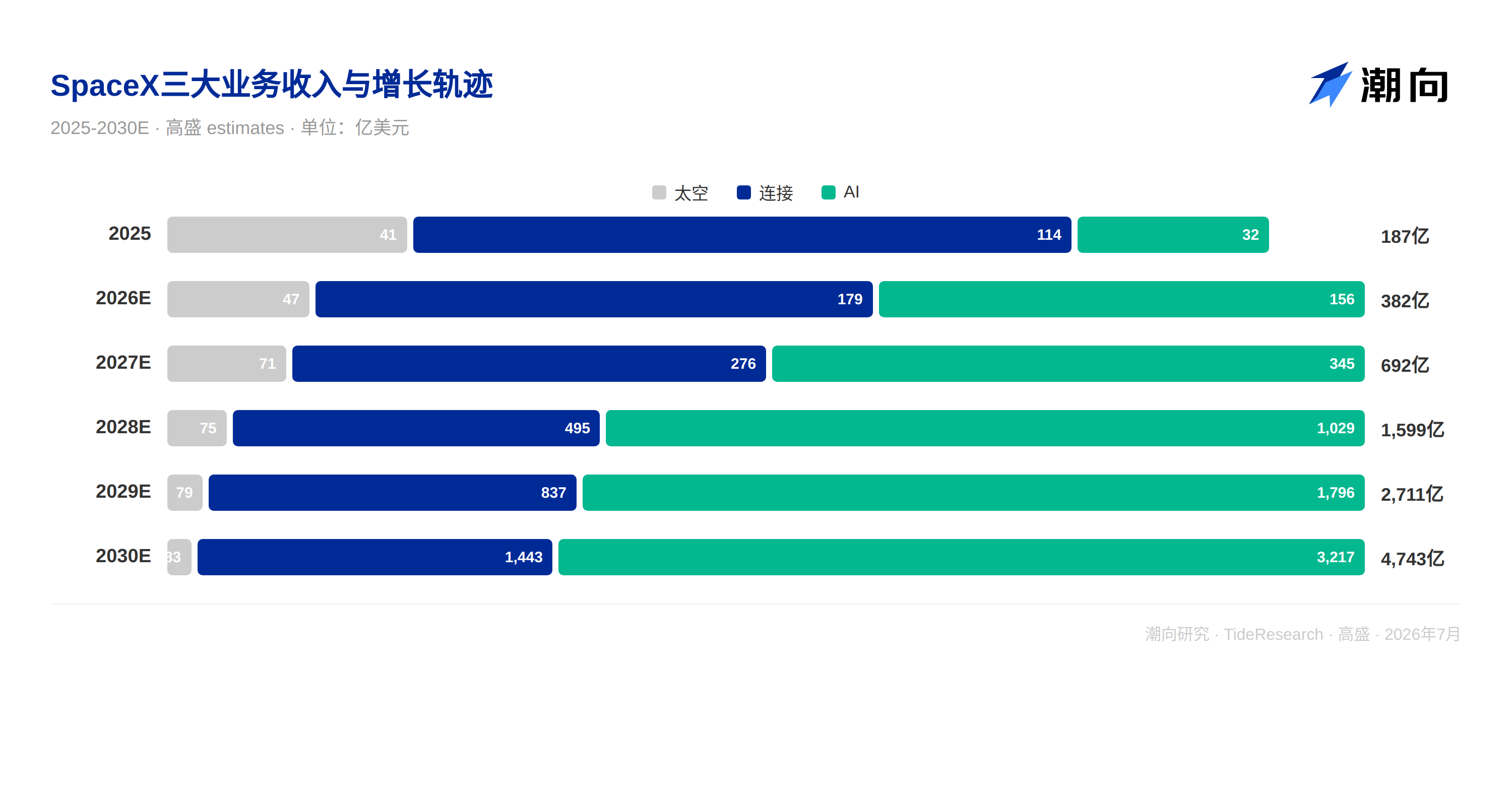
Goldman Sachs initiated coverage on SpaceX (SPCX) on July 7, giving it a buy rating with a 12-month target price of $205. Goldman Sachs framed the company through three independent businesses: Space (launch and reusability), Connectivity (Starlink broadband and satellite mobile communication), and AI (computational power and X/Grok advertising). Each business corresponds to a trillion-dollar market, and SpaceX's vertical integration is creating a chemical reaction among these three markets, using space capabilities to foster connectivity and using connectivity to support AI. SpaceX's revenue is projected to be $18.7 billion in 2025, $38.2 billion in 2026, $69.2 billion in 2027, and soaring to $159.9 billion in 2028.
A Leap from Launcher to AI Powerhouse
SpaceX is no longer just the "rocket company." Goldman Sachs defines it as a vertically integrated "infrastructure as a service" enterprise.
The first business is Space. The Falcon 9 and Falcon Heavy rockets have conducted over 658 missions with a success rate of over 99%. Starship is transitioning from testing to commercial operations, and Goldman Sachs estimates there will be approximately 100 Starship launches for connectivity between 2026 and 2028, with more than 9,400 launches for AI orbital computational deployment. SpaceX currently accounts for over 80% of the global payload delivered to orbit.
The second business is Connectivity. Starlink broadband users are projected to grow from 2.3 million in 2023 to 8.9 million by the end of 2025, with Goldman Sachs estimating 96.2 million by 2030, increasing its share of global broadband subscriptions from 0.7% to 6.5%. Starlink mobile currently has about 7.4 million monthly active connected devices, with predictions reaching 178 million by 2030.
The third business is AI. This is the biggest variable. In February 2026, SpaceX acquired xAI for about $250 billion and is concurrently acquiring Cursor (an AI programming tool). Goldman Sachs estimates SpaceX's AI computational power will expand from 2 gigawatts at the end of 2026 to 36 gigawatts by 2030, with about 26 gigawatts being orbital computational power. AI business revenue is projected to surge from $15.6 billion in 2026 to $321.7 billion in 2030.
Goldman Sachs combined the three businesses to calculate: Space revenue is expected to grow from $4.1 billion in 2025 to $8.3 billion in 2030 (15% five-year compound growth rate); Connectivity revenue is expected to grow from $11.4 billion to $144.3 billion (69% five-year compound growth rate); and AI revenue is projected to grow from $3.2 billion to $321.7 billion (107% five-year compound growth rate). Total revenue is expected to increase from $18.7 billion to $474.3 billion, a 24-fold increase over four years.
Vertical Integration: SpaceX's Core Barrier
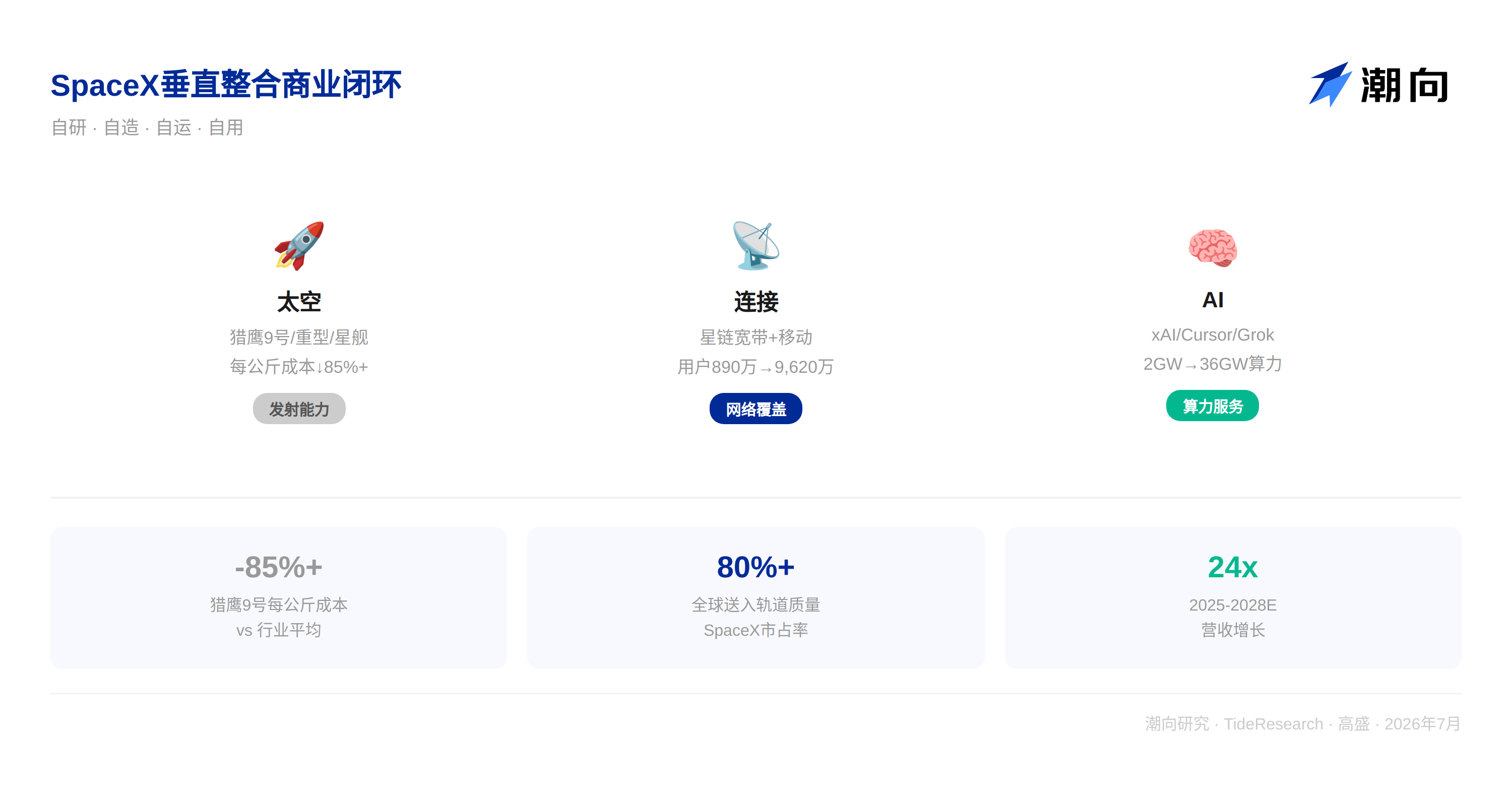
SpaceX's competitiveness does not come from any single business; it comes from vertical integration. It manufactures rockets, conducts launches, operates satellites, builds data centers, and trains large models.
On the space side, Falcon 9 has reduced the cost of launch per kilogram by over 85% from the industry average of $18,500. The goal of Starship is to reduce it by another order of magnitude; Goldman Sachs estimates that by 2030, the cost per kilogram for Starship will be about $183, which is 99% lower than the industry average.
On the connectivity side, SpaceX deploys Starlink with its own launched satellites, eliminating the need to pay any third party for launch fees. On the AI side, SpaceX is working with Tesla to advance the Terafab project, aiming to complete the design and manufacturing of AI chips in-house.
This "self-manufacture, self-operate, self-consume" closed loop allows SpaceX's cost structure to be naturally superior to any competitor.
Valuation and Risks: Assumptions Behind the $205 Target Price
Goldman Sachs prices SpaceX using a sum-of-the-parts valuation: Space business at 15 times EV/Sales, Connectivity business at 24 times EV/EBIT, and AI business at 28 times EV/EBIT, discounting each business's valuation two years into 2029 to arrive at a target price of $205. The upside scenario is $295, and the downside scenario is $95, with a risk-reward ratio of 2 to 1.
Goldman Sachs expects SpaceX to achieve positive free cash flow only by the fourth quarter of 2030, needing to issue approximately $270 billion in debt cumulatively between 2026 and 2030. In terms of corporate governance, the CEO and founder holds majority voting rights, and related-party transactions (including collaboration with Tesla on Terafab and Macrohard) need to be continuously monitored.
Trends Perspective
The most thought-provoking aspect of Goldman Sachs' report is: what does SpaceX's valuation hinge upon? Among the three businesses, the directions of Space and Connectivity are relatively clear; Falcon 9 has validated reusability, and Starlink's user growth and revenue scale are backed by data. The real uncertainty lies in AI. The AI business is projected to incur a loss of $6.35 billion in 2025, with Goldman Sachs expecting it to break even in 2028 and generate a profit of $81.3 billion in 2029. This leap in profitability comes from the scaled deployment of orbital computational power, where it will require more than 9,400 Starship launches annually starting in 2029 to transport AI satellites. The technology for orbital data centers has yet to be validated, and the FAA launch permits are limited to only 25 per year (for the Starship base), with other launch sites still under construction. Goldman Sachs' forecasts implicitly assume that advancements in technology, regulation, and manufacturing exceed expectations across all three dimensions.
Another point worth noting is the risk warnings that Goldman Sachs themselves noted: the CEO holds majority voting rights, the management team receives substantial performance-based equity incentives, and related-party transactions are frequent (including collaboration with Tesla). These cumulative factors may lead to significant stock price fluctuations.

Disclaimer
This article is a summary and interpretation by Trend Research of the third-party research report (Goldman Sachs, July 7, 2026). The ratings, target prices, profit forecasts, and related judgments quoted in this article represent the views of the said brokerage firm's analysts and reflect their institution's stance, not the views of Trend Research, nor do they constitute any investment advice.
Markets are risky, and decisions must be independent. This article should not be used as the basis for buying or selling any securities.
免责声明:本文章仅代表作者个人观点,不代表本平台的立场和观点。本文章仅供信息分享,不构成对任何人的任何投资建议。用户与作者之间的任何争议,与本平台无关。如网页中刊载的文章或图片涉及侵权,请提供相关的权利证明和身份证明发送邮件到support@aicoin.com,本平台相关工作人员将会进行核查。


