Author丨Hu Shixin Editor丨Ye Jinyan
Produced by Deep Network·Tencent News Xiaoman Studio
In the early morning of June 9, Beijing time, Apple WWDC 2026 kicked off in Cupertino. Cook took the stage as usual with a "Good morning", but this time it felt more like a farewell: this is his 15th, and also his last time hosting WWDC as CEO. On September 1, Senior Vice President of Hardware Engineering John Ternus will take over Apple.
This year marks the 50th anniversary of Apple, with its market value reaching a high of $4 trillion; however, this 78-minute keynote had no new hardware products, betting almost entirely on AI. Over the past two years, Apple Intelligence has been postponed multiple times, the reconstruction of Siri has yet to materialize, and Apple has had to pay $250 million in settlement costs in North America due to controversies surrounding AI promotions.
ChatGPT has rewritten the industry for two and a half years. Can Siri, once disliked by Apple users, still become the entry point for iPhone?
Apple's answer is to redo Siri, building its foundational capabilities with Google's model technology, and embedding AI into native applications like Safari, Photos, Passwords, and Shortcuts. However, the capital market does not seem to have immediately accepted this, as Apple's stock price fell 1.89% on the day of the event and continued to drop approximately 1.92% after hours, with a market value evaporating by over $75 billion.
After two years of waiting, Apple AI has finally taken center stage. The question is, has it truly filled the gaps, or is it just packaging lateness as a new beginning?
Siri AI, lending "soul" to Google
About 30 minutes into the event, Apple Intelligence and Siri AI took the stage.
It is reported that the next-generation Apple Intelligence will advance through cooperation with Google, using the technology behind the Gemini series models to create the next generation of Apple foundational models—Apple Foundation Models. One part of this model operates on the device side, handling tasks with lower latency and greater relevance to personal data; another part is handled by private cloud computing servers to address heavier requests such as image generation and complex reasoning.
Apple has also introduced a system orchestrator to schedule abilities like personal context understanding, world knowledge, App operation, and screen perception. In other words, Apple wants AI to not only answer questions but also to understand what users are looking at, what is in their devices, and which applications can be invoked.
Apple also continues to emphasize its consistent privacy narrative: data only serves the current request and will not be stored; both Apple and third parties cannot access it.
After the event, Apple executives added that this is not simply connecting to Gemini. The Apple foundational model is made up of multiple sets of models on the device side and cloud side, customized for Apple Silicon, and while it references Gemini’s distillation technology during training, what ultimately runs for users is still Apple's own model.
The revamped Siri has been renamed Siri AI, now possessing an independent app, with conversation history that can be synchronized across iCloud. It has been integrated into the Dynamic Island, supports screen content understanding, and can invoke applications to complete tasks through App Actions: such as generating party menus based on game schedules, extracting information from text messages to supplement invitations, recognizing bill splitting, and combining flight information to determine whether a backpack can be taken on board. Native applications like Safari, Passwords, Phone, and Photos have also integrated AI capabilities.
Apple's intention is clear: Siri is no longer just a voice entry point but has become a central hub interwoven with system and application operations.
However, the feedback after the event is not entirely optimistic. The main debate from the outside focuses on one point: Siri AI has indeed filled the gaps in context understanding, screen perception, and cross-application invocation, but the capabilities it showcased are mostly directions that have already been repeatedly validated by large model products in the past two years. It makes Siri more like a system-level assistant than before, yet it has not shown a truly unexpected new entry point.
In addition, due to regulatory requirements, Siri AI and the full capabilities of Apple Intelligence are currently not available to users in the EU and mainland China. For Chinese users, the core AI updates presented at the event can still only be seen, but not immediately used.
Cook’s AI debt
The passive state of Apple AI today is a result of gradual accumulation over the past decade or so.
Since Cook took over Apple, he has almost brought the company to its commercial peak. In the past 15 years, Apple’s market value has risen from about $350 billion to $4 trillion. However, on the other hand, the "Cook era" has excelled in deterministic management, making Apple slow in the competition for generative AI.
Veteran analyst Guo Mingqi previously commented that Cook built a profitable fortress with extreme supply chain management but also left Apple with a heavy AI debt.
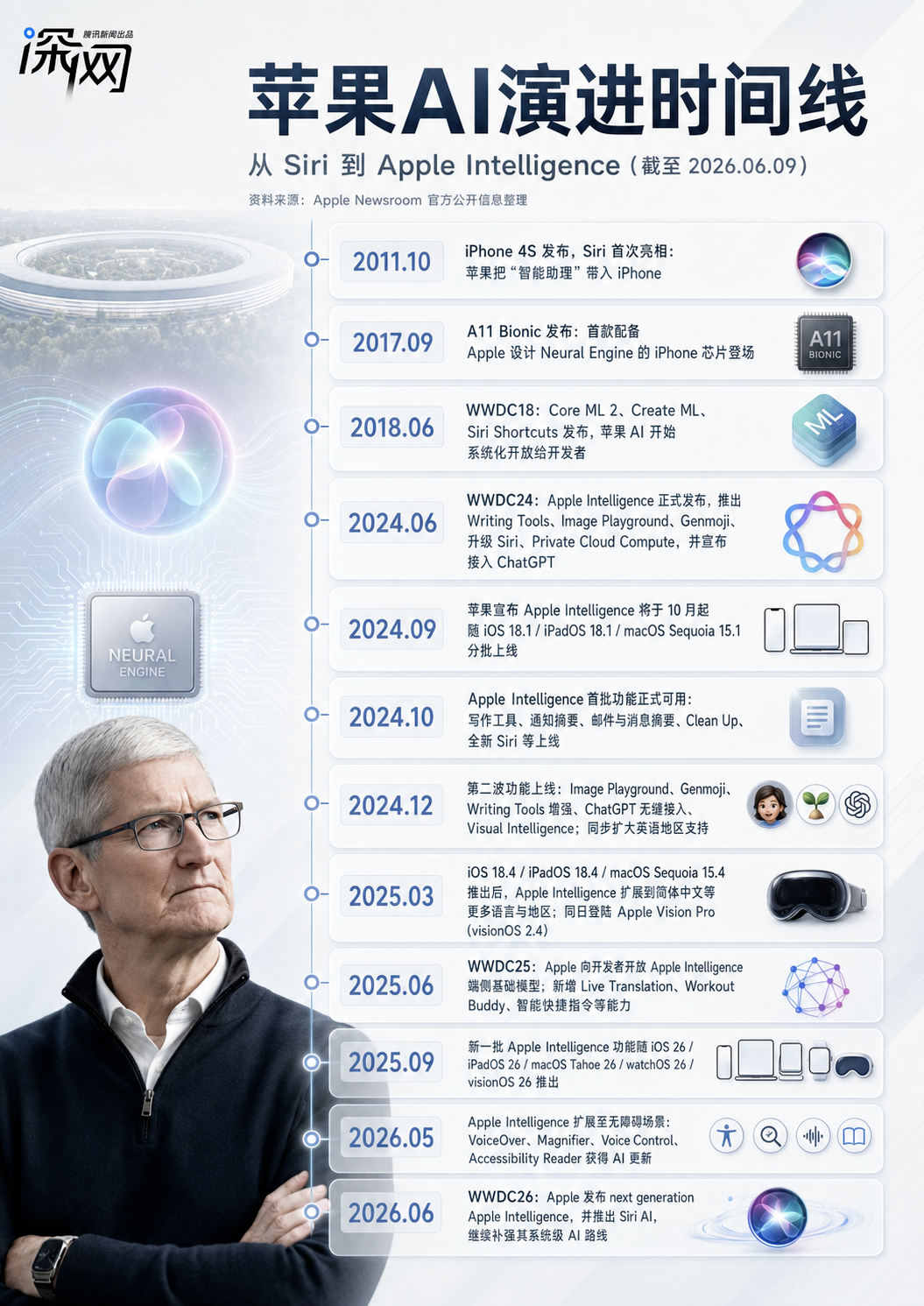
Siri is the most typical cut into this debt. In 2010, Jobs acquired Siri for $200 million. In 2011, with the release of the iPhone 4S, Siri was introduced. It was originally Apple’s first bet on smart assistant entry but missed multiple upgrade windows over the following years. The head of Siri has changed multiple times, from Scott Forstall, Eddy Cue, to Federighi, and John Giannandrea; each adjustment was hoped to be a restart, but none made Siri truly smarter.
In 2018, Cook hired Giannandrea from Google, trying to fill the AI capability gap. At that time, Apple's senior vice president of software engineering, Federighi, told the team that he was just the AI candidate Apple needed. But seven years later, Siri still remains in the awkward position of "can wake up, can answer, but not very useful." The real issue came to light with the emergence of ChatGPT. A senior Apple executive later admitted to Bloomberg that before that, Apple's intelligence could even be considered not a coherent solution.
Apple also attempted to remedy the situation. At WWDC 2024, Apple Intelligence was launched, and the demonstration showed Siri capable of understanding personal data and manipulating apps across devices; the iPhone 16 was also packaged as "born for Apple Intelligence." However, after the new device was launched, the core version of Siri was not made available as promised. Bloomberg later revealed that Federighi found that some demonstration functions were unstable during internal testing, and those stunning visuals were more of pre-recorded prototype videos. After repeated delays, Apple pulled down related advertisements, and users who purchased the iPhone 16 also filed lawsuits.
Apple then reorganized its AI team. It is reported that by March 2025, Siri was separated from Giannandrea and handed over to Vision Pro head Mike Rockwell. Rockwell was incorporated into the Vision Pro core team, replacing some of Siri’s original staff and working with Federighi and others to advance collaboration with Google to strengthen the foundational capabilities of the new Siri through Gemini and Google Cloud. The Information disclosed that a key reason for the collaboration was that Apple’s self-developed models were not ready, especially unable to run stably on the device side.
Organizational tremors followed. Core members such as Chief of the foundational model team, Pang Ruoming, successively left for Meta. By the end of 2025, Giannandrea announced his retirement, and former Google executive Amal Subramanian was appointed as vice president of AI, reporting to Federighi. Apple’s consistently robust product system appeared hurried for the first time in the face of AI.
This is not the only window missed under the Cook era. Deep Network previously sorted out several regrets of his: the "Titan" car project, which took ten years and cost nearly $10 billion, was ultimately abandoned; the Vision Pro technology was stunning, but the $3499 pricing and limited scenarios led to a lukewarm market response, with only about 390,000 units shipped throughout 2024. In comparison, Siri raises more anxiety from the outside.
Bloomberg reported that after the failure of Apple Intelligence, Cook rarely intervened deeply in the AI roadmap, participated in key decisions, and stated at the all-hands meeting in August 2025 that this is "in some ways an opportunity for us," and Apple would invest unlimited resources for this. A judgment from a senior executive is that Apple’s old playbook of being a latecomer and overtaking competitors with its billion users may no longer work this time.
(AI-generated image)
Not making the strongest model, but cannot lose the entry point
According to several analysts, what Apple is most keen to guard in AI this time is not the label of "the strongest model," but the primary entry point on the iPhone.
A developer who has long followed the Apple ecosystem believes that Apple can accept model capabilities to come from external collaborations and can also let some computing cost be shared by model vendors, but cannot accept users bypassing Siri and system services to directly use ChatGPT, Gemini, or Claude as the default entry point on their phones. What Apple aims to protect is the layer of system permissions where users present needs, retrieve data, and complete tasks.
This is also why Apple Intelligence repeatedly emphasizes device-side computing, private cloud computing, and personal context. Compared to simple question-and-answer, Apple cares more about whether AI can understand what users are looking at on the screen, the information already present on their devices, and which apps can be called. The aforementioned individuals judge that third-party large models may grow stronger and stronger, but they inherently find it difficult to gain the deepest personal context from users' phones, which is what Apple is unwilling to relinquish.
Thus, private cloud computing is not just a technical solution but also relates to commercialization. Federighi mentioned that functionalities relying on server models may have daily usage limits, while iCloud+ users can benefit from higher limits. Several analysts therefore deduce that Apple may bind high-cost AI functionalities with a subscription system in the future, but the prerequisite remains to make users believe: data is not handed over to external model companies, and Apple has not sacrificed its privacy commitments.
The entry point struggle may also change the rules of the App Store. Bank of America analyst Wamsi Mohan suggested that if Siri evolves into an AI agent, the focus of app competition in the future may no longer be just download volume and usage duration, but rather which services can be invoked by Siri. Mohan estimates that if Siri successfully transforms into an AI agent, it could bring Apple an incremental revenue of $15 billion to $30 billion by fiscal year 2030.
The cautious faction’s concerns are also clear. MoffettNathanson analyst Craig Moffett believes that the market has already priced Apple Intelligence as a catalyst rather than a potential risk. Currently, Apple’s valuation is higher than the five-year average; to support this valuation, it must prove that AI can bring about a larger-scale upgrade wave or convert into new service revenue. The capital market is looking not just for Siri to become more user-friendly, but whether AI can once again drive Apple’s growth curve.
The hardware entry point was originally seen as another dark line of Apple AI. Previously, multiple sources reported that Apple was advancing a series of wearable devices centered around Siri and visual perception, including smart glasses, pendant devices, and AirPods with cameras. They all point in the same direction: if the AI entry point shifts from the screen to visual, voice, and spatial perception, Apple cannot rely solely on the iPhone.
However, this path has not progressed smoothly. According to various reports, Apple has adjusted some of the Vision hardware roadmap, redirecting resources toward lighter smart glasses; the AirPods project with a camera, once thought to be close to final testing, was reported to have been temporarily shelved due to EU privacy compliance and supply chain adjustments.
An industry insider who has long tracked Apple believes that what Cook leaves for the next CEO is a system logic that needs to be rewritten in the AI era. In the past, Apple could wait for technology to mature and rely on software and hardware integration to create a better experience; but the AI window does not completely follow this rhythm; it requires continuous iteration, user habits, and a more rapid organizational response.
Dag Kittlaus, the original co-founder of Siri, remains optimistic. He told Bloomberg that as long as Siri gets a “brain transplant,” Apple still has the chance to make it a user’s top choice again. This assertion sounds simple, yet it points to the core issue Apple has faced over the past decade: Siri has never lacked entry points, but rather lacked sufficient intelligence.
免责声明:本文章仅代表作者个人观点,不代表本平台的立场和观点。本文章仅供信息分享,不构成对任何人的任何投资建议。用户与作者之间的任何争议,与本平台无关。如网页中刊载的文章或图片涉及侵权,请提供相关的权利证明和身份证明发送邮件到support@aicoin.com,本平台相关工作人员将会进行核查。


