DeFi handled bankruptcies for the first time like investment banks, not through community voting, but by distributing losses according to contract terms.
Written by: Sanqing, Foresight News
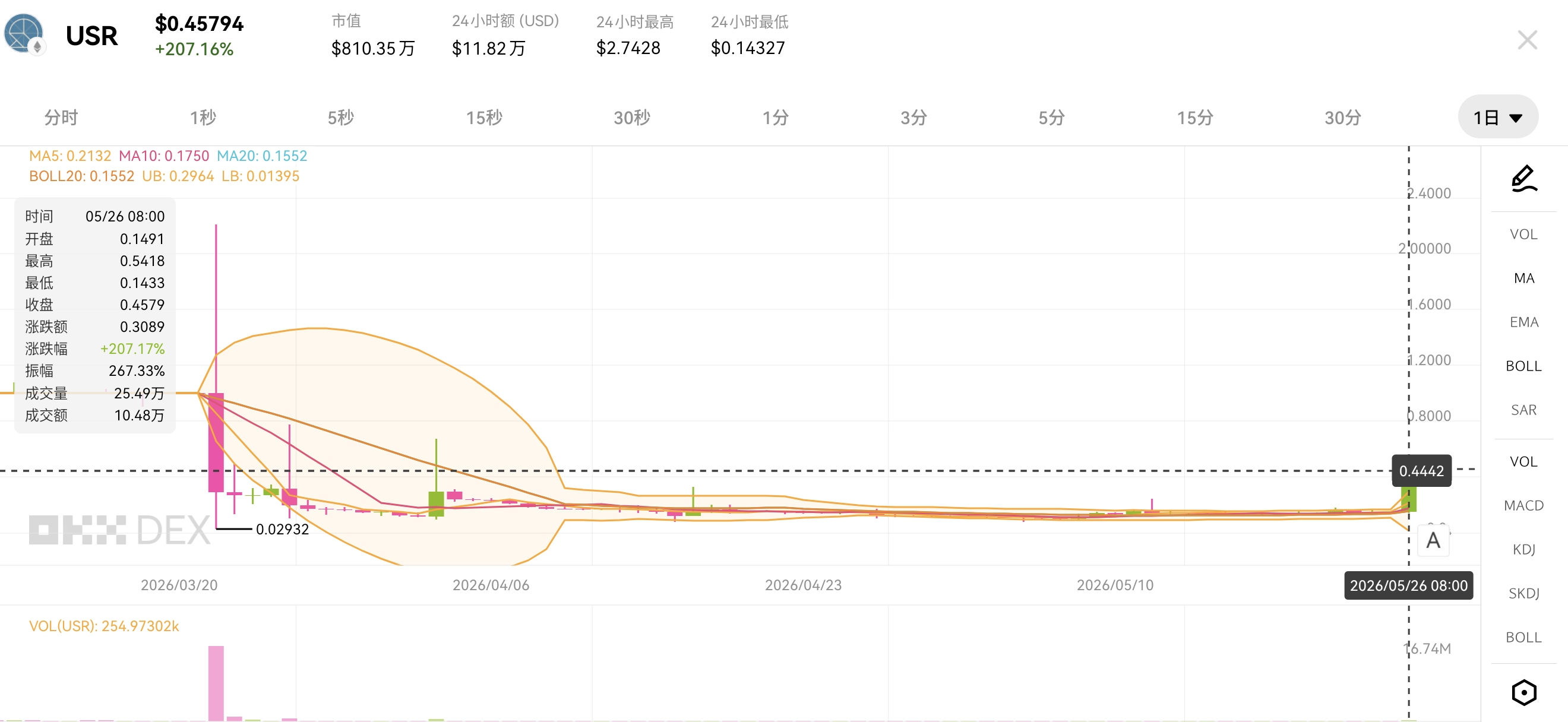
On May 27, the Resolv Foundation released the first complete recovery plan after the incident. It has been exactly two months since the outbreak. Previously, the attacker exploited a vulnerability in the AWS KMS environment on March 22 to call Resolv to mint keys, creating 80 million uncollateralized USR for approximately 200,000 USDC, which were then exchanged for about 25 million USD in ETH and transferred out. USR briefly fell below $0.03, and the protocol entered a paused state.
The announcement classified affected users into six categories. The claims window closes on August 26, and claims will not be accepted after that date. After the announcement, USR quickly rebounded from $0.14 to around $0.45.
Contract Terms Substitute Community Voting
The most critical sentence in the announcement defines USR as a senior tranche and RLP as a junior tranche, pointing to service term 4.3. The product design role of RLP has always been to absorb losses before USR.
This clause was downplayed during the outbreak of the incident and was re-invoked in the announcement as the legal basis for the entire compensation framework.
Previous incident aftermath in DeFi largely depended on governance voting or foundation backing, essentially involving post-event negotiations. Resolv's approach this time is different. Instead of letting the community vote on how to distribute losses, it directly references the existing layered structure in the product terms, accurately allocating losses to each category of holders.
This is a debt liquidation table executed based on senior/junior priority.
This language comes from collateralized debt obligations (CDOs), asset securitization, and Chapter 11 reorganization processes in U.S. bankruptcy law.
RLP: Named "Insurance," But Essentially "Cannon Fodder"
Defining "pre-event holders" and "post-event buyers" using snapshots and applying different compensation coefficients is quite rare in DeFi rescues.
The first category includes direct holders of USR and wstUSR, which are divided into two parts based on the snapshot. Pre-event holders are regarded as senior creditors and will receive full redemption at a 1:1 USDC ratio; whereas post-event buyers, due to mixing with the illegally minted supply, receive a uniform markdown compensation at a ratio of 1:0.5, regardless of their cost.
For users who bought post-event, as long as the purchase price is below 0.5 USDC, they have successfully bottomed out.
The second category involves liquidity positions related to USR, where the handling logic is more complex. Resolv decomposes each LP position into a USR portion and a paired asset, compensating the portion pre-event at a 1:1 ratio, while the rebalancing portion caused by the hacker's sell-off is compensated at a ratio of 1:0.5.
Ordinary LP providers will receive about 75% cash compensation and can also obtain RESOLV token compensation, which the official claims can bring the total compensation rate up to around 95% of the initial position. However, the actual compensation rate for leveraged LP positions, after deducting debts, will be significantly lower than that for ordinary LPs.
The third category is the one with the most controversy, RLP holders, who are treated as "cannon fodder" by the protocol, with each token redeeming for only 0.71 USDC, resetting their reference price to 55% of pre-event levels. For each RLP held, RLP holders can additionally receive 2.71 RESOLV tokens, which the official states can raise the comprehensive compensation rate for RLP above 60%.
However, the plan also clearly states that any RLP positions liquidated due to leverage will not receive any compensation, meaning that large leveraged RLP holders like Stream Finance face total loss.
The fourth category covers participants in the lending market. Users providing USR collateral on platforms like Morpho or Fluid have their creditor status equivalent to pre-event holders, enjoying 1:1 redemption.
Users providing USDC or USDT, not directly exposed to the USR collateral pool, will not receive direct compensation from Resolv, and recovery of losses depends on the protocols or vault managers involved.
The fifth category consists of USR Yield Maxi vault users, who will be compensated at 90% of the pre-event share price; the sixth category includes PT and YT positions on Pendle, which will also be redeemed at a 1:1 ratio based on the system token (SY) value after converting to wstUSR.
Old Debts Unsettled, New Lines Started
The second half of the announcement declared a new business line: Vault Street. Managed by the Resolv Foundation, it is positioned as an institutional distribution platform for tokenizing real-world assets. The first product, primeUSD, is currently in private testing and will go live publicly in June, targeting institutional treasuries and large capital pools, providing licensed leveraged tokenized U.S. Treasury exposure.
The TradFi background of the Resolv team is fully reflected in this business line. Structured products, leveraged financing, securitization... these labels have already been inscribed in the team's history, and the handling of the incident has merely brought this underlying feature to the forefront.
The functionality of the RESOLV token remains unchanged, with staking and unstaking having resumed on May 26, and 300,000 RESOLV rewards will be distributed over the next two weeks. The foundation's arrangement indicates that the old business line is nearing liquidation, while the new business line is starting.
The announced 60% compensation rate is based on calculating the RESOLV token at a reference price of $0.03. This is a commitment to back with tokens instead of cash. To fill the cash compensation gap, Resolv promises to allocate 10% of the total token supply for compensation, of which 70% belongs to the affected RLP holders.
According to Bitget market data, the RESOLV token has fallen over 22% in the last 30 days, with a current price around $0.023. It has already fallen below the reference price set in the announcement. Combined with over 10,000 tokens that will be linearly unlocked over 24 months, the compensation for RLP holders has significantly shrunk, and they must continue to bear the token downrisk over the next two years.
Using tokens to fill cash compensation gaps essentially transforms the funding pressure on the foundation into market risks for the victims.
免责声明:本文章仅代表作者个人观点,不代表本平台的立场和观点。本文章仅供信息分享,不构成对任何人的任何投资建议。用户与作者之间的任何争议,与本平台无关。如网页中刊载的文章或图片涉及侵权,请提供相关的权利证明和身份证明发送邮件到support@aicoin.com,本平台相关工作人员将会进行核查。


