Author: Victor, Mr. Z, 168X
“AI is the greatest infrastructure build in human history. Currently, the global investment is in the hundreds of billions, but this is just the beginning; there are still tens of trillions of infrastructure yet to be built.” — Jensen Huang, 2026 Davos Forum
For the first time in forty years, semiconductors have directly formed productivity, the entire supply chain is completely out of stock, and TSMC's orders are already booked until after 2030. Wall Street is still using old valuation models to shout bubble, and that is our cognitive gap.
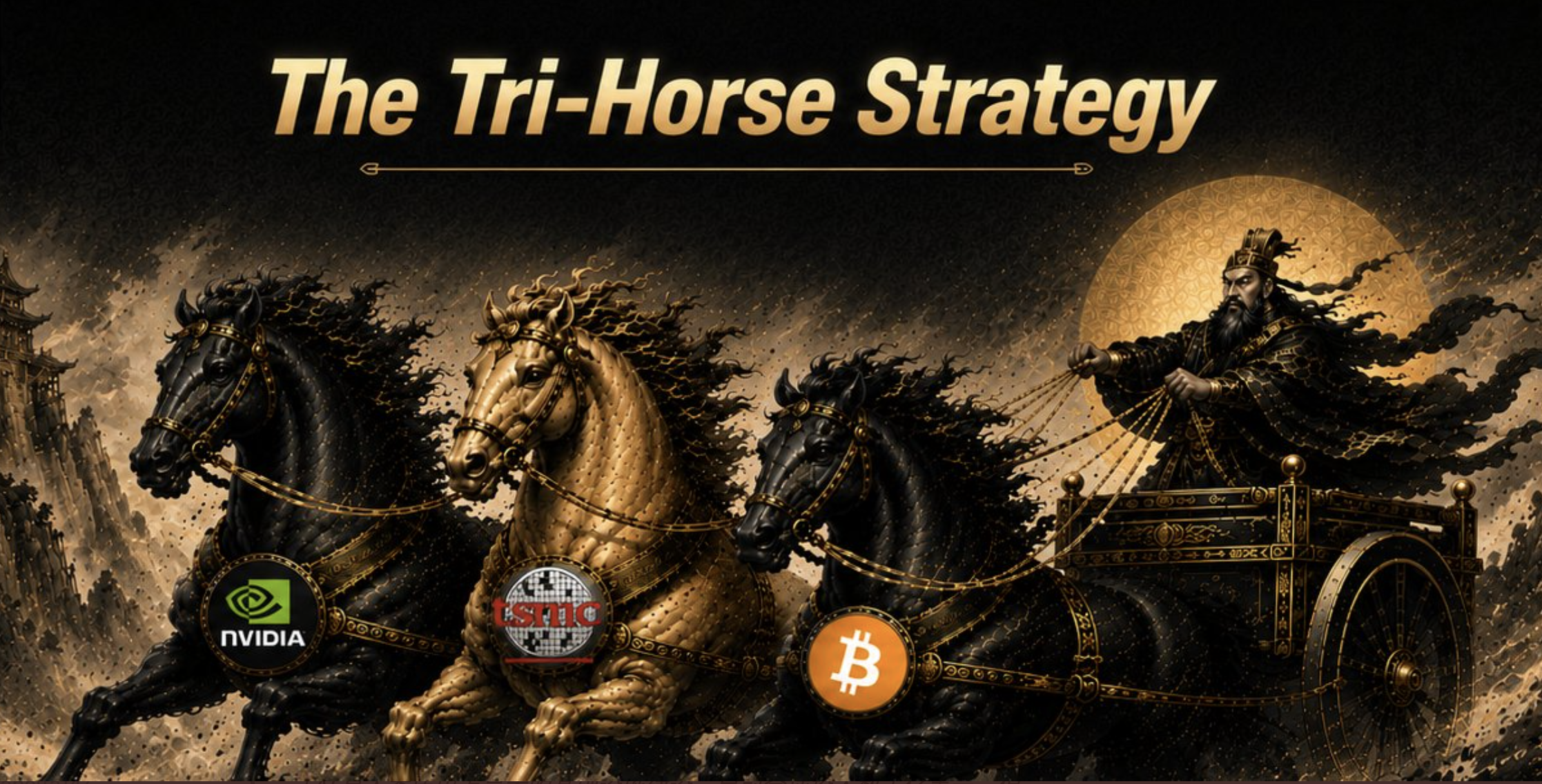
The three-carriage framework is a cross-market allocation model proposed by 168X: U.S. stocks, Taiwan stocks, crypto, building a nested barbell structure around three leading players (NVIDIA, TSMC, BTC), systematically laying out AI and cutting-edge technology. The core discipline is simple: all trading is to hoard more leaders.
If you, like us, firmly believe in the "second stage" of semiconductors, are not content with just capital market returns, and are pursuing high growth and high explosive excess returns, then the three-carriage framework is designed specifically for your 2026 investment strategy.
1. The Second Stage of Semiconductors is About to Start
Quoting Herman Jin, former Goldman Sachs FICC executive and founder of Zen Family Office in a dialogue at 168X (Read more: Exclusive Interview with Former Goldman Sachs FICC Executive: Semiconductor Shortages Favor the Latecomers! Buy Light Modules to the Fullest):
“For the past forty years, semiconductors have driven PCs, mobile phones, and the cloud, but they have never directly generated revenue. Humans have developed software on top of semiconductors, with software users generating productivity. However, starting from this generation of AI models, semiconductors have directly formed productivity.”
This trend will begin to surface in early 2024, and then confirmed in TSMC's Q1 earnings call in 2026 with a CapEx reaching $52-56B. As Jensen Huang said, the infrastructure layer organizes hundreds of thousands of processors into token factories, directly “manufacturing wisdom.” Computing power equals capacity, and capacity equals revenue.
After our exchange with Herman, we are even more convinced that semiconductors have just finished the first stage, and the key now is how to bet on the second stage.
The first stage is “Discovery”. The market has realized there is real demand for AI, with NVIDIA soaring from $12 to $150, and valuations of model firms in private equity have surged. TSMC's calm expansion pace in the first three years suppressed the bubbles and maintained high gross margins for all manufacturers, leading to a broad upward trend in the semiconductor supply chain.
The second stage is “Repricing”, which is happening now. The second stage, which the three-carriage framework bets on, is based on three core ideas:
1. Under the AI infrastructure cycle, the semiconductor supply chain should be entirely short.
According to Jensen Huang's "AI Five-Layer Cake Theory": Energy, Chips, Infrastructure, Models, Applications, every successful AI application will pull down the demand of the five layers. We can see that the semiconductor shortage has already spread from chips and advanced packaging to various components and assembly plants, causing significant price increases throughout the entire supply chain. TSMC's orders are already booked until 2030, and shortages will persist for a long time.
2. Cognitive Advantage: Wall Street has yet to understand the importance of CapEx.
In 2026, the combined CapEx of the four major cloud giants surpassed $700 billion, a 77% year-on-year increase, but Wall Street has not caught up. For decades, Wall Street's valuation logic has been “light assets, high margins, low CapEx”, and a decline in cash flow is instinctively seen as a bubble. But AI has turned companies into Token factories; without CapEx, there is no capacity, and without capacity, there is no revenue. When the valuation model catches up to the actual industry cognition, companies that invest without concern for cost will be significantly revalued, which is the alpha of the second stage.
3. Anthropic and OpenAI are not yet publicly listed.
Private valuations of Anthropic and OpenAI are nearing one trillion dollars, their model revenues are continuously rising; Anthropic's ARR (annual recurring revenue) has increased tenfold in the past twelve months to reach $19 billion, and OpenAI's ARR exceeded $25 billion in February of this year. The IPOs of tech giants will pose a significant liquidity siphoning risk to the market, but strong revenue may delay their public offerings. In other words, before these giants go public, the risk of the entire industry facing depressed valuations is relatively low.
2. Why Traditional Investment Methods Are Not Enough in 2026
Faced with the second stage of AI and semiconductors, how should we invest to capture more excess returns on Beta?
There are several mainstream investment methodologies in the market:
1- Index Investment: Long-term holding, regularly investing in SPY or QQQ, etc. For general investors who are unwilling or do not have time to actively research individual stocks, investing in the market remains the best option.
But the cost of index investing is that you can only receive Beta returns. This year, any stock in the semiconductor supply chain may have gains far exceeding the market. By 2026, the Taiwan stock market, which has a high proportion of semiconductors, has surpassed the UK and Canada, with a market capitalization soaring to the sixth largest in the world.
2- High Growth Investment: Betting entirely on high valuation, high volatility disruptive innovations; the most iconic example is Cathie Wood's ARKK, posting a 153% return during the pandemic era of 2020, but then crashing over 60% in 2022, with extreme volatility.
Since the end of 2019, ARKK's cumulative increase of 56.3% is far below QQQ's 233% increase during the same period. In the recent AI boom, ARKK's holdings are scattered across software, biotech, fintech, and consumer goods, with significantly underperforming results.
3- Traditional Barbell Strategy: Allocating 90% to ultra-low risk assets (government bonds, cash) and 10% to high-risk speculative positions. Theoretically, this can withstand black swans and capture asymmetric breakout opportunities. But the proponent Taleb also admits that this method cannot "make you rich," but only "prevent you from becoming poor.”
We did a simple calculation:
Assuming you have a principal of 1 million, placing 900,000 in government bonds at an annual rate of 4% and 100,000 in high-risk positions such as small-cap stocks or cryptocurrencies. Government bonds yield 40,000 in a year, and if the high-risk position doubles, that is 100,000, which could even go to zero. The overall return is 140,000, yielding an annualized 14%. It looks appealing. But if you had directly bought QQQ tracking the market during the same period, the 2025 increase of QQQ would be 20.77%, meaning your 1 million would become 1.2 million.
Traditional barbell strategies underperform indexes in bull markets; unless your principal is large enough, the absolute returns of traditional barbells are simply insufficient.
Is there a way to capture the second stage of AI and semiconductors, providing both asymmetric upside with a barbell strategy while not sacrificing returns due to excessive conservatism on the low-risk side?
3. The Three-Carriage Strategy: U.S. Stocks, Taiwan Stocks, and Bitcoin Allocation
The year 2026 is the "Year of the Fire Horse", traditionally seen as a period full of changes and great transformation.
Facing the latter half of 2026, 168X proposes the “Three-Carriage” investment principle, allocating across U.S. stocks, Taiwan stocks, and Bitcoin, helping investors combat this year's global upheaval and capture excess returns above Beta.
The three-carriage structure can be seen as an aggressive form of a barbell strategy, replacing the low-risk end from government bonds with leaders from the three major markets.
First Car: U.S. Stocks (45%), World's Strongest AI Ecosystem and Cutting-edge Technology
Allocation: Leaders $NVDA + 3-5 high-growth stocks
NVIDIA is the core holding of the U.S. stocks in the three-carriage strategy. NVIDIA not only sells chips, but its strength lies in the entire ecosystem; every pitfall it has traversed is a fortress. Buying NVIDIA is like acquiring the rental rights of the entire AI ecosystem.
In addition to NVIDIA, U.S. stocks also possess the world's most complete array of AI and cutting-edge technology stocks, including the AI cloud infrastructure, storage, optical communication that we are closely monitoring, as well as the very likely next breakout areas in space technology and robotics. These are the frontlines where AI is extending its reach.
Second Car: Taiwan Stocks (45%), World's Strongest Semiconductor Supply Chain
Allocation: Leaders $TSM + 3-5 high-growth stocks
TSMC (U.S. stock code $TSM, Taiwan stock code 2330) is the global leader in foundry services; no matter which model maker or chip company is the AI winner, they still need to turn to TSMC for production. The overwhelming demand for TSMC has also driven expansions across the entire supply chain including advanced packaging, IC design, passive components, testing interfaces, cooling products, etc., all of which are in short supply.
The downstream segments of the semiconductor supply chain are dominated by smaller and medium-sized Taiwanese firms, many of which have unique themes in the Taiwan stock market. These local companies often do not attract international investors' attention, but in the midst of this shortage, their revenue and stock prices are outperforming expectations.
We remain bullish on Taiwan. Before the end of 2026, Taiwan will be in triple resonance with industry advantages, favorable policies, and capital momentum.
Third Car: Crypto (10%), The Catcher of Macro Liquidity Overflow
Allocation: Leaders $BTC
Bitcoin is a hard currency with scarcity and anti-censorship properties, with real demand in the gray market. On the other hand, Bitcoin is extremely sensitive to macro liquidity; when global liquidity is ample, overflowing funds often rotate into Bitcoin, which can explode powerfully but need to be held for years.
This year, liquidity is concentrated in AI and semiconductors while the overall crypto market is in a bear cycle, so we will only allocate to BTC and will not deploy any other cryptocurrencies until we see clear bullish signals.
4. The Structure of the Three-Carriage Strategy: Large Barbell with Small Barbells
The underlying architecture of the three-carriage strategy is a set of nested barbell structures.
Large Barbell: U.S. and Taiwan Stocks (90%) vs Bitcoin (10%).
One end consists of companies with a fundamental basis whose financial data can be verified. The other end comprises high explosive crypto driven by liquidity.
Small Barbell: Leaders within each market vs Satellite Stocks.
Around the leaders, allocate about three to five satellite stocks, selecting those with high growth potential and clear themes:
Conservative (3-4 stocks): Segments with mid- to long-term supply chain logic, held for several months.
Explosive (1-2 stocks): Bet on short-term catalytic events, with high volatility, held for only a few days to weeks, rotating rapidly.
Using U.S. stocks as an example, the core position is concentrated in NVIDIA. For Taiwan stocks, TSMC is the core asset, and satellite stocks cover critical segments benefiting from shortages in advanced packaging, cooling, optical communication, etc., as well as thematic stocks in low-earth orbit satellites and robotics.
Bitcoin, as the only asset in crypto, does not require an internal barbell; it itself is the high volatility end of the large barbell.
The large barbell manages cross-market risks, while the small barbell captures the rotation rhythm within the market.
5. Core Discipline of the Three-Carriage Strategy: Hoarding Leaders
The most critical operating principle of the three-carriage strategy: all transactions are aimed at hoarding more leaders.
Even when the market cap of leaders is very large, their explosive power remains strong when the uptrend begins.
For example, in the U.S. stock market over the past six months, while the leader NVDA was oscillating at high levels, funds rotated into other segments, storage soared, and optical communication lit up. After the entire semiconductor sector rose, at the May meeting between the U.S. and China, NVDA finally broke new highs with a massive market cap of 5 trillion.
This logic has also been repeatedly verified in multiple cycles of crypto: “The existence of all altcoins is to exchange for more BTC.” Bitcoin's market cap is as high as 1.5 trillion, but between 2023 and 2025, there are hardly any altcoins that outperform Bitcoin.
The three-carriage strategy executes the core logic of "hoarding leaders" across three markets. When satellite stocks realize short-term profits, we will reinvest the profits into leaders at appropriate price points. Leaders are the cash of the three-carriage strategy.
To illustrate this logic with a simple calculation:
Assuming you allocated 1 million to U.S. stocks six months ago, with an initial allocation of 700,000 in NVDA, and 150,000 each in satellite stocks A and B. After a round of rotation, A increased by 80% and was sold for 270,000, while B increased by 40% and was sold for 210,000. All capital plus returns were poured back into NVDA.
After one round, your NVDA holding increased from 700,000 to 1,180,000. Next, NVDA rose by 11% in May, making your total assets reach 1,309,800, resulting in a six-month performance exceeding 30%.
Even if NVDA itself only consolidated during this period, after a few rounds, the position in the leader will grow large enough to make your overall portfolio highly correlated with the leader's trajectory, which is precisely the outcome we seek.
The bigger the better, the stronger the stronger.
6. Time Window and Suitable Investors
Any investment framework has an expiration date; there is no one-size-fits-all investment method. We assess that the applicability of the three-carriage strategy extends at least until the end of 2026.
We see three conditions under which the three-carriage strategy may fail:
- 1. Significant downward revision of Hyperscaler CapEx. If any cloud giant markedly reduces AI-related capital expenditures or postpones construction plans in their earnings report, it indicates cracks in the demand side.
- 2. Supply chain transitions from shortages to inventory accumulation. When critical links like HBM, CoWoS experience inventory buildup or shortened delivery times, supply and demand will flip, and valuation logic will shift from “shortage premium” back to “inventory cycle.”
- 3. Commercialization of AI application layer lags significantly behind infrastructure investment. The logic of the five-layer cake is top-down pulling. If the application layer cannot generate sufficient revenue to rationalize the underlying investment, the market will question the return on investment. Special attention needs to be paid to the IPO timing of Anthropic and OpenAI, as high expectations after listing will definitely face testing.
When any of these three occur, it will trigger signals that the strategy may no longer be applicable.
The three-carriage strategy is a high-concentration, high-growth combination, with 90% of the positions concentrated in the AI ecosystem and semiconductor supply chain. The 10% in BTC provides an opportunity for upside from liquidity overflow. Satellite stock holding periods range from several months to just days and require active management and discipline.
This is not a strategy to buy and forget, nor is it suitable for completely passive investors. The three-carriage strategy suits proactive investors with modest capital who firmly believe in the second stage of AI and semiconductors and are pursuing high growth and explosive returns.
7. The Right Moment to Launch the Three-Carriage Strategy in the Year of the Fire Horse
The year 2026, the Year of the Fire Horse, is marked by great transformation. However, the three-carriage strategy is not one that should be implemented all at once today.
At the time of writing (May 19), sentiment in the semiconductor sector has already overheated, with excessive congestion of chips. The market is overly optimistic, and themes like optical communication have irrationally surged. "Sell in May and go away" is likely happening; excessive consensus is often a precursor to short-term corrections.
We believe that within one to two months, the market is likely to experience a reset. This reset will be the true starting point of the second stage of semiconductors and the most critical opportunity for building the three-carriage strategy.
The three-carriage strategy is not just an investment theory. The 168X team will continue to share our actual operations in the future, including specific stocks, sector judgments, entry and exit timings, and rotation disciplines.
All trading is aimed at hoarding more leaders — NVIDIA, TSMC, Bitcoin.
In the Year of the Fire Horse, the three-carriage strategy will flourish.
免责声明:本文章仅代表作者个人观点,不代表本平台的立场和观点。本文章仅供信息分享,不构成对任何人的任何投资建议。用户与作者之间的任何争议,与本平台无关。如网页中刊载的文章或图片涉及侵权,请提供相关的权利证明和身份证明发送邮件到support@aicoin.com,本平台相关工作人员将会进行核查。


