Written by: Long Yue
Source: Wall Street View
On April 23, the war between the U.S. and Iran entered its eighth week.
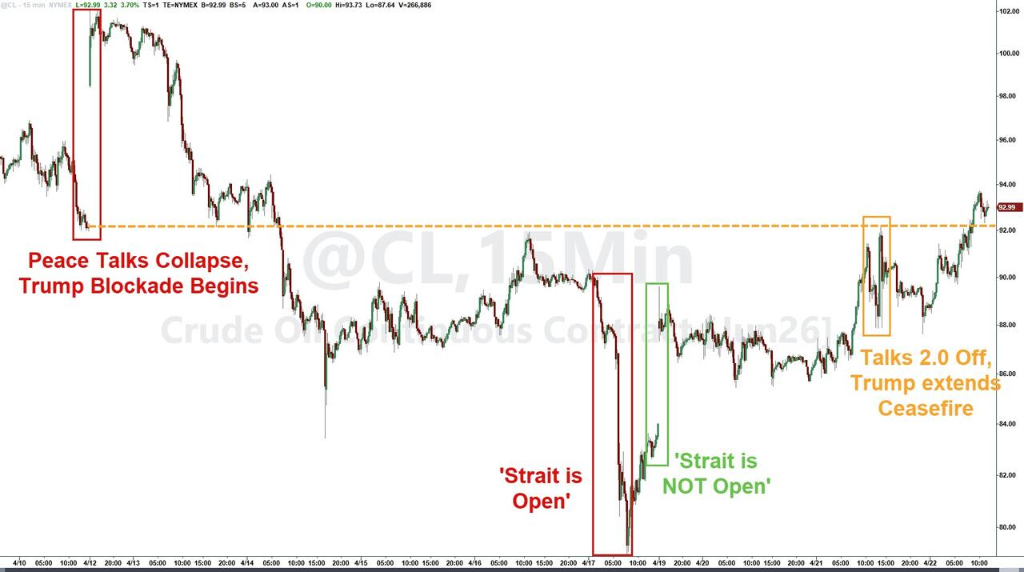
Just days ago, the situation seemed to change: a ceasefire was reached with Lebanon, Iran announced the reopening of the Strait of Hormuz, and negotiations in Islamabad seemed close at hand. But soon after, Trump announced that the U.S. maritime blockade would not be lifted and ordered inspections of vessels heading to Iran—Iran immediately announced the closure of the strait again and firmly rejected a second round of negotiations.
This flip-flopping is not the first time it has happened.
From the beginning of the war until now, this conflict can always be described with the same word: madness. A "mad king" president, called out from the war room by his aides, has waged a war full of reversals every hour, creating an uncontrollable market that even mainstream media cannot comprehend.
The latest insider information truly reveals to us where this "madness and loss of control" comes from and where it will lead the situation.
"Mad King" Trump: The President Locked Outside
On April 22, new insider information from U.S. local media revealed a scene from this year's Easter weekend that profoundly exposed the management of this war.
At that time, a U.S. F-15 was shot down in Iranian airspace, and two pilots were missing. When the news reached the White House, Trump shouted at his aides for hours.
"The Europeans didn’t offer any help," he repeatedly said. By then, the average gas price in the U.S. had risen to $4.09 per gallon, and images from the 1979 Iranian hostage crisis lingered in his mind.
"Look at Carter (the 39th President of the United States)… helicopters, hostages, that made him lose the election," Trump complained at the time, "What a mess."
He demanded the military immediately go save the pilots. But the aides judged that his impatience wouldn't help in such a moment. So, they kept the president outside the decision-making room and only reported progress to him at key points.
Vice President Pence connected via video from Camp David, and White House Chief of Staff Susie Wiles dialed in from her home in Florida, while the entire team tracked the rescue progress almost minute by minute—aircraft stuck in the sand, deceptive attacks against Iranian forces... and the president could only wait outside for phone calls.
One pilot was quickly found. The second pilot wasn’t rescued until late Saturday night. After two in the morning, Trump finally went to sleep.
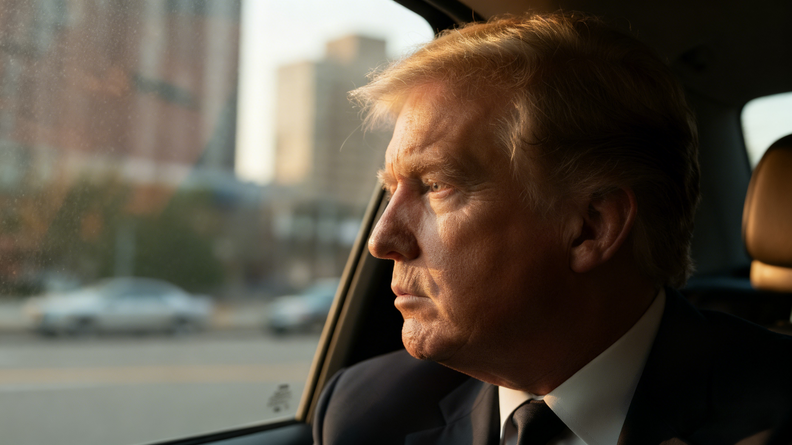
Six hours later, he posted a shocking social media message on Easter morning: "Open the Fuckin' Strait, you crazy bastards, or you will live in hell." At the end of the post, he added a line from an Islamic prayer.
This post did not stem from any national security plan. According to senior White House officials, it was an impromptu expression from Trump. He said he wanted to make himself "appear as unstable as possible, as offensive as possible," because he believed that was the "language the Iranians could understand."
After sending it, he asked his aides, "What’s the reaction?"
From being a collapse consumed by fear to playing the part of a mad strategist—Trump switched roles within 12 hours. The question is: which one is the real him? Or are both?
International relations scholar John Mearsheimer referred to him in a recent interview with a term: mad king.
"The Crazy War": The Fundamental Trust Between the U.S. and Iran Destroyed
Under this extreme emotional leadership, the U.S. diplomatic actions have shown a severe and counterintuitive regression, directly leading to the breakdown of today's peace talks.
Iran has repeatedly emphasized that it is the U.S.'s repeated threats and unpredictability that led them to reject a second round of negotiations.
Mearsheimer pointed out incisively in the review that last Friday there was actually an extremely valuable ceasefire window: when Iran initially opened the strait as a gesture of goodwill, the U.S. should have taken the opportunity to push forward the Islamabad negotiations.
But the Trump administration at that moment personally tore up the understanding: not only did he publicly announce the refusal to lift the maritime blockade against Iran, but he even ordered the U.S. military to intercept, fire upon, and board Iranian vessels.
"As a result, the Iranians did a 180-degree turn and closed the strait again."
This kind of lack of strategic stability and tactical "flip-flopping" at crucial moments has completely exhausted Washington's strategic credibility. In the eyes of hardliners in Iran, the U.S. has become a "madman" devoid of contractual spirit, making any negotiations meaningless.
The total collapse of trust directly pushed the peace talks to their demise.
"Crazy Strategy": How Israel "Sells" War and "Controls" Trump
The source of this loss of control lies in Washington's rare decision to "outsource" great power strategy to external lobbying forces.
International relations scholar John Mearsheimer stated that, apart from a very few individuals like Defense Secretary Pete Hegseth, most military and intelligence leaders in the U.S. hold strong skepticism or even opposition toward this war. They clearly anticipate the extremely high risks, including Iran's countermeasures to block the strait.
But Trump completely ignored the warnings from domestic experts. Mearsheimer bluntly stated: "It was the Israelis who sold him a bill of goods."
In the White House war room, Israeli Mossad chief David Barnea and Prime Minister Benjamin Netanyahu painted a fantasy for Trump:
The powerful military force of the U.S. would bring about a quick and decisive victory without any concern that Iran would close the Strait of Hormuz. Obsessed with Venezuela's "change of regime without bloodshed in just hours" experience, Trump readily bought into it.
After the war began, Trump would see footage of explosions in Iran and some "victory videos" every morning. His aides described that he was "shocked" by the scale of the military power and continually praised the performance of the U.S. military.
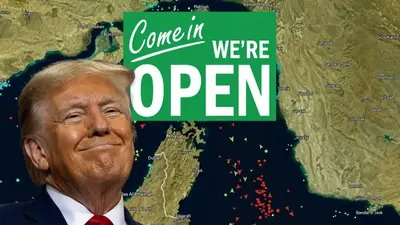
However, the "impressive" scenes on the battlefield did not translate into political victories. When the war truly enters deep waters, the strategic loss of control began to show.
On the one hand, faced with a blockade of the strait that chokes 20% of global oil supply, Trump rejected the military's suggestion to deploy ground troops to seize Hark Island (which accounts for 90% of Iran's oil exports) due to his extreme fear of unacceptable U.S. military casualties;
On the other hand, Israel even bypassed the U.S. and directly attacked Iran's largest South Pars gas field, forcing Trump to urgently distance himself on social media. This state of being tactically restricted by others and strategically cautious assured that the progress of the war would be wholly out of control.
"Crazy Hormuz": A Problem Without a Plan
When top decision-makers are both unpredictable and led by external forces, the execution at the grassroots level is inevitably thrown into chaos. The Strait of Hormuz is the best example.
Before the outbreak of war, Trump told his team that the Iranian government would likely yield on the strait issue, and even if they did not yield, the U.S. military could cope. But when tanker traffic quickly came to a standstill after the bombing began, some White House advisers felt caught off guard.
Trump later expressed his delayed surprise: "Someone with a drone can just shut it down."
This is the most ironic image in the whole story: the person who started the war had never thought about what would happen after.
Faced with the embarrassing situation of high-level decision-makers lacking a plan for the core throat, Jim Bianco, founder of market research firm Bianco Research, bluntly stated at the Hedgeye investment summit on April 23:
"My frustration lies in the fact that they have no plan for the Strait of Hormuz, or rather, they have a plan but it doesn't work at all. What the market really cares about now is the flow of oil. The market can be patient regarding nuclear issues; but when it comes to the flow of oil, the market has no patience."
In this back-and-forth political game, Brent crude has already surpassed $102, completely reversing last week's downturn and continuing to rise.
"Hysterical Market": "Oil Pricing Mechanism Has Collapsed"
When political decisions lose their anchor, financial markets also lose their anchors.
The first to collapse is the pricing mechanism of basic commodities. Jim Bianco revealed an extremely dangerous signal: the pricing function of the global oil market has become dysfunctional.
In normal years, price differences between Western Canadian Select, Brent, WTI, or spot Oman crude oil typically maintain a narrow range of $1 to $2, which is a sign of a healthy global energy supply chain. But today, due to the bi-directional blockade and a prolonged war with "no timetable," the price differences of these spot crude oils have soared to an astonishing $60!
"If you're extremely bearish, you can find a quote at $70; if you're extremely bullish, there are also real goods prices at $130."
Bianco warned that this extreme discreteness proves that the physical network of the oil market has been cut off by geopolitics. Brent crude surpassing $102 is merely the surface; the real deadly part is that the foundational pricing anchor has disappeared.
In other words: no one knows how much oil is really worth. This is not market volatility; it is market failure.
However, in the face of the abyss of the real economy, the U.S. financial market presents a kind of "apocalyptic carnival" madness.
The U.S. stock market continues to hit new highs. Funds engage in high-frequency trading driven by Trump's emotional tweets, chasing "meme stocks." As long as the White House releases any positive news, the market mindlessly buys in.
Trump himself even spent a lot of time during the war's standoff bragging to his donors about being deserving of a "Medal of Honor" and studying the renovation plans for the White House ballroom.
But the illusory K-lines cannot cover up the bleeding beneath. The University of Michigan Consumer Sentiment Index has issued the harshest judgment—this 74-year-old authoritative data plunged to 47 points this March, an unprecedented fall.
The level of despair among the American public regarding the current economy has far exceeded that during the 2008 subprime crisis, the 9/11 attacks, and the stagflation of the 1970s.
This is an extremely fragmented and completely out-of-control K-shaped macro picture: the bullish in the stock market raise a glass to the manipulated news streams from the White House, while gasoline prices reaching $4.09 have already shattered the survival bottom line for ordinary people.
Is Trump "Manipulating" the Market?
This is the most sensitive and hardest to publicly discuss issue among market participants.
Keith McCullough directly voiced what many people are thinking at the summit: "Trump seems to be getting increasingly accustomed to manipulating the market trends whenever he wants and in the direction he wants, because people are still too focused on individual factors."
He further pointed out that the current correlation coefficients between the dollar, oil prices, gold, and Bitcoin are nearing 95%. "It's not complicated," he said, "If you can know in advance the direction of oil prices and the dollar, you can predict the direction of almost all assets."
Even more striking is a detail he mentioned: Iran has begun releasing emoji packs of Lego toys, mocking that there are people shorting oil every time Trump announces that the strait will "soon open."
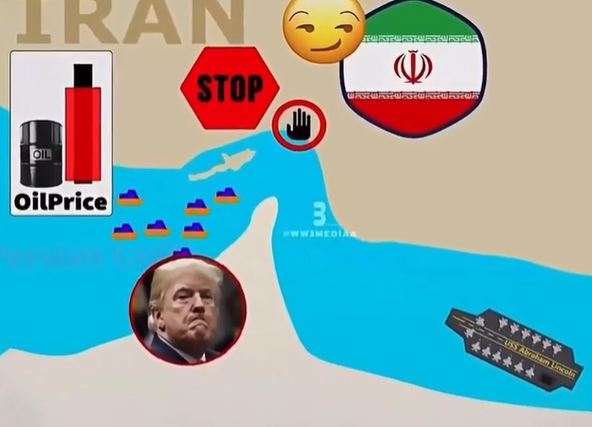
"This has become an open secret," McCullough said, "And it seems that no one cares, because everyone wants the same thing—market up, Trump is pulling, good, continue."
The Real Risks of This Game
Mearsheimer said something in the interview that is worth pondering repeatedly:
"The Trump administration should want to reach an agreement. There are two reasons: First, they cannot win on the path of escalation; Second, they risk pushing the global economy off the cliff. So they should want an agreement."
"But sometimes Trump acts like he wants an agreement, and sometimes he acts like he does not want one."
This is precisely where the current situation is most dangerous—not destruction intentionally inflicted by either side, but a systemic loss of control driven by decision-making chaos.
Trump dares not truly send ground troops to seize Hark Island while constantly issuing the toughest threats on social media, and even emitting contradictory signals when his aides try to control the situation.
In this "coward game," both sides are waiting for the other to blink first. The problem is: when one side’s decision-maker is in a state of unpredictability, no one can genuinely calculate where the Nash equilibrium of this game lies.
And once the gears of "loss of control" begin to turn, it is difficult to stop them in the short term.
免责声明:本文章仅代表作者个人观点,不代表本平台的立场和观点。本文章仅供信息分享,不构成对任何人的任何投资建议。用户与作者之间的任何争议,与本平台无关。如网页中刊载的文章或图片涉及侵权,请提供相关的权利证明和身份证明发送邮件到support@aicoin.com,本平台相关工作人员将会进行核查。


