Author: David, Deep Tide TechFlow
After the hacking incident of Kelp DAO, AAVE dropped from around $112 to about $90, a 20% drop in 24 hours.
At the same time, Aave also left behind $195 million in bad debt. I believe that most of those who previously held AAVE or wanted to leverage this piece of news for contracts are mainly concerned with one thing:
Is this 20% drop finished or just beginning?
I tend to think that there may still be a short-term rebound, and the volatility is not over. Because this drop is actually driven by emotions, reflecting the market's initial pricing on how the negative event of KelpDAO affects AAVE.
The real variable that determines the price movement of AAVE is still who will fill the $195 million bad debt hole.
First, let’s quickly review the background.
After Kelp was stolen, the hacker used freshly minted rsETH as collateral and borrowed $236 million worth of WETH from Aave. The money was borrowed, the collateral became worthless, and the $195 million bad debt hung over Aave.
While the various nested borrowing and lending principles of DeFi are complex, the essence of this matter is not complicated:
It’s just that AAVE took the hit and created bad debt, and the bad debt needs to be filled. If it can be filled, the matter will be resolved; if it cannot, then the situation will be even scarier.
You may ask, what does this have to do with the AAVE token itself?
Can we simply think that if a protocol loses trust and funds, its token will be sold off and then go to zero? If the negative issues are resolved, will the token price come back?
Emotion is one variable, but the mechanism of filling the bad debt in the AAVE protocol will also structurally affect the price of AAVE.
Three scenarios that may affect the price
First, Aave has a mechanism called Umbrella for absorbing bad debt, which reduces losses brought by bad debts through layers of protection. AI summary is shown in the diagram below.
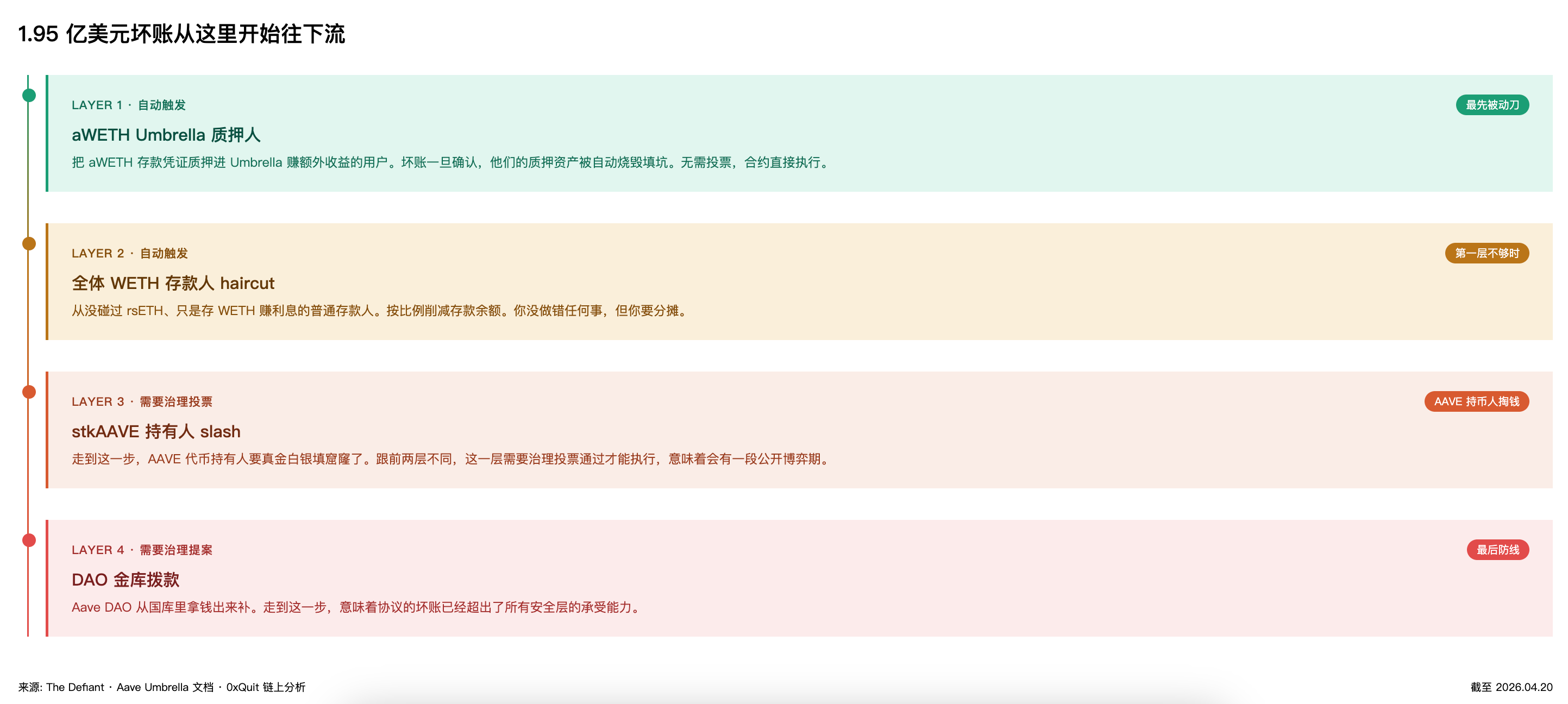
In simple terms, if the amount of bad debt is too large, and the first few layers cannot cover it, then it will require using AAVE which is staked in the protocol to fill the hole. This theoretically may induce market sell actions, thereby affecting the price of AAVE.
Thus, for AAVE holders and those trading the news, the key issue is how far down the bad debt hole will flow.
Here are my several projections.
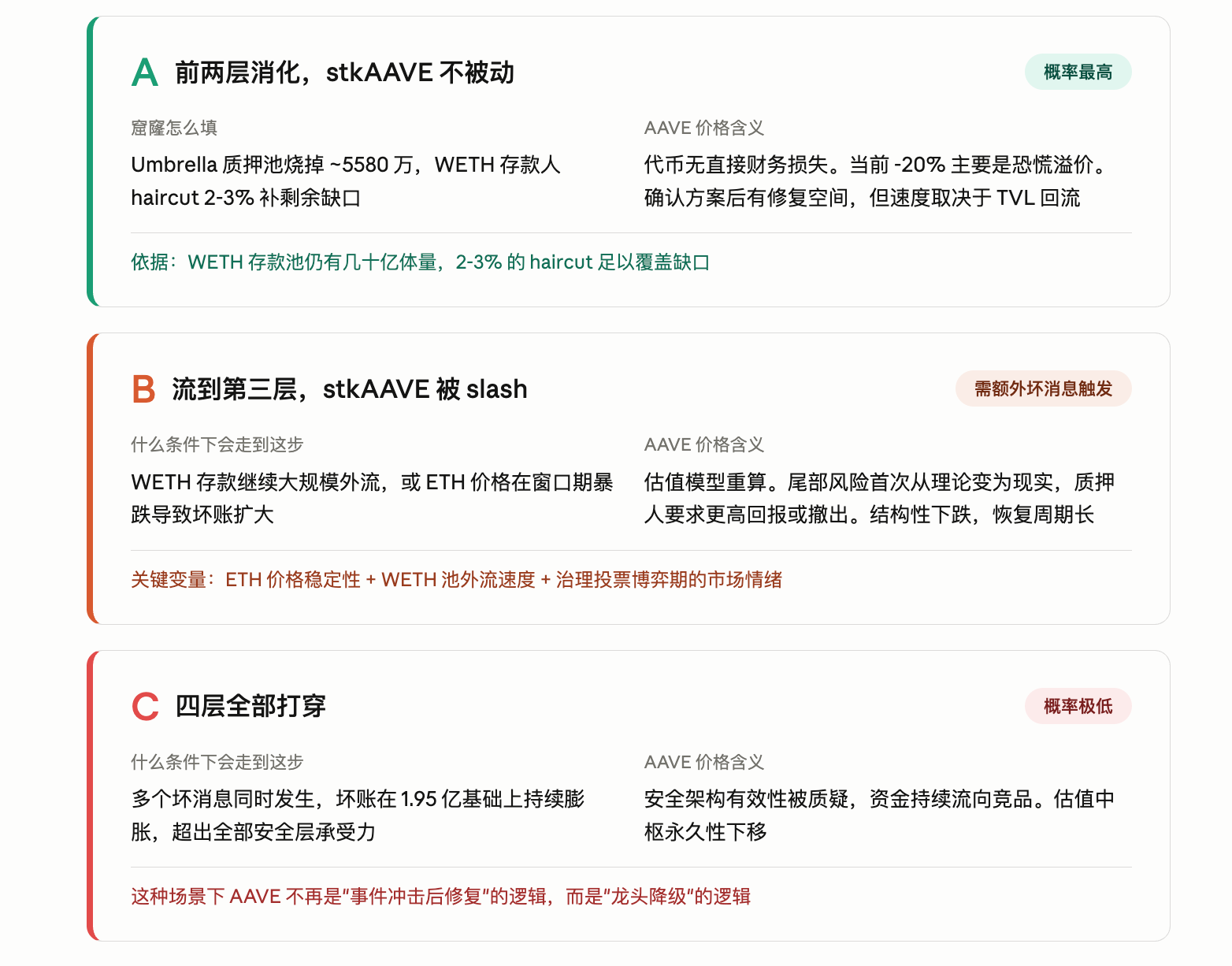
1. First scenario: The first two layers hold up, AAVE holders do not have to pay.
I checked the actual size of the Umbrella staking pool. The aWETH pool is about $55.8 million, while the hole is $195 million. The first layer can only cover less than 30%, and the remaining roughly $140 million will certainly flow to the second layer.
The second layer is where all WETH depositors share the losses proportionally.
Currently, although $5.4 billion has been withdrawn by large holders, the total amount of WETH deposits in Aave is still in the tens of billions. To cover the $140 million gap, depositors may have to bear a loss of two to three percent. The proportion is small, but for those who "just saved money for interest, never touched rsETH," this loss feels very unfair.
This is what I believe is the most probable outcome. The first two layers digest the hole, and the principal of AAVE holders will not be affected.
This means AAVE token itself has no direct financial loss; that 20% drop is purely driven by panic. Once Aave officially confirms "no need to touch the third layer," the market will breathe a sigh of relief, and the price will have room for recovery.
However, the speed of recovery depends on whether the TVL can come back. It's easy to lose money, but hard to come back. Attracting them back requires time and requires Aave to present convincing risk control improvement plans.
So even in the best scenario, the price recovery of AAVE will be relatively slow. There may be a short-term rebound, but mid-term may need to watch the speed of TVL stopping its decline and the overall market environment.
2. Second scenario: Flows to the third layer, AAVE holders will really have to pay.
If the first two layers can’t hold up, governance voting will be initiated to cut down the principal from those who have staked AAVE.
However, I think this scenario would require additional bad news to trigger, which makes it relatively less likely than the first scenario.
For example, before the bad debt handling plan is released, if WETH deposits continue to flow out on a large scale, those who can still share the losses in the pool are decreasing, and the haircut ratio of the second layer is pushed to a level unacceptable by depositors, forcing the mechanism to continue downward.
Or if the price of ETH drops significantly during this window, triggering a new round of liquidation failures, the bad debt will continue to inflate beyond the $195 million mark.
Once it reaches this point, the nature changes.
The market has never seen stkAAVE actually slashed; this risk has always been priced as a theoretical clause with a weight close to zero. After executing it once, everyone will have to reassess how much tail risk they need to bear by holding AAVE.
Stakers will demand higher returns to compensate for this risk; if they can't get it, they will withdraw, and the tokens withdrawn will return to the market, creating selling pressure. The price faces much greater pressure than in the first scenario, and the recovery cycle will be long because it alters the AAVE valuation model itself.
3. Third possibility: Even the fourth layer cannot fill the hole.
The probability is very low, but cannot be completely ruled out. It requires multiple pieces of bad news to happen simultaneously. If it comes to this point, the market will start to question the effectiveness of Aave's entire security architecture, and funds will continuously flow to competitors, resulting in a permanent decline in the central valuation of the token.
So overall, I believe that this hole in AAVE is most likely to be filled at the first two layers. The basis for this is that although the Umbrella staking pool only has $55.8 million, even if half of the second layer’s WETH deposit pool is withdrawn, its volume is still far greater than the remaining gap.
The current price of $90 may have already factored in overly pessimistic expectations.
What time points should you pay attention to?
After which signals can we consider the worst phase to be over?
I personally focus on three things.
The first is the official announcement of bad debt handling by Aave. Currently, it is still in the "exploring paths" stage, with no specific figures. Once it comes out, the market will be able to calculate how much the first layer burned, how much the second layer has taken, and whether to touch the third layer to sell AAVE in the filling hole scheme mentioned above.
I feel that at this node, the pressure of uncertainty pricing will be significantly released, and the announcement is the most important single catalyst.
The second is the stop of TVL decline. It does not need to return to AAVE’s peak of $26.4 billion; as long as it no longer declines week-over-week, that's enough. A stopping TVL decline means the panic outflow of depositors has ended, and the underlying revenue of the protocol will not continue to deteriorate, which has certain guiding significance for the short and mid-term.
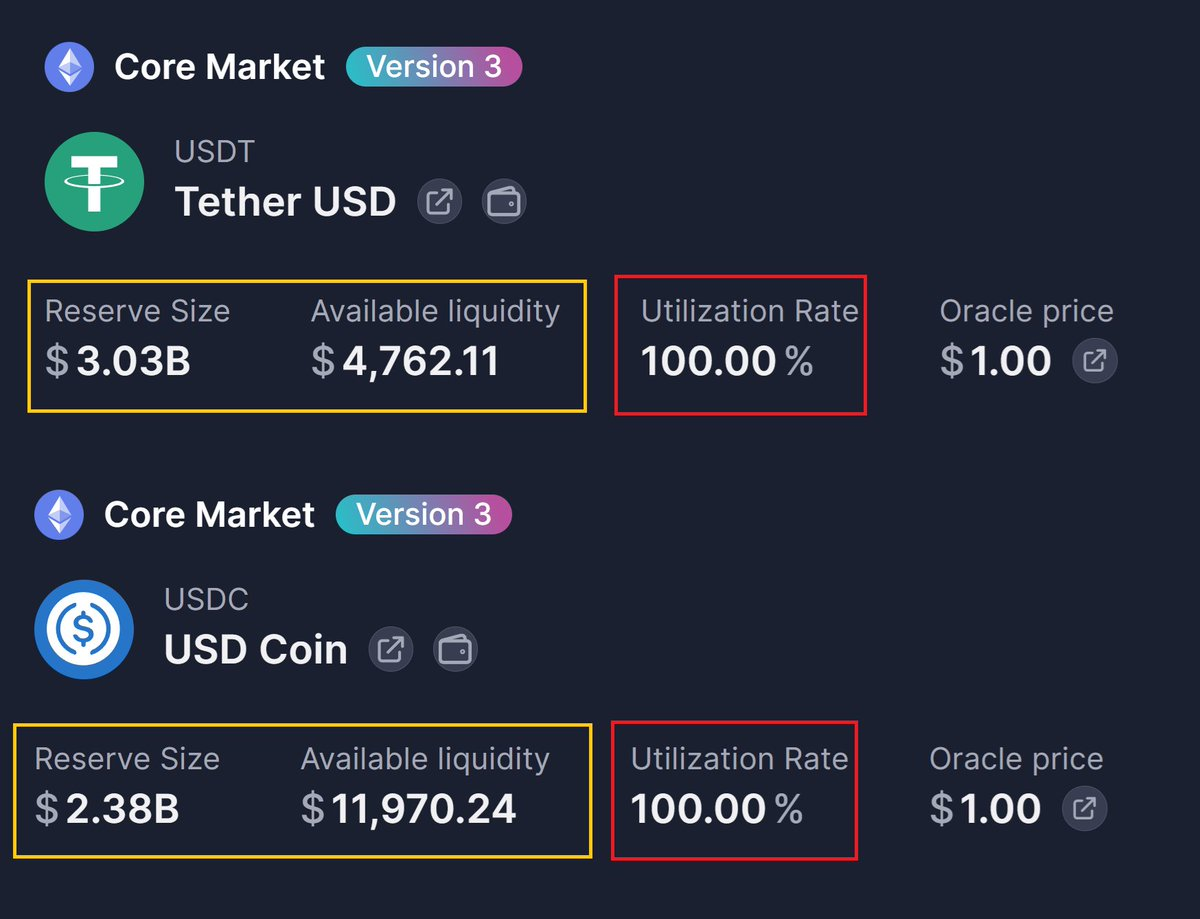
The third is that core market utilization returns to a normal range. Right now, the USDT and USDC markets are both sitting at 100%, meaning depositors cannot withdraw funds. A return of utilization to the 60-80% range indicates that liquidity is recovering and the run on funds has essentially ended.
This data can be seen on Aave’s front-end interface and can be monitored in real-time.
If at least two out of the three signals come out, I think we can consider the worst stage to be over. Before this, I will treat all price rebounds as technical recoveries after a drop, rather than trend reversals.
Returning to the question at the beginning of the article: AAVE dropped 20%, is it enough?
My view is that the current price has probably factored in part of the "worst-case scenario," but the confirmation signal for the "best-case scenario" has not yet come out. During this intermediate time, the price will go through repeated fluctuations.
For those looking to buy the dip, my advice is to wait for signals. Wait until you see at least two of the three: bad debt handling announcement, TVL stabilization, utilization return to normal range. By then, the price may have already recovered somewhat from the bottom, but you will be buying into a fundamentally clearer asset rather than a speculative token.
For those trading contracts, the volatility in the coming weeks will be very high. The governance voting window, every time Aave makes an official statement, and every significant fluctuation of ETH will be amplified by the market.
When direction is uncertain, volatility itself becomes a relatively certain trading opportunity.
Lastly, let me mention what impressed me the most about this incident. This time, there were no issues with Aave's contract code, but the $195 million bad debt still happened, because the problem lay in the protocol’s choice of which collateral to list, the lending ratio set for it, and which other protocols it partnered with.
In the crypto world of DeFi, I increasingly feel it is like Cao Cao's warships in the Battle of Chibi in "Romance of the Three Kingdoms," with protocols tied together; a single wind and fire can lead to mutual destruction.
DeFi is still too difficult for most non-professionals. This lesson may be hard to absorb at the root of DeFi, but the trading opportunities brought by volatility need to be maximized.
Note: This article is based on mechanism deductions and personal judgments from public data and does not constitute investment advice. DYOR.
免责声明:本文章仅代表作者个人观点,不代表本平台的立场和观点。本文章仅供信息分享,不构成对任何人的任何投资建议。用户与作者之间的任何争议,与本平台无关。如网页中刊载的文章或图片涉及侵权,请提供相关的权利证明和身份证明发送邮件到support@aicoin.com,本平台相关工作人员将会进行核查。


