Written by: Thejaswini M A
Translated by: Saoirse, Foresight News
I have never fully believed in this system. Not because I am smarter than anyone else, but because those who shout the loudest about decentralization are often the quickest to get your money into their ecosystem. In any history, this combination has never been a good sign.
But I have kept watching. You have to watch too, because this is the most exciting show happening right now. The entire industry is built on the radical idea of "trustless currency," yet almost everyone inside is untrustworthy. The irony is everywhere.
Now, just as all obvious things eventually become known to everyone, people are slowly coming to a conclusion — and some of us have long known this: decentralization has always been more of a performance than a true belief. The goal is to harvest "fool's money." Those who spend all day saying "banks are the enemy" are now shaking hands with the most centralized political powers on the planet, simply because it benefits their investment portfolios.
I am not even angry. I am just watching because this show is too good.

On October 31, 2008, as the aftershocks of the financial crisis lingered, Satoshi Nakamoto published a nine-page white paper. He proposed a form of electronic currency that required no banks, no governments, and no permission from anyone. Two parties could transact directly, without intermediaries taking a cut or a central authority deciding whether you are qualified to trade.
To be fair, the initial idea was compelling. It was born from a world where hedge funds and central banks excessively leveraged the economy, profiting from the losses of ordinary people while relying on government bailouts when things went wrong. The anger behind this was entirely justified. If even a system that allows elites to profit handsomely while making the public foot the bill doesn't make people angry, then what is there left to be angry about?
The brilliance of the structure designed by Nakamoto lies in its elimination of human factors. Without a central point of control, there is no single point of failure. Instead, there are thousands of nodes, equal and mutually verifying. You cannot bribe the entire network, nor can you threaten it with a phone call. There will be no freezing of someone else's wallet just because a regulator is in a bad mood.
The anarchic design is a beautiful conception.
People often blame the decline of the industry on the influx of venture capital, NFT chaos, or the collapse of FTX. But these are just symptoms. The real problem emerged much earlier — if you pay enough attention, it was almost evident from the very beginning.
The problem with decentralization is that it is expensive, slow, and requires thousands of participants, each lacking incentives for consensus. Centralization, on the other hand, is efficient, quick, and profitable. Therefore, when real money comes in, economic laws begin to apply as usual. The industry starts to differentiate, yet few are willing to openly acknowledge it.
In May 2017, the top two Bitcoin mining pools controlled less than 30% of the total hash rate, and the top six pools controlled less than 65%. This was the most decentralized moment in Bitcoin mining history. Nine years later, the peak is long gone. By December 2023, the top two pools controlled over 55% of the hash rate, and the top six accounted for as much as 90%.
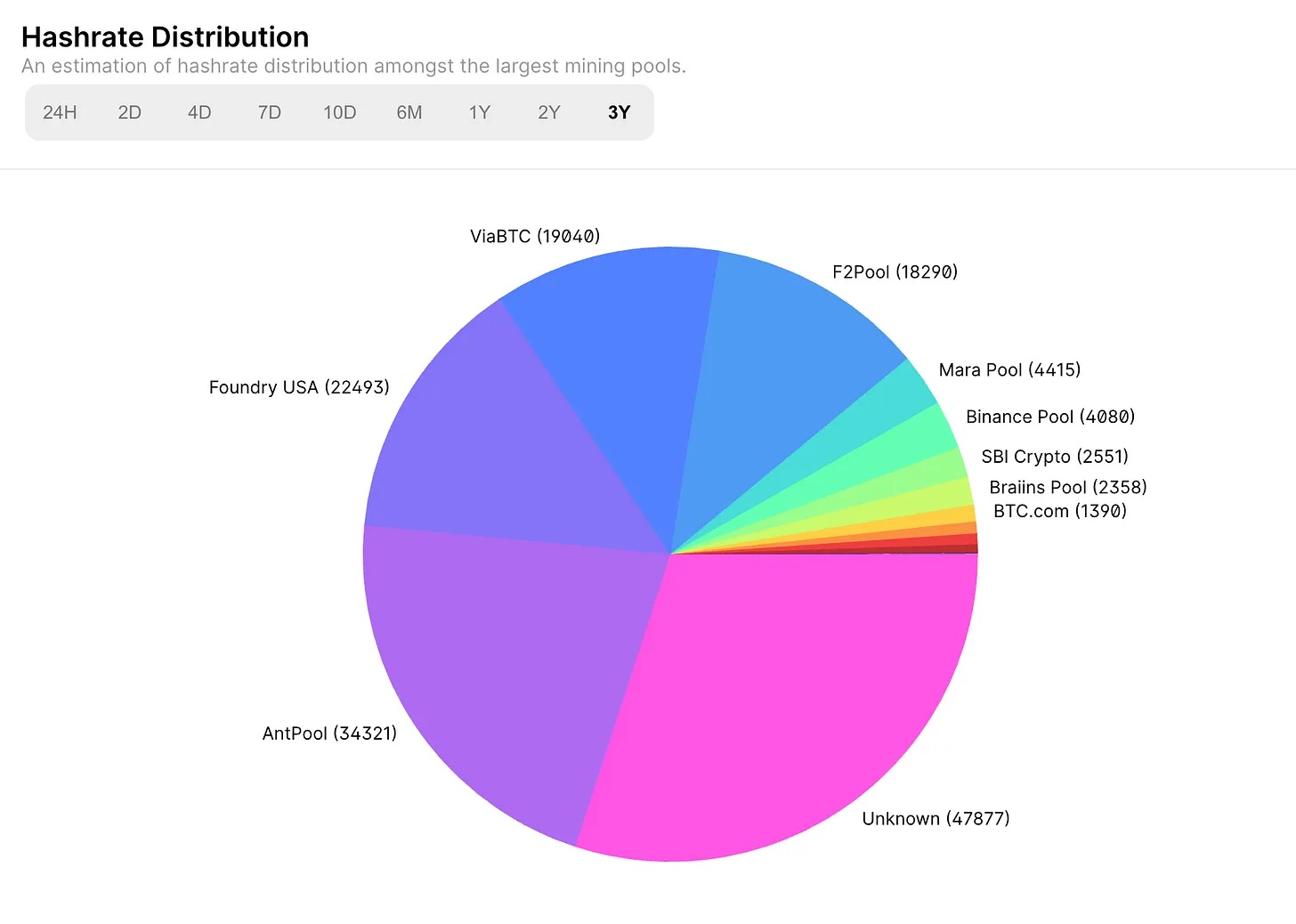
Today, Foundry USA controls about 30% of the total network hash rate, Antpool about 18%, and together they add up to nearly 50%. By March 2026, abstract risks finally became reality: Foundry mined six consecutive blocks, triggering a rare two-block chain reorganization that covered Antpool and ViaBTC's valid blocks. Small miners watched helplessly as their valid work was erased from the ledger. Bitcoin has never experienced a 51% attack; network integrity remains intact, but the centralization risk that the white paper aimed to prevent is no longer a theory, but numbers trending dangerously on charts.
The white paper depicted a system that no single entity could accomplish. This year, it turns eighteen. You can feel it for yourself.
I want to articulate my thoughts rigorously because lazy criticism can easily go awry. Trust me, I have tried.
Looking at all the crypto products that have real users, real trading volumes, and real revenues today, you will find that the vast majority are not decentralized.
But did they really claim to be decentralized? Confusing this point will make your criticism sound sharp, but it would miss the target.
Stablecoins are the only uncontroversial successful category in the crypto industry. Used for trading, cross-border remittances, and serving as payment tools in countries with ongoing currency devaluation. By 2025, USDT and USDC together accounted for 93% of the total market capitalization of stablecoins, processing unprecedented trillions of dollars in transaction volume.
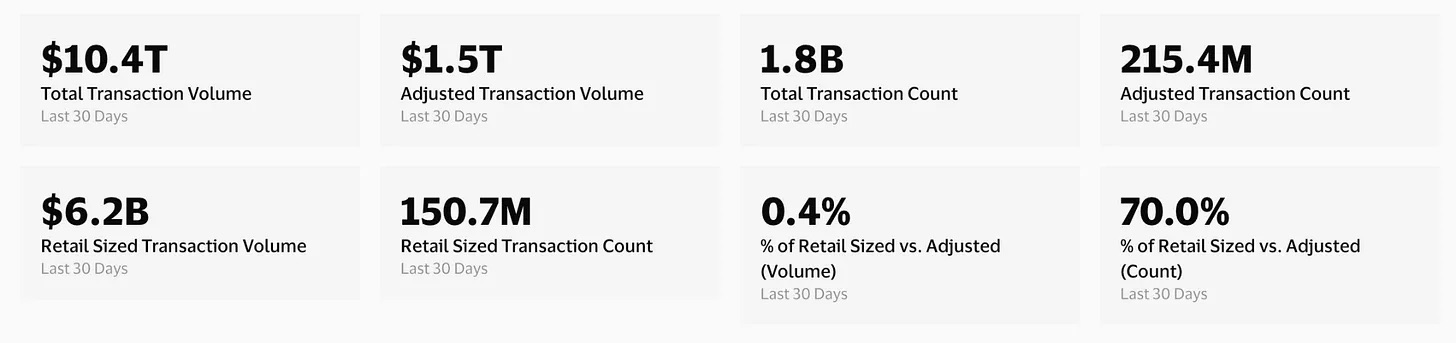
@visaonchainanalytics
Both USDC and USDT are issued by companies and can freeze wallets. Not to mention, their reserves are kept in banks — and banks are the institutions this industry was supposed to replace. The decentralized stablecoin DAI, often cited as proof that ideals still exist, holds just a 3%-4% market share. No one has ever marketed USDT as a decentralized product; its selling point has always been efficiency.
Transfer dollars cross-border in minutes, settle in seconds, without intermediary banks, without SWIFT codes, without a three-day clearing period. They retain the issuer but eliminate all the inefficient and costly intermediaries between the issuer and users. The real "revolution" that traditional finance lost was, in fact, a centralized dollar reissued by a company on the blockchain. And this was its original promise, and it delivered.
Hyperliquid, which processes billions in volume, is incredibly fast and the product itself is impressive. But in any practical sense, it is controlled by 16 validators. During the March 2025 JELLY incident, these 16 validators reached a consensus and delisted a certain token in two minutes, turning a nearly $12 million loss into a profit. Two minutes. Getting Ethereum governance to reach any decision in two minutes would probably require a natural disaster; even so, there might still be someone in some forgotten time zone publishing a dissenting blog post.
Some call it FTX 2.0, but that designation is not accurate. Hyperliquid made decisions like a company. What it truly garnered recognition for was: solving problems, compensating users, introducing on-chain validator voting mechanisms for subsequent delistings, and continuing to operate. The issue is, for a time, Hyperliquid's marketing expended significant effort insisting it was not a company while its operational mode was exactly like one.
Prediction markets. Polymarket saw the first true mainstream breakout of the crypto industry during the 2024 U.S. presidential election. Journalists quoted its prices, and even those who had never held ETH were using it. No one ever asked if it was decentralized enough; people only cared about its accuracy. And it was indeed accurate. Occasionally, there were discussions about insider trading and the "truth machine" positioning, some of which also came from me. It was simply a useful product, treating crypto technology as an underlying pipeline rather than an ideological banner.
I could write an entire section about DAOs, but the three words "Decentralized Autonomous Organization" might be the most ridiculous combination in the language. Let's leave it at that.
These are the things that have truly taken off, and most of them are much more usable than the proposals described in the white paper.
The current crypto world has divided into two categories.
One type is the infrastructure side: built for efficiency, scale, and real use, trading decentralization for performance, and most of them are quite frank about it.
The other type is the protocol layer: Bitcoin, Ethereum, Solana; they remain structurally distinct from all previous systems, and decentralization is not a marketing slogan, but a design attribute retained under massive pressure of opposition. Products will compromise for user demands, while users just want usable things. Under the competitive pressure of real money, the industry is inevitably moving towards centralization. This is merely a law, not a moral failure. The revolutionary rhetoric of the protocol layer is continuously borrowed by the product layer, even though the two are no longer the same thing.
In 2019, founders were still quoting the Cypherpunk Manifesto in their speeches; by 2023, they were sitting in Senate hearings claiming they had always hoped for constructive collaboration with regulators. For a large part of the industry, decentralization is merely a regulatory strategy cloaked in ideological garb: as long as no one is in charge, no one needs to take responsibility. This ideology is sufficiently confusing to lawyers and regulators, giving them time to raise funds, launch products, and exit from many well-known cases smoothly. When regulation becomes inevitable, this ideology is cast aside to avoid trouble.
There are still true believers in the industry. They entered the crypto world because they witnessed governments destroying currencies, freezing accounts for political reasons, and excluding entire groups from basic financial services. They have become the moral cover for this industry, which is essentially profit-driven. Profit-seeking in itself is fine, but there is no need to disguise it.
In my opinion, this trade-off may be worth it, and those making the choice know in their hearts, even if they won't admit it outright. The pure form of decentralized ideals struggles in the face of reality. No one is conspiring to kill decentralization. The fact is that when people choose between "usable products" and "unworkable principles," they will always choose the former. Silently, without declaration, and without a funeral.
What I find truly darkly humorous is the political dimension of this story.
Before signing any crypto-related legislation or appointing any pro-crypto regulators, the Trump Organization's revenue surged 17 times in the first half of 2025, reaching $864 million, of which over 90% came from crypto-related projects. According to The Wall Street Journal, by early 2026, the Trump family had cashed in at least $1.2 billion from World Liberty Financial alone. His 19-year-old son Barron is listed as a "DeFi visionary" on the project website. Honestly, it’s worth a five-minute moment of silence for the person who wrote this copy.
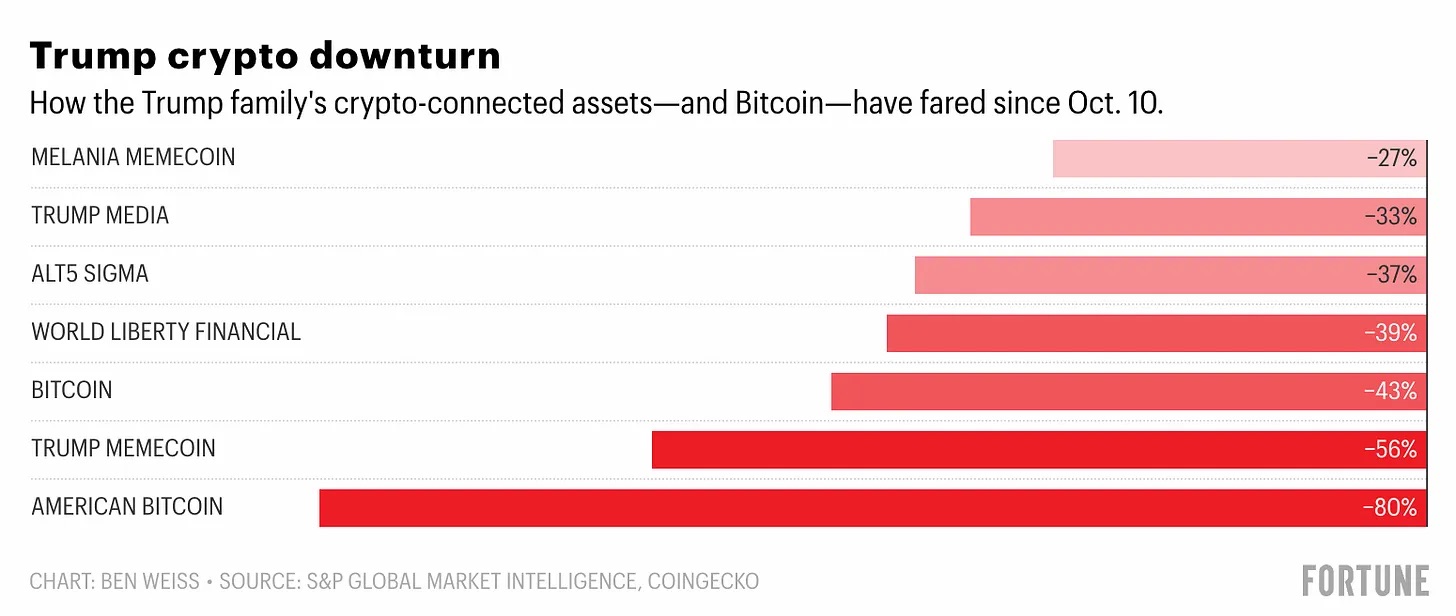
@fortune.com
This person called Bitcoin a scam in 2021, and by 2024 was speaking at a Bitcoin conference. Those who have long advocated that "the government has no right to control your money" are watching a sitting president profit directly from the industry they regulate, while the mainstream response is to speculate on coin prices and shout "the bull market is here."
In economics, there is a concept called revealed preference: what you actually do speaks more to the issue than what you claim to believe. The preference displayed by the decentralization movement under real political scrutiny is: we care about decentralization until it incurs costs; thereafter, we only care about price.
I don't want to overjudge. I am just recording the truth because someone has to do it.
The fervor of "we want to change the world" seen in 2017 and 2021 has mostly faded. The NFT crowd has dissipated, and people in the metaverse have found other topics to confidently express fallacies about. Those remaining are quieter, less messianic, and much more honest about what they are truly doing. The protocol layer is operating as designed, while the application layer has produced astonishing products. This revolution has still birthed practical financial infrastructure, changed the way global value flows, and made a large number of people very rich.
All I want to say is: be honest about what you are doing.
If you are creating a centralized exchange with better experiences and crypto channels, just say so. If your stablecoin is issued by a company, can freeze wallets, and has reserves in banks, just say so. If your DAO is actually controlled by three wallets, and everyone present knows it, you might as well just say that too. Users can handle honesty. What they cannot bear in the long run is the chasm between narrative and reality. And ultimately, they will express dissatisfaction by leaving.
Satoshi has been silent for fifteen years. Perhaps he foresaw all of this and chose to quietly watch the grand performance from the sidelines. Or maybe he simply knows when to exit.
免责声明:本文章仅代表作者个人观点,不代表本平台的立场和观点。本文章仅供信息分享,不构成对任何人的任何投资建议。用户与作者之间的任何争议,与本平台无关。如网页中刊载的文章或图片涉及侵权,请提供相关的权利证明和身份证明发送邮件到support@aicoin.com,本平台相关工作人员将会进行核查。


