Author: Max, 01Founder
On March 2, 2026, Beijing time, Monday, 8 PM.
This should have been an ordinary night.
At this hour, the office buildings in the East 8 Time Zone are brightly lit, which is the peak time for programmers to process work orders.
Meanwhile, on the other side of the Earth in New York and San Francisco, developers waking up have just brewed their first cup of coffee, ready to start a day of building.
Millions of dialogue boxes are flashing across screens worldwide.
Some are requesting optimization of a piece of Python code, some are trying to get AI to polish an academic paper about to be submitted, and others are seeking emotional comfort.
In this era, AI is no longer just a tool; it feels more like the water and electricity of the digital industry, a given existence.
Then, without warning, the power was cut off.
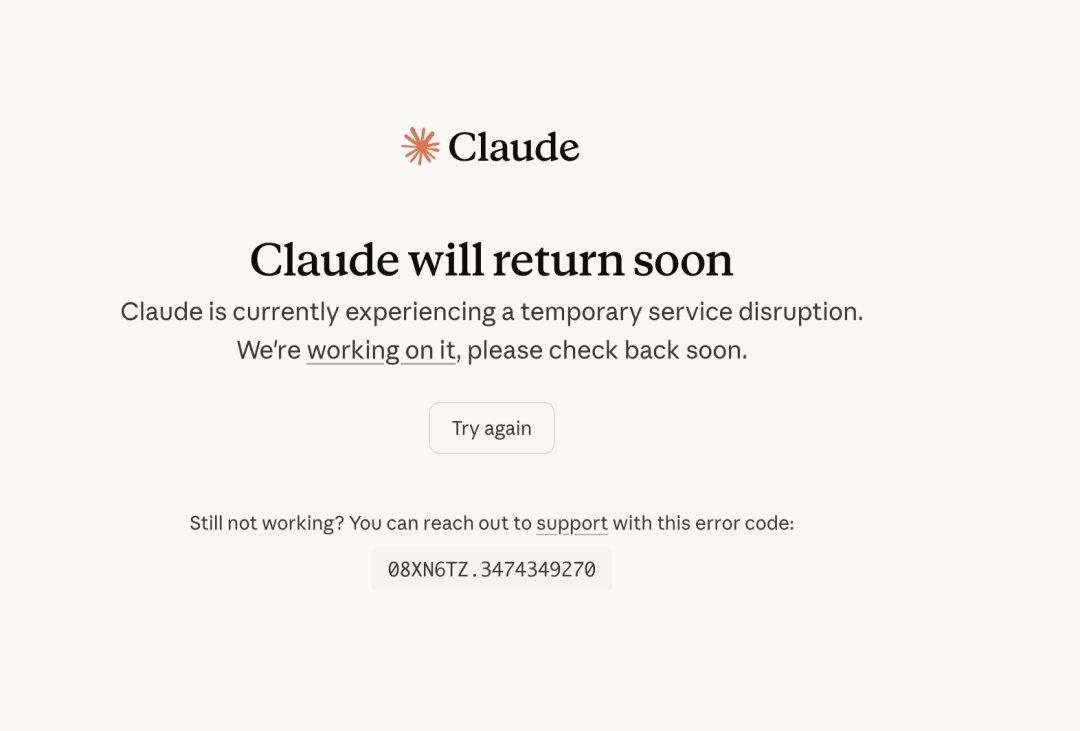
There were no spinning loading circles, no thinking prompts, only cold error codes and a line in black that read Claude will return soon.
In the first few minutes, everyone just felt irritated.
People in the WeChat group began to ask: Is my account banned?
Some even joked: Woke up and global writing and coding abilities decreased by ten times??
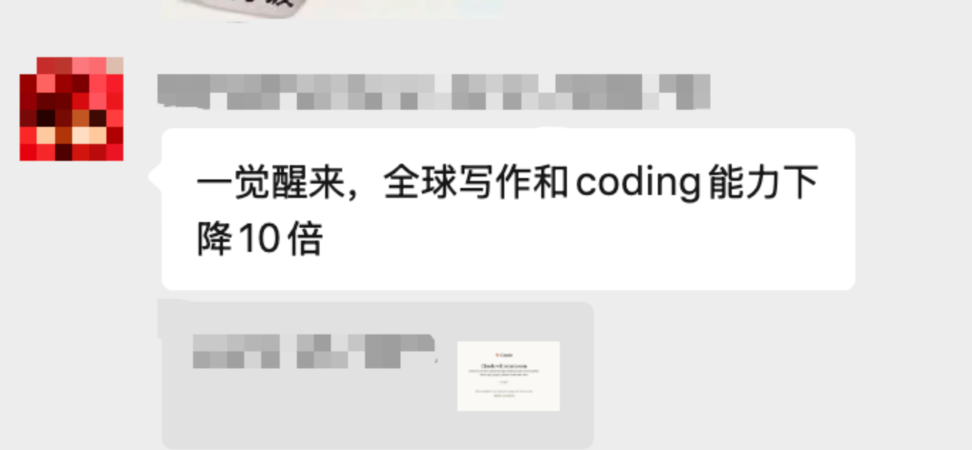
People were accustomed to looking for reasons within themselves or believing this was just another routine glitch.
Perhaps it was a bug written by an engineer at Anthropic when releasing a new version, or an automatic scaling failure of the Kubernetes cluster.
But soon, panic spread like a virus on Reddit, Hacker News, and X (formerly Twitter).
Because it wasn't just Anthropic's Claude, soon people discovered that Grok under Musk also lost response, and even some multinational bank apps relying on AWS's Middle East nodes began to report errors.
This did not seem like a routine service interruption, but rather a sweeping global AI circuit breaker.
People started flocking to social media, trying to find official apology statements.
Typically, we would see PR language like "We are investigating API latency."
But this time, there were no explanations from any official level.
Instead, there was a news push from thousands of kilometers away, tinged with the smell of gunpowder.
1. The Butterfly Over the UAE
The news was confirmed around 9:00 PM.
The source of this crash was not at the headquarters in San Francisco, nor at the data hub in Ireland, but in the Middle East.
Ten hours earlier, AWS's official status page updated with an extremely rare announcement:
Its core region located in the UAE (UAE) me-central-1 (specifically the mec1-az2 availability zone) suffered a physical strike.
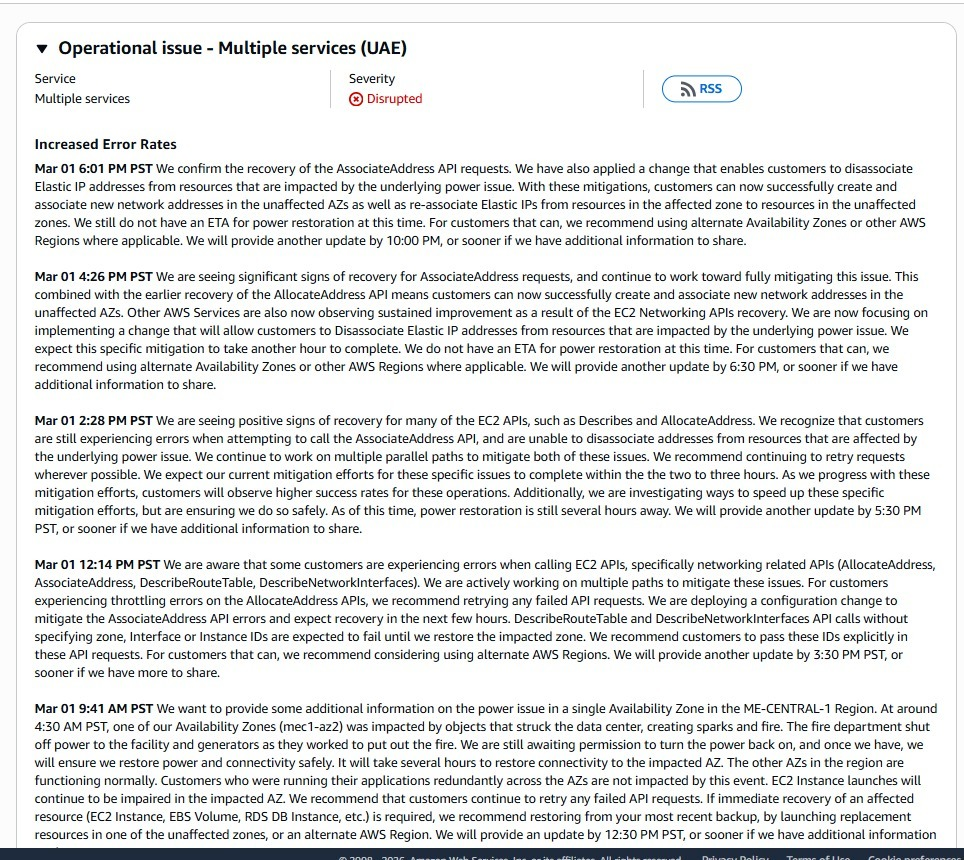
Please note this phrase: physical strike (Physical Event).
According to fragments of information pieced together by Reuters and local media:
An unidentified object (very likely a suicide drone or missile related to recent geopolitical conflicts) struck the data center's supporting power facilities.
Though the core server room may not have been directly hit (it has the highest level of physical protection), the fire caused by the explosion triggered the data center's circuit breaker mechanism.
To prevent the fire from spreading and causing greater secondary disasters, the automatic fire suppression system took over, and power supply was forcibly cut off.
This is what is known as a black swan.
In the past, we were told that systems are redundant, data is replicated, and services are always online.
Architects designed countless plans to deal with hard drive failures, fiber cuts, or even earthquakes, but few drew a missile in their architectural diagrams.
But on this night, reality schooled all technical optimists:
Cloud, after all, is comprised of physical entities like steel bars, concrete, diesel generators, and submarine cables.
It is not magic floating in the sky; it is a corporeal existence crawling on the ground. It fears fire, fears water, and even more so fears bombs.
This is a typical butterfly effect.
Thousands of kilometers away, a drone that may only cost a few thousand dollars fell, and its shockwave not only destroyed local walls but also instantly traveled along the submarine cable, reaching your desktop, cutting off the signal on your screen, evaporating hundreds of millions of dollars in instantaneous productivity worldwide.
But at this point, most people may still have a huge question in their minds:
Since my Claude model runs on servers in the USA, why would a blast in a data center in the UAE lead to a global shutdown?
02. The Digital Suez Canal
This is precisely the most surreal and most chilling aspect of the whole incident.
To understand the disaster of tonight, we must retake geography class.
We must realize that the Middle East is no longer just a simple oil-producing region; it is the Suez Canal of the digital age.
Open the world submarine cable map, and you will see an astonishing sight:
Several main backbone cables (such as AAE-1, SMW5) connecting Europe (EMA) and Asia (APAC) nearly converge in the narrow area of the Red Sea, Mandeb Strait, and Persian Gulf. (See the top comment for the lost image reference: Missing image one)
Data centers in the UAE are not just warehouses for storing data; they are the heart and pumping stations of massive data exchanges.
Although Claude's brain (model inference) may be in the USA, its neural core, or the control plane of the cloud service, is synchronized globally.
Modern cloud architecture, in pursuit of ultimate reliability, has instead created a global chain reaction.
Authentication (Auth), global traffic management (GTM), and billing systems often need to maintain real-time heartbeats among global nodes.
When the UAE node suddenly went offline due to a physical strike, it was like a key interchange on a highway suddenly collapsed.
Your request was not rejected by the servers in the USA but got lost on the digital elevated road that broke in the Middle East on its way to America.
Moreover, the impacted is far more than just AI.
The mobile banking system of Abu Dhabi Commercial Bank (ADCB) also paralyzed at the same time, causing a large number of cross-border transfers in the region to fail.
This is the fragility of the digital ecosystem under modern civilization.
AI, banks, logistics, all these seemingly independently operating cornerstones of modern civilization are actually tied to a fragile fuse.
3. The Oil of the AI Era
We can’t help but ask: Why build such critical infrastructure on a powder keg?
If we rewind time a few decades, the targets of war were typically refineries and oil pipelines.
That was the blood of the industrial era.
But in 2026, when Microsoft, Google, and Amazon spend hundreds of billions in the Middle East, when Nvidia's chips are stacked here, roaring day and night, the balance of strategy has shifted.
There are two forces at play:
- One is cost and energy. The Middle East has extremely cheap electricity (from natural gas and photovoltaics), while AI training is precisely a massive power-consuming beast.
- The second is geopolitical ambition. Both the UAE and Saudi Arabia are competing to become AI sovereign nations, requiring data to remain within their borders (Data Residency).

Thus, tech giants are flocking, establishing magnificent data temples in the desert.
Data centers are the oil fields of the new era; computing power is the electricity of the new era.
But tonight’s attack is a landmark historical turning point:
This is the first time the core infrastructure of large American tech companies has been forced offline due to a clear act of war.
It marks the official arrival of the oil-fieldification era of data centers.
In the past wartime logic, the bomb targets were to cut off energy or transportation.
But tonight's incident demonstrates that destroying a cloud computing availability zone is as destructive as blowing up a dam.
You are not just cutting off a chatbot; you are severing the logistics dispatch system, the financial settlement network, the public opinion analysis engine of your opponent, and even the automated data flow of hospitals.
This is the superdistance effect of the modern world.
Tonight, a bomb from the physical world traversed thousands of kilometers of fiber optics, directly penetrating the display in front of us.
The moment you realize your Claude Code cannot autocomplete code, you have effectively become a digital refugee of this geopolitical conflict.
Your productivity has been stripped, your workflow cut off, simply because someone in a corner of the Earth decided to press the launch button.
A billion-dollar AI company's lifeline depends on the security status of a data center in the desert.
This is not a technical issue; this is a supply chain security problem, even a national security issue.
4. The Ark of the Privileged Class
In the midst of the chaos mentioned earlier, I noticed an image circulating on social media.
As the civilian Claude.ai, API, and Claude Code were all in the red, with the status bar filled with orange and red indicating failures, a line at the very bottom of the Status page was glaringly lit with green:
Claude for Government: Operational (Running normally)
A keen-eyed netizen captured this moment on Twitter, adding a hilariously absurd comment:
@DeptofWar stop hogging all the servers bro. (Department of War, stop hogging the servers, bro.)
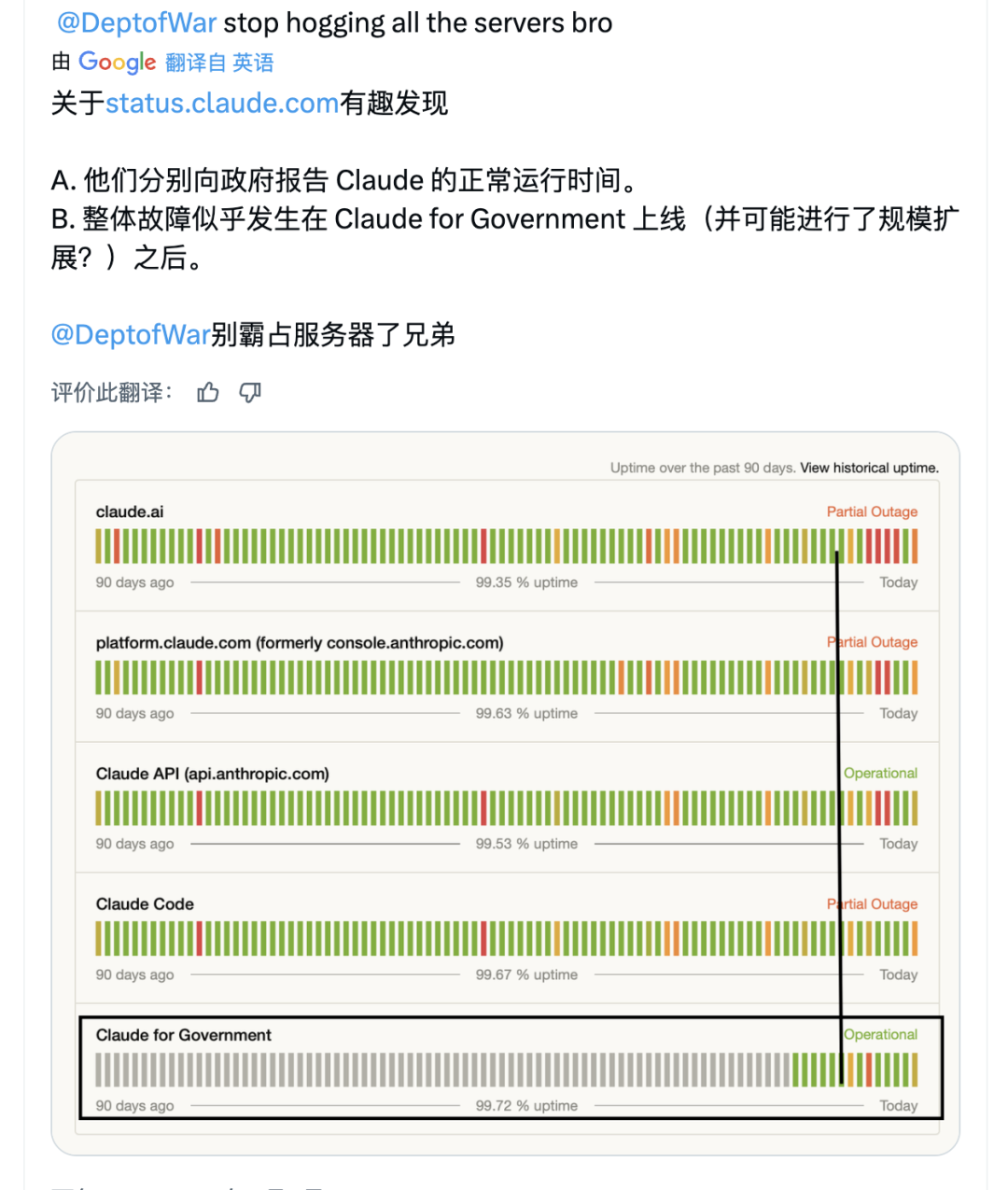
This seemingly absurd joke accurately hits a certain cruel truth.
The image shows that the government version of Claude seems to have just gone live (initially shown as gray and offline), and while it went online and remained fully green, civilian services began to collapse en masse.
This inevitably creates an illusion: as if that massive war machine sucked dry all computing power resources.
Of course, technically, it is not due to depletion but isolation.
Government cloud services (GovCloud) typically run in physically isolated fortresses with independent power supplies and satellite links, not using civilian routing at all.
But this feels more like a metaphor: in this storm, only the privileged elite boarded the Ark of Noah. (See top comment for the lost image reference: Missing image two)
This image plainly tells us: the machines that create war (War Machine) always have the highest survival priority, and their computing power remains constantly connected.
Whereas those AIs that connect ordinary people, serve creativity, communication, and emotional comfort are the first to be sacrificed as collateral damage.
We are going crazy in front of the screens because we cannot write code and feel anxious because papers cannot be saved;
while the systems that decide to launch missiles, those chips calculating ballistic trajectories, are calmly blinking with green light, unharmed, continuing to create new chaos on this planet.
Our AIs are silent, but the missile guidance systems remain online.
5. Many people's tomorrows will never come
Writing to this point, I have mixed feelings.
As an AI practitioner and half a tech blogger, I should analyze multi-active disaster recovery architecture or discuss the future of decentralized AI computing power.
But tonight, at this moment, all technical terms seem so pale.
At this moment, AWS engineers are making repairs, rerouting traffic to Europe and Singapore.
Perhaps by the time you read this article, Claude has already recovered, and the familiar dialogue box can pulse again.
A few hours later, the data flow will run smoothly again.
A few days later, this outage will be archived as a cold Incident Report.
A few weeks later, we will completely forget tonight's anxiety, continue sitting in safe rooms, complaining about AI's occasional hallucinations, as if nothing ever happened.
Services can be restarted, and data can be restored.
But please do not forget where the root of this error lies.
Next to that data center, on those streets hit by unknown objects, in the homes of those civilians forced into war due to escalating conflicts.
For us, this is just a 502 Bad Gateway, a brief offline moment, even an excuse not to work overtime.
But for many people thousands of kilometers away, the explosion tonight is not a bug that can be fixed.
There is no refresh button, no fault rollback, and no disaster recovery system.
Our servers will soon return to normal.
But for many people, their tomorrow will never come.
May the world be at peace.
免责声明:本文章仅代表作者个人观点,不代表本平台的立场和观点。本文章仅供信息分享,不构成对任何人的任何投资建议。用户与作者之间的任何争议,与本平台无关。如网页中刊载的文章或图片涉及侵权,请提供相关的权利证明和身份证明发送邮件到support@aicoin.com,本平台相关工作人员将会进行核查。


