Original title: "Manufacturing Palantir in Bulk, 58-Year-Old Peter Thiel Wants to Profit from War"
Original author: Jack, Dongcha Beating
Editor's Note:This article was first published on February 2, 2026. Less than a month after completing this piece, Palantir once again validated the disturbing logical loop with data: war is its best advertisement. Yesterday, as the U.S.-Iran conflict escalated, global risk assets were pressed down, while PLTR surged against the trend by 7%, closing at $145. Q4 revenue increased by 70% year-over-year, guidance for the entire year of 2026 is $7.2 billion (+61%), and U.S. commercial revenue growth surged by 115%—Wall Street analysts collectively raised target prices, with UBS jumping from neutral to buy. More noteworthy is that DHS just signed a $1 billion five-year AI platform procurement agreement, covering CBP and ICE. The ImmigrationOS mentioned in the article is transforming from contract documents into real-life law enforcement machines.
When Palantir's market value reached $328 billion, distinctly separating itself from traditional military contractors with a 200 times price-to-earnings ratio, Thiel's "hard technology + financial fuel + political revolving door" looped game was no longer a theoretical deduction, but was becoming the underlying code for the operation of the American national machine. Even more interestingly, in the terrifying "AI apocalypse script" from Citrini Research that shocked Wall Street, Palantir was listed as the only template that might survive— even OpenAI is copying its homework. The following is the original content:
In January 2026, Minnesota lost control.
The Trump administration announced the termination of Temporary Protected Status (TPS) for Somalia, meaning that tens of thousands of Somali refugees who had lived in the U.S. for many years must leave by March 17. Minneapolis has the largest Somali community in the U.S., making it the city most directly impacted by this policy.
Then, "Operation Metro Surge" came as scheduled. Over 2,000 federal immigration officers (ICE) in tactical gear surged into the city, exceeding the total number of the Minneapolis Police Department. They drove black SUVs and conducted intensive raids and arrests in residential areas.
A large number of disturbing videos quickly emerged on social media. Agents smashed car windows with window-breaking tools, dragged screaming drivers out in a chokehold, and pressed them to the cold ground. The most shocking incident was the death of 37-year-old American citizen Renee Good. This legal observer was fatally shot in the head by a federal agent from across the windshield while documenting the law enforcement action. Officials claimed she attempted to ram people with her car, but video footage showed her vehicle was only slowly turning.

Behind this massive hunt lies a name, Palantir.
Multiple investigative reports revealed that ICE was utilizing a tool called ELITE developed by Palantir on a large scale in Minneapolis. This system integrates a massive amount of data about monitored individuals, including medical assistance, tax records, utility bills, etc., and algorithmically coldly marks them as targets on the map.
According to publicly available federal contract records, ICE awarded Palantir a $30 million contract modification on April 17, 2025, to develop a platform codenamed "ImmigrationOS." Public contract defense documents explicitly mention that the system was created to support the President's executive order to accelerate deportation actions. Many believe that this platform is tailored to support the "surge" of large-scale actions beginning in 2026.
In recent years, Palantir has been condemned by public opinion as a "data butcher." Its data support of the Israeli military during the Gaza War, combined with long-standing ethical controversies and over a decade of losses, has made Palantir an "unwelcome entity" in both Silicon Valley and Wall Street.
But everything changed in the past year.
From "Data Butcher" to "AI Belief Stock"
In 2025, Palantir exploded onto Wall Street. This company, which had been dormant in controversy for twenty years, completed its transformation from "marginal contractor" to "backbone of the U.S. stock market." Being officially included in the S&P 500 in September 2024 was just the beginning; the company subsequently moved its listing from the New York Stock Exchange to Nasdaq, with its stock price soaring 150% within a year, briefly surpassing a $400 billion market value, rendering all traditional valuation models pale.
Behind this is a dramatic reversal of its financial data. After 19 consecutive years of losses, Palantir finally achieved GAAP profitability for the first time at the end of 2022 and entered a hyper-growth phase in the second half of 2024. By 2025, its quarterly revenue broke the $1 billion mark for the first time, reaching $1.181 billion, with year-over-year growth soaring from about 20.8% in early 2024 to 62.7% in the third quarter of 2025.
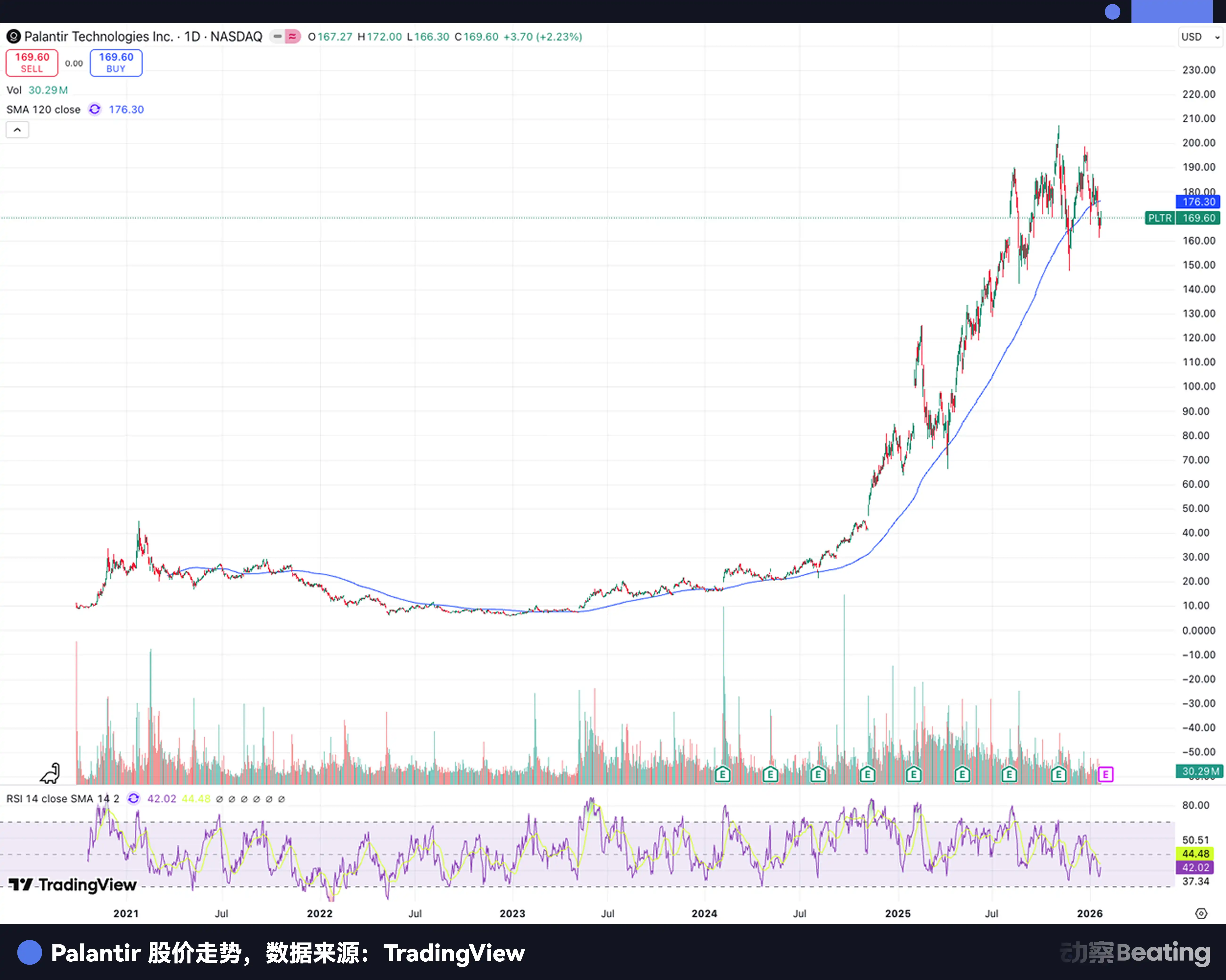
The core engine of growth comes from the explosion of its commercial business. In the third quarter of 2025, Palantir's U.S. commercial revenue surged by 121% year-over-year. This astonishing figure completely shattered the market's traditional perception of its "government dependence." On Reddit, retail investors hailed it as an "AI belief stock," claiming that Palantir was building the underlying digital operating system of modern civilization. In 2025, retail investors net purchased nearly $8 billion of Palantir stock, making it the fifth largest security in terms of net buying that year, directly pushing the price-to-sales ratio above 100 times.
However, beneath the intoxicating prosperity lies Palantir's darkest history of being ostracized by the entire Western financial system.
In September 2020, to retaliate against investment banks for suppressing its valuation, Palantir CEO Alex Karp and co-founder Peter Thiel chose a highly provocative direct listing model. They bypassed the traditional banking underwriting process and did not pay hefty underwriting fees to banks. This meant that Palantir was declaring a full-scale war against the entire Wall Street system.
Palantir's "original sin" is rooted in its very genesis, as it was one of the first startups funded by the CIA's In-Q-Tel investment fund in 2005. Although it only received $2 million in seed funding at the time, this intelligence agency background resulted in deep ties between Palantir's business and the government and military, especially with ICE.
Since 2014, Palantir has provided the U.S. Immigration and Customs Enforcement (ICE) with contracts worth $41 million to develop ICM investigation case management systems and FALCON mobile applications, allowing federal agents to track targets' geographical movements in real-time through mobile tower data to identify and track illegal immigrants.
Long-term collaboration with ICE has led Palantir to be classified as a "potential human rights violator" and a "monitoring social risk" company within the ESG framework. Palantir's scores across major ESG rating agencies have long been at the bottom level. Ethos ESG gave Palantir an F rating, with a composite score of just 18.1 points (out of 100), ranking in the bottom 1% of the entire software industry. On social dimensions like "accountability" and "LGBTQ+ equality," Palantir's scores are all 0.
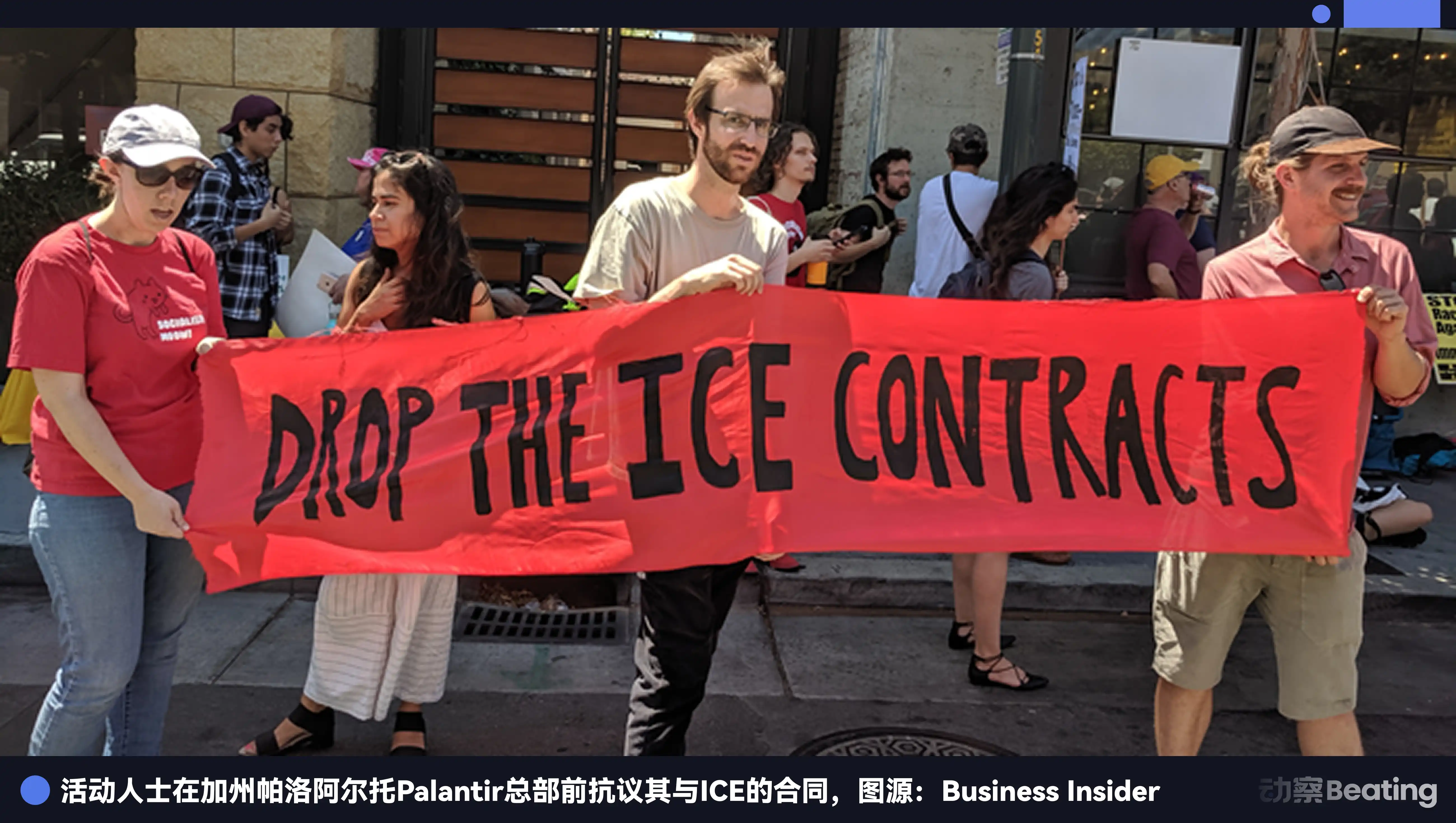
This directly resulted in Palantir being excluded by numerous ESG funds and banking institutions. In the modern financial system, ESG evaluations are no longer marginal moral references but rather core valves for banks to assess credit risk, allocate capital, and determine business access. For mainstream banks, supporting a company with a bottom-ranking ESG rating not only implies regulatory compliance pressure but also risks triggering collective protests from its own employees and shareholders.
In this ongoing social hostility, ESG standards became the most effective financial shackles to strangle Palantir.
JPMorgan Chase was Palantir's first large corporate client, spending $120 million in 2009 to use its software to monitor internal fraud. However, as this project was labeled "monitoring employees" by public opinion, JPMorgan quickly terminated its collaboration with Palantir and swiftly cut financial ties. Morgan Stanley, as Palantir's long-term financing advisor, dramatically cut its valuation from $20 billion to $4.4 billion in 2018.
Palantir also faced financing struggles in the Western financial market. Due to its extremely low ESG metrics, Norway's largest asset management company Storebrand Asset Management and the Norway Public Pension Fund KLP implemented strategies to divest and refuse to invest in Palantir, and major European banks began to impose invisible financial exclusion on Palantir.
To survive, Palantir had to turn to non-Western traditional financial powers for support, such as Malaysia's sovereign wealth fund Khazanah Nasional. This left CEO Karp utterly disillusioned with the Western traditional financial system. He repeatedly criticized "woke culture" and the hypocrisy of Silicon Valley and Wall Street in public, denouncing them for enjoying the dividends of democratic order while refusing to support the technology that maintains order.
From its establishment in 2003 until the end of 2022, Palantir never achieved GAAP profitability in any year. The wheel of fate began to turn in 2022, thanks to two "explosions" from different dimensions: one erupted in the Eastern European plains amidst war, and the other was the deep-seated revolution in large language models in computing centers.
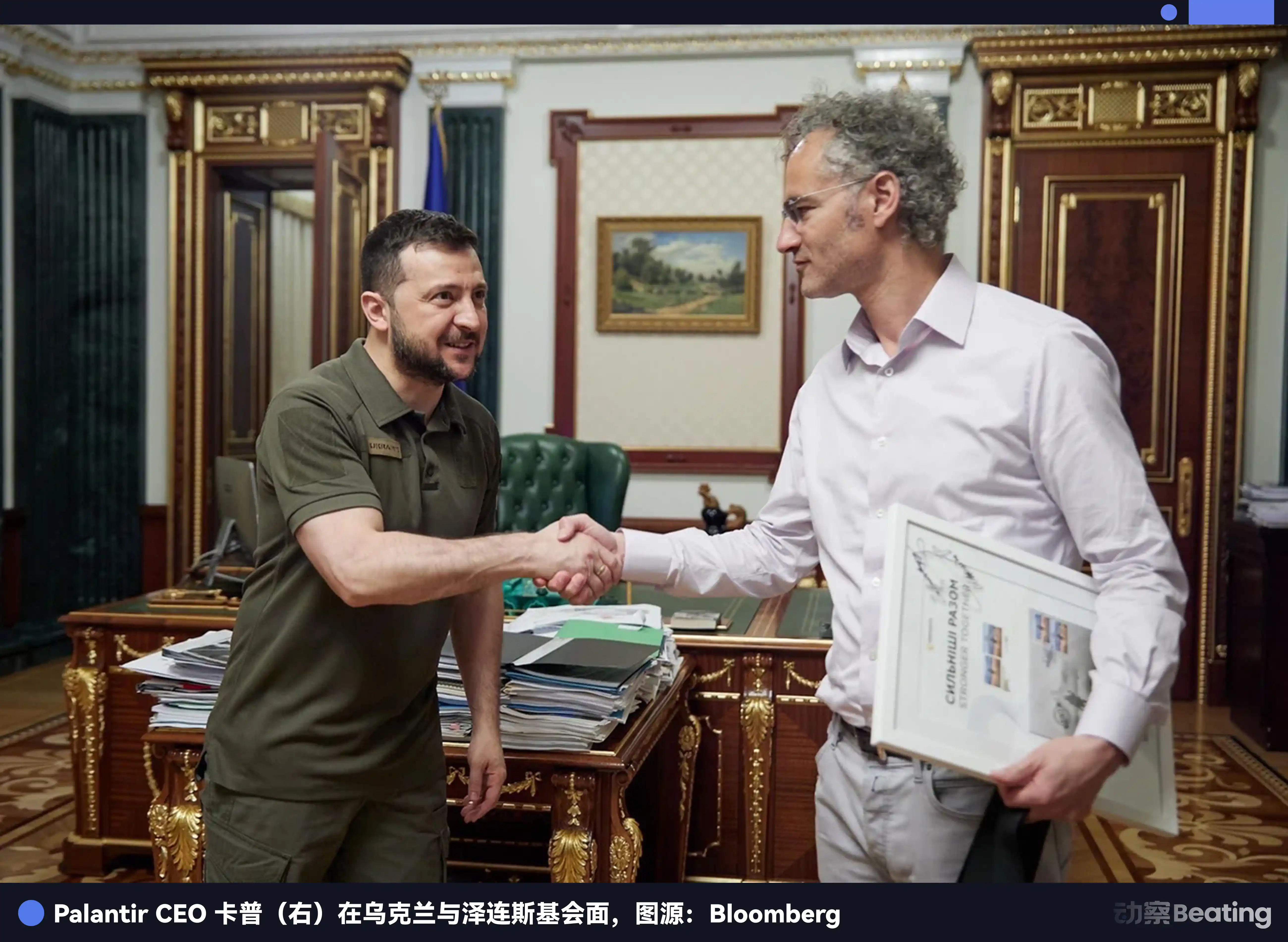
The Russia-Ukraine war became Palantir's best advertisement. Its technology was widely used for target aiming, refugee resettlement, and battle damage assessment on the Ukrainian battlefield, and Zelensky personally praised Palantir vigorously on social media. European politicians suddenly realized that, in the face of a brutal survival crisis, the moral fastidiousness of ESG seemed utterly powerless.
On the other hand, the revolution in large language models triggered by ChatGPT directly provided nuclear fuel for the launch of Palantir AIP artificial intelligence platform. Palantir's core team realized that a once-in-a-lifetime "rehabilitation" opportunity had arrived. CEO Alex Karp candidly stated in an interview in 2023, "We have waited for this moment for twenty years."
The AIP launched in 2023 is the strategic core of Palantir's response to the wave of large language models. It connects the disorganized internal data of enterprises to large models with categorized labels, providing them with a "logical exoskeleton." Meanwhile, the extremely aggressive Bootcamp sales model shortened the sales cycle from a year to just a few weeks. In the first half of 2025 alone, Palantir hosted over 500 training camps, driving its number of commercial clients to increase by 65% year-over-year, with adjusted operating profit margins soaring to an astonishing 51%.
In September 2024, Palantir was officially included in the S&P 500 index, meaning that passive funds tracking the index, regardless of whether they include ESG screening, must purchase its stock. Former critics of Palantir and those who held a reserved attitude towards it on Wall Street have now become major collaborators or research supporters for promoting AIP.
The victory in the public market has allowed Palantir to escape the suffocating fate of "debanking," but this brutal game reveals a profound systemic fracture. Palantir's breakthrough is a heroic anomaly, while there are still many startups deeply focused on hard technology in Silicon Valley, desperately struggling in the "valley of death" due to the tightening shackles of ESG standards and the politically correct tendencies of traditional banks.
What they need is a completely new financial infrastructure, a capital force that dares to ignore "woke culture" and can deeply understand its own value.
The Rise of Lonely Mountain: From "Palantir Gang" to New Financial Sovereignty
In July 2020, just before Palantir prepared for its direct listing, a name that had disappeared for a decade reappeared on the company's board: Alexander Moore.
In Palantir's internal epic, Moore symbolizes something totemic; he is the company's "employee number one." In 2005, when Peter Thiel was still scrambling for that meager $2 million investment from the CIA, Moore, holding the title of Operations Director, built Palantir's initial framework in a makeshift office in Silicon Valley. In 2010, he chose to leave Palantir on the eve of its stunning performance on the Afghan battlefield, diving into the venture capital circle and eventually becoming a partner at 8VC.
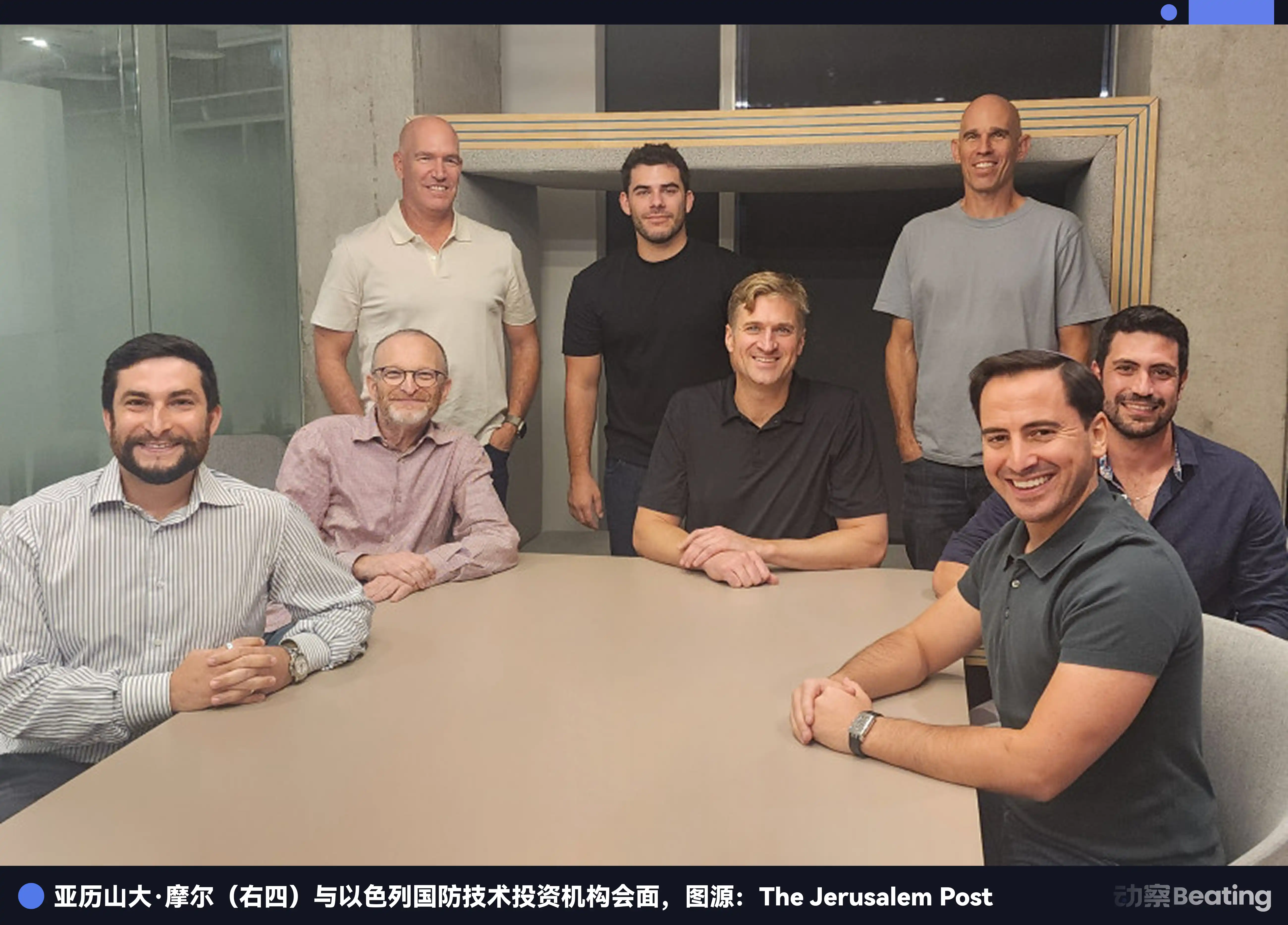
Moore's return in 2020 was more akin to a convergence of power. Behind him, 8VC is led by Palantir co-founder Joe Lonsdale, the most industrially ambitious among the "PayPal gang." This return seems to convey a strong signal: that group of young people who once reshaped the intelligence community with code is now returning to reshape America's industrial mother body.
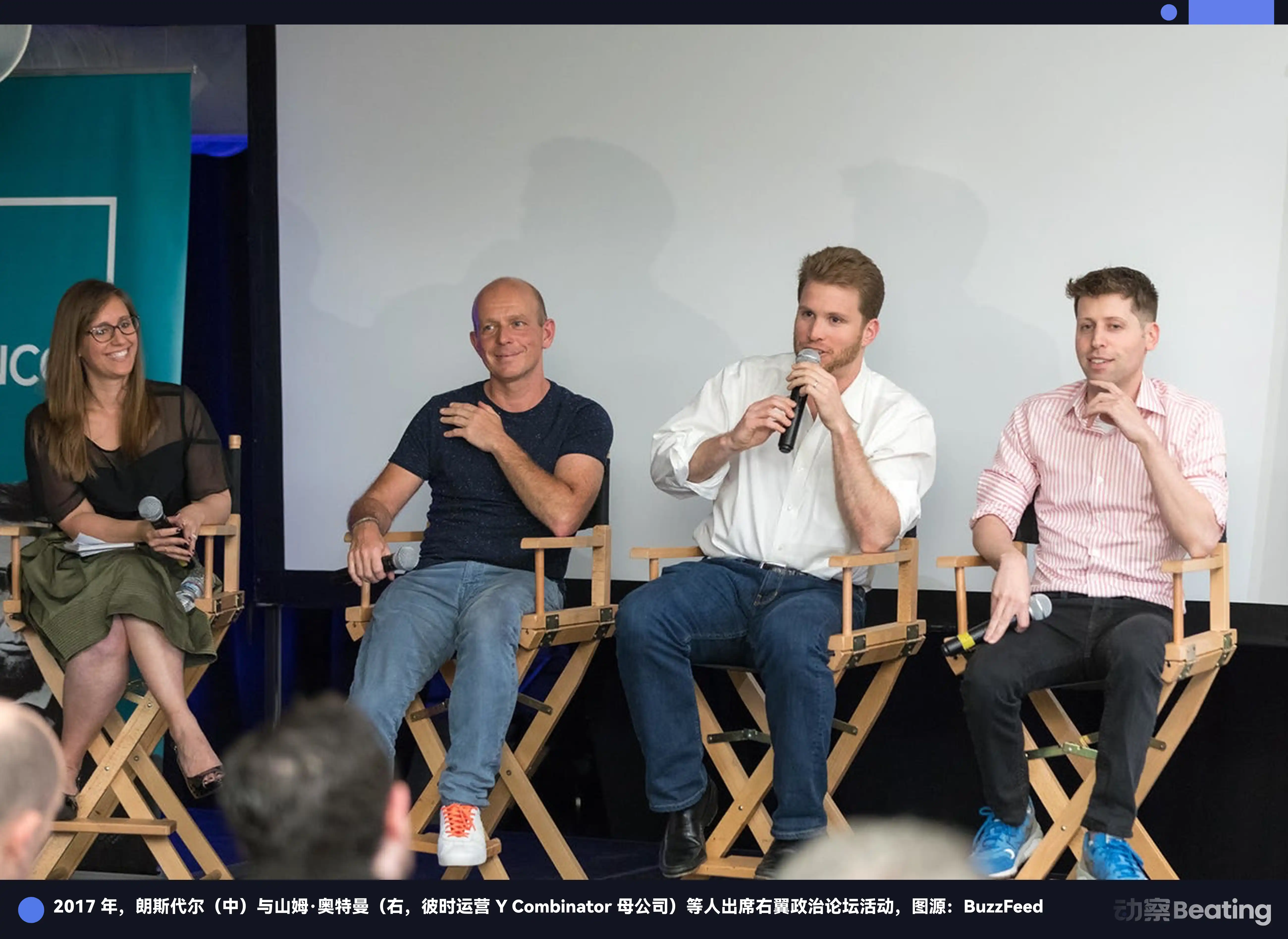
In the triumphant year of 2025, the "Palantir Gang" united once more, with Lonsdale, Anduril founder Palmer Luckey, and their godfather Peter Thiel pushing a crazier plan in the power gaps of Washington and Silicon Valley—establishing Lonely Mountain Bank. This is not a traditional commercial bank; its very birth is a public rebellion against the existing financial order. During the regulatory chill following the collapse of Silicon Valley Bank, Lonely Mountain Bank received approvals and endorsements from the Office of the Comptroller of the Currency (OCC) and the Federal Deposit Insurance Corporation (FDIC) in an astonishingly "privileged" speed within just four months.
This "special treatment" is backed by a dramatic shift in the power landscape between Washington and Silicon Valley. In the face of change, bureaucracy had to yield to the "Thiel network."
Lonsdale proposed a grand vision for Lonely Mountain Bank: to become America's "comprehensive commercial company." This concept is rooted in the practical lessons he learned from founding 8VC after leaving Palantir. During his tenure at 8VC, Lonsdale focused on hard technology fields like defense, government, and industrial infrastructure, incubating and investing in a host of hard tech companies, including Anduril and Epirus. However, this experience plunged him into a profound "structural despair," which he summarized as the mismatch of "capital geometric structures."
In the traditional venture capital context of Silicon Valley, software companies are light-asset with quick returns, while defense hard tech companies like Anduril require massive upfront capital investments, often burning billions before reaching IPO. Hard tech startups must face the "trinity" execution pressure: operating hardware manufacturing, software integration, and complex Washington business relationships simultaneously. More brutally, they confront the insurmountable "valley of death," where the Department of Defense's budget cycle lasts 2 to 3 years, causing many startups to die in the black hole of budget processes before obtaining their first official procurement contracts due to cash flow breakage.
Lonely Mountain Bank rejected the traditional financial credit mindset and absorbed a large number of former Navy SEALs and senior engineers from SpaceX, using an unprecedented dimension to examine the underlying data of hard tech companies, granting it asset pricing capabilities that traditional banks cannot possess. When Anduril presented a test data for hypersonic missiles, JPMorgan saw high-risk R&D expenses, while Lonely Mountain Bank viewed future defense orders.
This model directly eliminates the bottlenecks of financial capital flowing to the real industry and the vacuum of credit. Based on its profound hard tech background and unique government receivables financing model, Lonely Mountain Bank can accurately assess the default risks of a pending contract and provide asset-backed loans based on that assessment. This means that Anduril can use future missile orders and its factory equipment as collateral to obtain current operating funds without needing to dilute its equity for cash.
However, Lonely Mountain Bank's most hidden core moat is that it is a deeply "relationship-based bank." Over the past decade, Peter Thiel and Palantir's network has quietly infiltrated the U.S. federal government and military. Today, this web of connections has transformed from a behind-the-scenes advisory list into a decision-making center at the forefront, providing Lonely Mountain Bank's clients with a highway to government contracts.
In the Pentagon, Deputy Secretary of the Army Michael O'Briant controls the Army's budget and procurement strategy. Although he signed a recusal agreement, as a former senior director at Anduril, the "fast procurement" reforms he promotes directly benefit the non-traditional defense contractors that Lonely Mountain Bank serves. The newly established Army "201 Brigade" has even directly awarded Palantir CTO Shyam Sankar the rank of Army Reserve Colonel. Jacob Helberg, a former senior advisor to Palantir's CEO, now serves as the Deputy Secretary of State for Economic Growth, and the "Pax Silica" Silicon Valley Peace Initiative he leads is forcibly reshaping global supply chains, clearing geopolitical barriers for mineral and chip companies that Lonely Mountain Bank invests in.
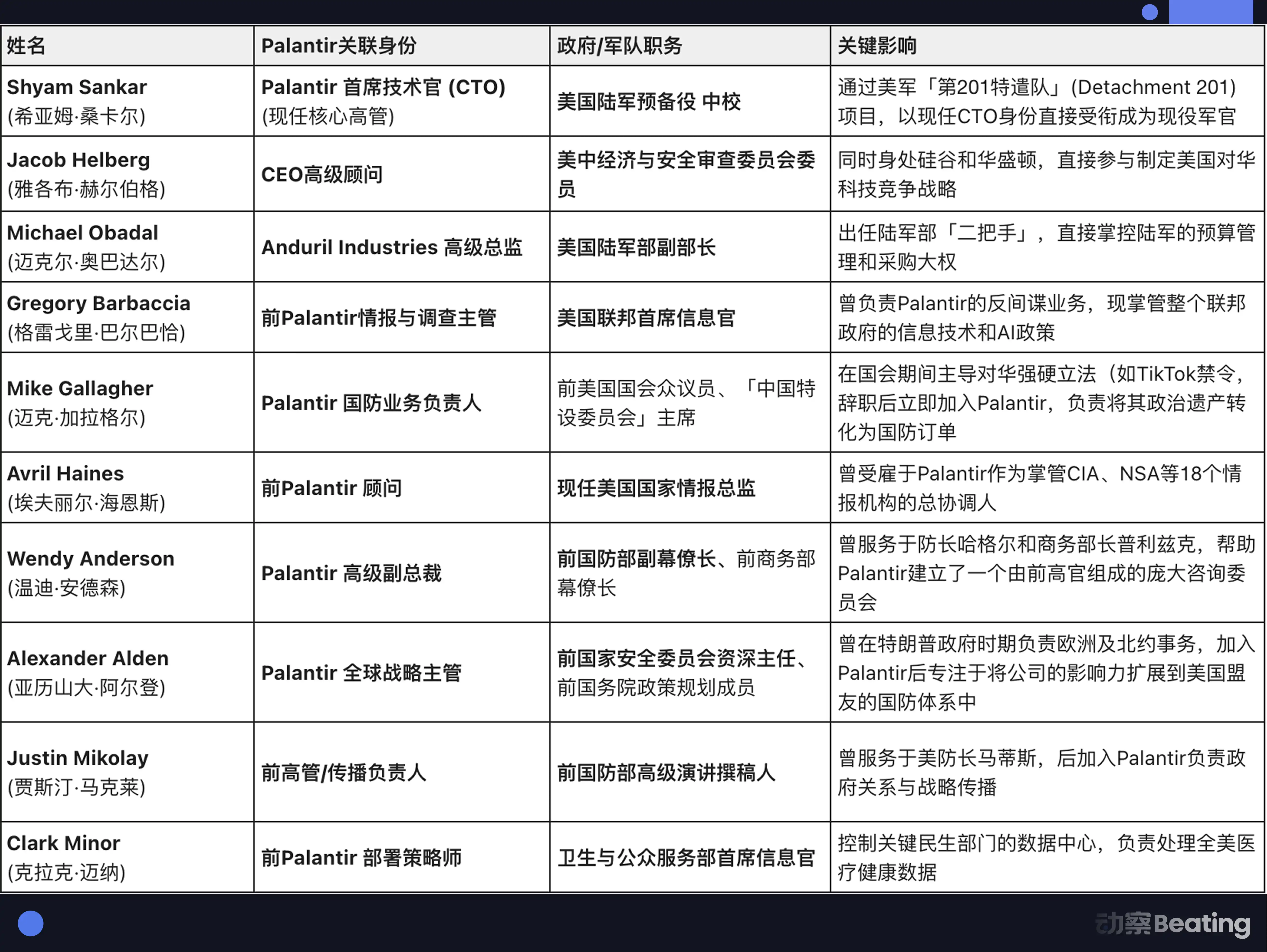
In the future, clients of Lonely Mountain Bank will no longer face the black box of bureaucratic systems but rather their own allies sitting across the decision-making table.
Under the protection of a vast power network, Lonely Mountain Bank's internal structure displays an extraordinarily calm contrast. To stand firm in the ruins of financial regulation, Lonely Mountain Bank adopted an extremely conservative strategy known as the "fortress model," maintaining a Tier 1 leverage ratio of no less than 12%, which is nearly double that of traditional commercial banks. The massive deposits it absorbs are strictly prohibited from being used for high-risk lending; rather, they are forcibly locked in safes of highly liquid assets like U.S. Treasuries.
At the same time, Lonely Mountain Bank has built a highly aggressive payment engine. With compliance backing from former DOJ superstar prosecutor Katie Haun and her crypto venture Haun Ventures, Lonely Mountain Bank merged with stablecoin company Atticus, positioning itself as "the most regulated stablecoin trading hub." For defense tech companies operating globally, wars do not adhere to a 9-to-5 banking schedule. Utilizing stablecoins as a settlement layer allows the bank to provide 7x24 hours cash clearing services even during public holidays, ensuring supply chains stationed at the Polish border or Pacific bases can execute second-level payments.
Thus, the puzzle of Lonsdale's "American comprehensive company" finally closes. The chaebols structure that played a core role in post-war Japan's rise is characterized by a deep intermingling of financial and industrial capital. Now, the "Palantir Gang" is engaged in an infinite game that transcends venture capital logic. In this game, finance is reshaped into "financial fuel" for hard technology, driving America's long-stalled heavy industry.
However, the geographical center of this transformation is no longer the Silicon Valley Bay Area, but points to a heavier, more tangible coordinate. There, the once "rust belt" is being remolded into America’s "new defense industrial corridor" by this new financial power.
American Power, Silicon Valley's "Reindustrialization" Dream
If you drive through the southern suburbs of Columbus in the winter of 2026, you will see a strikingly cyberpunk scene: next to Rickenbacker International Airport, a super factory codenamed "Arsenal-1" is breathing like a giant beast.
This factory, which plans a floor area of 5 million square feet, is the crown jewel of Anduril and is the largest single defense manufacturing project in Ohio's history. Its outer walls flash cold signal lights, and thousands of engineers and technicians are producing autonomous jet fighters named "Fury," all equipment managed in real-time by a system called "Arsenal OS." There is no noise from traditional assembly lines, only the tranquil flow of data and deadly efficiency.
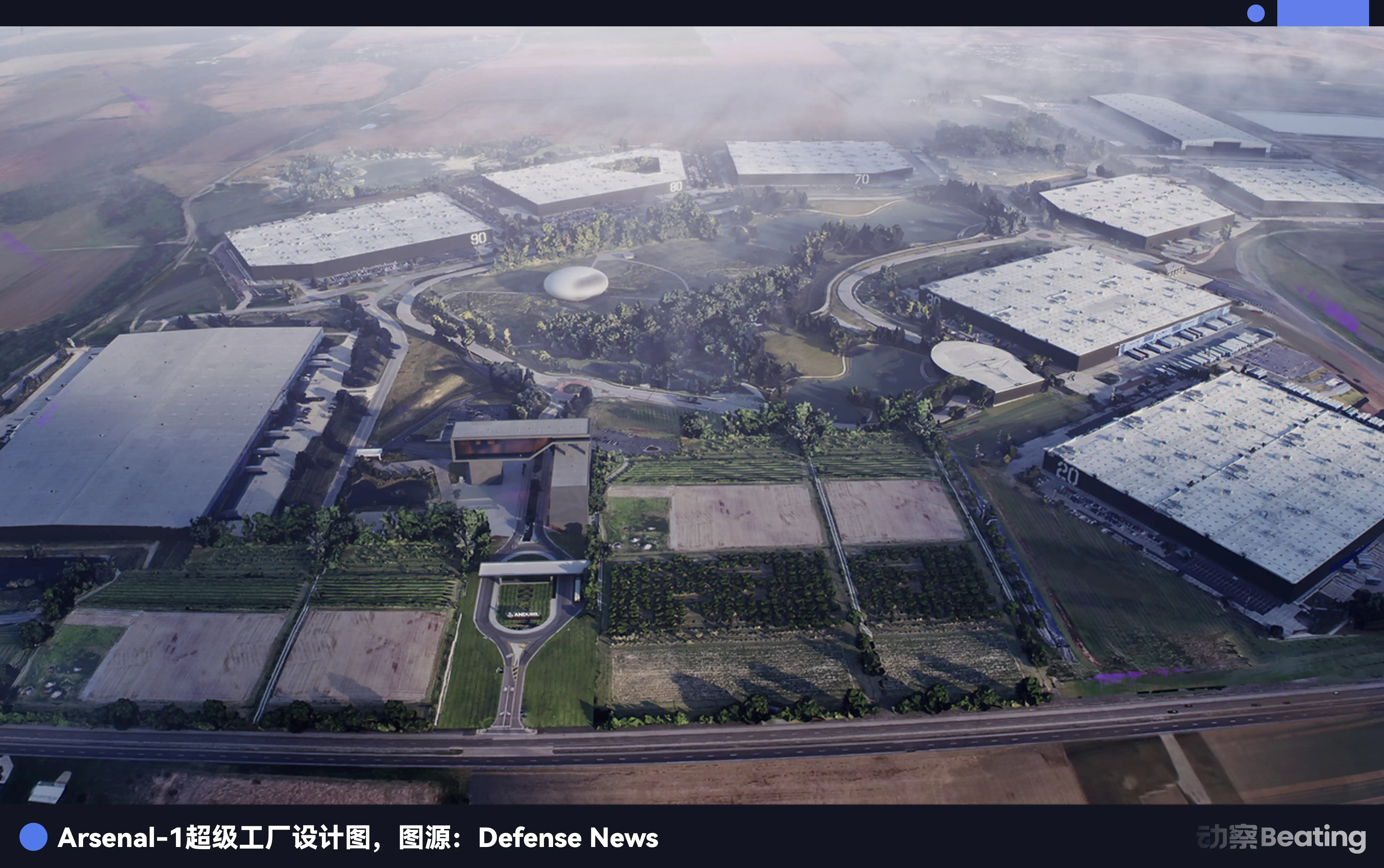
This land was once the heart of American industry, forged by Cleveland's steel, Akron's rubber, and Dayton's aerospace components into the foundation of the "democratic arsenal" during World War II. However, with the advance of globalization and deindustrialization, it became the infamous "rust belt," with factories closing down, leaving behind vast ruins and towns corroded by opioids, marking scars of America's decline.
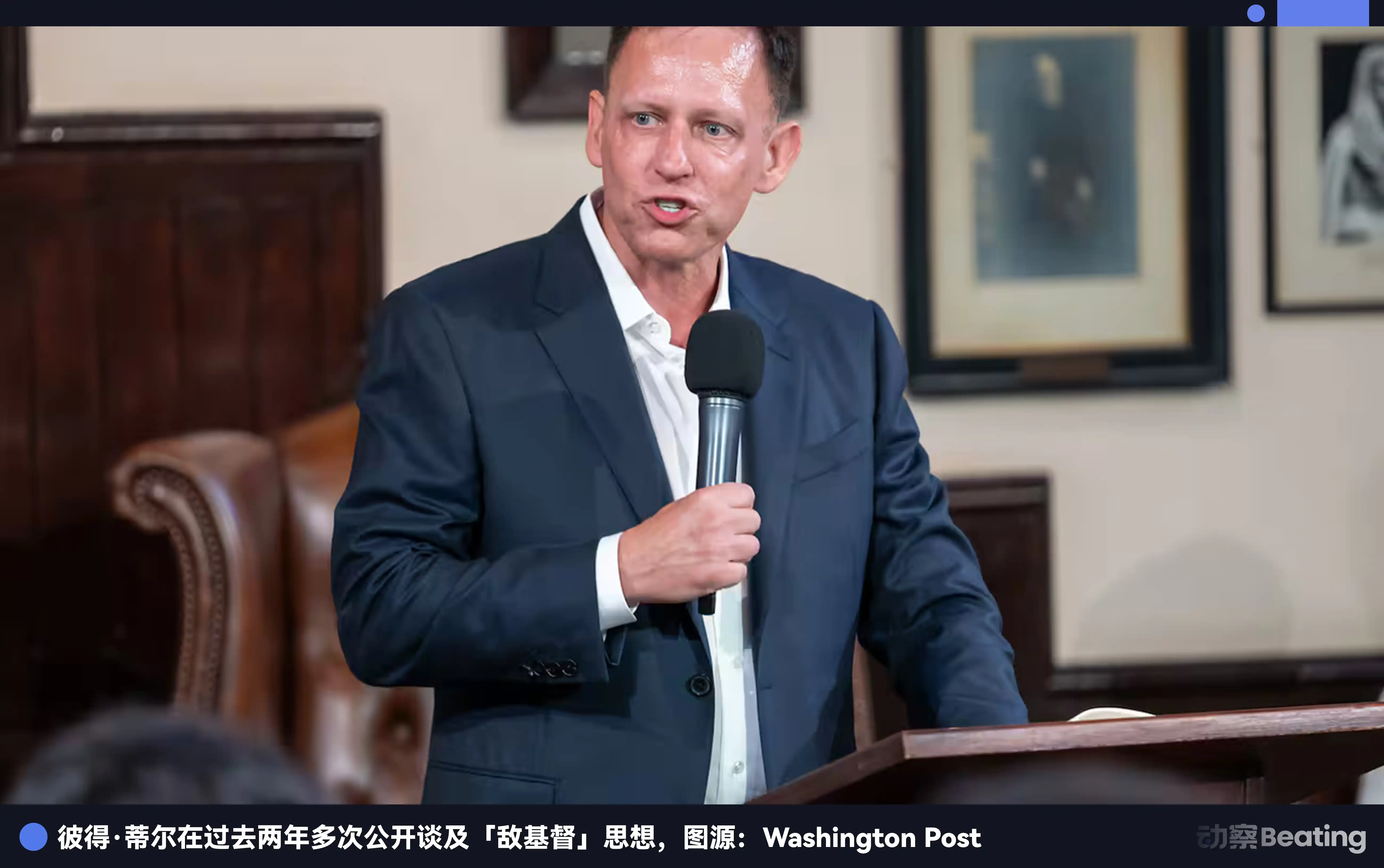
But around 2024, the winds shifted dramatically. Peter Thiel and core Silicon Valley capital like A16Z began to shift their focus from software companies in the San Francisco Bay Area to hard technology in the American Midwest on a large scale. This was a philosophical liquidation of the logic of development that Silicon Valley had pursued for the past twenty years, initiated by Peter Thiel.
The roots of this liquidation can be traced back to Thiel’s thunderous curse: "We wanted flying cars, but what we got were 140 characters." In Thiel's view, the so-called "tech boom" since the 1970s is a colossal lie. The elite of Silicon Valley have become addicted to the illusion of prosperity in the digital world, optimizing advertising algorithms and social media to make people addicted to clicking on screens, but have remained mired in a fifty-year stagnation in the physical world.
Thiel argues that this avoidance of the physical world has led not only to hollow economic growth but has also rendered Western civilization fragile in the face of geopolitical challenges. Therefore, he established a somewhat apocalyptic investment creed within Founders Fund: if technology cannot solve "hard problems" like nuclear fusion, space transportation, and hypersonic defense, then all unicorn companies will ultimately be meaningless.
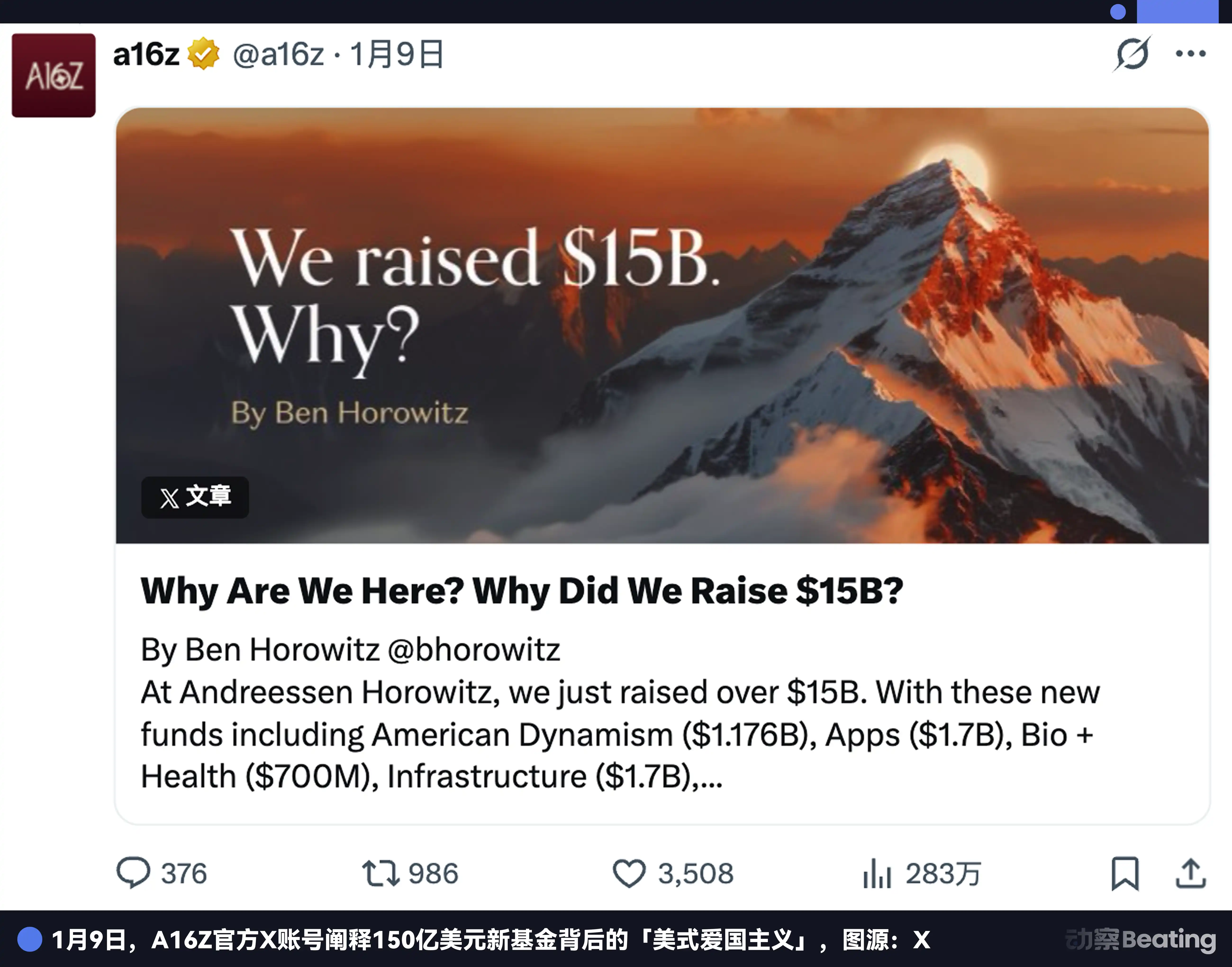
To realize this philosophical vision of returning to the atomic world, Silicon Valley’s elites have shown unprecedented political aggressiveness. A16Z has packaged it as the "American Dynamism" movement, with the core objective being to reconstruct rigid national-level infrastructures with Silicon Valley's venture capital.
To this end, A16Z broke the tradition of venture capital firms not directly engaging in politics, establishing a high-spec office in Washington D.C. and forming a lobbying team composed of former high officials from the Department of Defense and veteran lobbyists. According to public records, A16Z’s federal lobbying expenses exceeded $1.8 million in 2025, surpassing the total of the entire American Venture Capital Association. Their core mission is singular: to help hard tech companies like Anduril and Hadrian traverse the "valley of death."
Within the walls of the Arsenal-1 factory, this philosophical movement is being transformed into disruptive productivity of the traditional military-industrial complex.
Traditional military giants like Lockheed Martin are accustomed to cost-plus contracts, where the government foots the bill no matter how long development drags on or how much it exceeds costs, which essentially rewards inefficiency. Anduril’s model exemplifies the "Thiel-style" approach— utilizing venture capital to develop products, iterating quickly until the product matures before selling to the military.
Meanwhile, the "American Dynamism" camp emphasizes absolute supply chain sovereignty, with SpaceX being the best case study. Unlike traditional defense contractors that outsource components to global supply chains, Anduril builds solid rocket engine factories to ensure that American missiles can still launch from warehouses even when global shipping is cut off by war. Here, the production line is itself part of the software; through "Arsenal OS," the factory can seamlessly switch production from reconnaissance drones to cruise missiles within weeks based on battlefield demands—a flexibility unimaginable with traditional rigid production lines.
This "reindustrialization" movement also has an ultimate umbrella of political protection—Vice President J.D. Vance from Ohio. As a former disciple of Peter Thiel, Vance is the perfect link connecting Silicon Valley capital with rust belt workers. After assuming the vice presidency, he became the highest spokesman for "American Dynamism" in the White House, vigorously promoting an upgraded version of "buy American" clauses and providing hefty tax credits for tech companies building factories in the rust belt.
Data appears to verify this strategy’s madness and success. By early 2026, Ohio's manufacturing output had achieved double-digit growth for four consecutive quarters, with over 15,000 new high-end manufacturing jobs created. Not only Anduril, but also Intel's wafer fab in Licking County and the nuclear fusion startup Helion Energy supported by Lonely Mountain Bank have also established roots on this land.
With the alliance of Silicon Valley elites and Washington powers, this is no longer just Peter Thiel's philosophical utopia; America's "reindustrialization" seems to be transitioning from a hollow slogan into a reality woven of steel and code.
The Achilles' Heel of Leviathan
When we shift our gaze from the bustling munitions factories of Ohio back to the global supply chain map, the revival fervor of Silicon Valley elites will quickly be doused by cold facts. This American reindustrialization machine, which attempts to reverse the historical gravity, is hurtling full speed towards invisible reefs composed of physical limits and economic laws. This is the foundational logical deadlock of geopolitics and macroeconomics.
The most lethal soft underbelly lies in the elemental curse buried deep in the ground. While the Arsenal-1 factory can assemble drones day and night, the critical raw materials that constitute these machines' nerves and bones are not under their control. This is a deeply ironic closed loop. According to data from the U.S. Geological Survey (USGS), China controls around 90% of the global rare earth refining capacity. The Mountain Pass mine in California is the only rare earth extraction site in the U.S., but the ore excavated here still needs to be shipped to China for refining due to a lack of domestic separation technology, then bought back at high prices. This means that Ohio's new factory is essentially manufacturing weapons intended to contain China with materials sourced from China.
Alongside the supply chain crisis is the "kilowatt war" occurring on the U.S. domestic electric grid. While Silicon Valley elites market "American Dynamism," they deliberately evade an awkward physical fact. The high-energy-consuming AI data centers and new manufacturing sectors they rely on are engaged in a mortal struggle on the same increasingly aged power grid.
Palantir's training for the new generation of large models requires exponentially growing computing power, with the energy consumption of its single data centers approaching that of a medium-sized city. According to predictions by Boston Consulting Group, by 2030, the electricity consumption of U.S. data centers is expected to reach 7.5% of total consumption, while the manufacturing recovery will further squeeze the remaining space. Before the commercialization of the nuclear fusion technology that Lonely Mountain Bank invests in, the U.S. faces a zero-sum game: when the digital brain competes with the industrial body for limited energy, the giant's actions are destined to experience fatal rigidity due to a lack of blood supply.
The deepest and most challenging deadlock hides within the genetic paradox of dollar hegemony. Historically, no country has simultaneously served as "the world's largest industrial exporter" and "the global financial hegemon," as this requires two entirely opposing monetary policies. To revive manufacturing and occupy markets through weapon and industrial goods exports, the U.S. needs a weaker dollar to lower production costs. However, to maintain Wall Street's financial hegemony, attracting global capital flows back to support financial prosperity requires maintaining a strong dollar status.
This is the modern version of the famous "Triffin's Dilemma."
Vance and Thiel attempt to forcibly reverse this trend through administrative means, turning the dollar from a public good serving global financial circulation into a national tool serving domestic industry. This means America may need to tolerate prolonged inflation and even force Wall Street to relinquish profits through administrative intervention to subsidize the assembly lines in Ohio. This is a political gamble that touches the core of the nation. Will the financial capitalists of Manhattan truly be willing to sacrifice their global financial scepter for the workers of the rust belt?
From the cold hunt in Minneapolis to the secret convergence in Washington's power corridors, a group of "hackers" who once reshaped the intelligence community with code are attempting to rewrite the physical world with the same logic. They are wagering money, reputation, and even the fate of America, striving to prove that the "Silicon Valley model" can save an empire's twilight. The answer may not lie in those beautifully presented pitch decks but rather in the blizzards of the next winter and whether that fragile supply chain can continue to turn.
免责声明:本文章仅代表作者个人观点,不代表本平台的立场和观点。本文章仅供信息分享,不构成对任何人的任何投资建议。用户与作者之间的任何争议,与本平台无关。如网页中刊载的文章或图片涉及侵权,请提供相关的权利证明和身份证明发送邮件到support@aicoin.com,本平台相关工作人员将会进行核查。


