Author:Xu Shan
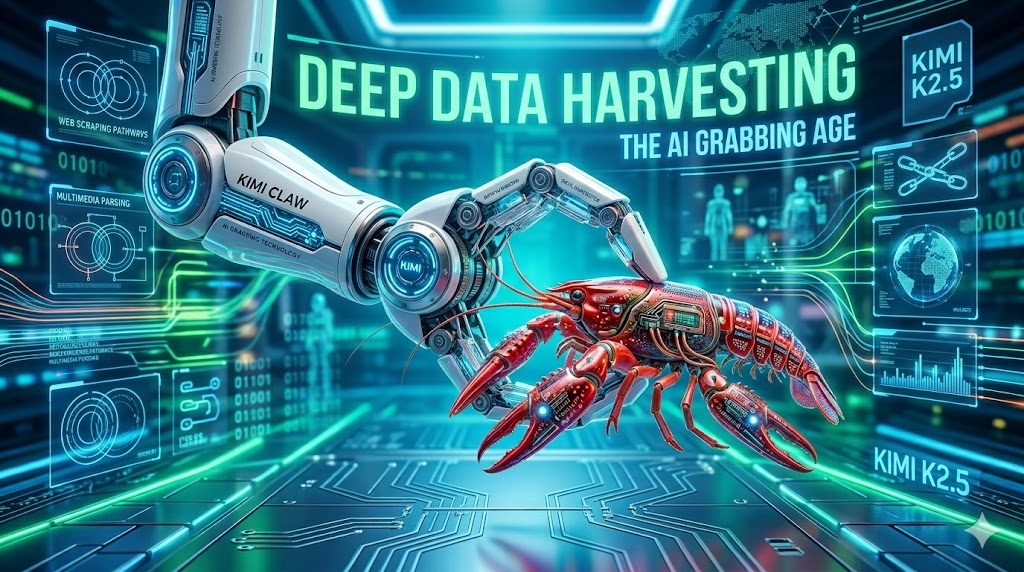
In 2026, a small crayfish stirred up the entire AI circle, and OpenClaw's momentum continues after the New Year.
Recently, several domestic model manufacturers have successively launched products that compete with OpenClaw, such as MaxClaw launched by Mini Max and Kimi Claw launched by Kimi. Obviously, the AI execution capability demonstrated by OpenClaw, and the level of tolerance that developers have shown towards the AI execution results have shown the market a value space.
Among the competing products, Kimi Claw has a relatively clear positioning. It is not a Claw product developed from scratch, but rather a managed cloud service based on OpenClaw, with data hosted in Moonshot cloud and directly configured with 5000+ ClawHub community skills.
Its advantages lie in its stability of use, ease of deployment, and simplicity of getting started. Relying on the cloud, it can achieve 24/7 online execution operation. Opening Kimi's official website, you only need to click to create, and Kimi will directly deploy Kimi Claw.
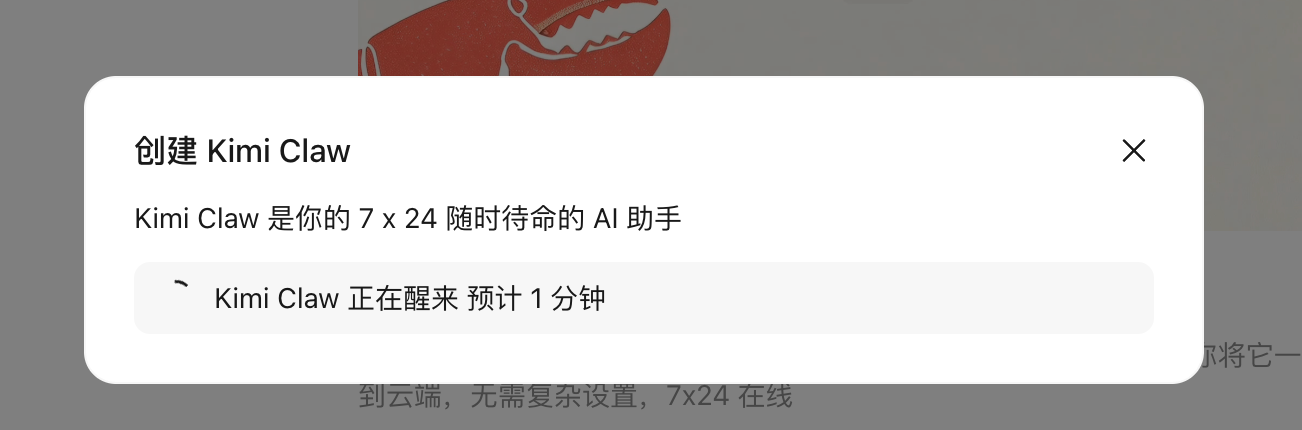
One-click deployment of Kimi Claw|Image source: Geek Park
In other words, Kimi Claw is not an independent new product. It essentially serves as a virtual machine prepared for users remotely, allowing users to directly access the OpenClaw environment running in the cloud through Kimi.
It has not made any functionality reductions or additional packaging; it is almost indistinguishable from deploying OpenClaw locally, except that it completes the steps of deployment, configuration, and environment setup for the user, but does not handle the tuning process after OpenClaw deployment. If one has not learned to correctly give instructions and arrange tasks reasonably, the difficulty of getting started remains relatively high.
For users who have never encountered OpenClaw-type products, this can lead to a misalignment of expectations. Users may think that accessing OpenClaw will allow for automated AI execution, but in fact, it only adds a portable interface, and there is still much to explore in subsequent settings. Therefore, providing some popular preset Skills for OpenClaw-type products will become a key direction for many AI model companies to focus on next.
Currently, Kimi Claw is still in the Beta testing stage and is only open to Kimi Allegretto members.
1. Build an Automated Office Workflow in 30 Minutes
We found that many users, like us, after accessing OpenClaw, still could not grasp the boundaries of AI execution capabilities. They were full of curiosity about what it could and could not do, but also full of uncertainty, not knowing where to start after integration.
In fact, whether it is locally deploying automation AI like OpenClaw or directly accessing external interfaces like Kimi Claw, the overall usage mindset can be divided into two paths: building applications from scratch and optimizing applications starting from a halfway point. We have conducted practical experiences from these two modes, first choosing to develop an application from scratch to optimize the workflow.
Before experiencing Kimi Claw, I first examined what tasks in my work could be structured into a fixed workflow, or which tasks in my workflow could improve under the support of AI. Prior to this, all I needed to consider was what type of AI tool to interact with to achieve better results.
I chose the work diary segment, combining daily workflows, work records, work summaries, and reflections to output a work report for the day. Creating a report used to be a task I spent time filling out alone, but now I hope the AI can automatically capture it and then automatically form a table through conversational interaction.
I first provided a rough idea to the AI optimization command and finally gave a very long and complex instruction covering various aspects such as role definition, skill configuration, data access, core workflow, multimedia table structure, key memories, permissions, and boundaries to Kimi Claw.
Kimi Claw quickly analyzed the instruction and confirmed execution details with me. For instance, basic information, Feishu permissions, data storage, and triggering methods. Then we began to build a Feishu application according to the instructions and would send the App ID and App Secret to Kimi Claw.
In one step, when I needed to build tables within Feishu, I let Kimi Claw directly provide me with the table style, which was then given to Feishu's built-in AI system to let Feishu automatically build the table.
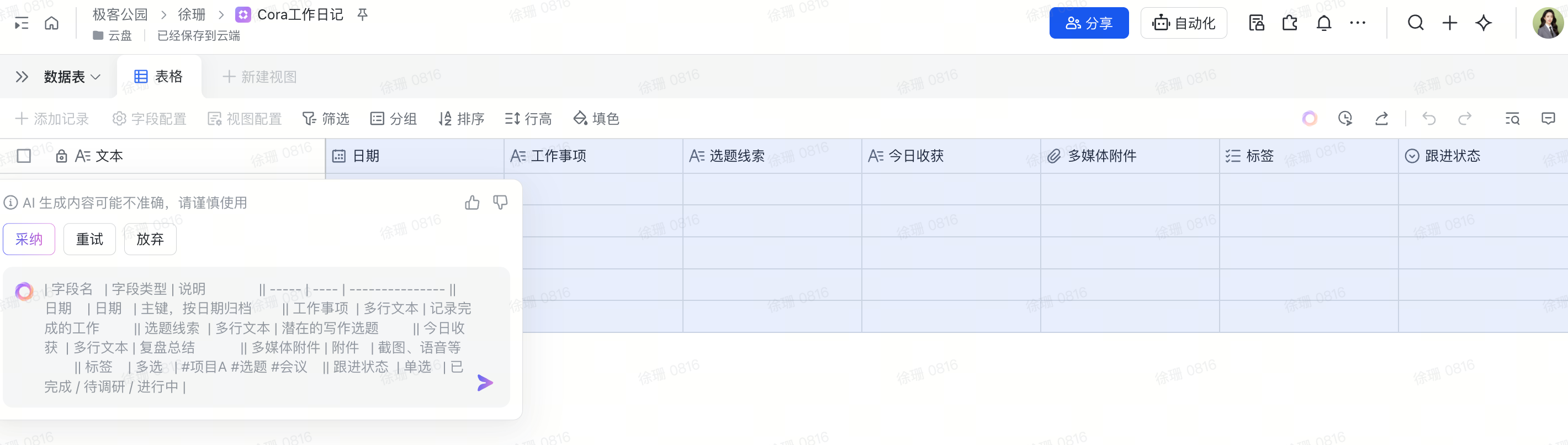
One of the application pages built by Kimi Claw|Image source: Geek Park
After experiencing a series of issues like not finding collaborators, not being able to locate the application page, and not finding the ID, I successfully received the first message from Kimi Claw after about half an hour.
The speed of building this bot was faster than I expected. When encountering problems, I directly told Kimi Claw where I was stuck and then selected appropriate solutions from the options it provided. If the solutions were not suitable, I would continue to ask Kimi Claw for alternative solutions.
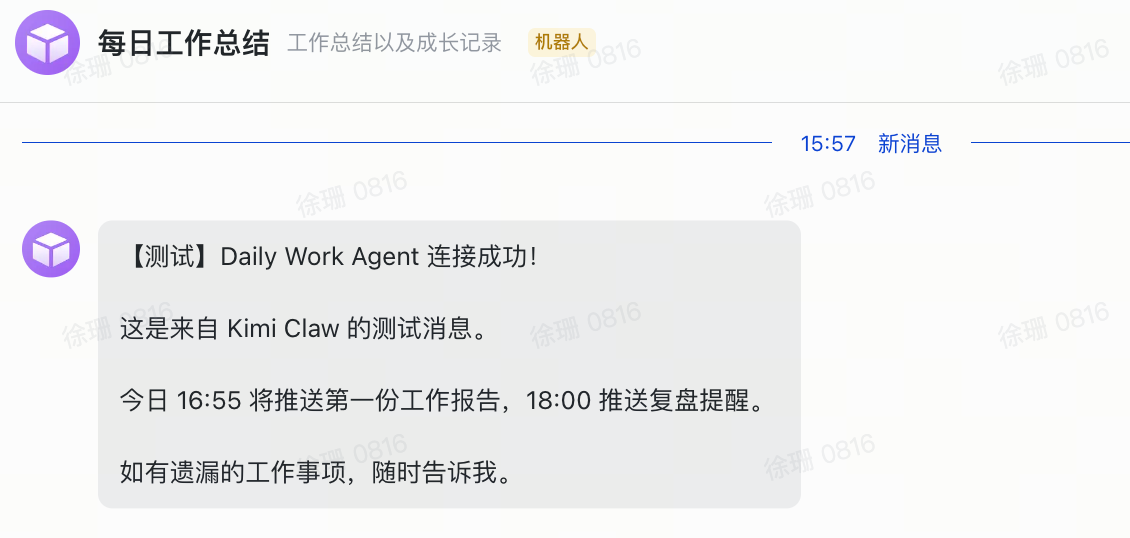
One-click deployment of Kimi Claw to Feishu|Image source: Geek Park
During the workflow building process, the importance of cross-platform capabilities became even more prominent. After consecutively opening 12 Feishu permissions, I ultimately built the AI application without achieving the ideal state. I hoped the AI could read my chat records with others to sort out my work tasks, but after several attempts, the AI application still returned an empty group chat list and stated that the Feishu AI application required the AI to only read conversations it participated in; the application could not read group chat lists.
Overall, I believe Kimi Claw is quite familiar with some conventional workflow platforms like Feishu and DingTalk, and most of the commands provided can directly correspond to execution methods. Zero-basis users can also understand and execute them. However, such enterprise applications will place great importance on their information permissions, and the conditions for opening configurations are also relatively strict. Perhaps for AI to truly integrate into workflows, it relies not only on tools like Kimi Claw but also on waiting for more suitable applications to emerge that are integrated with AI.
Moreover, during operation, numerous bugs may appear. For example, during this process, user tasks interacting with Kimi Claw and running Agent tasks may be incorrectly counted into individual work arrangements. Learning to modify bugs also became a key part of tuning the AI.
If you choose to actively customize the applications or features you want from scratch, you need to have a clear operational path in mind and possess basic product thinking. One must clarify the openness and connectivity of the interfaces at both ends of information input and output, while controlling the costs of each call and operation.
This workflow setup consumed approximately 15k-25k tokens throughout the process, costing about 1 yuan according to Kimi's pricing method. But the daily cost was approximately 0.53 yuan, totaling about 15.9 yuan in a month.
2. Automated AI News Assistant Setup Test: "Prefabricated" Applications Are Quick to Get Started, Modifications Have Costs
In addition to letting AI create a customized application I envisioned, I also experienced some "prefabricated" applications, such as having Kimi Claw automatically gather news.
During our first round of automated news gathering tasks, we tried to let Kimi Claw scrape a certain tech news media's official website. When we gave the instruction:
Please monitor xxxx's industry website, summarize the last week and the next 3 days, and whenever a new article containing the keyword "AI" is published, please automatically capture the title, abstract, and publication time, and compile this information into an online table. Meanwhile, please analyze potential hit articles in the report according to the style I set.
Kimi Claw would ask us for specific configuration information, but during the first round of news scraping tasks, we found that many official websites actually have anti-scraping settings, making it difficult to monitor information on quality websites. Kimi Claw also found it challenging to provide an accurate range to scrape, leading to idle operations, and each idle operation meant a significant consumption of tokens.
This monitoring task ran about 8 times from 4 AM to 11 AM today, consuming about 180K tokens, costing approximately 3.68 yuan. If set to run once an hour, the daily cost would be about 11 yuan, totaling nearly 330 yuan per month.
Subsequently, after consulting with relevant people, we began to abandon writing instructions ourselves and instead downloaded a related instruction package from ClawHub and continued to customize news based on this basic instruction.
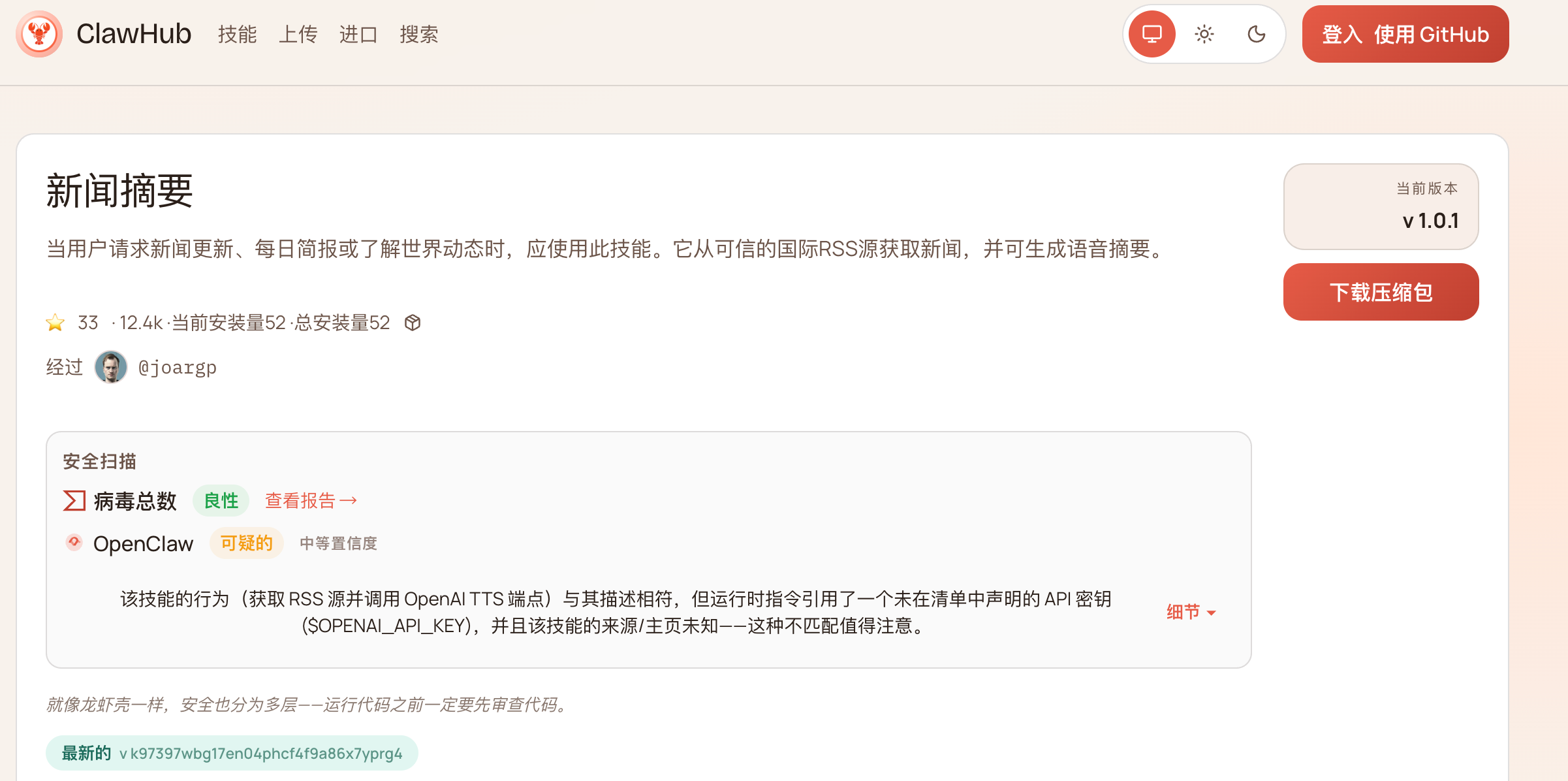
Deploying the Clawhub file to Kimi Claw|Image source: Geek Park
Then, we made relatively detailed settings regarding Chinese media, news filtering criteria, as well as the frequency and timing of information sending. Eventually, we were able to obtain a good version of the AI news scraping results.
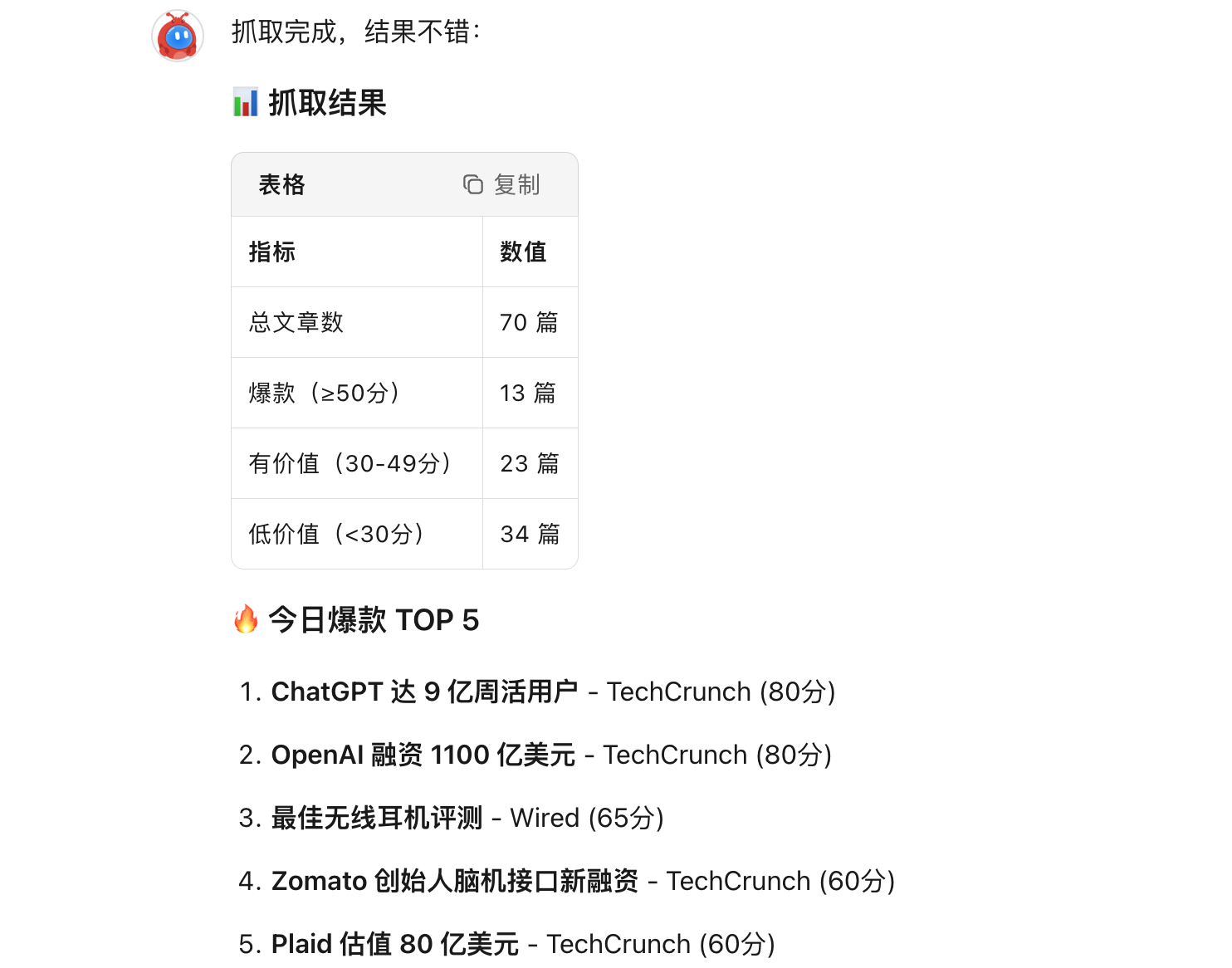
Kimi Claw's automatic scraping results|Image source: Geek Park
It is evident that if merely passively using prefabricated applications, the focus should be on learning to select quality skill packs (skills) and being able to adapt and optimize existing functions based on one's own scenario.
However, if one wants to customize these prefabricated AI applications, they often circle back to the challenges encountered when building applications from scratch, making the difficulty of development and optimization not low, and the final output may not be ideal.
In this process, users actually need to spend a lot of time experiencing the convenience and adaptability of different Skills within the same category of products, then deciding on which category of Skills to carry out secondary development, modification, and expansion. This also tests the user's product thinking.
3. Kimi Claw User Experience: Strengthened AI Execution Power, Instructions Are Productivity
At the current stage, Kimi Claw's core value lies only in lowering the deployment threshold of OpenClaw, allowing domestic users to quickly access it. However, the product itself does not come with scenarios or skills, resembling more of an "interface" rather than a "finished product."
We also discovered during the experience that, although Kimi Claw operates on the Kimi K2.5 model at its core, it is a combination of "bare model + native OpenClaw" and does not inherit the multi-round search, content reinforcement, automatic error correction, and other capabilities that have been deeply optimized by search teams for user high-frequency scenarios in the official Kimi version.
In other words, the ease of use of the official Kimi is due to a dedicated team optimizing the model for high-frequency user scenarios, providing automatic completion capabilities; whereas the "bare" model accessed within the OpenClaw environment is closer to directly calling APIs and has not undergone specialized optimizations.
After a deep experience, I can distinctly perceive the core differences between using Kimi Claw and using traditional AI or ordinary Agent products. These differences concentrate on AI execution capability and the importance of instructions, which is also the key logic for using such products.
Firstly, regarding execution capability, Kimi Claw can execute tasks even when you are not using your computer, unlike the traditional model where users give instructions and then wait for the task to complete. I can even tell Kimi Claw when to execute this instruction so that when I turn on my computer, I can directly see the results of each scheduled output. However, it also reminds me to set stop endpoints for some experiential applications to reduce unnecessary resource consumption.
Secondly, concerning instructions, in the past, my instructions to AI were usually quite concise and targeted at the issue, adjusting only when the direction given by the AI was incorrect. However, whenever Kimi Claw runs complex instructions, it calls on many Agents for assistance, significantly increasing the tokens consumed. Thus, when providing instructions, it’s necessary to clarify the operating methods, permission scope, execution paths, as well as safety and cost control.
For example, in the past when I queried news, my instruction was "give me 10 news tips related to OpenClaw and tell me their news value." Now my instruction is:
As an information retrieval specialist, you have permission to use web search tools (limited to web_search and web_open_url, prohibited from accessing paid news databases that require login), but must operate within the following constraints: 1) First execute a search with the keyword 'OpenClaw latest news', obtaining only the top 5 high-weight results (prioritizing tech media and official blogs, excluding forum spam); 2) When analyzing the news value of each item, strictly limit the evaluation to 'technological breakthroughs', 'business impact', and 'security risks', summarizing each dimension in one sentence and prohibiting discussions of irrelevant background; 3) Disable browser automation clicks and deep scraping skills throughout to avoid triggering anti-scraping mechanisms and excess token consumption; 4) The output format is a table: news title | source | value label | brief basis (≤30 words/item); 5) If search results are fewer than 10, immediately stop supplementary searches and output according to the actual number, prohibiting any second broad search just to meet the number. Expected token budget kept within 8K, and when the path deviates, immediately terminate and report rather than self-correct.
In most cases, I even let the AI optimize my directive expression before handing it to Kimi Claw. Only by providing specific and accurate instructions can one obtain the best results within a reasonable token consumption range. Moreover, many public forums have dedicated Skills libraries prepared for OpenClaw that can help users better start using popular application practices.
Precise and concrete instructions are the prerequisites for obtaining quality results within reasonable token consumption. The process of using Kimi Claw essentially involves the user balancing model capability, output results, and usage costs.
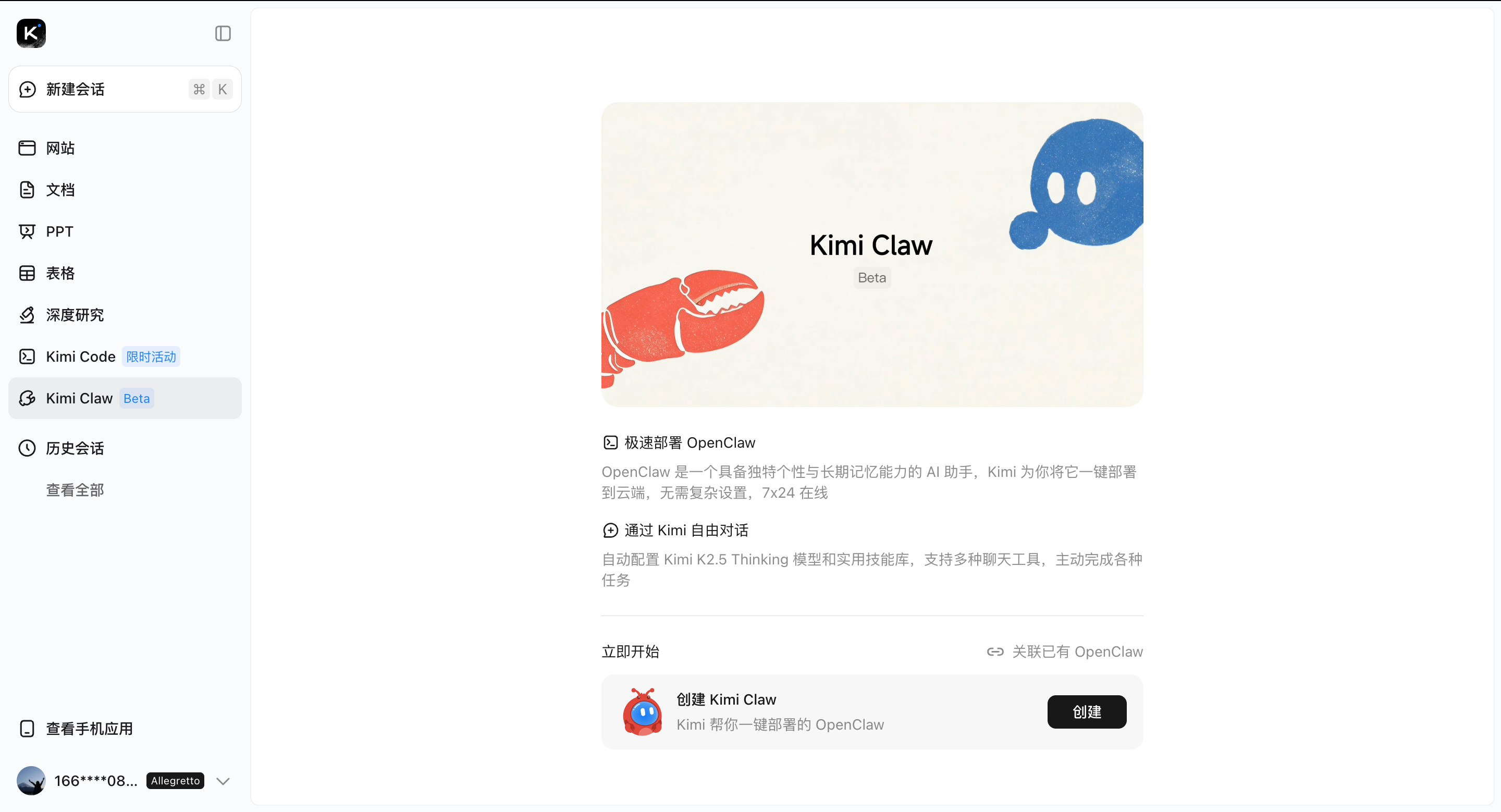
Kimi Claw |Image source: Geek Park
Finally, tuning the AI.
Even after you quickly set up an AI application, you will find that this AI bot will not be practical from the start. Its classification of various instructions and task merging will significantly differ from human understanding, and you still need round after round of instructional tuning to explore the product's boundaries. Especially since many information source interfaces are not fully publicly accessible. Achieving proper access and transfer of information rights is not an easy task.
In the end, the application effect currently exhibited by Kimi Claw is definitely not a simple AI application like a Chatbot, possessing numerous AI capabilities for users to use directly, but rather a developer tool that requires users to understand the development process and make choices after considering various comprehensive trade-offs; only that this developer tool can support some simplified automated deployments.
Automated AI Still Has Room for Development
Although OpenClaw thoroughly ignited people's imagination about automated AI starting in 2026, recent frequent security incidents and new product testing experiences show that OpenClaw is still just a key, an opportunity, and not the final answer.
Whether it be pragmatic real scenarios or scalable commercialization paths, the AI industry still has not carved out a clear and mature route. Conversely, the market continuously raises expectations for Claw-type products through repeated hype cycles, even attracting a large number of ordinary users attempting high-risk operations beyond their capabilities.
What can be confirmed is that automated AI has been valued by the industry since the day AI was born, but whether cloud-hosted forms like OpenClaw and Kimi Claw can produce genuinely successful and scalable products still has immense unverified space. Especially since these AI tools may directly acquire the permissions to modify your terminals and files.
In the early days, as people's understanding of AI capability boundaries was unclear, many new users would directly grant permissions without considering security restrictions and secondary permission confirmations. Handing over such high operational authority to AI essentially opens up systemic risk. This is also why, for such products to truly scale and commercialize, safety and permission governance will be more challenging hurdles to overcome than simply "not whether the capability is strong."
From directly interacting with large models, to engaging with singular Agents, then to collaborating with clusters of Agents, and now to the usage method of OpenClaw, the industry has derived many similarly functional but differently pathing attempts based on the same AI capability foundation. This precisely indicates that the entire industry remains in the exploratory phase of AI functionalities. Beyond mature and stable interactive paradigms like ChatGPT, people's logical use, boundaries, and value of new forms like Agents and Claws are still collectively being explored.
Perhaps, we will need to wait until 2026 to truly witness a batch of stable, usable, and genuinely valuable automated AI applications being realized.
免责声明:本文章仅代表作者个人观点,不代表本平台的立场和观点。本文章仅供信息分享,不构成对任何人的任何投资建议。用户与作者之间的任何争议,与本平台无关。如网页中刊载的文章或图片涉及侵权,请提供相关的权利证明和身份证明发送邮件到support@aicoin.com,本平台相关工作人员将会进行核查。


