Author: Yetta, Investment Partner at Primitive Ventures, Wildon, Researcher at Primitive Ventures
Weekly trading volume of 1.5 billion USD, with total trading volume exceeding 10 billion USD in 60 days. While everyone is applauding Polymarket's 13 billion USD valuation and its high-profile collaboration with the NYSE, this platform from the East, still in the "seed stage", has quietly achieved a bottom-up breakthrough. This is our comprehensive investment judgment on Opinion Labs.
The Era of Single-Player NPCs is Coming to an End
For the past few decades, we have been living in a "single-player game". The truth is produced by a few institutions, and narratives are finalized in boardrooms; most of us are merely NPCs moving along a predefined script. Web2 allowed us to voice our opinions, but did not truly involve us in decision-making. How beliefs are formed and how consensus is shaped remain locked in algorithmic black boxes and power structures.
But what if belief itself could flow and be priced?
Opinions are not just expressions of attitude but bets.
Disagreements are not just emotional confrontations but price divergences.
Consensus is not just retweets; it’s a curve that may reverse at any time.
Reality is no longer a script to be watched but a game involving multiple participants.
The Not-So "Long Tail" Paradox
The discussion of whether prediction markets are financial markets or content markets is quite interesting. As a financial market, it performs exceptionally well in a few scenarios. Without liquidity, there are no prices; without prices, there are no signals. Mechanisms like order books, market makers, and depth operate smoothly during globally attention-concentrated events like the U.S. elections, but start to fail once removed from those scenarios.
Human attention is inherently fragmented. Most of the things we truly care about heavily depend on specific contexts and regional backgrounds, such as cultural gossip, local politics, celebrity scandals, and various social issues. The internet has not converged these interests but has caused them to branch infinitely. Content is experiencing explosive growth, but capital and liquidity are forever scarce.
Thus, the paradox arises:
Markets need concentration to be effective;
Yet human opinions are inherently dispersed.
If a platform can only rely on a few leading events to maintain liquidity, it resembles an "event exchange" rather than a true market for belief games. Therefore, the problem becomes: when information itself refuses to converge, how do you build a financial system on top of it?
Why We Invested in Opinion Labs
A year ago, we invested in @opinionlabsxyz, while Polymarket had just completed its first large-scale validation during the election cycle, and the Prediction Market had become one of the strongest narrative threads in the Western VC circle. We judged that such a content/event-driven play would not see the East absent, so we approached Opinion to complete the investment. Six months later, the discussion around the Prediction Market spread to Asia, to BNBChain. At that moment, the only entity with a mature product that could launch immediately and capture the momentum was Opinion.
More importantly, they reached this scale with minimal capital consumption. In terms of product rhythm, execution density, and per capita output, they are one of the most efficient teams we have seen.
East ≠ West: Prediction Markets are Diverging
Prediction markets are clearly showing a divergence between the East and West, and the reason is simple. Assets can converge globally, but opinions cannot. The dollar, gold, and U.S. stocks can form a unified price, but what people choose to bet on is a cultural product. The true expansion of prediction markets depends on liquidity, but more importantly, on shared attention.
In the U.S., this shared attention is extremely concentrated. Sports betting has nurtured retail habits for decades, and politics has long evolved into a national-level reality show. Attention naturally converges on a few super-events. Kalshi and Polymarket accordingly gravitate towards leading markets, serving high-frequency and professional traders with thicker order books.
In East Asia, the situation is completely different. The political discussion space is limited in China, Japanese retail investors generally have low political participation, and Korean users' attention shifts more towards speculation, entertainment, social issues, and pop culture. In different markets, what retail investors genuinely care about and what they have enough knowledge to express judgments on varies greatly.
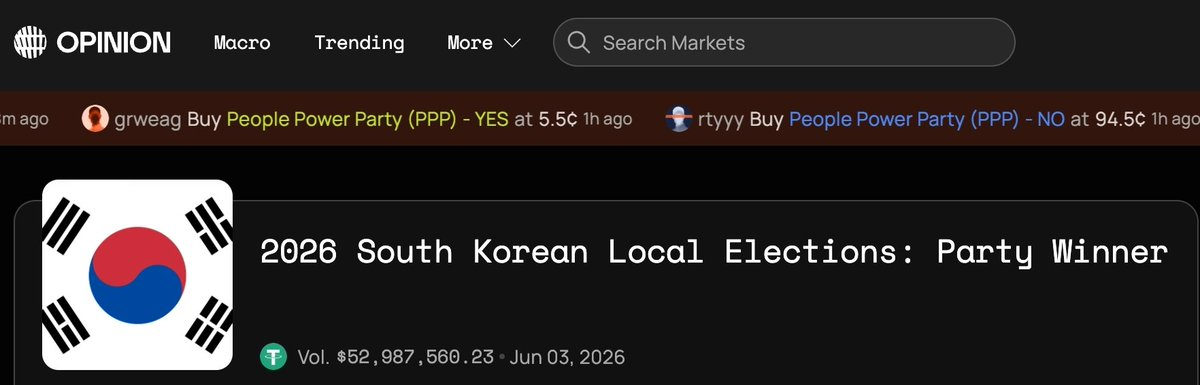
This difference is very intuitively reflected in the data. For the 2026 South Korean presidential election, Polymarket's trading volume was about 400,000 USD, while Opinion Labs reached 52 million USD. Prediction markets cannot be winner-takes-all because the formation of beliefs is highly localized.

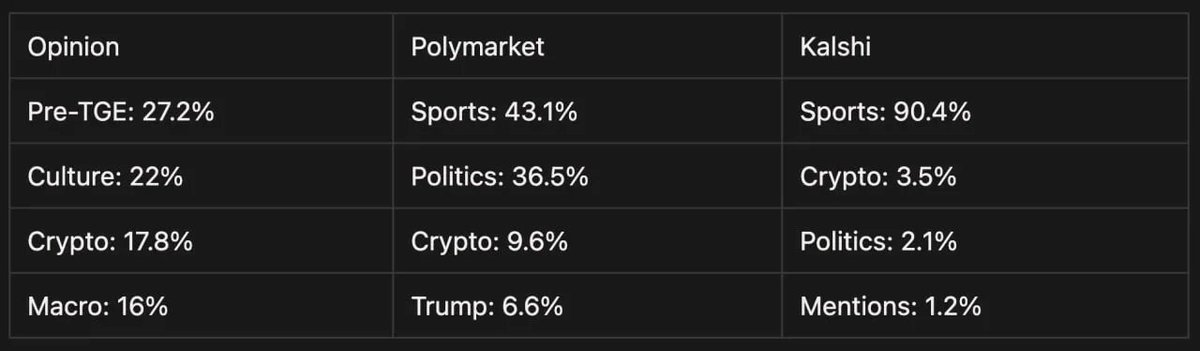
When shared attention is absent, liquidity does not automatically concentrate, but rather disperses naturally. The structure we see reflects this: compared to Polymarket and Kalshi, Opinion’s trading distribution is significantly more dispersed; trading volume has not collapsed to a few leading events but continues to spread across a large number of mid-tail markets that offshore users genuinely care about.
AI as the Key to Scale
Human-led market creation can no longer keep pace with this era. When opinions are infinite and contexts are highly localized, if it still relies on manual filtering and manual launches, prediction markets will be forced to converge to a few leading events.
This is precisely why AI has become indispensable.
At Opinion Labs, AI transforms scattered claims into structured markets: automatically generating clear settlement rules, defining failure boundaries, and combining staking mechanisms to constrain behavior and reinforce accountability. Market creation no longer relies on the judgments of a few editors or operations teams but can scale up. Numerous locally-oriented markets with cultural attributes can be generated quickly without being drowned in low-quality content.
As the market begins to extend into the long tail, the real challenge is settlement. Long tail markets often rely on complex, dispersed, unstructured information sources. A single adjudication mechanism cannot handle this complexity. AI can process information cross-referencing and verification on a large scale while hardware-level security and human governance serve as the final safety net.
This means that prediction markets may finally have the opportunity for horizontal expansion. Not compressing global attention onto a few super-events, but allowing beliefs themselves to be organized, traded, and verified in a highly decentralized world.
Prediction Market 2.0: One Paradigm, Two Evolutions
In prediction markets, there is a clear division between the East and West.
The West has chosen financialization and institutionalization. Hence we see IB founders say that the highest-frequency trades are in weather/temperature contracts. More broadly, sectors like energy, agriculture, and shipping have long been exposed to climate risks, yet consistently lack sufficiently refined, tradable hedging tools. In this context, the development direction of prediction markets becomes whether they can scale liquidity, produce sufficiently robust derivative structures, and be understood and accepted by institutional risk control systems. Entrepreneurs are contemplating how to refine it into qualified financial infrastructure.
The East, on the other hand, is heading towards internetization and contentization. It resembles a more entertainment-driven information consumption and expression mechanism. In this context, the core concern is at what point users are willing to bet and on what. It represents a form of content monetization: betting is a sense of participation, odds reflect narrative intensity, and trading volume signifies emotional consensus. The product does not need to deal with complex financial engineering, but rather a set of content operation logic, which is how to transform hotspots, public opinion, and social discussions into ongoing trading motivations.
Prediction Market has entered 2.0. It is no longer a single market where one wins all, but rather two different evolutionary directions shaped by culture. Both point to a more significant change where the market is no longer just a place for trading results but a mechanism atomized to handle uncertainties themselves.
免责声明:本文章仅代表作者个人观点,不代表本平台的立场和观点。本文章仅供信息分享,不构成对任何人的任何投资建议。用户与作者之间的任何争议,与本平台无关。如网页中刊载的文章或图片涉及侵权,请提供相关的权利证明和身份证明发送邮件到support@aicoin.com,本平台相关工作人员将会进行核查。


