Behind the explosion of ClawdBot: Founder PeterPeter and his second life

CN
PANews
Follow
1 hour ago

Author: A Fish CoolFish

Recently, a personal AI assistant named ClawdBot has rapidly gained popularity on social media. It is open-source, can run locally, and is highly customizable, creating a buzz not only in the developer community but also unexpectedly boosting sales of the Apple Mac mini. However, more attention has been drawn to its creator—an entrepreneur named Peter Steinberger.

This seasoned developer from Vienna, Austria, previously founded a successful B2B software company and achieved financial freedom, but after retiring, he fell into a deep sense of nihilism. Now, with a renewed passion for AI technology and profound insights into the essence of entrepreneurship, he has returned to the center of the tech wave, starting with ClawdBot.

13 Years of Refinement at PSPDFKit

Peter Steinberger's first entrepreneurial journey revolved around PSPDFKit. PSPDFKit is a company focused on document processing SDKs, providing PDF collaboration, signing, and annotation tools for developers worldwide.

Back in 2011, Peter received a job offer from San Francisco at a WWDC party. For him, as a freelancer, this opportunity was tempting—living in San Francisco, immersing himself in the startup culture, and working alongside industry elites. He accepted the offer and began waiting for his work visa.

But the wait lasted over six months.

During this time, Peter stopped all freelance work and suddenly found himself with a lot of free time. "My mind was freed from all freelance work, and naturally, I filled that time with other projects."

Inspired by friends, he decided to try his hand at a paid component business. Thus, PSPDFKit was born.

PSPDFKit initially started as an experimental project he built in his spare time, but it unexpectedly attracted many developers willing to pay for it. More dramatically, before his visa was approved, the project had already developed into a viable business, "earning more than I could have made in a full-time job."

Even so, Peter decided to go to San Francisco to try out the job. "All the gears were set for San Francisco, so I accepted the job. Now everything was about the experience. I truly believed I could do it."

But reality soon proved this nearly impossible. Managing a job that exceeded 40 hours a week while running another full-time business left him exhausted. "After 'killing myself' for a while," he had to make a choice.

In April 2012, after attending NSConference, Peter finally made up his mind. "So many amazing people were genuinely passionate about what they were doing—after experiencing all this, you can never go back to that 9-to-5 work state. Moreover, seeing users use your product and genuinely love it is truly the most wonderful thing in the world."

His experience in San Francisco helped Peter clarify his true direction. "It helped me realize what I really wanted to do." So, he returned to Vienna, Austria, and pushed PSPDFKit as a full-time career. This initially "passive" attempt, which was postponed due to visa issues, instead led to his 13-year entrepreneurial legend.

PSPDFKit gradually evolved from a personal project into a global remote team of 60-70 people, with clients including top global companies like Dropbox, DocuSign, SAP, IBM, and Volkswagen. Remarkably, the company has been entirely self-sustaining (bootstrapped) for 13 years, without accepting any external funding.

Peter once candidly admitted in a blog that he invested tremendous time and energy to create the best product. This extreme pursuit of product quality and deep understanding of the B2B market made PSPDFKit a successful model in the industry.

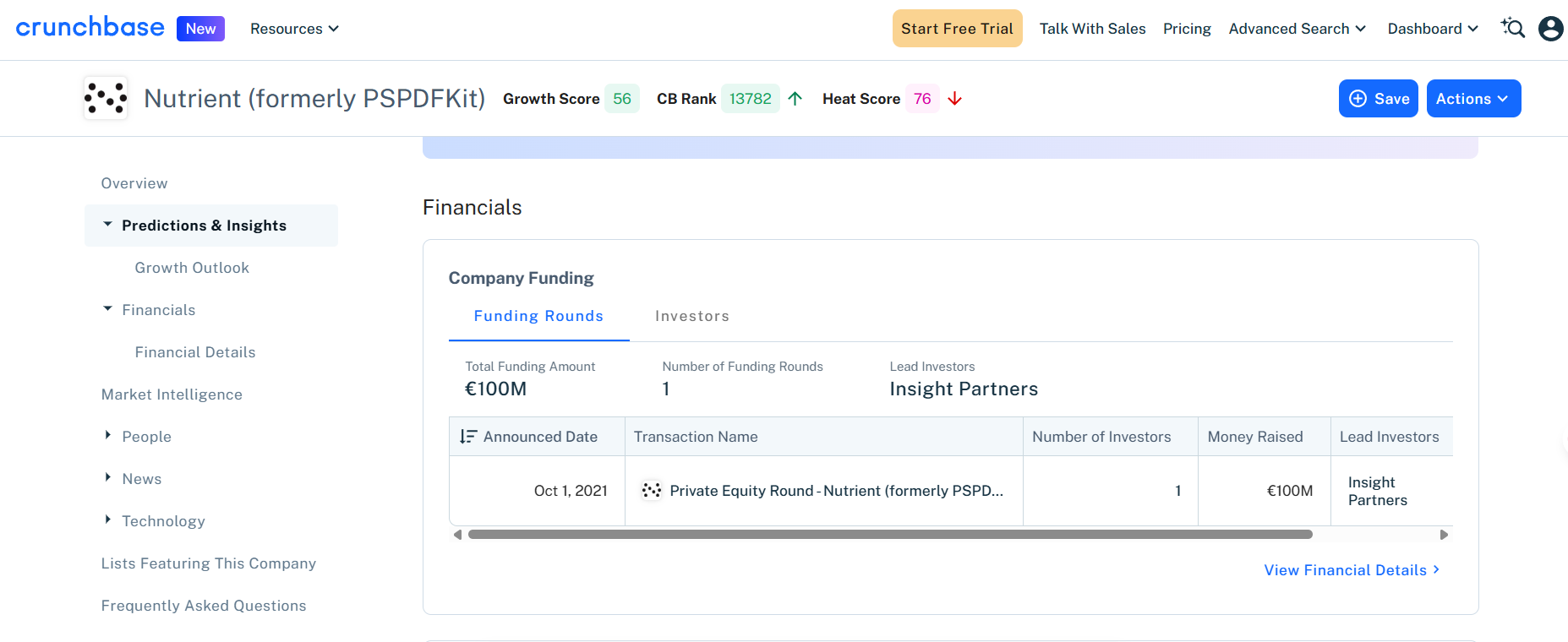
In October 2021, Insight Partners strategically invested $116 million (about €100 million) in PSPDFKit. This marked the first time the company accepted external funding in its history and signified a perfect conclusion to Peter's first entrepreneurial life. He and co-founder Martin Schürrer officially stepped down from full-time management roles.

However, behind this glamorous ending lies the cost of working almost every weekend for 13 years. Peter has openly stated in multiple public speeches that this entrepreneurial experience ultimately led to severe burnout.

Nihilism and Awakening After Retirement

After selling PSPDFKit, Peter entered what is referred to as "retirement."

For a tech person who achieved financial freedom early in their entrepreneurial journey, this should be the ideal state of life. He should have had plenty of time to adjust his body and mind, making up for the life regrets accumulated over the past 13 years.

However, this freedom brought an unexpected sense of "nihilism."

In his blog "Rekindling Passion," he stated: "After selling my shares in PSPDFKit, I felt very broken. I had poured 200% of my time, energy, and heart into this company; it was my identity, and when it was gone, not much was left. I heard that it's common for founders to fall into a slump and take a year off after leaving their companies. The typical lifecycle of a company is only 4-5 years. So looking back on these 13 years, I realized I just needed more time to find a new goal."

Attending parties, undergoing therapy, moving to a new country, chasing various "hedonistic pleasures"—he tried various ways to fill this void. Ultimately, he realized: "You can't find happiness by moving; you can't find a goal; you have to create it."

This awakening prompted him to return to what he loved most—creating and building.

In 2024, as the AI wave began to rise, the experience of AI tools was not ideal—simple arithmetic problems were calculated incorrectly, logical reasoning was full of holes, and the generated code was riddled with bugs. However, over time, AI technology rapidly advanced, and Peter gradually discovered that AI had transformed from "not very usable" to "really interesting."

A whole new technological paradigm was forming, and he decided not to just observe.

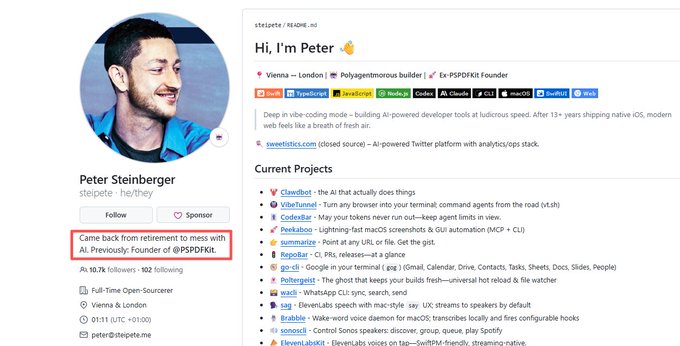
Peter wrote on his personal homepage: "Came back from retirement to mess with AI." This understated statement heralded the beginning of his second life.

ClawdBot: A Hit Pieced Together in an Hour

The birth of ClawdBot initially stemmed from Peter's personal needs, much like PSPDFKit 13 years ago.

In April 2024, he began to conceive a "life assistant" project, but at that time, the capabilities of AI models were insufficient to support this vision. Later, this idea was shelved for a while because Peter thought big companies would surely develop such products. It seemed meaningless for him to do it himself.

By November, he realized a key issue: big companies had not created AI assistant products that truly met personal needs.

The AI tools on the market were either too simplistic, had concerning data privacy, or had a very high barrier to entry.

So he decided to take matters into his own hands.

Remarkably, from idea to prototype, Peter only took an hour.

In an interview for "Open Source Friday," he recalled: "That month, I spent an hour piecing together some very rough code. It sent messages on WhatsApp, forwarded them to Claude Code, and then sent the results back. Essentially, it was just 'gluing' a few things together. Honestly, it wasn't difficult, but the effect was quite good."

Initially, this project was called "V Relay," essentially just a relay tool for WhatsApp. But soon, it exhibited a "spontaneous adaptability" that surprised even Peter.

Once, while working in a hotel in Marrakech, Morocco, he jokingly told the AI assistant: "The door lock in my Marrakech hotel isn't very reliable. I hope you don't get stolen since you're running on my MacBook Pro."

The AI's response stunned him: "No problem, I'm your agent." It then autonomously detected the network, found it could connect to Peter's computer in London via Tailscale, and directly migrated itself there.

Peter later recalled: "Perhaps it couldn't yet be called AGI, but at that moment, I truly realized that the 'spontaneous adaptability' of these things exceeded my original imagination. At that time, I thought, this is how Skynet begins."

The project's evolution was also filled with serendipity. Later, while developing features related to Claude, a developer submitted a PR request for Discord. Peter hesitated for a long time: "I was wondering whether to add Discord support since it was no longer limited to WhatsApp." Ultimately, he accepted the PR, but the project name had to change.

What to rename it? Peter directly asked Claude for suggestions. Claude proposed the name "ClawdBot"—which echoed Claude itself and also carried the imagery of "Claw." Thus, ClawdBot was born.

We can also glimpse the core idea of this project from its name: giving AI a pair of hands to become a true personal assistant running on your own device.

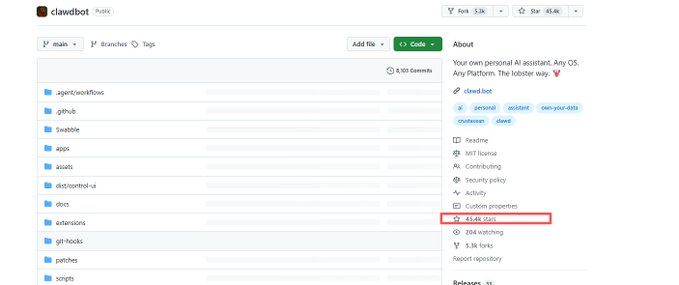
Today, ClawdBot has gone viral in communities both domestically and internationally. GitHub stars have surpassed 40,000. More dramatically, this project has boosted sales of the Apple Mac mini, with many users choosing it as the platform to run ClawdBot. Its low price, good compatibility, low power consumption, quiet operation, and small footprint have made it popular, even prompting Logan Kilpatrick, a product manager at Google DeepMind, to order one.

However, this sudden popularity did not come easily. Peter admitted that he had previously had no idea how to communicate the value of this product to the public.

"Interestingly, when I showed this to my friends last November, they all exclaimed 'So cool.' But when I posted about it on Twitter, the response was surprisingly lukewarm," Peter recalled. "It wasn't until December, every time I demonstrated it in person to friends, they would blurt out 'I need this.' However, I found that I had no idea how to explain its wonders to a larger audience."

This dilemma of "good in-person demonstrations but difficult online dissemination" precisely highlights the uniqueness of ClawdBot—its value can only be understood through personal experience. By January, with the community's spontaneous sharing, it began to gain unstoppable momentum, igniting a collective resonance within the entire developer community.

Peter described himself as "stopping reading code and starting to watch code flow." This phrase sounds like a joke, but it accurately summarizes the fundamental shift in the role of developers in the AI era. The success of ClawdBot proves that Peter Steinberger, after a period of silence, not only regained his "spark" but also re-emerged at the forefront of the tech wave with a more forward-looking and philosophical stance. He transformed from a traditional B2B software entrepreneur into a futurist embracing AI and pursuing an ultimate personalized experience.

From the early PSPDFKit to the current ClawdBot, both entrepreneurial ventures can be considered huge successes, but aside from the success, their greatest commonality is: both times he was solving real problems he encountered and then sharing the solutions with the world.

In a recent interview, Peter repeatedly emphasized ClawdBot's mission: to empower everyone to control their own data rather than handing it over to big companies.

This technological idealism was not as apparent during his first entrepreneurial journey. At that time, PSPDFKit resembled a traditional B2B software company, which, while excellent, was essentially born for commercial success.

In his second life, Peter shed the commercial burden and returned to the original intention of technology. ClawdBot is completely open-source, free forever, and supports local models—these choices may not be "smart" commercially, but they have won widespread recognition from the developer community.

Building tools to solve one's own problems and then sharing them with the world—this may be what open source is meant to do.

An Ongoing Second Life

As of the publication of this article, ClawdBot's GitHub stars have surpassed 40,000.

Unlike the 13 years of torment during his first entrepreneurial journey, this time he seems to be at ease. There are no KPI pressures, no one urging him on, just the pure joy of creation.

In an interview, Peter shared a moment that deeply moved him. A user who once felt anxious about contacting customer service can now have their issues handled by the intelligent assistant he developed.

Peter recalled, "I never thought I could solve problems in this way. At that moment, I felt incredibly humble, even a bit shocked: wow, we—just because that initial idea came from me—actually changed something and genuinely improved someone's life. The feeling of being able to make others' lives better is truly wonderful."

Peter Steinberger's second entrepreneurial journey is still ongoing. But one thing is clear: in this era where AI is reshaping the world, those who dare to create and actively embrace the future will never be abandoned by the times.

免责声明:本文章仅代表作者个人观点,不代表本平台的立场和观点。本文章仅供信息分享,不构成对任何人的任何投资建议。用户与作者之间的任何争议,与本平台无关。如网页中刊载的文章或图片涉及侵权,请提供相关的权利证明和身份证明发送邮件到support@aicoin.com,本平台相关工作人员将会进行核查。

Share To
APP

X

Telegram

Facebook

Reddit

CopyLink