Since the fourth quarter of 2025, Avalanche has seen a resurgence in on-chain activity that has almost coincided with institutional adoption.
On one hand, the mainnet activity metrics have repeatedly hit new highs at the end of the year and in January, while on the other hand, there has been a surge in events more focused on institutional workflows and compliant distribution. Even in a poor market, the story of assets moving on-chain continues to accelerate.
Institutional Route Promotes Asset On-Chain
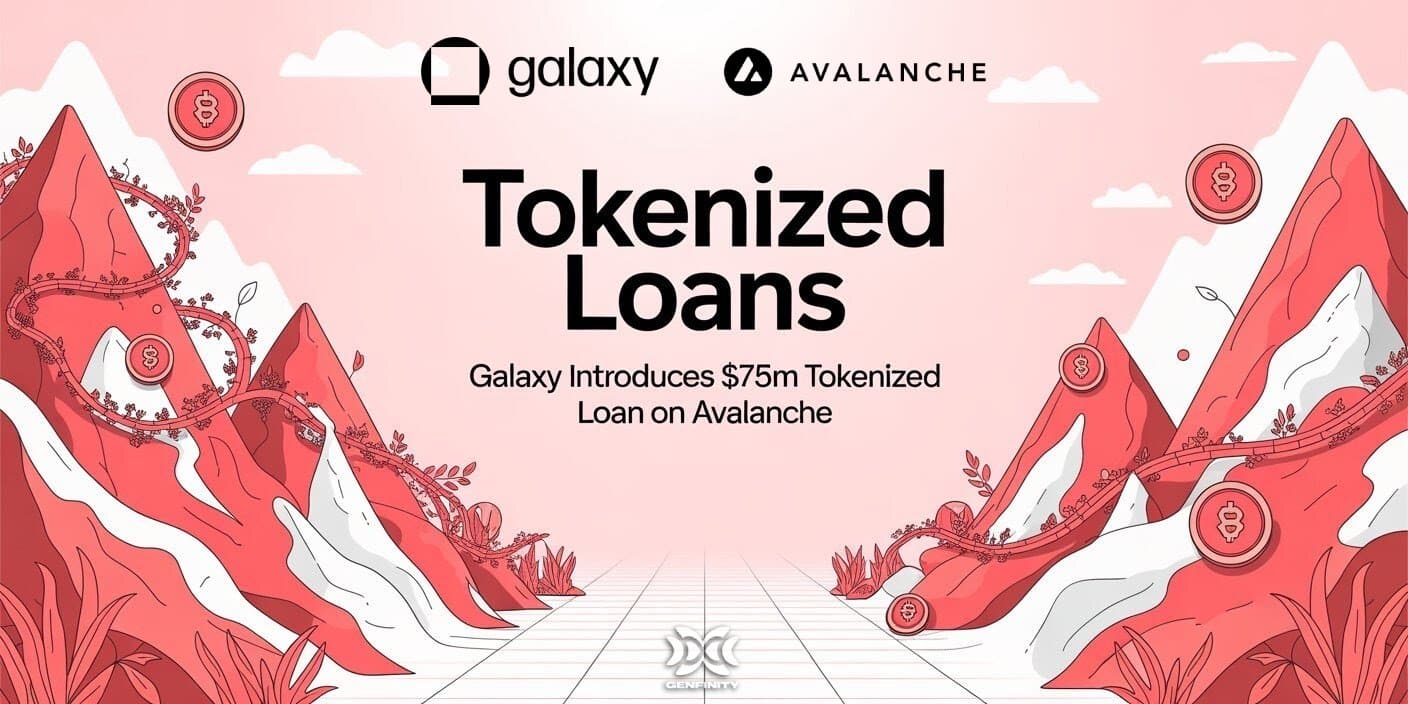
In January 2026, the well-known crypto investment bank Galaxy Digital announced the successful issuance of its first tokenized loan obligation (CLO) on Avalanche, with a total scale of $75 million, of which $50 million was subscribed by the institutional credit protocol Grove.
A CLO is a structured credit product that packages corporate loans and sells them to investors of varying risk levels. The different tiers of debt are tokenized and issued by the regulated digital asset platform INX through the Avalanche network, providing trading to qualified investors.

This investment is actually Grove's second large-scale deployment on the Avalanche platform. In July of last year, Grove announced its launch on the Avalanche platform, with an initial deployment strategy aimed at issuing real-world assets (RWA) worth up to approximately $250 million on the network. Grove allocated funds to JAAA issued on the native chain through the multi-chain protocol Centrifuge, and the token for this share was issued and circulated on the Avalanche C-Chain.
As a high-performance public chain designed specifically for institutional finance, Avalanche not only offers advantages such as EVM compatibility, rapid deployment, and access to compliant distribution channels, but also emphasizes the quick deployment of customizable Avalanche L1 (Atomic Network, Subnet), which is more conducive to balancing access, compliance, performance, and risk control requirements. This has made it one of the preferred partners for financial institutions looking to establish a presence on-chain.
For example, New Jersey-based real estate infrastructure company Balcony announced in May last year that it utilized the AvaCloud platform to deploy a scalable, dedicated Avalanche L1 service aimed at digitizing and tokenizing property records for over 370,000 parcels, with a total value of approximately $240 billion. AvaCloud is a managed blockchain service provider for Avalanche L1, assisting enterprises in building, deploying, and scaling Layer-1 networks.
Data's "Ice and Fire"
Avalanche's institutional route has facilitated steady growth in its on-chain assets. According to Token Terminal data, the total market capitalization of stablecoins and tokenized funds on the Avalanche mainnet has increased by approximately 70% over the past two years since January 2024.
According to data from RWA.xyz, as of January 21, the stablecoin assets on the Avalanche network exceeded $2.2 billion, and the total amount of RWA assets surpassed $1.351 billion—of which Distributed Assets (distributable assets) were approximately $636 million, and Represented Assets (represented assets) were about $715 million.
Distributable assets refer to tokenized assets that can be transferred peer-to-peer between wallets, focusing on market coverage, inclusive finance, and platform interoperability; represented assets, on the other hand, do not allow asset transfers outside the issuing platform, with the blockchain network serving more as a shared ledger for accounting and settlement.
By December 2025, the total transaction volume on the Avalanche network exceeded 10 billion transactions. With this milestone data, the ecosystem officially welcomed a revival at the end of the year. That month, the Avalanche C-Chain set new records for the highest single day and single week in 2025, with active addresses reaching 651.2 million and weekly capital inflows of $43 million, briefly ranking second among all blockchains.
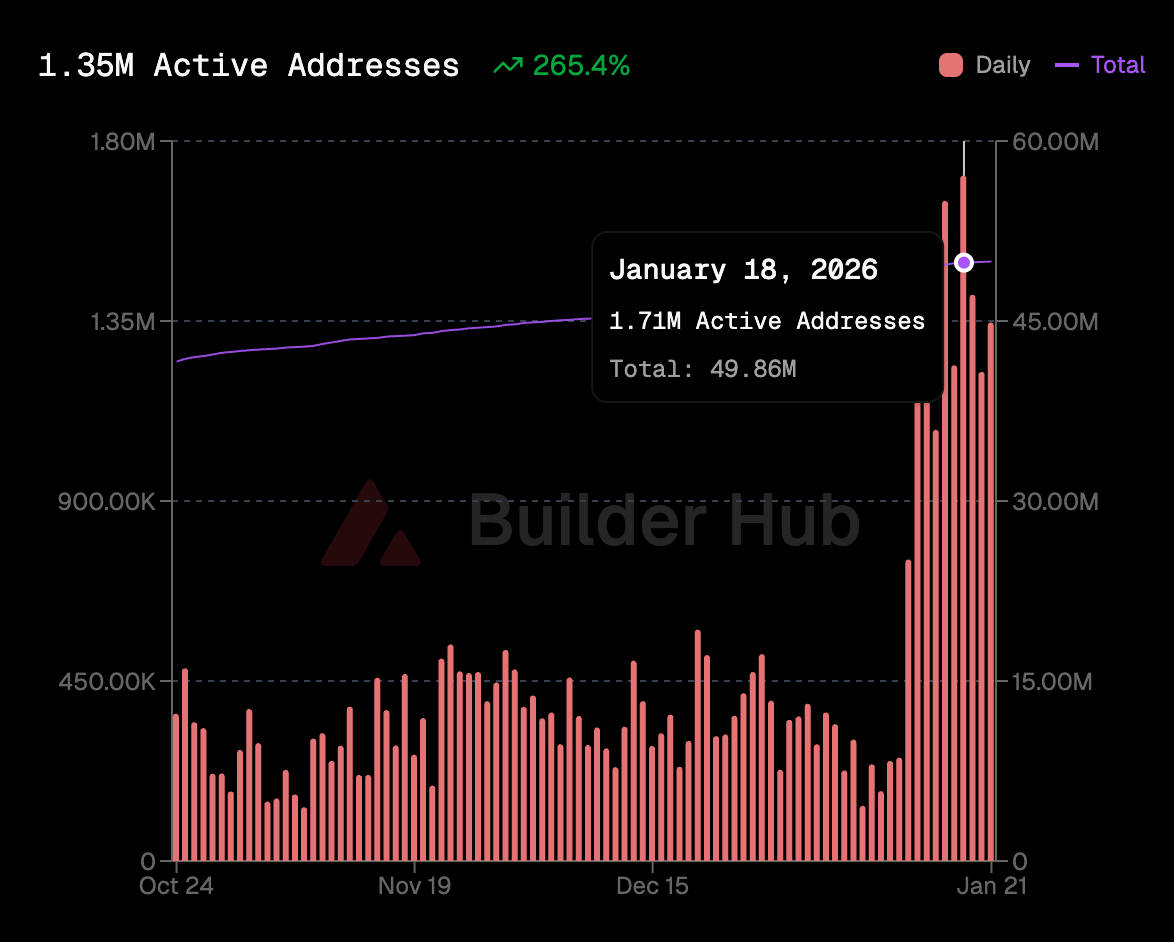
Entering the new year, Avalanche continued the growth momentum from the end of last year, with the number of daily active addresses on its mainnet (primarily the C-Chain, along with the P-Chain and X-Chain) repeatedly hitting new highs, peaking at 1.71 million on January 18.

However, if we shift our focus from on-chain activity to asset pricing and DeFi activity, we do not see a corresponding "recovery curve." According to CoinGecko market data, from mid-January to now, the closing price of AVAX has fluctuated roughly between $12 and $15, closing at about $12.09 on January 20, marking the lowest value since November 2023.
Looking at DeFiLlama's chain-level metrics, the native TVL of Avalanche is approximately $1.66 billion, and the bridged TVL is about $3.62 billion, while on-chain fees/income remain relatively low on a daily basis. This means that even though the number of transactions and addresses is increasing, it does not necessarily correspond to significant value capture at the protocol layer.
However, considering the macro level, cryptocurrencies, especially L1 tokens, have generally been under pressure over the past year. Even if the ecosystem sees institutional collaborations or technological advancements, these are overshadowed by stronger market beta and the persistent issue of a lack of large-scale applications. The pricing issue for Avalanche is not unique to it alone.
Attracting Talent, Launching a Million-Dollar Builder Competition
For infrastructure, a sluggish market period is also a good opportunity for accumulation, allowing for a more focused approach to ecosystem building.
Taking advantage of this wave of increased on-chain activity, Avalanche has noticeably intensified its actions on the developer supply side. On January 21, the Avalanche Foundation announced the launch of the "BuildGames" builder competition, offering a total prize pool of $1 million, with the official setting a six-week duration and rolling review for applications starting immediately. This competition does not specify a direction and does not limit specific types or tracks. Outstanding teams will also have the opportunity to receive follow-up guidance and funding from Avalanche's official incubation program.

From the existing system of the foundation, Avalanche's developer support does not rely solely on single competitions to attract new talent, but is divided into several parallel pipelines.
The first is the official accelerator Codebase, which focuses on rapid mentoring and non-dilutive funding support for early teams. Selected teams can receive a $50,000 funding grant and practical support ranging from product to token design, validator/infrastructure strategy, growth, and compliance.
The second is the foundation's Grants system, which focuses on funding for infrastructure and AI-related projects. Finally, there is Retro9000, with an official pool of up to $40 million to reward teams that have already made actual deliveries and impacts on Avalanche L1 or key toolchains, lowering the threshold of "financing before delivery" and directing resources toward builders with proven value.
In terms of infrastructure development, Avalanche completed a network upgrade codenamed "Granite" at the end of last year, which consists of three ACPs (ACP-181/204/226). The Granite upgrade introduced dynamic block times, biometric authentication, and a more stable validator view, enhancing cross-chain message reliability and performance.
Overall, in the past month, the Avalanche ecosystem has introduced institutional-scale capabilities, laying the foundation for development in 2026 with the construction of infrastructure and developer incentives.
免责声明:本文章仅代表作者个人观点,不代表本平台的立场和观点。本文章仅供信息分享,不构成对任何人的任何投资建议。用户与作者之间的任何争议,与本平台无关。如网页中刊载的文章或图片涉及侵权,请提供相关的权利证明和身份证明发送邮件到support@aicoin.com,本平台相关工作人员将会进行核查。