Tariffs for territory? How Trump's "island purchase plan" shakes the global financial market?

CN
PANews
Follow
2 hours ago

Author: Changan, Amelia I Biteye Content Team

The United States has once again raised the tariff stick, but this time the target is not trade deficits, but territory. Trump has officially declared war on traditional European allies: using the ownership of Greenland as a condition, he has wielded the sword of tariffs.

For investors, understanding this conflict is not only about seeing the geopolitical landscape clearly but also about protecting their assets amid severe liquidity fluctuations.

This article will deeply analyze how this tariff event will affect every investment decision you make.

Background: From Military Exercises to Tariff Threats

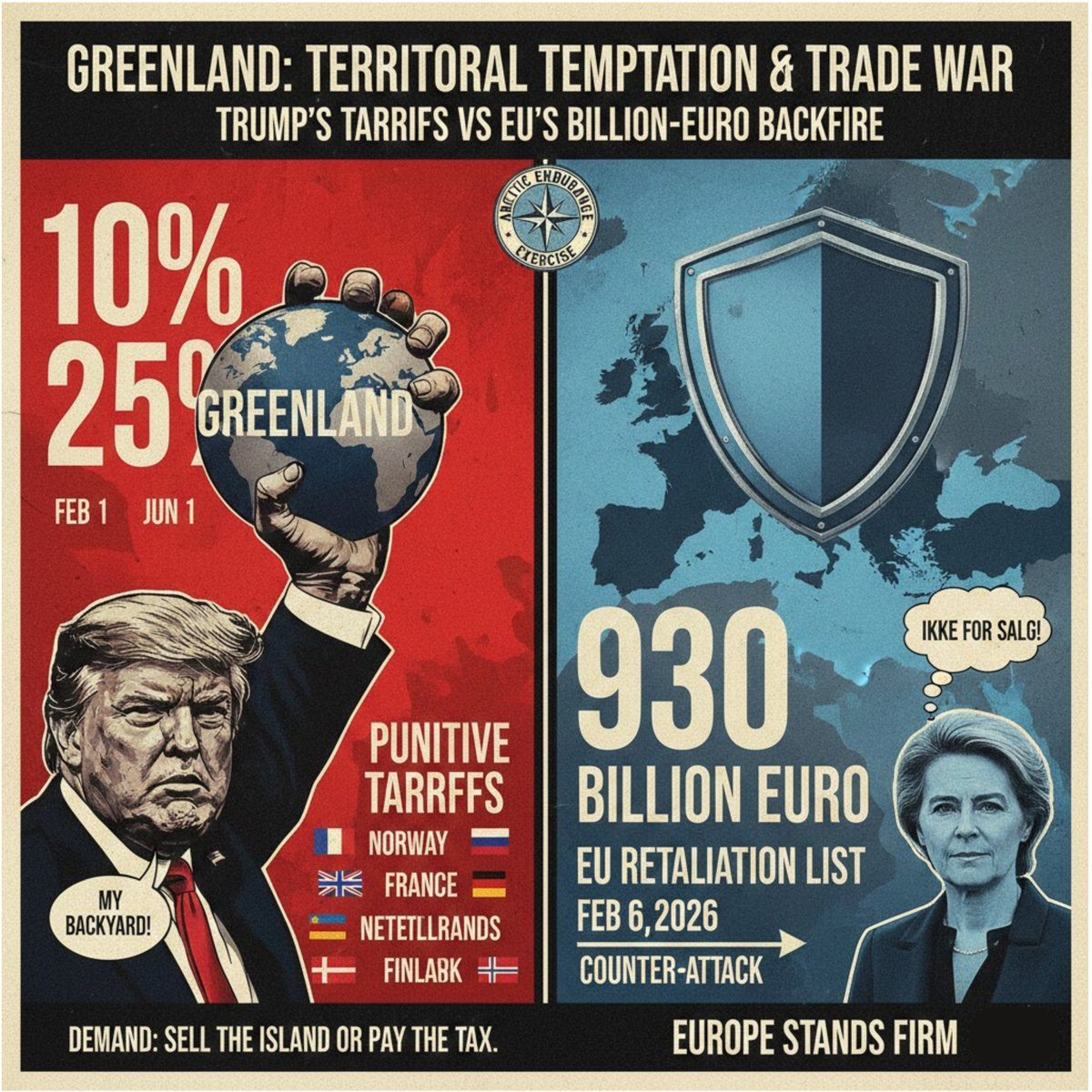
The direct targets of the new tariffs are Denmark, Norway, Sweden, France, Germany, the United Kingdom, the Netherlands, and Finland.

The trigger was the recent deployment of troops from these eight countries to Greenland for Arctic endurance exercises. In Trump's view, Greenland should be America's backyard, and this military presence without his approval is deemed provocative. Thus, he quickly resorted to his most familiar weapon - tariffs.

Trump's demand is simple and direct: either sell the island or pay the tax.

  • Starting February 1: 10% punitive tariff.

  • Starting June 1: Increased to 25%.

Only an agreement to purchase Greenland will lead to the withdrawal of tariffs.

Currently, Europe is taking a hard stance, with Denmark reiterating that Greenland is not for sale. According to the latest news from Brussels, the ambassadors of the 27 EU countries have convened an emergency meeting to discuss retaliatory measures.

The EU holds a list drafted last year, with a total value of up to 93 billion euros. This list was originally suspended due to last year's trade agreement, but the suspension period is set to expire on February 6, 2026. This means that if Trump acts on February 1, the EU could retaliate within days.

Both sides are currently frantically playing their cards.

  • Trump is betting: European unity is fragile, and a 10%-25% tariff is enough to cause internal strife in the European economy, ultimately forcing a compromise.
  • The EU is betting: American companies cannot afford to lose the European market, pressuring the U.S. Congress and voters to push back against Trump.

Transmission of Tariffs and Market Repricing

In response to this news, global markets have experienced significant volatility today: Hong Kong stocks fell by 1.05% during the day, and major Asian markets, including the Nikkei index, generally declined; risk aversion has increased, with spot gold rising by more than 2% at one point, reaching a historical high alongside silver prices; Bitcoin's price plummeted by $4,000 within two hours, with a daily decline of about 3.6%.

The key difference between this Greenland tariff war and previous tariff issues lies in the territorial sovereignty aspect rather than trade issues, making it less likely for the EU to concede easily.

So, what are the differences between this Greenland tariff war and previous tariff wars? Its impact is mainly reflected in three aspects:

1. International Trade and Goods Level: The punitive tariffs imposed by Trump on the eight European countries directly cut off the low-cost circulation path for high-value industrial products.

As the U.S. heavily relies on supplies from Denmark, Germany, and other countries in the fields of precision instruments, pharmaceuticals, and high-end automobiles, the tariff costs will quickly transmit through the supply chain to the end market, triggering severe input inflation pressure.

In this macro uncertainty, global trade volume is affected, and the risk premium for physical assets is pushed higher, with spot gold and silver prices driven to new historical highs.

2. Liquidity and Interest Rates: Trump's linking of tariffs to territorial sovereignty has disrupted the existing balance of international capital. Under tariff pressure, global trade credit is shrinking, leading to a significant increase in the cost of obtaining dollars in offshore markets; meanwhile, risk aversion has driven funds back to the U.S., concentrating on buying U.S. Treasuries. This mismatch in capital flow has resulted in a noticeable regional imbalance in global dollar liquidity.

Currently, the U.S. Treasury market is experiencing increased volatility. The yield on 10-year Treasuries is caught in a fierce battle between safe-haven buying pressure and long-term inflation expectations.

In the short term, while safe-haven funds entering the bond market can lower yields, as the market begins to digest the inflation risks triggered by tariffs and concerns about the debt burden from large-scale U.S. fiscal expansion, long-term Treasury yields face the risk of a second rise. This lack of transparency in the interest rate environment is weakening the support for high-valuation assets.

3. Cryptocurrency Market: Cryptocurrencies have failed to demonstrate safe-haven properties during this crisis, instead being significantly pressured due to their high correlation with macro liquidity.

As offshore dollar liquidity tightens, institutional investors, in response to margin gaps in traditional markets, have prioritized reducing their holdings of highly volatile crypto assets. Bitcoin triggered large-scale liquidations after breaking key support levels, leading to a sharp shrinkage in the total market value of cryptocurrencies, once again exposing their vulnerability amid extreme geopolitical turmoil.

In summary, tariff barriers induce trade shrinkage → input inflation raises interest rate expectations → global dollar liquidity tightens → institutions sell across assets to cover margins, ultimately leading to a crash in the cryptocurrency market.

KOL Opinions Summary

  1. Phyrex @Phyrex_Ni (XHunt Ranking: 765)

Opinion: If Trump really starts implementing the Greenland tariffs on February 1, it is very likely to trigger market expectations of rising inflation again, which could lead the Federal Reserve to maintain high interest rates for a longer period, potentially causing investors to lower their risk appetite and possibly seek safety through asset sales.

https://x.com/Phyrex_Ni/status/2012961389602857402?s=20

  1. qinbafrank @qinbafrank (XHunt Ranking: 1533)

Opinion: The biggest difference between the Greenland tariff war and previous tariff issues is that the core is a territorial sovereignty issue rather than a trade issue. Trump's ultimate demand is to gain long-term control over Greenland's defense and mineral resources through a long-term agreement. The Greenland tariffs have increased uncertainty, which the market dislikes the most.

https://x.com/qinbafrank/status/2013041531926794415

  1. The Kobeissi Letter @KobeissiLetter (XHunt Ranking: 1054)

Opinion: This time, Trump's plan to acquire Greenland is indeed more demanding than previous requests, and market turmoil may last longer. However, they believe that the best traders will take advantage of the asset price fluctuations brought about by the trade war. Volatility is opportunity.

https://x.com/KobeissiLetter/status/2012608685462220879

  1. Deep Tide @TechFlowPost (XHunt Ranking: 652)

Opinion: Trump has been obsessed with acquiring Greenland since 2019, and this time he has weaponized tariffs against NATO allies for the first time, prompting the EU to consider activating counter-coercion tools for retaliation against U.S. goods, marking a deterioration in transatlantic relations. Bitcoin essentially remains an "American asset" reliant on the dollar system, losing its appeal amid U.S.-European conflicts, while gold and other "stateless" assets become the true safe-haven choice, marking a shift in the international order towards economic nationalism and calling for a "de-Americanization" revolution in cryptocurrencies.

https://x.com/TechFlowPost/status/2013071438375497963

  1. Crypto Circle Veteran @Bqlsj2023 (XHunt Ranking: 1519)

Opinion: An in-depth analysis of Trump's insistence on acquiring Greenland, including its strategic location, control of Arctic shipping routes, missile defense bases, and rich rare earth and energy resources, while reviewing multiple historical attempts by the U.S. to purchase. The post also predicts that the EU tariff negotiations may last 4-6 months based on the experience of the U.S.-China tariff war, suggesting that the current crash in the cryptocurrency market is a temporary black swan event, advising investors to wait and buy the dip when conditions ease, while emphasizing that this round of market fluctuations will revolve around the tariff war.

https://x.com/Bqlsj2023/status/2013176823497261390

  1. The Long Investor @TheLongInvest (XHunt Ranking: 40695)

Opinion: Trump is using tariff threats as an extreme pressure negotiation tactic (this time aimed at forcing the EU to sell Greenland), with the real goal of forcing a deal rather than long-term tax increases. The market will replay the fixed cycle of "panic sell-off—negotiation easing—new high rebound," and investors should take advantage of this artificially created short-term volatility to find buying opportunities amid panic.

https://x.com/TheLongInvest/status/2012975844948623864

Biteye Opinion: TACO Action Guide

A term circulating in the market is: TACO (Trump Always Chickens Out). This meme originates from observations of his past negotiation style: although he always starts with extreme tariff threats, when faced with significant pressure from stock market turmoil or domestic interest groups, he often chooses a suitable time to reach an agreement and declare victory.

Based on this logic, what signals should we pay attention to?

1) Focus on Safe-Haven Funds: Before the tariffs are truly implemented, gold and silver remain core assets against geopolitical risks.

2) Maintain Liquidity Vigilance: When offshore dollars experience a dollar panic, avoid blindly leveraging during liquidity clearing periods.

3) Look for Wrongly Killed Assets: Historical experience shows that when the market falls into irrational panic, companies with solid business fundamentals that are wrongly punished due to macro sentiment often rebound first after the volatility.

免责声明:本文章仅代表作者个人观点,不代表本平台的立场和观点。本文章仅供信息分享,不构成对任何人的任何投资建议。用户与作者之间的任何争议,与本平台无关。如网页中刊载的文章或图片涉及侵权,请提供相关的权利证明和身份证明发送邮件到support@aicoin.com,本平台相关工作人员将会进行核查。

Share To
APP

X

Telegram

Facebook

Reddit

CopyLink