2026 Kaito Marketing Guide: Turning "Attention" into a Tradable Asset

CN
PANews
Follow
3 hours ago

Over the past year, Web3 projects have increasingly approached "growth" as follows:

Spending more and more money to buy shorter and shorter attention spans.

While most Web3 growth tools remain stuck in a task-driven model of "spend - share - airdrop," user growth in practice is often simplified to a rapid scaling process: first, spend money to create exposure, then increase engagement through sharing and task completion, and finally convert with airdrops or points. This method may generate considerable data feedback in the short term, but it essentially revolves around one-time actions, with growth effects highly dependent on continuous investment, making it difficult to form long-term accumulation.

In contrast, @KaitoAI is not optimizing efficiency within an existing task system but is gradually evolving into a highly structured user growth operating system (Growth OS). It does not merely score content or distribute points; instead, it reorganizes user expressions and interactions that were originally scattered across Twitter (X) into a long-term operational growth system through a comprehensive, quantifiable, competitive, and compound attention allocation mechanism.

This article will systematically break down how Kaito's internal mechanisms help projects achieve user growth, and later validate how these mechanisms are applied in the projects themselves through two quality cases: @Calderaxyz and @berachain.

1. The Essence of Kaito: Not a Marketing Tool, but an "Attention Allocation System"

The first step in understanding Kaito is to step outside the perspective of a "marketing platform." Kaito's true positioning is as an InfoFi system that transforms "attention, content contribution, and user behavior" into computable assets.

In traditional growth models, projects typically focus on three core metrics: exposure, clicks, and conversion rates. There is nothing inherently wrong with this set of metrics, but the implied premise is that as long as users complete specified actions, the system will assume that growth has occurred.

In the Web3 context, this premise often does not hold. Growth mechanisms based on task completion can only confirm "whether actions have occurred," but they struggle to determine why users act and whether they have a long-term willingness to participate. This leads to growth data being easily amplified by the lowest-cost actions, appearing lively but often showing limited performance in retention and genuine recognition. At the same time, such mechanisms tend to attract efficiency-oriented participants, such as airdrop farmers or bots. To combat witch attacks, projects can only continuously raise task complexity and participation thresholds, resulting in rising growth costs while potentially valuable users are kept out by higher barriers.

It is against this backdrop that Kaito has redefined growth metrics. In the Kaito system, the focus is no longer on the immediate data from a single action but rather on the long-term and structural quality of participation. For example, whether the project is repeatedly mentioned in the long-term information flow and forms stable recognition (Mindshare), whether it can continuously reinforce the same core narrative rather than being diluted by fragmented voices (Narrative Control), and whether users are willing to consistently produce content with incremental information around the same project over a longer period (Consistent Contribution).

This also means that Kaito's goal is not to help projects create short-term data spikes but to enable projects to occupy a stable, accumulative position in the long-term information flow of Crypto Twitter.

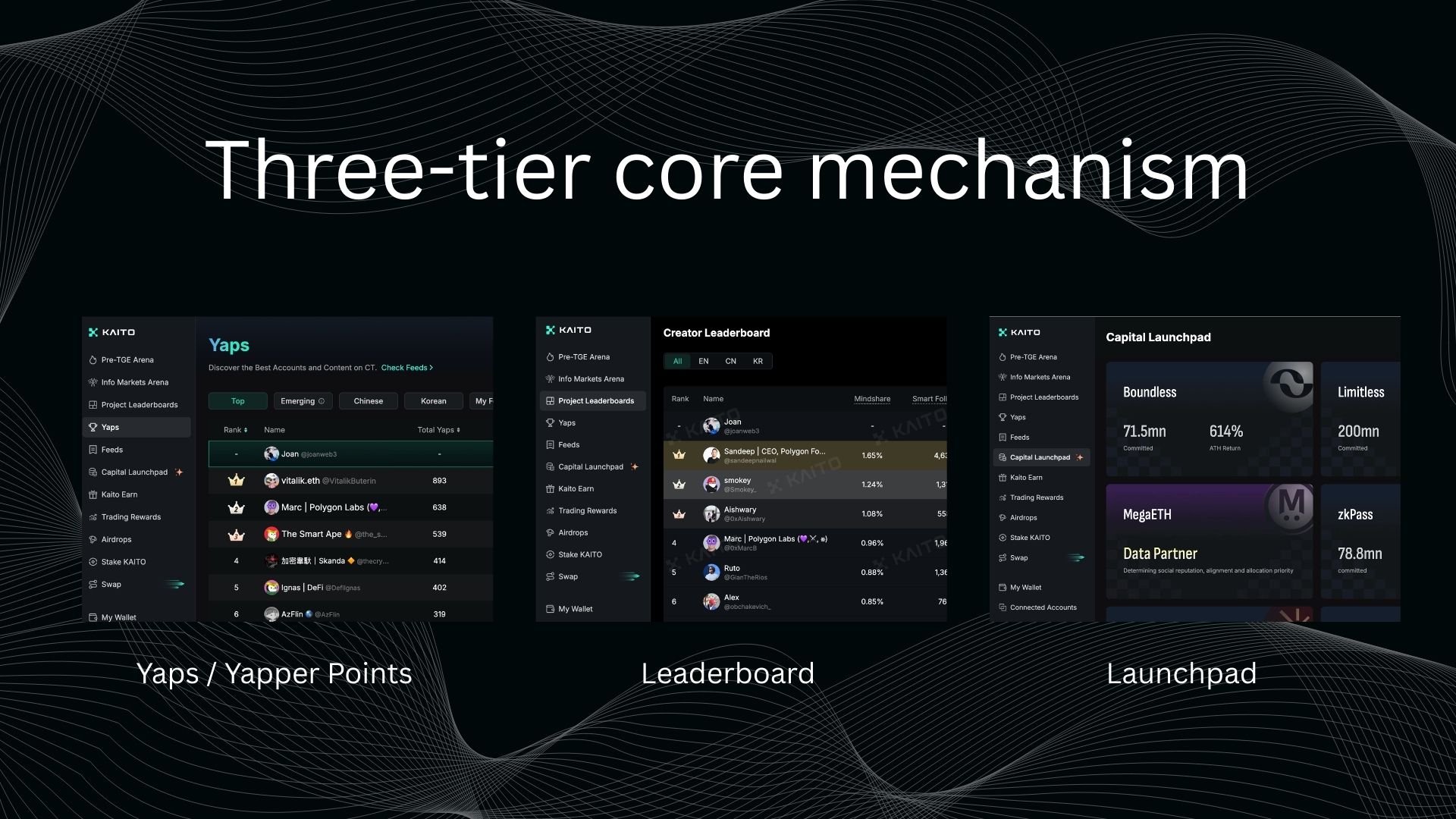
2. How Kaito's Growth System Operates: Three Core Mechanisms

The first key design of Kaito is Yaps / Yapper Points. Before Kaito, the lifecycle of a high-quality tweet was very short; apart from likes and shares, it was difficult to create any long-term value. However, after Kaito, every content output enters the user's long-term contribution record and continues to influence their future earnings through points, rankings, and historical weight. This long-term accounting mechanism directly changes the creators' objective function: they no longer just pursue a "viral tweet" but begin to manage a content identity that can be validated over time.

At the same time, Kaito's algorithm does not treat all interactions equally. The Yap scoring comprehensively assesses whether a piece of content truly brings information increment to the project, examining semantic depth and originality, its relevance to the project narrative, and whether interactions come from genuinely influential crypto users. This step completes a critical correction at the growth level—prioritizing the quality of traffic over the scale of traffic, thereby systematically compressing the space for botting, farming accounts, and ineffective interactions. Content in Kaito is no longer just a one-time expression but gradually evolves into a growth asset that can be valued over the long term.

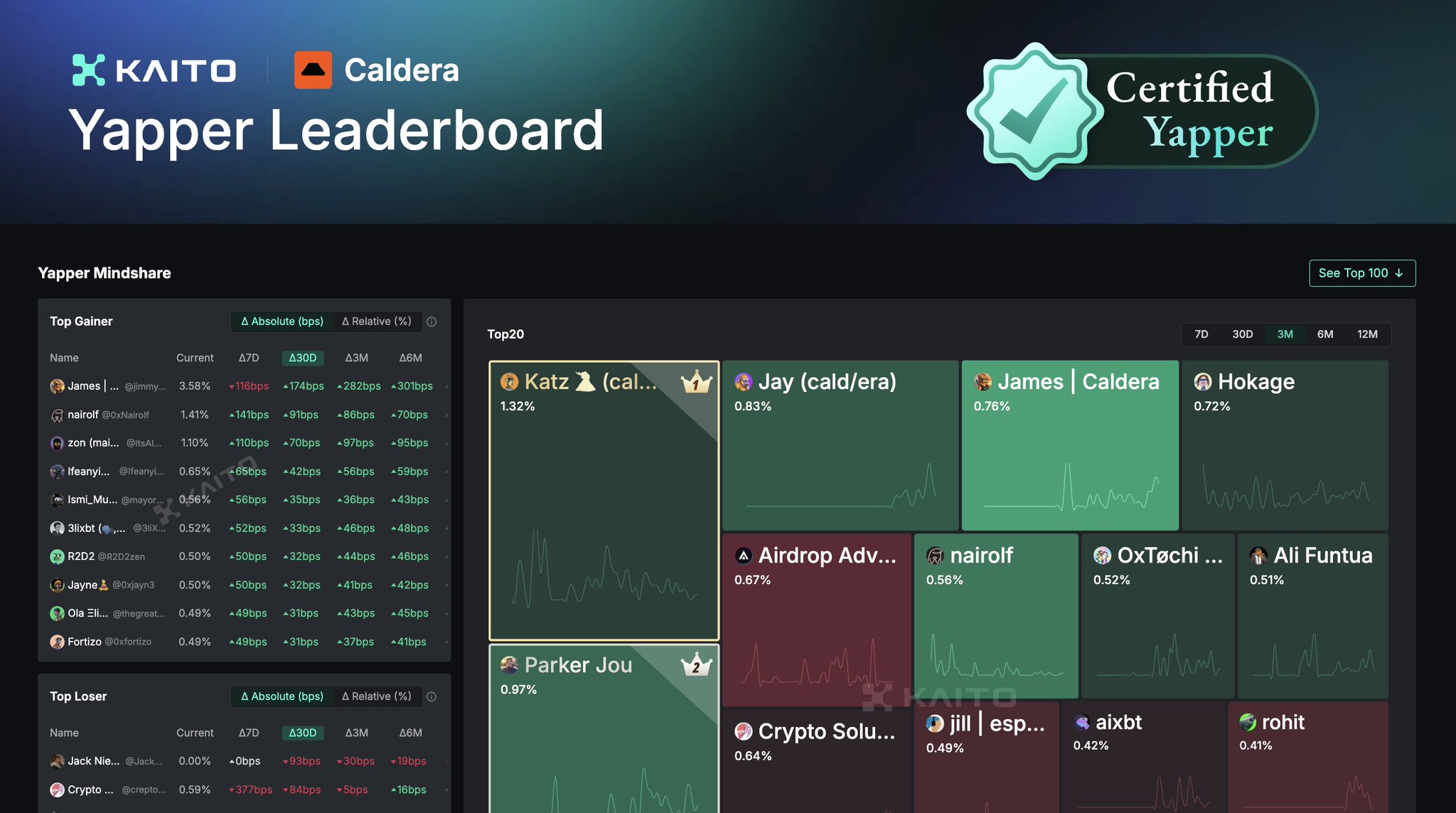
If Yaps are responsible for "assetizing" content, then the Yapper Leaderboard is responsible for transforming this asset into a growth engine. Its value lies not in the ranking itself but in guiding user behavior toward long-term, high-quality, and high-consistency directions through continuous competition and clear rules.

Rankings heavily depend on the continuity of posting, consistency of narrative, and long-term contribution accumulation, making it difficult for behaviors attempting to short-term rank to maintain an advantage. In contrast, those who genuinely understand the project and are willing to invest continuously will naturally rise. Meanwhile, Kaito releases the dissemination power from centralized operations to the community through algorithmic weights and incentive designs, allowing positive narratives and in-depth interpretations to be systematically amplified without losing control. Over time, this mechanism will also gradually organize scattered tweets into a recognizable content pool, enabling new users to quickly identify who the core voices are, thus providing a foundation for the continuous accumulation of Mindshare.

Finally, Kaito pushes growth toward a closed loop through the Yapper Launchpad and Capital Launchpad, with a simple core logic: giving "those who speak for the project" real weight in resource allocation. Content contributions are transformed into quotas and airdrops through the Leaderboard, ultimately landing in tokens and participation rights, thus turning attention into real benefits and making high-quality users long-term stakeholders.

3. Case Validation: When Kaito is Used as a "Growth System"

Among all of Kaito's successful cases, Caldera and Berachain are highly representative not because of their size or popularity but because they form a highly consistent system coupling between growth goals, content structure, incentive design, and platform mechanisms. This makes Kaito not merely a "traffic amplifier" but embedded within the growth logic of the projects themselves.

The following will break down these two projects from three perspectives: mechanism adaptation, user behavior shaping, and growth results.

1. Caldera: Using Kaito to Filter and Retain High-Quality Users in the Pre-TGE Stage

The Caldera case is particularly suitable for understanding how Kaito helps achieve high-quality user growth when the project itself has a complex technical narrative, rather than just simple exposure.

Understanding and utilizing Kaito's algorithm preferences in advance: Before entering the Kaito system, Caldera had already recognized a fact: Kaito's Yap Points and Leaderboard mechanism do not inherently favor "viral content" but are more likely to reward content with high semantic density, strong narrative consistency, and long-term cumulative value.

Based on this understanding, Caldera did not guide the community to produce "project introduction" or "emotional mobilization" tweets but consciously encouraged the community to create around a series of highly structured topics, such as the architectural principles of Rollup-as-a-Service, its positioning in the modular Rollup ecosystem, and the technical relationships with EigenLayer, DA layer, and execution layer. These topics not only have high information density but also require creators to possess understanding capabilities, naturally reducing the possibility of spam and simplicity.

From a growth perspective, the core of this step is to actively guide community creation behavior into the "algorithm-friendly zone," rather than letting users consume enthusiasm through trial and error.

Using the Leaderboard to systematically filter high-investment users: Caldera's use of the Kaito Yapper Leaderboard is not seen as a result display tool but as a user behavior shaping mechanism. During the Pre-TGE stage, Caldera deliberately extended the Leaderboard's operating cycle, making it difficult for any users attempting "short-term arbitrage" to establish a stable position on the leaderboard; conversely, only those willing to continuously output and gradually deepen their understanding over weeks or even months can steadily accumulate advantages.

This creates a clear filtering effect at the user level: low-patience, low-cognition users are naturally eliminated; high-cognition, high-investment users gradually concentrate at the top of the leaderboard. From the perspective of the growth system, Caldera effectively completed a "community quality filtering" using Kaito's Leaderboard, concentrating limited incentive resources on the group most likely to convert into long-term users and ecosystem participants.

Structurally binding content contributions with real usage: Unlike many projects that only stay at the content incentive level, Caldera consciously avoids letting Kaito become a purely "mouthpiece arena." During the Leaderboard's operation, Caldera continuously incorporated Testnet deployment, developer tool usage, and real interactions with ecosystem DApps into community discussions and content creation, binding "participating in products" with "participating in narratives" under the same incentive logic.

These actions do not always directly count toward Yap Points, but they are constantly referenced, analyzed, and reviewed at the content level, forming an implicit scoring mechanism: users who have genuinely used the product are more likely to produce high semantic density content, which is more easily rewarded by the algorithm.

Ultimately, a highly positive feedback loop is formed: using the product → forming understanding → outputting high-quality content → gaining higher weight in Kaito → obtaining more resources and attention → further deepening participation. This allowed Caldera to solidify a core user group that both understands the technology and possesses dissemination capabilities before the TGE.

2. Berachain: How to Use Kaito to Maintain Long-Term Mindshare Rather Than One-Time Hype

If Caldera demonstrates Kaito's capabilities in "technical project Pre-TGE growth," then the Berachain case illustrates how Kaito is used to maintain long-term Mindshare rather than a one-time narrative explosion.

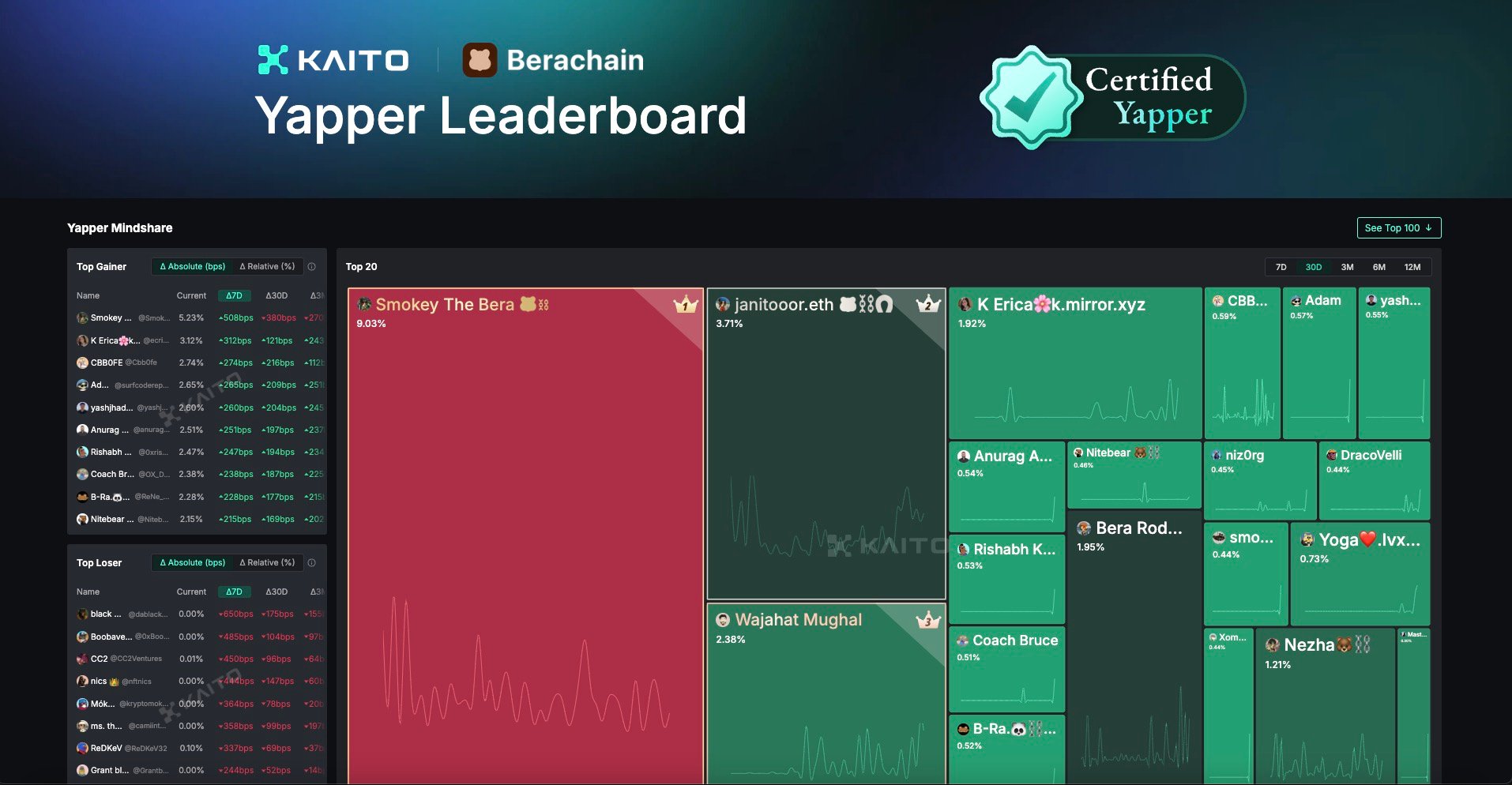
Treating Kaito as a long-term narrative infrastructure rather than a short-term activity tool: Berachain views Kaito as a long-term operational narrative infrastructure. From the beginning, the project accepted the natural fluctuations of the leaderboard instead of trying to create a surge in rankings through short-term incentives. This design allowed community content to gradually form a division of labor structure: some creators focused on in-depth breakdowns of the PoL (Proof-of-Liquidity) mechanism, some continuously tracked ecosystem projects and incentive changes, while others were responsible for translating technical narratives into more communicable culture and memes. Kaito's algorithm did not enforce a uniform content format but, through long-term weight accumulation, allowed different types of "sustained and relevant" content to gain reasonable positions within the system.

Leveraging Smart Followers weight to amplify core community structural advantages: Within the Berachain community, there already exists a network of core accounts that are highly interrelated and frequently interact. Kaito's Smart Followers mechanism effectively amplifies this structural advantage. Interactions from core crypto users and high-reputation accounts provide additional weight to the content, continuously pushing Berachain's discussions toward more influential social network layers. Ultimately, this transforms the originally implicit "core community structure" into a growth resource that is algorithmically identifiable and rewardable. This is also one of the key reasons why Berachain can maintain high Mindshare at multiple time points.

Facilitating long-term rather than speculative participation through stable incentive expectations: Berachain does not promise clear material returns at every node but instead conveys a signal to the community through a long-term, predictable Kaito incentive structure: that long-term participation in narrative construction is itself systematically recorded and recognized. Under this expectation, users' participation decisions no longer rely on the ROI of a single activity but are closer to a long-term investment behavior. This psychological shift is crucial for building a highly engaged community.

3. The Common Logic Behind the Two Cases

Although Caldera and Berachain differ significantly in stages, narratives, and product forms, they follow highly consistent principles when utilizing Kaito: growth is not achieved through "amplification" but through "screening"; algorithms are not adversarial objects but need to be understood in advance and actively adapted to; the core role of incentives is to shape long-term behavior rather than stimulate short-term participation.

4. Mechanism Elevation: The "Value Reassessment" and Credibility Shift of 2026

At the beginning of 2026, Kaito officially launched a paradigm-level evolution—transitioning from "attention distribution" to a comprehensive elevation of "reputation assetization." The core of this upgrade lies in the system no longer focusing solely on "content generation" but beginning to define "what kind of participation is worthy of long-term valuation."

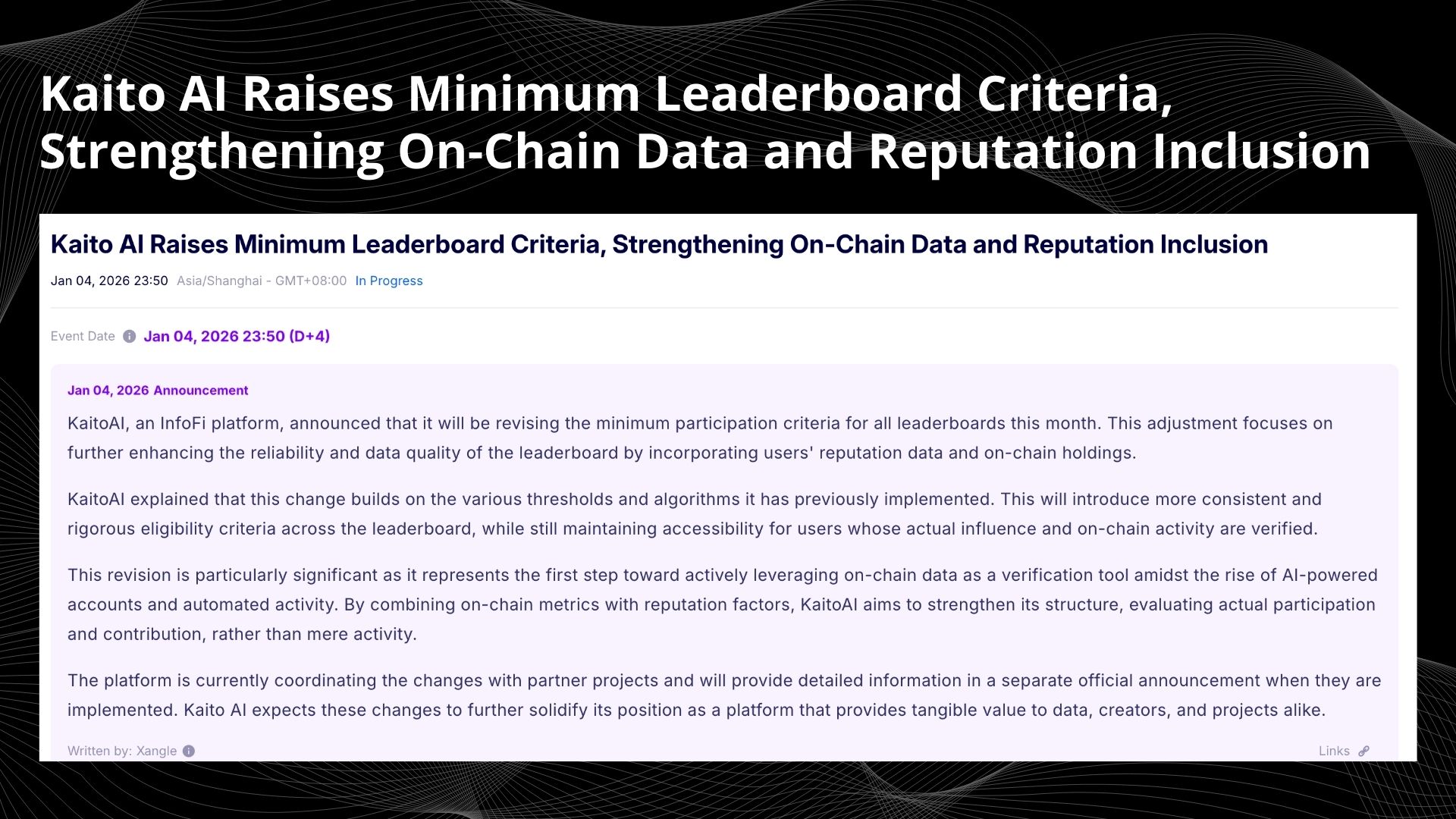
The most iconic action occurred on January 4, 2026, when Kaito officially announced the upgrade of the admission standards for all leaderboards. This update restructured the weight logic of influence from the ground up by introducing reputation data and on-chain holdings. This means that in Kaito's ecosystem, the "false prosperity" that solely relies on AI scripts and automated posting has lost its space for survival. The system began to filter out low-quality activities by combining on-chain metrics with social reputation weights, ensuring that every output's influence has a genuine capital endorsement. Kaito is shifting from measuring "who is speaking" to measuring "who is qualified to be taken seriously."

Complementing the algorithmic reshuffling is the formal implementation of the gKAITO governance mechanism. This mechanism marks Kaito's evolution from a growth tool to a reputation-based governance system. Community members are no longer merely traffic contributors but deeply participate in the quality control of token issuance through a five-dimensional model that assesses thought leadership, engagement, and cultural contribution. Under the gKAITO framework, content production has completed the transition from "traffic behavior" to "reputation asset," with influence officially anchored to governance rights, revenue rights, and investment priority rights.

免责声明:本文章仅代表作者个人观点,不代表本平台的立场和观点。本文章仅供信息分享,不构成对任何人的任何投资建议。用户与作者之间的任何争议,与本平台无关。如网页中刊载的文章或图片涉及侵权,请提供相关的权利证明和身份证明发送邮件到support@aicoin.com,本平台相关工作人员将会进行核查。

Share To
APP

X

Telegram

Facebook

Reddit

CopyLink