Bitchat is a peer-to-peer messaging application developed by Jack Dorsey, the co-founder of Twitter, now known as X. Launched in mid-2025, the app was built around the idea of censorship-resistant communication and operates without central servers, phone numbers, or user accounts.
The application relies on Bluetooth Low Energy mesh networking, allowing messages to be transmitted directly between nearby devices. Messages can “hop” from one device to another, extending communication across wider areas as more users join the network. This structure allows Bitchat to function even when mobile data and broadband connections are unavailable.
In addition to its offline capabilities, Bitchat can optionally integrate with open internet protocols such as Nostr, enabling global message reach when connectivity is restored. This hybrid design positions the app for use during natural disasters, protests, or government-imposed internet restrictions.
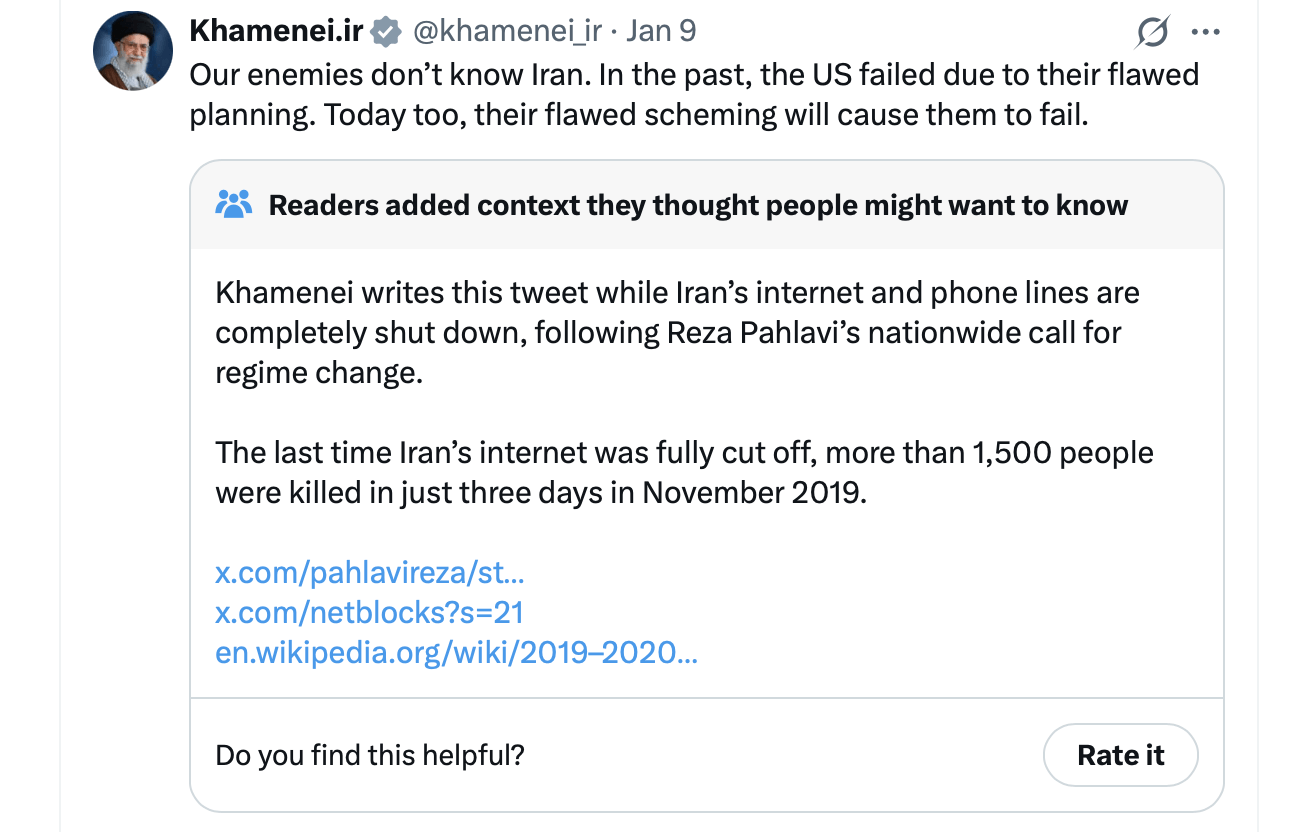
Ali Hosseini Khamenei is an Iranian Shiite cleric and politician who has held the title of Supreme Leader—the Islamic Republic of Iran’s highest political and religious authority—since 1989. In this image his X post has been tagged with a Community Note explaining that while he is able to post on X, his entire country’s internet and phone lines have been shut off.
Interest in Bitchat has increased sharply in Iran following the onset of a near-total internet shutdown around Jan. 8, 2026. App analytics indicate more than 1.5 million aggregate installs, 226,000 downloads in the past week, including roughly 11,000 in the most recent 24-hour period, though country-specific figures are not publicly available.
The surge in usage coincides with widespread protests across all 31 Iranian provinces, driven by economic deterioration, currency devaluation, corruption allegations, and political grievances. Reports cited in the overview describe severe government responses, including the restriction of mobile networks, social media platforms, and in some cases even landline access.
With traditional communication channels disrupted, Bitchat has been promoted by activists as a way to coordinate locally without relying on centralized infrastructure. Users have shared the app through direct Bluetooth transfers and Android APK files, creating localized “sharing hubs” that expand the mesh network as more devices come online.
Also read: ‘Big Orange’ — Another Saylor Teaser Puts Markets on Watch for Strategy’s Next BTC Buy
Privacy and security are central to Bitchat’s appeal. Messages are end-to-end encrypted and relayed directly between devices, reducing reliance on intermediaries that could be monitored or shut down. The app does not require users to submit personal information, a feature viewed as critical in high-surveillance environments.
The app has also drawn attention for its potential economic use cases. Iran has an estimated 7 million cryptocurrency users, and Bitchat can transmit bitcoin ( BTC) transaction data offline between peers. While transactions still require eventual internet access for confirmation, the system allows users to prepare transfers during outages.

The ongoing Iranian protests kicked off on Dec. 28, 2025. They began with shopkeepers in Tehran’s Grand Bazaar downing tools in protest of economic pain, including a collapsing currency and rising inflation. By late December, the demonstrations had gone nationwide, morphing into openly anti-government chants aimed at Supreme Leader Khamenei.
Bitchat’s use in Iran follows similar adoption patterns observed during internet disruptions in countries such as Nepal, Indonesia, Madagascar, and Uganda. In several cases, download volumes increased sharply during periods of political unrest or restricted connectivity.
However, the surge in interest has also led to risks. An unauthorized clone of Bitchat surfaced in Iran, prompting warnings from the original developers. The clone reportedly uses copied code without attribution, lacks open-source transparency, and solicits donations, raising concerns about surveillance or data misuse.
Developers and activists have urged users to verify that they are downloading the authentic version of Bitchat from official repositories. They warn that unofficial copies could expose users to security threats, particularly in politically sensitive situations.
Bitchat’s growing presence in Iran highlights how decentralized communication tools can operate during periods of network disruption, while also underscoring the importance of user education and verification in environments where misinformation and imitation software can spread quickly.
What is Bitchat?
Bitchat is a decentralized messaging app that allows encrypted communication without internet access using Bluetooth mesh networking.
Why is Bitchat being used in Iran?
The app is being used during an internet blackout to enable local communication when traditional networks are unavailable.
How does Bitchat work without the internet?
Messages are passed directly between nearby devices using Bluetooth, forming an expanding peer-to-peer mesh network.
免责声明:本文章仅代表作者个人观点,不代表本平台的立场和观点。本文章仅供信息分享,不构成对任何人的任何投资建议。用户与作者之间的任何争议,与本平台无关。如网页中刊载的文章或图片涉及侵权,请提供相关的权利证明和身份证明发送邮件到support@aicoin.com,本平台相关工作人员将会进行核查。


