Author: CoolFish
Zuckerberg has dropped a deep-water bombshell, as Meta officially announced the completion of its acquisition of the AI startup Manus.
With a transaction price in the billions, it has become Meta's third-largest acquisition in history, following WhatsApp and Scale AI.
Even Instagram, which once reshaped the social landscape, may have to take a backseat in light of this acquisition's price tag.
After the acquisition, Manus founder Xiao Hong will serve as Vice President at Meta. But what is most breathtaking is not just the price, but the speed.
According to reports, the entire acquisition negotiation took just over ten days, prompting Zhenge Fund partner Liu Yuan to remark, "It's so fast that it makes one wonder if this is a fake offer."
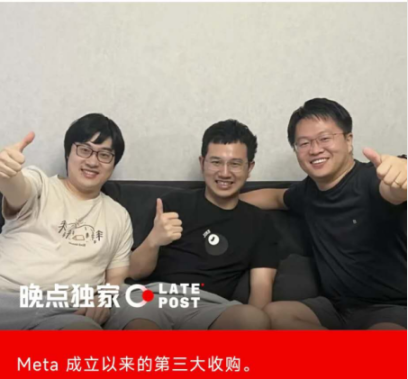
This "lightning war" pace is extremely rare in the history of mergers and acquisitions among Silicon Valley giants.
It feels more like a "bride-snatching" endeavor—perhaps Zuckerberg knows better than anyone that Manus is a ticket he must secure on the road to the future of agents.
1. The "Other-Dimensional" Time of a Small Town in Jiangxi
In 1993, Xiao Hong was born in a small town in Suichuan County, Ji'an City, Jiangxi Province. It is known as the "Red Core, Tea Capital, and Hot Spring Town."
For children in this small town, the options are either to study hard to leap over the dragon gate or to work for survival.
Xiao Hong wrote himself a third script: he liked to tinker with computers.
His family had an old desktop computer. While many kids used it to play games or watch movies, Xiao Hong often went online, exploring and experimenting with various software.
This became even more evident in high school, where he became passionate about using software and writing review articles.
In the "Other-Dimensional Software World" community, we can still see a wealth of content he wrote. Among them, the earliest article, written in 2010, titled "GeeXBox: The Free Media System That Lets You DIY Your Own Portable Media Center," has over 100,000 views.
"Wow, this is my (Xiao Hong's) first article in the Other Dimension. It surely isn't as good as Xiao X's, but I hope everyone will like it."
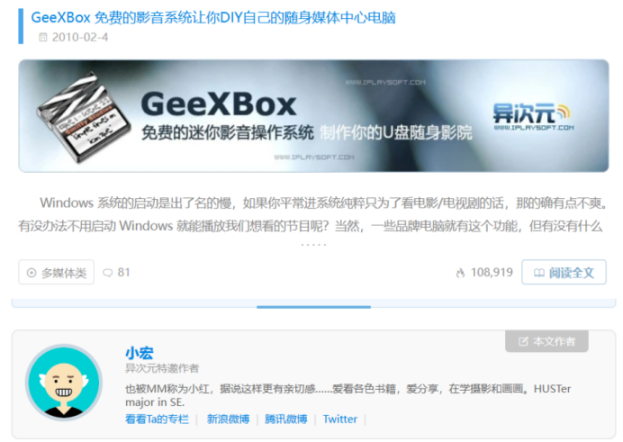
At that time, he was still a high school student, writing software reviews, and achieving 100,000 views without any traffic pool or algorithmic recommendations—an impressive feat.
Through those words, we can perhaps clearly capture two core underlying abilities that later contributed to his success: one is the ability to break down hardcore, complex technology into "human language" that even laypeople can understand, and the other is his understanding of what is cool and his ability to make others feel, "This thing is really exciting."
This "let's try something fun" geek logic has remained unchanged for 15 years, from the media system in 2010, to Bitcoin in 2013, and to Manus in 2024.
2. The "Message in a Bottle" from Huazhong University of Science and Technology—You Don't Need to Invent Demand
In 2011, Xiao Hong scored 600 on the college entrance examination and was admitted to the Software Engineering program at Huazhong University of Science and Technology.
"From now on, our education level will no longer be higher than yours; all the decisions in your life will be made by you." This was the message left to Xiao Hong by his parents.
During his four years in college, Xiao Hong studied his favorite major while also embarking on his earliest entrepreneurial experiences.
According to an article from the WeChat public account "Innovation and Entrepreneurship at Huazhong University," Xiao Hong was active in technical clubs during his time at Huazhong University and joined the Qiming Academy's "Co-Creation Team," serving as the deputy captain.

In 2013, WeChat was just getting started. Xiao Hong led a team to create a "WeChat Message in a Bottle"—the Huazhong version of a campus message in a bottle. Users could reply "message in a bottle" to "throw a bottle" and write what they wanted to say, while others could randomly receive and reply to these messages.
It sounds simple, but in that era, this kind of gameplay was quite novel.
In just three days after its launch, the WeChat backend recorded 40,000 replies, making it a favorite among many students. From the backend feedback data, requests for romantic partners and venting frustrations dominated the content of the message in a bottle.
A campus social product that captured the most genuine needs of college students.
This entrepreneurial experience in college showcased Xiao Hong's keen insight into social needs and product experience, which would be validated again in his future product designs.
You don't need to invent demand; you just need to accurately meet it.
3. Nightingale and Butterfly: The Romance of Xiao Hong
In 2015, the mobile internet was rapidly and vigorously developing, and most graduates from Huazhong University could easily find jobs at large companies. Unlike his peers, Xiao Hong had already firmly decided to pursue entrepreneurship.
"I hardly heard of him applying for jobs or looking for work; he even rented a house with his partners, living and working there. He focused more on technological innovation and wanted to put his ideas into practice," said Xiao Hong's classmate, Xiao He.
In 2015, Xiao Hong founded Wuhan Nightingale Technology Co., Ltd. in the Optical Valley, and the initial Nightingale was just "singing" in a small apartment in Wuhan.
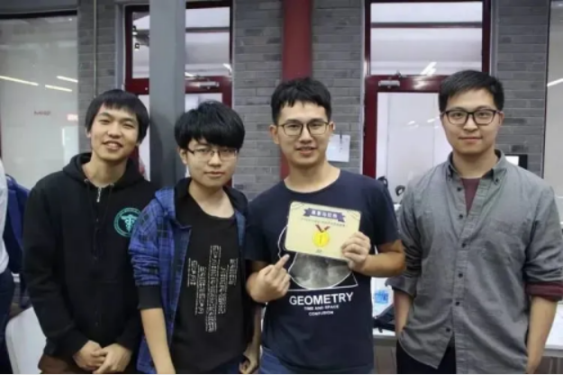
The landlord even suspected that this group of young people was involved in a pyramid scheme.
Xiao He pointed out that the name Nightingale comes from Oscar Wilde's "The Nightingale and the Rose."
"You can tell from the company name, Nightingale Technology, Butterfly Effect; the former is taken from Wilde's story, showing he has a bit of romantic sentiment."
Romance is romance, but reality never listens to Wilde's stories.
In that "gold rush era" of mobile internet, Xiao Hong's story began with a very clear "self-denial."
At that time, the WeChat ecosystem was still a wild land, yet Xiao Hong focused on the application development and promotion within the WeChat ecosystem.
The first successful product was Yiban Assistant—an enhancement plugin developed for WeChat public account editors, which remains a favorite among public account editors to this day.

But for Xiao Hong, this business was too "stable," so stable that it felt somewhat boring.
If you set your sights on the stars and the sea, you won't linger too long in a comfortable harbor.
Thus, in 2018 and 2019, his team went through some trial and error, creating small products like a family photo album mini-program, a live-streaming quiz mini-program, and a bookstore mini-program. Some of these products made a splash, while others barely made a ripple.
On November 28, 2019, the WeChat Work team held a service provider recruitment salon in Wuhan, which led to the birth of Weiban Assistant.
Tencent WeChat Work Vice President Li Zhifeng recalled at the 2021 SaaS conference, "That day, dozens of companies attended, and among them was a young guy with a backpack. Others might have just passed it by, but he went back and decided to go all in on WeChat Work, developing based on its ecosystem, and wrote the first line of code that day."
The young guy he mentioned is Xiao Hong, CEO of Weiban Assistant.

At that time, Weiban's development was not smooth.
Although version 1.0 had just been launched, it soon faced the pandemic. Worse still, the market was flooded with various external tools, making the compliant and restrained Weiban seem like a clumsy good child in comparison.
Perhaps it was due to Xiao Hong's persistence that a turning point arrived on May 25, 2020.
At that time, Tencent launched a large-scale crackdown on personal WeChat external tools, banning a large number of personal accounts, with some users having over 100 accounts banned, causing hundreds of thousands of customer resources to vanish in an instant.
At 3 a.m. the next day, Weiban Assistant published an article on its official WeChat account titled "Just Now, WeChat's Mass Ban! Customer Resources Instantly Reduced to Zero, What Should Private Domain Operations Do After the Ban on WeChat Auxiliary Tools?" which garnered over 100,000 views the next day.
With external tools banned, companies began to seek alternative products, and Weiban Assistant naturally met these demands, enjoying the benefits brought by WeChat's crackdown on external tools.
This experience is worth savoring. At the crossroads of short-term interests and long-term value, Xiao Hong always firmly chooses the latter. This is not just courage, but a kind of confidence in understanding.
4. From Monica to Manus, the Butterfly Begins to Flutter
At the end of 2022, ChatGPT was born.
For ordinary people, it was a toy for chatting; but for Xiao Hong, it was a tombstone of the old era.
He began to establish Butterfly Effect.
This time, his goal was no longer WeChat, but to turn his attention to the gateway of the internet—browsers.
Among the wave of AI shell companies that emerged like mushrooms after the rain in 2023, Monica seemed like a quietly miraculous company—one of the few that survived and thrived.
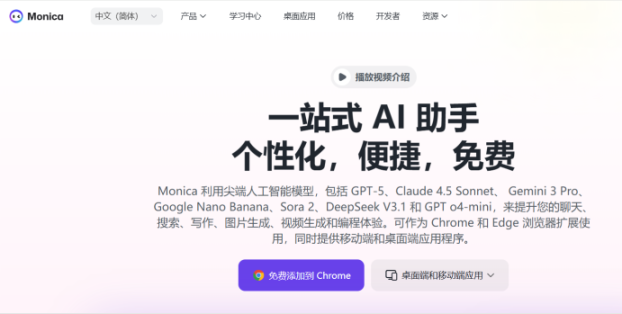
As of now, Monica has accumulated millions of active users worldwide, with an ARR (Annual Recurring Revenue) rapidly surpassing ten million dollars.
Logically, he should be popping champagne, but he didn't.
Xiao Hong realized that while technological capabilities were continuously evolving, product forms often lagged behind.
"When making Monica, I found that 'context' is key, so I made the plugin automatically capture webpage information, eliminating the need for users to copy and paste. Later, Cursor became popular, proving that when the model's coding capabilities mature, Chatbots are not the best product form; a carrier more aligned with coding workflows is needed."
"At the end of last year, we saw the emergence of new capabilities like 'Agent' that can perform complex planning and autonomous execution, and we judged that it also lacked a good product form. This was our opportunity: to seize the window of model capability overflow."
This is the reason for the birth of Manus.
In Xiao Hong's view, the ultimate question is—what is the ultimate "shell" for AI?
His answer is: a computer. In the digital world, a computer is the terminal through which humans handle all affairs. Therefore, equipping AI with a dedicated computer theoretically allows it to complete all tasks like a human.
According to Manus's official introduction, the name Manus comes from the Latin "Mens et Manus" (Mind and Hand). However, Manus's hands were already caught in the whirlpool of public opinion at the time of its birth.
On March 5, 2025, Manus was launched. Prior to this, it had already become "top-tier traffic" in the tech circle—invitation codes were even being traded on second-hand platforms for tens of thousands of dollars, making them hard to come by. However, the moment the product was unveiled, public opinion took a sharp turn, and the initial excitement was quickly drowned out by a wave of skepticism.
Many believed that Manus lacked significant innovation, viewing it merely as a shell product that utilized foreign models. "It doesn't have its own large model; it is a product developed based on existing large models in the industry."
Some even questioned: why was there seemingly no reaction from the tech community to such an exciting product, with only self-media outlets reporting on it?
It became apparent that within a week of Manus's release, its reputation had undergone a significant reversal. This was not only evident domestically but also showed severe polarization internationally.
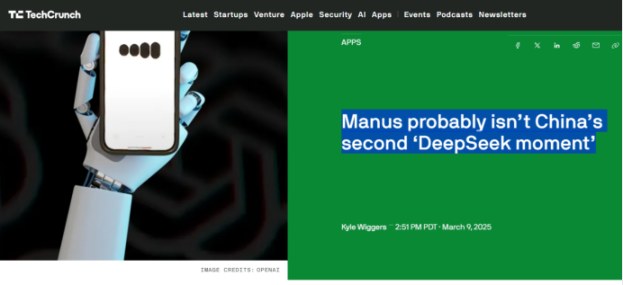
TechCrunch reported that Manus might not represent China's second DeepSeek moment. However, shortly after Manus's launch, Twitter founder Jack Dorsey stated that the product was excellent.
In the face of criticism, the Manus team did not shy away from admitting it was a "shell." This in itself is not frightening; the key lies in whether it can solve users' problems.
Just like product innovation and underlying technological innovation. Apple does not produce chips and screens, yet the iPhone remains the most successful smartphone.
Innovation lies in the system, interaction, and ecosystem, not in the hardware itself.
In April, the Series B financing led by Benchmark was completed, with a post-investment valuation of $500 million; however, shortly after their investment, the U.S. Treasury Department initiated a review of Benchmark's investment in Manus to check for compliance with the 2023 restrictions on AI investments in China.
Some voices in Silicon Valley began to question: "Is it compliant for a Chinese company to use Anthropic's model and receive American funding?"
Xiao Hong found himself in a position that no one wanted to occupy.
Regulations in the AI field between China and the U.S. tightened to a delicate critical point in the first half of 2025. Manus was caught in the middle: using Claude at its core, investors in Silicon Valley, users spread across the globe, and the company registered in Beijing.
Every link could potentially become a reason for being stuck.
He perhaps had only two paths before him:
The first path was to retreat to the domestic market and create a "Chinese version" of an AI agent. Safe, but the ceiling would be clearly visible.
The second path was to proactively cut ties and transform Manus into a truly "global company." Painful, but it could lead to greater distances.
Xiao Hong chose the second path.
No one knows how much pressure Xiao Hong endured during that time.
In 2015, he named the company "Nightingale"—the bird from Wilde's story that sings with its life and waters roses with its blood.
Ten years later, he might understand the full meaning of this name.
To let Manus bloom globally, he had to sacrifice something.
This is not a runaway; it is a self-mutilation for survival.
But Manus did not stop there.
On May 12, Manus ended the invitation code model, opened registration to all users, and launched a subscription plan, with over a million users already on the waiting list before the opening.
From June to July, it was perhaps the most controversial phase for Manus. The co-founder of Manus confirmed that the headquarters would be relocated to Singapore. Starting from July 8, the Beijing-based Butterfly Effect company, where Manus was located, began layoffs. About 80 employees in the China region were laid off, and content on social media platforms like Weibo and Xiaohongshu was cleared.
During this time, the label of "runaway" was almost affixed to Manus and Xiao Hong.
In October 2025, Manus released version 1.5, reducing the average task completion time from 15 minutes in April to less than 4 minutes.
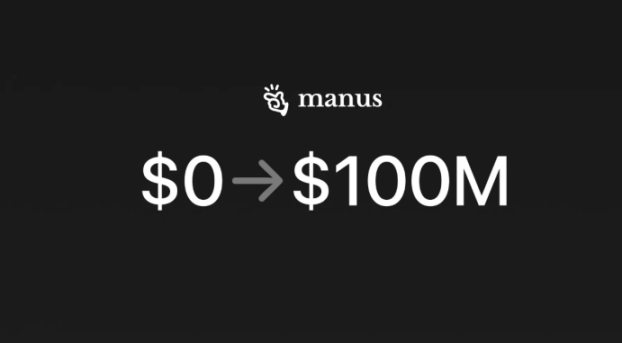
In December, Manus announced that its annual recurring revenue (ARR) had surpassed $100 million. It took less than nine months to go from commercialization to $100 million ARR.
Looking back at the initial message in a bottle product, Xiao Hong had long recognized that users do not actually care whose model you are using; they only care about one thing: can it meet my needs, can it help me get this done?
The answer Manus provided was: yes.
5. You didn't expect it, but Xiao Hong is still a Bitcoin holder
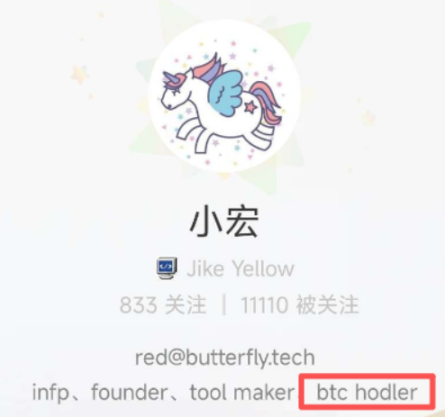
That's right; on Xiao Hong's "immediate" personal homepage, in addition to founder, INFP, and tool maker, he has a simple identity: BTC Holder (Bitcoin holder).
This is not a speculative label that follows the trend.
If you turn back the clock to 12 years ago, you will find that this sensitivity to new things has long been ingrained in his genes.
In November 2013, just entering university, Xiao Hong wrote a long article on "Other-Dimensional Software World": "What is Bitcoin? How to Use It? Download Bitcoin Wallet Client."
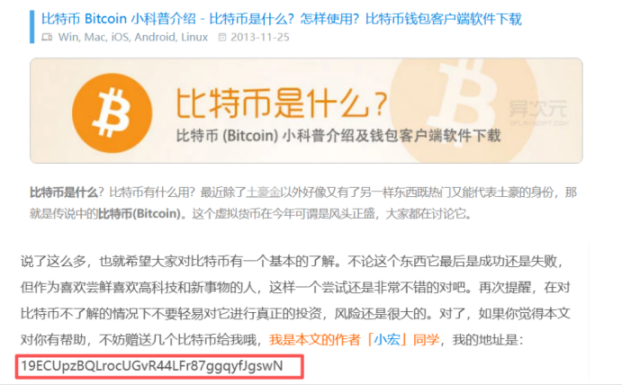
In a year when Bitcoin had not yet entered the public eye, most people still regarded it as a "tulip bubble" or "geek's toy," but at that time, Xiao Hong had already posted his wallet address at the end of the article, writing, "Just buy a few bucks and put them in your wallet, see how cool it is."
Out of curiosity, I checked that address. In February 2014, the holdings in that address were worth only $0.793; today, 12 years later, that asset is worth $1,969.
A 2,482-fold increase!

That address should have long been inactive; this amount of money is trivial for today's Meta Vice President, but what this number reflects is extremely astonishing: he is someone who can find and hold onto the "future."
This "holding" determination is vividly reflected in Manus's valuation curve.
In early 2024, when Monica had just begun to emerge, ByteDance offered $30 million to acquire it. For a post-90s entrepreneur, this was enough to achieve financial freedom, a perfect opportunity to "cash out."
But Xiao Hong refused.
Just as he once held Bitcoin through a long cycle of ups and downs, he recognized that Agents were the true ticket to AI general intelligence. He chose to continue "holding" and keep running down that path.
Just a year and a half later, Meta knocked on his door with a multi-billion dollar offer.
From $30 million to billions, the leap was not just in valuation magnitude but also the highest reward for long-termism.
Xiao Hong also stated in an article that he enjoys "trying new things" and "new things." But in fact, what he is truly good at is identifying those signals that have real vitality amid the long noise.
Whether it was the small-town youth holding $0.7 worth of Bitcoin 12 years ago or the Meta Vice President standing next to Zuckerberg today, worth billions, his core has never changed:
Identify a future, and then hold onto it as if holding a belief.
"That way, you can directly feel Bitcoin; just buy a few bucks and put them in your wallet~ 'Bro, I have Bitcoin now,' see how cool that is."
In Conclusion
From a small town in Ji'an, Jiangxi, to a small apartment in Wuhan, and then to the spotlight in Silicon Valley, Xiao Hong's story may be telling us:
True innovation does not necessarily have to invent the wheel from scratch; it can also recombine existing elements to create products that truly solve problems.
Looking back at Xiao Hong's "Monologue of the CEO of Weiban" written in 2022, how could the past Weiban not be today's Manus?
Today's Weiban (Manus) still has a distance from everything mentioned above. To ensure they exist beyond the paper, the members of this company must double their efforts. In this process, physical exhaustion, mental tension, and sometimes even the grievance of being misunderstood are inevitable.
At this time, just silently recite that phrase that has inspired countless people:
Per aspera ad astra, through this arduous journey, to reach the sky.
Recommended Reading:
RootData 2025 Web3 Industry Annual Report
Insider trading may be the most valuable part of predicting the market
Dragonfly Managing Partner Haseeb: The 3 Top Crypto Investors in My Eyes
a16z Six Executives' Views on Crypto Trends in 2026: Stablecoins, Payments, RWA…
免责声明:本文章仅代表作者个人观点,不代表本平台的立场和观点。本文章仅供信息分享,不构成对任何人的任何投资建议。用户与作者之间的任何争议,与本平台无关。如网页中刊载的文章或图片涉及侵权,请提供相关的权利证明和身份证明发送邮件到support@aicoin.com,本平台相关工作人员将会进行核查。


