After years of proofs of concept and sandbox experiments, 2025 marked a shift for tokenized real-world assets ( RWAs) from curiosity to capital markets tool. Data compiled by rwa.xyz shows the sector expanding across asset classes, blockchains, and institutional use cases, even as market conditions tested weaker models.
At a high level, the tokenized asset universe ended 2025 with a clear divide. Distributed RWAs—tokens that can move freely between wallets and protocols—reached nearly $19 billion in value, while represented assets locked to issuing platforms towered above them at nearly $400 billion. The imbalance mattered less than the trend: mobility, not just token labels, increasingly defined which products attracted sustained demand.
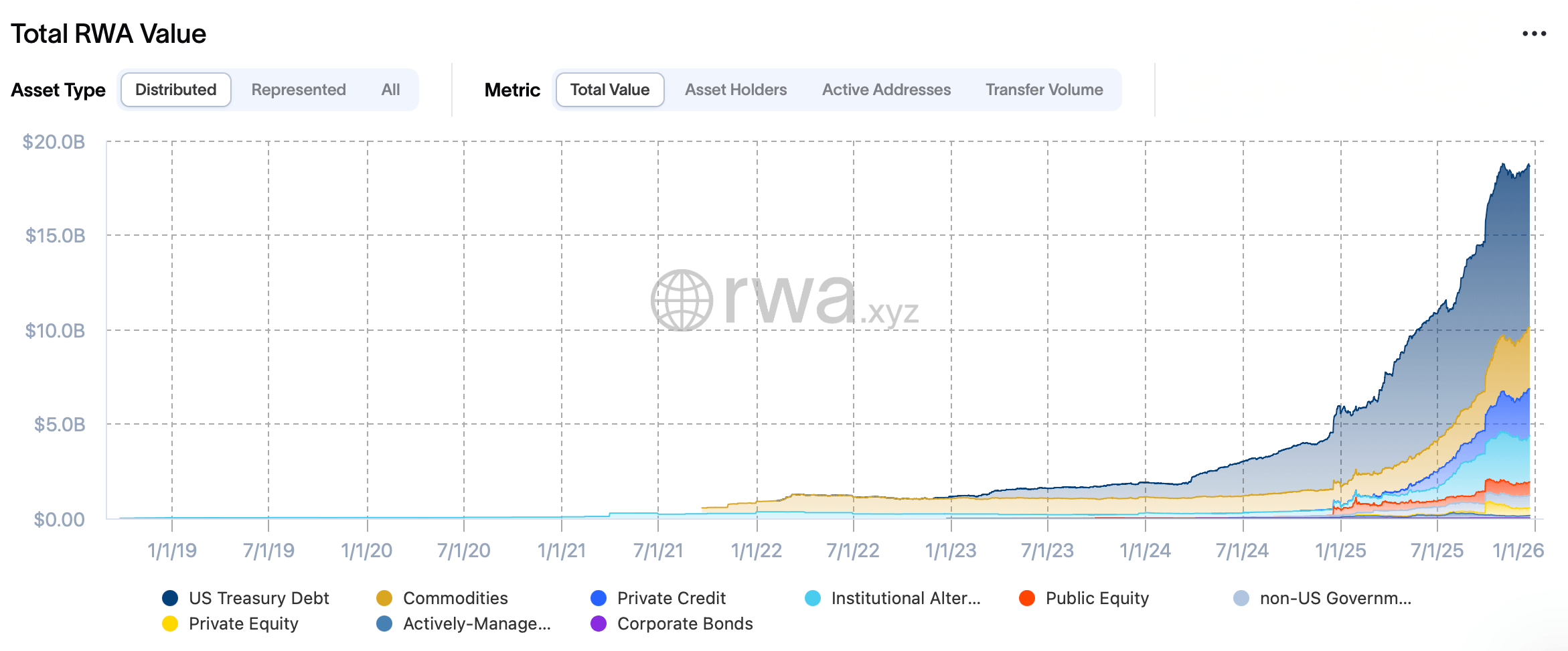
Stablecoins remained the heavyweight of tokenization, accounting for roughly $300 billion in value and more than 200 million holders. But beyond dollar-pegged tokens, investors spent 2025 gravitating toward yield-bearing RWAs that felt familiar, transparent, and useful in an onchain setting.
Treasuries Took Center Stage
Tokenized U.S. treasuries emerged as the backbone of the distributed RWA market. With nearly $9 billion in value by late December, onchain treasuries delivered something crypto-native products often struggle to offer: predictable yield without creative math. In a year marked by elevated interest rates, treasury-backed tokens became the default parking spot for onchain capital seeking stability.
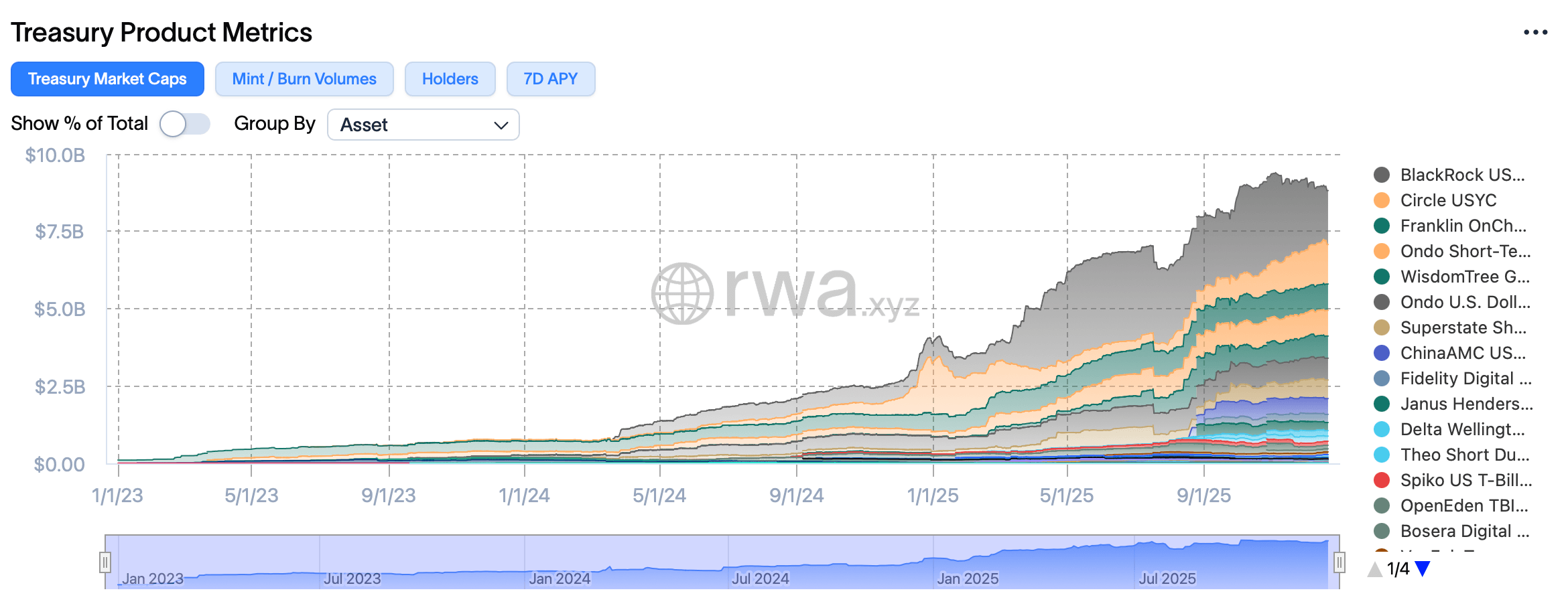
Issuers such as Securitize, Ondo, and Circle dominated this category, collectively accounting for more than half of the tokenized treasury value. Their products didn’t chase novelty; instead, they focused on compliance, liquidity, and operational reliability—attributes that institutional allocators tend to appreciate.
Credit, Bonds, and the Hunt for Yield
Beyond U.S. treasuries, tokenized debt diversified meaningfully in 2025. Non-U.S. sovereign bonds attracted investors looking for currency exposure, while private credit platforms quietly scaled into one of the largest RWA segments by loan volume. By year’s end, private credit protocols had originated more than $29 billion in loans, with nearly $18 billion still active.
Unlike treasuries, private credit carried real risk, and the yields reflected it. Double-digit annual percentage rates drew capital, but repayments, refinancing, and borrower performance remained central concerns. The market didn’t ignore those risks—it priced them.
Commodities Went Digital, Gold Stayed King
Tokenized commodities had a solid year, led overwhelmingly by gold. Tokens backed by physical bullion accounted for the bulk of the sector’s $3.7 billion market value, reinforcing gold’s role as a familiar hedge in unfamiliar systems. While transfer volumes softened later in the year, the category’s overall growth showed that investors still value hard assets—especially when wrapped in onchain transparency.
Of course, gold‘s rise in value helped bolster the tokenized commodities sector a great deal.
Tokenized Funds and Stocks Find Their Lane
Institutional funds—hedge funds, venture vehicles, and alternative strategies—made incremental progress onchain, even as the category saw modest drawdowns late in the year. The pullback reflected redemptions more than abandonment, with platforms continuing to expand offerings despite uneven flows.
Tokenized public stocks, meanwhile, delivered one of the strongest growth narratives of 2025. Total value climbed sharply, transfer volumes jumped, and the number of holders rose by nearly 15 percent in a single month. Fractional ownership and round-the-clock trading appealed to global investors who were more interested in access than tradition.
Ethereum Still Led, But It Wasn’t Alone
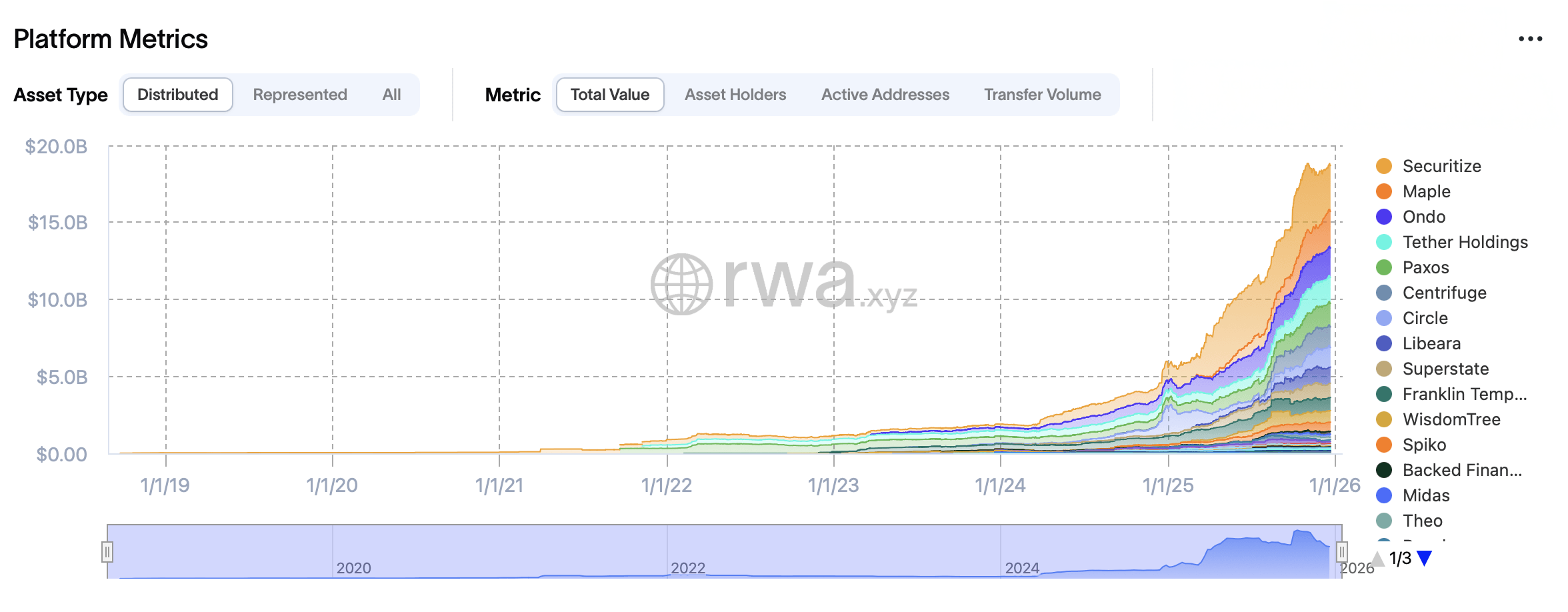
From a technical standpoint, Ethereum remained the primary settlement layer for RWAs, hosting the majority of tokenized products and value. But it wasn’t a monoculture. BNB Chain, Solana, Arbitrum, Stellar, Avalanche, and Polygon all supported growing pools of tokenized assets, highlighting the sector’s multichain reality.
Issuers increasingly treated blockchains as infrastructure choices rather than ideological commitments, selecting networks based on fees, compliance tooling, and settlement needs.
Also read: Blackrock’s 2025 Investment Themes Put Bitcoin and IBIT Front and Center
Why 2025 Mattered
Tokenized RWAs resonated in 2025 because they solved practical problems. Fractionalization lowered barriers to entry. Onchain settlement reduced friction. Transparent data improved trust. And integration with decentralized finance (DeFi) allowed traditional assets to function inside programmable systems rather than alongside them.
Major asset managers, including Blackrock and Franklin Templeton, didn’t treat tokenization as a side quest. Their involvement signaled that RWAs were evolving into infrastructure rather than experiments.
Looking Ahead to 2026
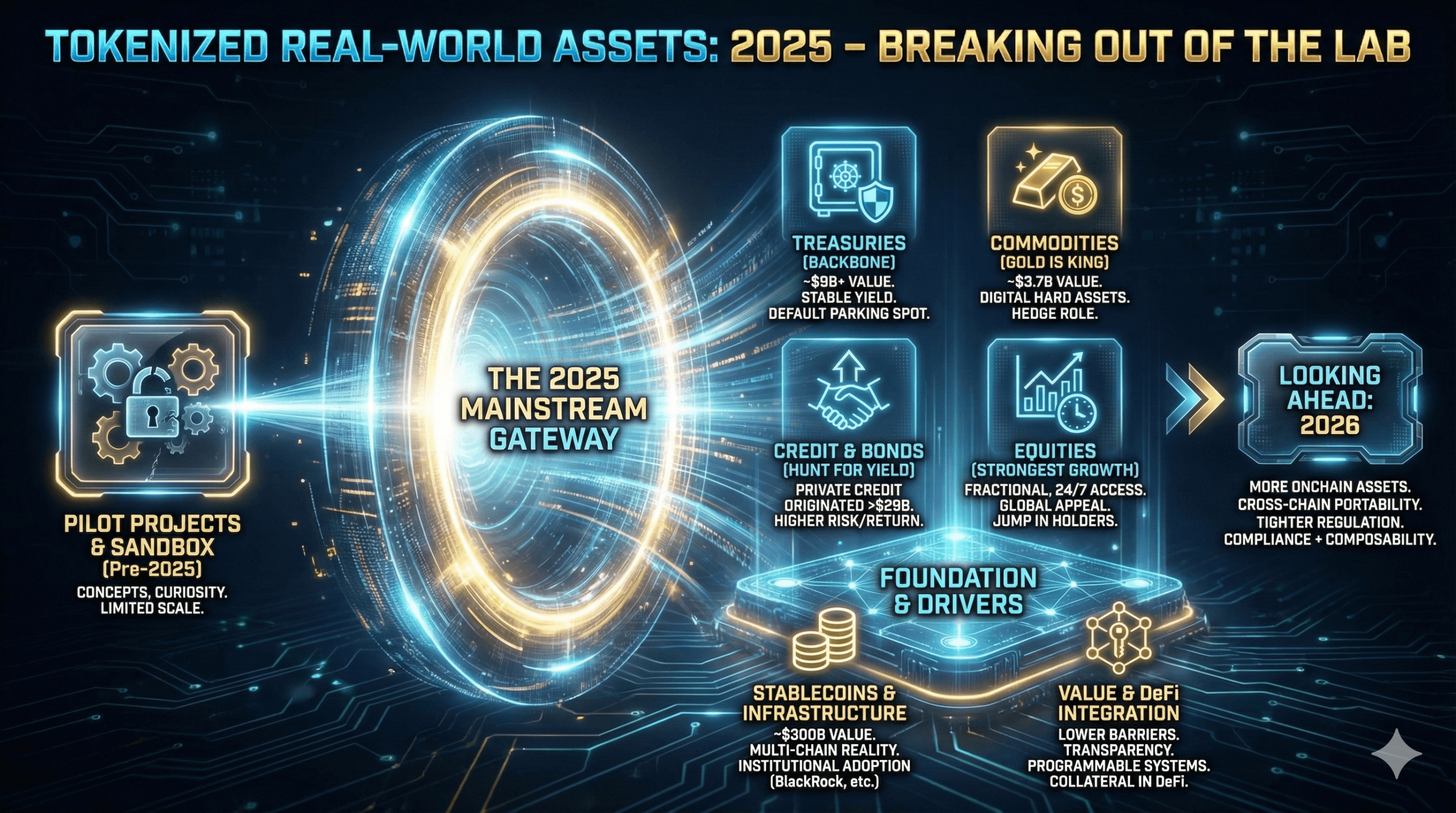
As 2026 begins, the trajectory is clear. More assets will move onchain. More represented products will aim for portability. Cross-chain infrastructure will improve. Regulation will tighten, not disappear. The winners are likely to be platforms that balance compliance with composability and yield with transparency.
Tokenized real-world assets didn’t replace traditional finance in 2025—but they stopped asking for permission to sit at the same table.
- What are tokenized real-world assets ( RWAs)?
They are blockchain-based tokens that represent ownership or exposure to traditional assets like bonds, credit, commodities, and stocks. - Why did RWAs grow in 2025?
Investors sought yield, transparency, and easier access to traditional assets through onchain infrastructure. - Which RWA category led the market in 2025?
Tokenized U.S. treasuries dominated distributed RWAs by value and adoption. - Are RWAs used in decentralized finance?
Yes, many tokenized assets are now used as collateral, trading instruments, and yield components in defi protocols.
免责声明:本文章仅代表作者个人观点,不代表本平台的立场和观点。本文章仅供信息分享,不构成对任何人的任何投资建议。用户与作者之间的任何争议,与本平台无关。如网页中刊载的文章或图片涉及侵权,请提供相关的权利证明和身份证明发送邮件到support@aicoin.com,本平台相关工作人员将会进行核查。


