No one is happy in the casino economy; young Americans are losing confidence in the future.

CN
12 hours ago

Why Do We Feel Depressed?

Author: 0xJeff

Translated by: Deep Tide TechFlow

Good morning, greetings from Washington D.C.! This article is a bit long, so it might get cut off in your inbox. If you are looking for an affordable holiday gift for a loved one (or anyone) and want to support local bookstores, In This Economy? is a great choice!

During this time, I have started a new journey for work, with destinations including Michigan, Kentucky, and Washington D.C. While going through security, I saw a lady in front of me coughing with her mouth wide open like a baby. I stared at her, first surprised by her "carefree" attitude, then felt a deep sense of fear.

Most people are friendly. But living in society means facing different internal norms of others. Some people cough with their mouths open, and that’s the reality. I have a theory: they might think that the collective comfort is not their responsibility, perhaps due to a lack of belonging in public spaces. This is a phenomenon of social drift, becoming increasingly evident in public spaces (like staring at a phone while walking and bumping into walls, or standing in the middle of pedestrian traffic blocking the way).

However, I believe there are many similarities between these mouth-open coughers and the ongoing economic downturn we are witnessing. If you have lost trust in the surrounding systems, why should you adhere to collective norms? Working hard seems unrewarding, so why not "take a gamble"? Institutions are lying! But that YouTuber who made the cover image isn’t lying; he points at a bowl of pasta with a wide-open mouth expression, asking some "serious questions." We no longer trust each other. As Jordan Schwartz, the student chair of the Harvard Public Opinion Project, said:

"Generation Z is on a path that could threaten the future stability of American democracy and society. This is a five-alarm crisis, and if we want to restore young people's confidence in politics, America, and each other, we must act immediately."

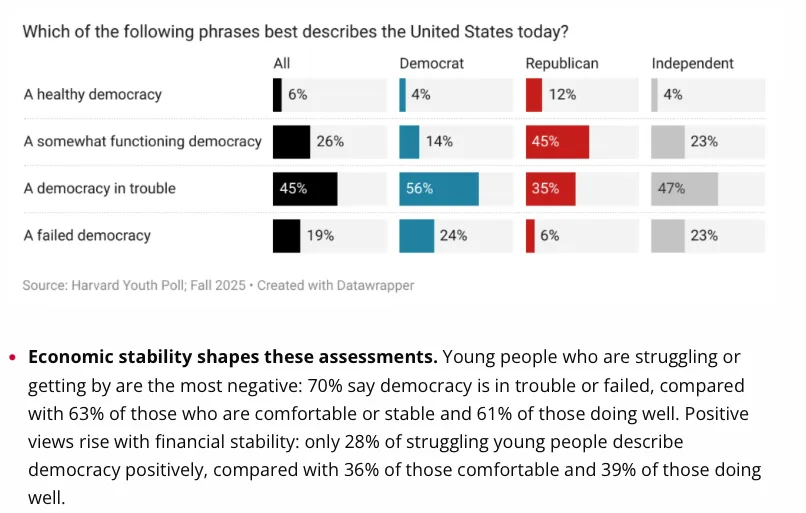
The project he oversees—the Harvard Youth Poll—surveyed over 2,000 Americans aged 18 to 29 about trust, politics, and artificial intelligence. When asked whether they believe America is a healthy democracy, respondents showed clear partisan divides, but the anxiety was evident.

Trust among groups is also collapsing. Only 35% of young Americans believe that people with different opinions want the country to improve. 50% view mainstream media as a threat. And only 30% believe their economic situation will be better than their parents'.

Thus, we can draw three noteworthy concerns from this survey:

  1. Concerns about democracy

  2. Concerns about the economy

  3. Concerns about each other

I believe that without understanding how we discuss the economy, we cannot truly understand the economy itself. Here, we are facing a compound effect of three factors: (1) the adaptation process in the post-pandemic era; (2) "micro-solipsism" triggered by smartphones; and (3) the younger generation witnessing objectively unfriendly behavior in politics being rewarded instead. People (understandably) are experiencing a "cognitive drift," with some even calling it "medieval peasant brain," related to the continuous information flood from the internet (for example, someone putting potatoes in socks to "detox").

We are trapped in a compound crisis—economic deterioration and cognitive overload interact to form a recursive trap, where each side worsens the other and destroys the resources needed to break through the predicament.

  • Economic pressure (such as Baumol's cost disease, housing issues, and a weak labor market) weakens our ability to think clearly, making us more susceptible to scams, poor decisions, and exploitative markets, which in turn exacerbates economic pressure.

  • Economic pressure + information overload weakens trust in institutions.

  • Loss of trust makes coordination impossible, problems remain unsolved, and unresolved issues deepen the crisis.

Currently, we are trying to understand the economy in a context where social and cognitive environments are changing faster than traditional economic indicators. This is the backdrop of "Vibecession."

Note: Given that Paul Krugman and Scott Alexander have recently revisited this concept, it is worthwhile to re-examine the past meanings of "Vibecession" and its evolution today.

"Vibecession": Past and Present

I first introduced the concept of "Vibecession" in July 2022. At that time, inflation was receding (but still painfully high), the labor market was recovering, and the economy was growing. AI had not yet taken center stage, there were no tariff barriers, and large-scale infrastructure investments were underway. From the data, everything seemed to be improving.

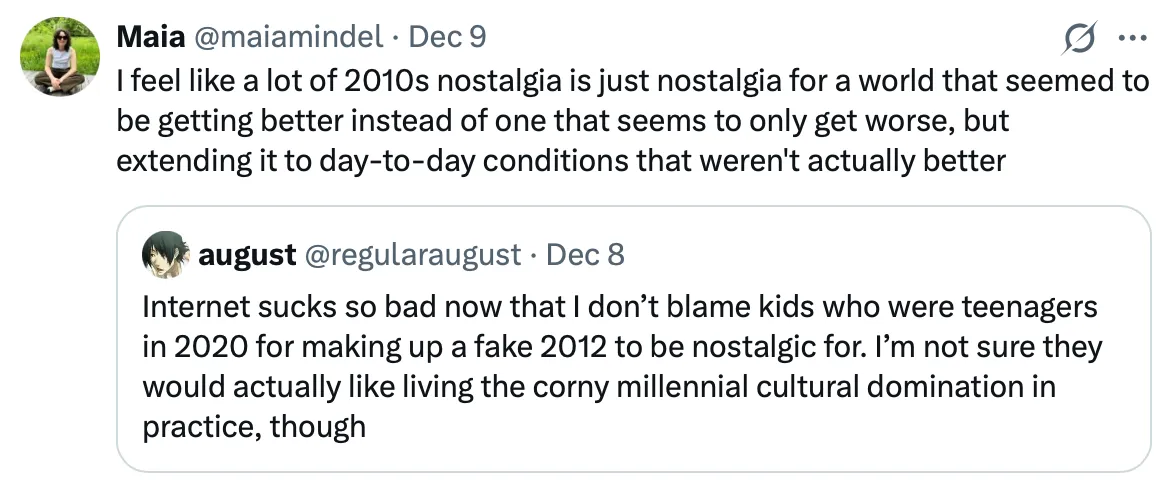
While there were many issues in the 2000s and 2010s (really a lot!), people's emotions had not completely collapsed. Nowadays, there is even a nostalgic trend on TikTok (nostalgiacore), where teenagers have fabricated a beautiful fantasy of "2012"—they long for infinite scarves, third-wave coffee shops, and the time when Instagram was just for sharing photos of daisies in fields, rather than the hyper-competitive algorithmic battlefield it is today.

At that time, there was still a glimmer of hope (which was also the core idea of Obama's campaign!), and people had "better" expectations for the future of the internet. Although there were already some issues with the internet, it had not yet reached the point of profiting from generating anger.

Some claim that "the entire past decade has been a Vibecession," but emotional data does not support this assertion. In fact, the emotional break is evident and sharp.

The chart below roughly shows the starting point of "Vibecession," illustrating the divergence trend between emotions and economic data. After the pandemic shock, real disposable income recovered and continued to grow, returning to normal trends. However, public sentiment never recovered. It slipped into a range similar to an economic recession (or even lower) and has remained there, even as economic fundamentals stabilized.

I believe part of the reason lies in the cumulative effect. The chaos brought by the pandemic has not ended, prices of various goods remain unstable, stores are understaffed, teachers and students are exhausted, the public information dissemination system has collapsed, and institutions appear fragile. Daily frictions in life have increased in countless small details. The surge in housing prices during the pandemic has never receded. As the Federal Reserve begins to raise interest rates, mortgages "lock" people in place. Rent has skyrocketed, and the path to adulthood—moving, renting, saving, buying a house—has been shattered for many. If you didn’t buy a house before 2020, you may never be able to.

But as Dan Davies wrote, "Vibecession" may not have a specific trigger point. "The vibe is like a supercooled liquid, just waiting for a random shock to cause a phase change." And the pandemic was that shock.

Vibecession arrived early. Now, economic data matches people's emotions, or at least is closer than before. We are now facing a low hiring environment, persistent inflation, and extremely strange trade policies. When the National Bureau of Economic Research (NBER) defines a recession, it focuses on three aspects:

  1. Depth: How severe is the economic decline?

  2. Breadth: How widely is the pain spread?

  3. Duration: How long does it last?

If we observe the decline in consumer sentiment, it (roughly speaking) fits the definition of a recession—it lasts long, affects a wide range, and sentiment levels are continuously approaching historical lows. Kevin Gordon from Schwab calls it "Vibepression"—extremely low sentiment, while GDP is propped up by AI-related investments. Can an economy thriving due to AI data center construction make ordinary people feel happy? The answer is clearly no!

But why do we have this deep sense of melancholy?

Part One: Economic Deterioration

A few weeks ago, Michael Green published an article claiming that "$140,000 is the new poverty line," pointing out that almost no one can afford the cost of participating in society today. This article sparked heated discussions online. Subsequently, Tyler Cowen and Jeremy Horpedahl published rebuttals. However, as John Burn Murdoch wrote, the reactions to this article are themselves very interesting.

Most people strongly agreed with the article's viewpoint (many rebuttals were countered with "Who cares if the data is accurate, the vibe is right!"). The article was republished by media outlets like More Perfect Union and The Free Press. Whether left or right, people read this article and said, "Yes, this is why everything feels so bad. This is poverty. My economic pain has finally been validated by data. What a relief."

Being "seen" in analysis is a relief. Paul Krugman, in his series of articles on "Vibecession," pointed out that the following three key concepts have not been well captured by traditional economic data:

  1. Economic participation: Can you afford the cost of participating in society?

  2. Security: Are you one bad tooth away from bankruptcy?

  3. Fairness: Are you being deceived?

People need to feel that they can afford the expenses of a house, children, or a car, that they won't go bankrupt because of a medical bill, and that others are not deceiving them. However, the answers to these questions are becoming increasingly difficult to determine.

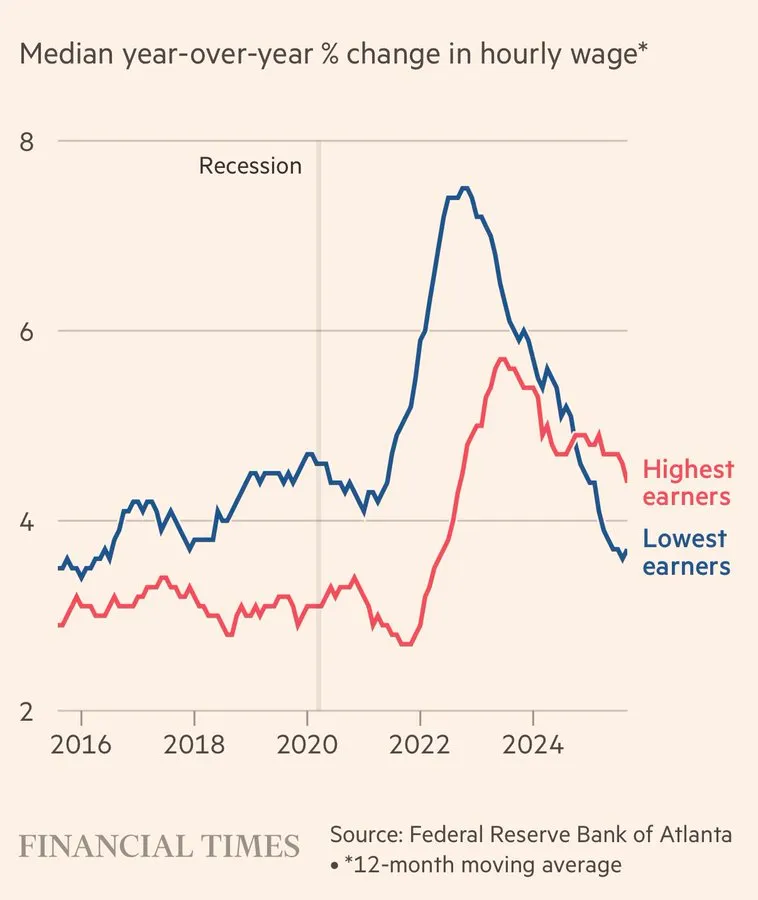
Regarding the first issue—the Federal Reserve's interest rate cut yesterday sparked much controversy and division. Their dual mandate—price stability and maximum employment—is under increasing pressure. Inflation has not fallen to the 2% target (the bond market is very concerned about this). The labor market is weakening, and inequality is worsening.

There is indeed very real economic pain, and participating in society is becoming more difficult. Young people once voted for Trump to improve the economy, but now they are turning against him. According to the Yale Youth Fall 2025 Poll, young people aged 18 to 29 show strong dissatisfaction with President Trump's handling of the economy.

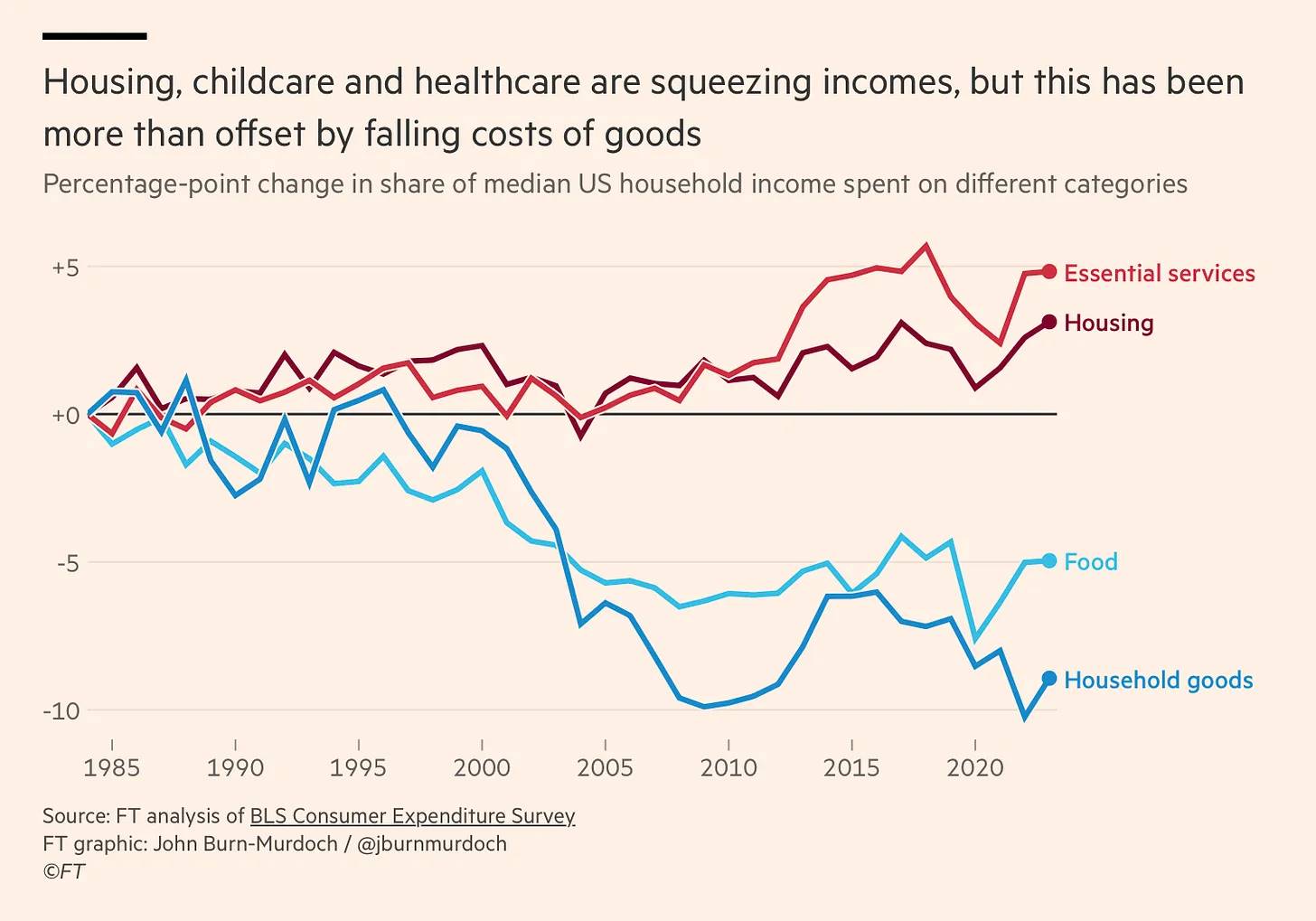
John Burn Murdoch points out that we are facing "Baumol’s Cost Disease."

The same productivity growth that drives down the prices of tradable goods has led to rapidly rising costs for face-to-face services. Industries that require intensive face-to-face labor, such as healthcare and education, have to raise wage levels to attract workers who might otherwise choose higher-paying jobs in more productive sectors, due to slow (or even stagnant) productivity growth. The result is that even if the types of goods and services people consume remain unchanged, as the standard of living in the country rises, they find an increasing amount of their spending going toward basic services.

Prosperity may actually make life more expensive.

Source: The Financial Times. Paul Starr documents the collapse of cultural affordability under Baumol’s Cost Disease in The American Prospect, noting that "public elementary and secondary schools, public libraries, low-tuition land-grant colleges, and the mass media of the 20th century—including free radio and television" were once free or at least heavily subsidized. However, support for the arts and education is now being cut.

In reality, this means that the core elements of middle-class life—housing, healthcare, childcare, education, and retirement—are all in the Baumol sector. The costs in these areas are rising faster than wage growth. Even if you "do everything right," you may still feel financially strained.

In the 20th century, we addressed the Baumol cost problem to some extent by socializing or heavily subsidizing these areas, such as public schools, public libraries, low-tuition state universities, and public hospitals. Through policy, we made these expensive and low-productivity sectors more affordable. However, at the very time we should not be doing so, we are privatizing (or dismantling, bureaucratizing) these sectors. We are asking families to bear costs that were previously shared by socialization. Is it any wonder that the middle class feels increased pressure?

Of course, the situation will only become more complex. Artificial intelligence will make productivity in non-Baumol sectors extremely efficient. Software development, data analysis, and any computer-related work will become abundant and cheap, meaning the productivity gap between scalable and non-scalable sectors will turn into a vast chasm.

The second issue—the government shut down this year over healthcare issues. The average healthcare insurance cost for a family of four is $27,000 per year. Insurance costs are expected to rise by 10%-20% next year. Many people are just one bad tooth away from bankruptcy.

The third issue—we are rapidly moving toward an economic model of "quid-pro-quo." Once a beacon of democracy, the United States is now engaging in land deals with Russia, requiring tourists to provide five years of social media information, threatening the independence of independent institutions, including the Federal Reserve, and ignoring antitrust laws to support media control. When you read such news and see such headlines, it’s natural to feel very bad.

Therefore, for many people, especially young individuals trying to build their lives, the economic fundamentals have indeed worsened. But economic pressure alone cannot fully explain this profound sense of anxiety. At this point, cognitive factors come into play.

Part Two: Cognitive Overload

These issues are not new, right? For years, America has been sliding toward a more difficult equilibrium. People have long experienced high housing costs, a tight job market, and the effects of Baumol’s Cost Disease. However, the difference today is that these pressures are falling on a public that is already overwhelmed cognitively and socially.

For most of human history, literacy was scarce, while attention was abundant. Most of the time, people were in what we now call a "boredom" state, aside from work. Today, the situation is exactly the opposite—literacy is declining, attention has become a commodity, and people's cognitive load is completely overloaded. Jean Twenge wrote in The New York Times an article titled The Screen That Ate Your Child’s Education:

In a study published in October in The Journal of Adolescence, I found that in countries where students used electronic devices more for entertainment during school hours, the decline in standardized test scores in math, reading, and science was significantly greater than in countries where usage was lower.

And Brady Brickner-Wood wrote in The Curious Notoriety of Performative Reading:

Americans are spending 40% less time on leisure reading than they did twenty years ago, and 40% of fourth graders lack basic reading comprehension skills… Meanwhile, colleges are partnering with companies like OpenAI to introduce chatbots into student curricula, while humanities departments are being continuously cut.

If you don’t trust any information sources, you won’t trust economic data either. We have conducted a massive experiment—giving people unrestricted access to millions of things that could make them lose control—and the answer is no, it really doesn’t work; this approach is like boiling the entire crowd into an egg.

The loss of education and deep reading has led to various chain reactions: weak basic skills, declining media literacy, and, more importantly, a collapse of trust. David Bauder's research on youth news consumption indicates that "about half of the surveyed teenagers believe that journalists give special treatment to advertisers and fabricate details like quotes."

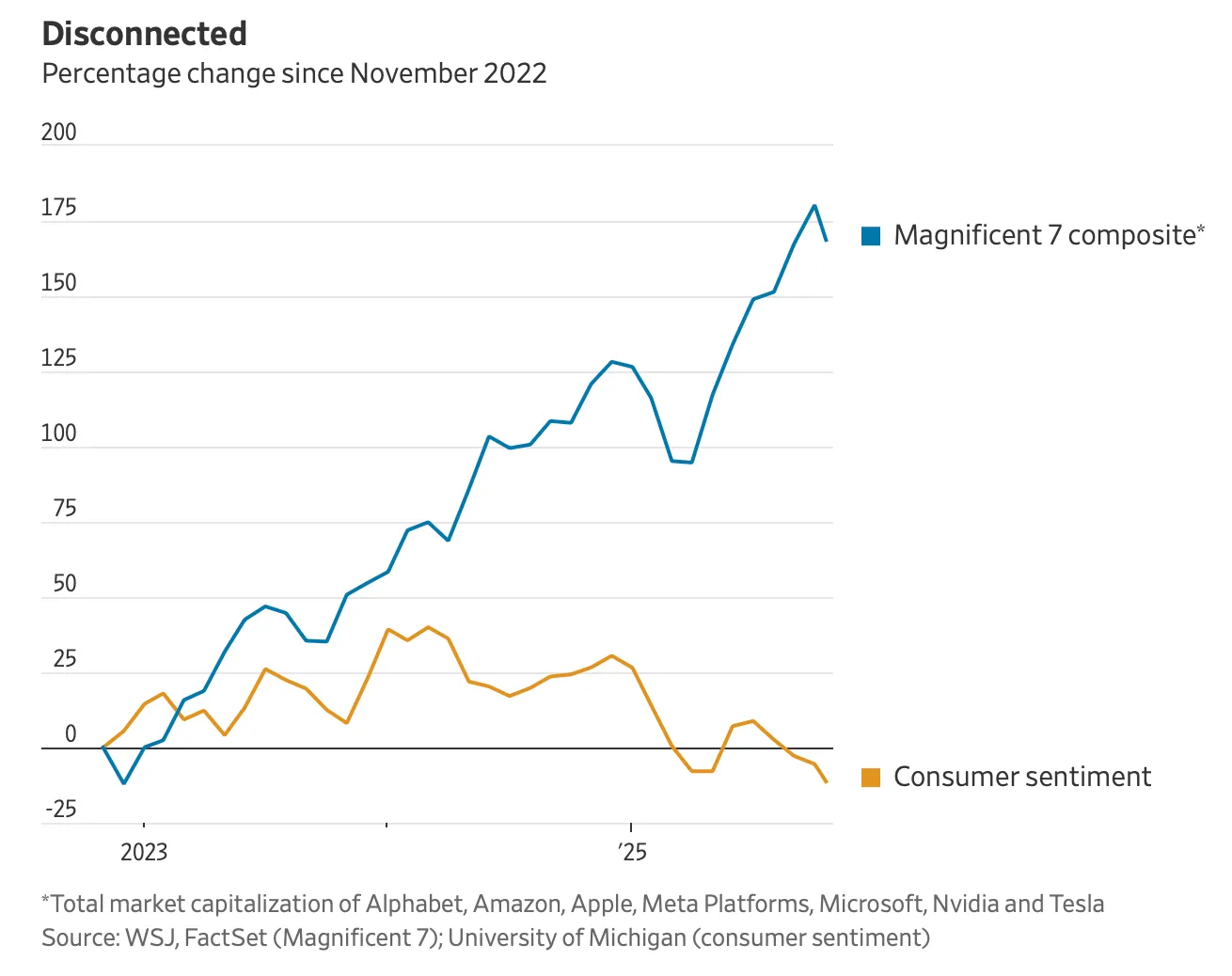
Artificial intelligence will only complicate all of this. Greg Ip summarized it very well in an article in The Wall Street Journal titled The Most Joyless Tech Revolution Ever: AI Is Making Us Rich and Unhappy. Nearly two-thirds of people feel uneasy about artificial intelligence, and only 40% trust the AI industry to do the right thing. We have all this technology, but we neither trust each other nor feel very good.

Source: Greg Ip, The Wall Street Journal (WSJ)

So, when we talk about negative emotions, there is indeed a "computerized" quality that runs through it.

We are collectively troubled by the "Bullshit Asymmetry Principle": we find that it is indeed ten times harder to debunk a lie than to create one. This has led to marketing and product strategies like "ragebait"—which is also a good way to raise a lot of venture capital?

Misinformation has become an effective means of accumulating wealth: if you lie to many people and make them angry at you, Twitter will pay you a large sum of money. People abroad are also exploiting this "money printer"—which logically makes sense!—and polluting American politics in a way that should perhaps be considered illegal?

Many people are also "skimming" at various levels, gaining an advantage through cheating, as Krugman mentioned regarding the "scam" issue. Every adult can feel their attention slipping away, their thinking flattening, their world filled with noise, lacking neutrality, and no institution truly exists to protect them. Brother, your brain is being sold—along with your attention slipping away, your cognitive ability, depth of feeling, and sense of certainty are also disappearing.

Confidence, optimism, and long-term thinking all require "mental space." If the information environment becomes chaotic, the emotional environment will also become chaotic. And if attention is the infrastructure of democracy, then that infrastructure is in tatters.

We are witnessing the consequences of outsourcing human learning to screens. Now, we may see what happens when we outsource humanity itself to artificial intelligence. When you cannot trust any information source, you cannot trust economic data either. When attention is fragmented and thinking is flattened, people become more susceptible to the next stage: being exploited.

Part Three: Extractive Economy

As the cognitive world gradually collapses, the maintenance of the physical world is also not satisfactory. The significant friction between the decaying things in the physical realm (like bridges, schools, and the labor market) and the over-optimized things in the digital realm (like large language models, algorithms, and various operations in advertising) is becoming increasingly evident.

In this newsletter, I hold a rather severe attitude toward artificial intelligence (AI)—it should be clear that I believe AI is a tool that can indeed bring significant breakthroughs to science—but AI itself is creating a complete downward spiral. In a documentary, Demis Hassabis's discussion of AI is very important, and as Linus Torvalds said in a recent interview:

I have great faith in the potential of AI, but I am not optimistic about the things surrounding AI. I think the market and marketing are sick. This will lead to a crash.

Today, people are becoming billionaires through the expansion of data centers, which drives up electricity costs and brings the risk of power outages. These data centers occupy vast physical spaces, but their impact is almost invisible to the average person, with the only noticeable effect being the ever-increasing electricity bills.

The AI race is a battle for energy, not computational power. As The Financial Times writes:

In the competition among global superpowers, AI may be slowed down by outdated grid infrastructure and a failure to provide sufficient power capacity.

Source: The Financial Times

The Financial Times also reported that OpenAI's partners have taken on $100 billion in debt to build AI's computational capacity. This is concerning because debt is where problems become dangerous. The dot-com bubble was primarily a stock collapse, meaning there was no complex web of debt relationships. But once debt issues come into play, things can quickly become very tricky.

The U.S. has also decided to sell some of Nvidia's top chips to China in exchange for soybeans and a 25% kickback. As the U.S. Department of Justice stated:

The country that controls these chips will control AI technology; the country that controls AI technology will control the future.

So, you know, it's fine. The Financial Times reports that the U.S. is losing the AI race, with "many American companies, including Airbnb, becoming loyal fans of the 'fast and cheap' Qwen." They also posed the question: "Can the West catch up with China?"

The chart below is very important—when we talk about the future, we often see the U.S. as the number one contender among global superpowers, but China is investing in the key factors needed for AI success—energy. Meanwhile, the U.S. is choosing the opposite direction.

Source: Phenomenal World

Barclays estimates that by 2025, more than half of U.S. GDP growth will come from AI-related investments. People have realized that we are betting the economy on something that doesn't really promise much, like "Hey :) this thing is going to take your job :) now it can do art too :) it might make some people very rich, but your electricity bill (which is already changing voter attitudes) will go up. And China might win. Also, suicide is against the terms of service."

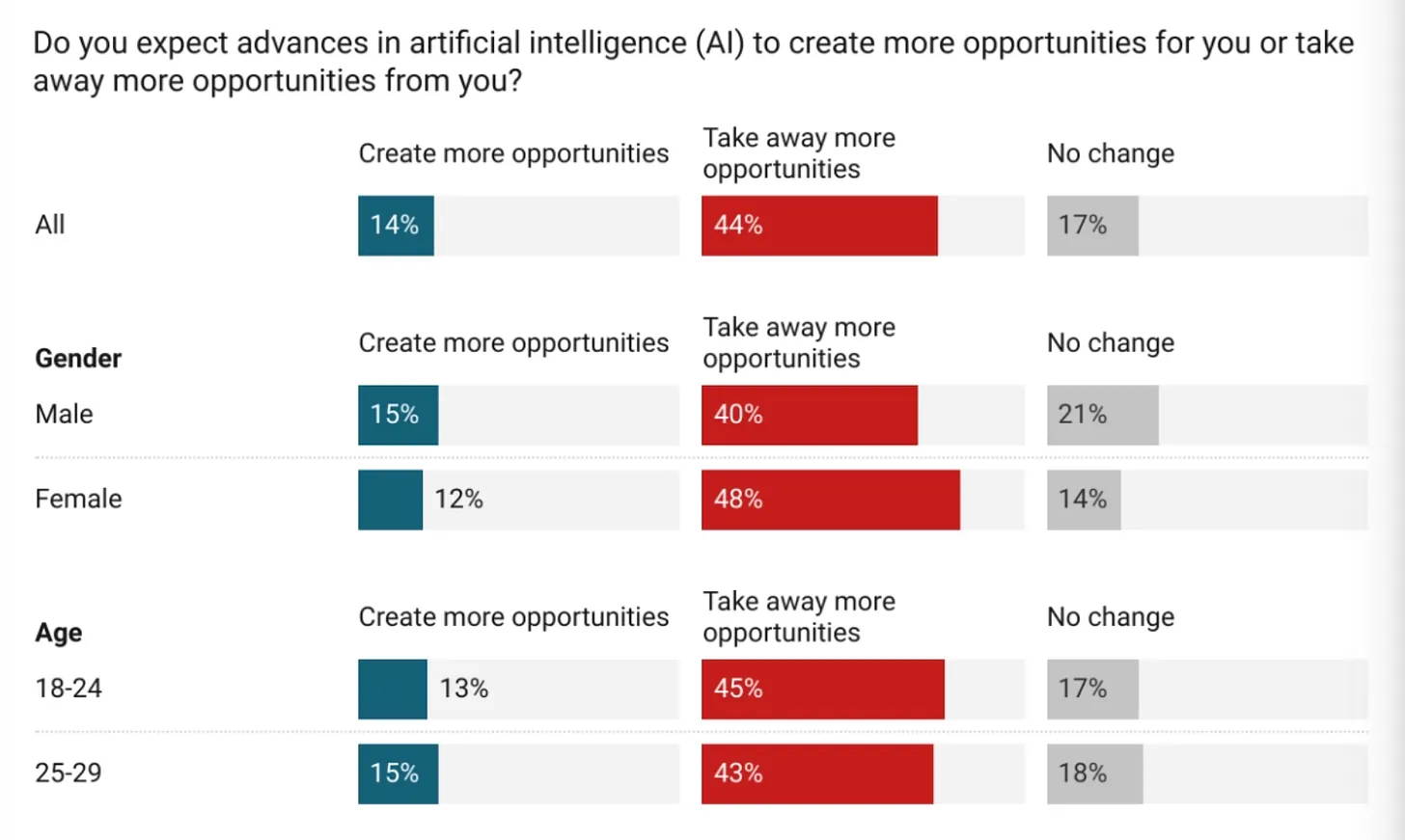
Almost all young people are very worried that AI will take their jobs. MIT's Iceberg Index estimates that about 12% of U.S. wages come from jobs that AI could do cheaper today, but only 2% of jobs are currently automated. This capability already exists; it just hasn't been fully activated.

How can you trust a system that seems indifferent to what will happen to your future?

Source: Harvard Youth Opinion Poll This may partially explain why nearly 40% of Americans over 50 believe the economy is "getting better," while most Americans aged 18 to 49 think the economy is "getting worse." These are two entirely different economic worlds. Older individuals are largely insulated from the impacts of AI and housing, while young people are facing the direct blows of these threats.

Source: Civiqs

Adam Millsap wrote an interesting article exploring "Total Boomer Luxury Communism." This concept roughly refers to the older generation "hoarding opportunities and resources while young people struggle to buy homes and support the generous social security and Medicare benefits expected by the wealthiest baby boomers." This intergenerational tension will only intensify with the development of medical technologies that extend longevity and resource scarcity.

So, what should people do? AI is taking jobs, policies are increasingly designed around the elderly population, and everything seems filled with uncertainty. How do we move forward into the future?

Gambling?

Kalshi's co-CEO Tarek Mansour recently stated, "Our long-term vision is to financialize everything and turn any disagreement into a tradable asset."

Financializing everything??? Every disagreement, every uncertainty, every future outcome—all of these become bets to wager on??? This is an extreme extension of Marx's logic of "commodity fetishism." When every interaction becomes a transaction and every opinion becomes a tradable asset, it becomes extraordinarily difficult to form unity.

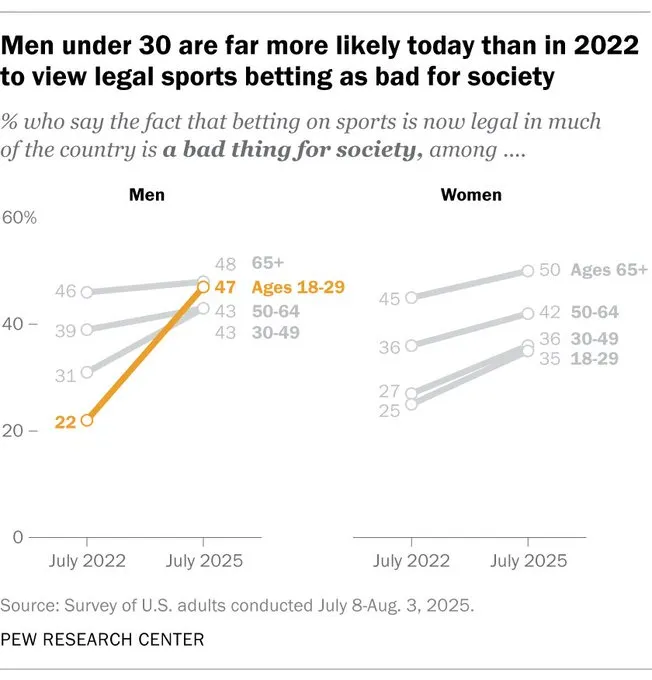
Gambling has become one of the few activities that can provide immediate returns and even change lives. Living near a casino increases the likelihood of becoming a problem gambler. And when you live in your phone, with casinos coming directly to you, I think you can imagine what happens. But the fact is, no one really wants this kind of life. As shown in the image below, this is the truly frustrating aspect of the "casino economy"—no one wants it.

Attention is monetized, engagement is optimized, risk is financialized, and everything looks like a scam. As Whitney Curry Wimbish wrote in The American Prospect, and as Emily Stewart mentioned in Business Insider, layers of middlemen are extracting value with almost no real regulation or protections. Some might say, "Well, clearly the market has expressed its preference, and that preference is that people are willing to spin the roulette wheel." But I don't know how to respond to that.

As the labor market tightens, upward mobility stagnates, and wealth concentrates at the top and becomes increasingly difficult to reach, gambling seems to become a rational response. In this structure, people lose their sense of purpose and meaning (Victor Frankl, save us), and this is precisely when problems begin to fester.

Reduced cognitive bandwidth + ubiquitous extractive systems = rational economic paranoia. People feel deceived because they are often deceived. When traditional paths become unpredictable, people turn to "narrative ladders"—like online communities, aesthetic categories, etc. These become ways to understand uncertainty. The debate over the "$140,000 poverty line" arises in this context. People's reactions are about identity and experience, and whether their worldview can be understood by others. These reactions are not entirely rational, but they do exist.

When values diverge and the common foundation weakens, collective solutions become structurally impossible. Even if there is broad consensus—no one really wants a "casino economy"—we still cannot coordinate to stop it because we cannot agree on what "stopping it" should look like or who should have the power to achieve it.

For the past 70 years, America has been built on a simple contract: provide growth, and people will tolerate everything else. But this year, as I walked 40 weeks on the road, the most consistent feedback I heard from people of different ages, regions, and income levels is that the basic trajectory of life no longer feels meaningful. While this is some scattered anecdote, it is the most frequently mentioned concern when people stopped to talk to me—their worries. They are not only concerned about their financial situation but also anxious about the entire future.

Part Four: Trust

We are in a complex crisis where economic pressure reduces cognitive bandwidth, and the reduction of bandwidth fuels extractive behavior, while extractive behavior exacerbates economic pressure. Stress and overload erode trust, the loss of trust hinders collaboration, and the failure of collaboration leaves problems unresolved, which further deepens the crisis.

This is not a problem that can be solved with a single policy lever. When traps exist at the intersection of multiple areas like housing, AI regulation, and media literacy, you cannot simply "fix housing" or "regulate AI" or "improve media literacy" to solve it. Economic deterioration and cognitive collapse are mutually reinforcing; they have destroyed the institutional capacity and social trust needed to address these issues.

This sounds dire! But breaking this cycle does not require solving all problems at once. We need to identify the most actionable points and recognize that improving one part will weaken the trap's impact in other areas.

Directly reduce economic pressure—make Baumol sectors (like education, healthcare, etc.) affordable again (I know, this is too simple, right?). If people have more breathing room economically, their cognitive bandwidth will increase. We all know this. More bandwidth means being less vulnerable to extraction and fraud. Less vulnerability means better decision-making, and better decision-making means less economic pressure.

Directly regulate extractive behavior—ban or strictly limit business models that profit from confusion and cognitive overload. Kalshi wants to financialize everything? We can say "no"! We can ban prediction markets on elections. It all comes down to incentives. We can regulate physical casinos, and we can certainly regulate digital casinos.

Make the benefits of AI clear—currently, people's experience with AI is "your electricity bill has gone up, and ultimately it will take your job." If AI is to drive growth, then that growth needs to manifest in tangible benefits for ordinary people's lives—such as reducing healthcare costs through diagnostic tools, cheaper goods, and more time.

None of this is easy, and it's even hard to imagine. But there is hope. You don't need to solve all the problems at once. This requires economic affordability (I've heard the "affordability journey" has just begun), national governance capacity, some friction, and an understanding of "humanity" in a tech-filled world. There is also a seemingly simple yet actually daunting task—eradicating crony capitalism and establishing some common sense of reality.

During my cross-country flight, the internet went down, just hours after that person was coughing into the air. I was frantically typing, doing all sorts of "very important work," like writing this newsletter. We were all typing in the dark, emailing, and busy on Slack. When the internet disconnected, we started opening the airplane windows. Outside was one of the most beautiful sunsets I had ever seen. There was something to ponder in that.

In the end, I really liked this quote from a recent interview with Kahlil Joseph:

"There’s a famous story about Jimi Hendrix tuning his music for transistor radios because that was the device soldiers used to listen to music, so he tuned his work for FM radios. He wasn’t thinking that someone would be listening to his music on a thousand-dollar sound system. That has always impressed me—catering to where people are."

Thank you.

Notes:

  1. University of Michigan Survey of Consumers (UMich Survey of Consumers) transitioned from random dialing surveys to online surveys in mid-2024.

  2. Netflix and Paramount are vying for Warner Brothers. According to The Wall Street Journal (WSJ), "David Ellison assured Trump administration officials that if he acquired Warner, he would undertake a comprehensive reform of CNN, which happens to be one of President Trump's frequent targets of criticism."

  3. Reflections on the impact of the internet are beginning to spark strong reactions. Róisín Lanigan wrote an article titled "The Next Status Symbol is an Offline Childhood," which is quite straightforward in its title. More similar articles are emerging, such as P.E. Moskowitz's "The Internet is Destroying Our Memory and History," exploring the gains and losses brought by the internet.

  4. Cracks are appearing in the financial markets. Applied Digital faced difficulties selling bonds and had to offer a high yield of 10% to attract buyers. They provide data center services for CoreWeave, which in turn provides data center services for Nvidia and OpenAI.

  5. Kalshi is facing a nationwide class-action lawsuit, with plaintiffs accusing it of operating an "illegal sports betting platform." The lawsuit claims that Kalshi "deceived" customers into thinking they were betting against other consumers, while in reality, they were betting against the house (i.e., Kalshi). Additionally, a Nevada court ruled that Kalshi is not exempt from state gambling regulations, posing significant challenges to its business model. A Bloomberg analysis shows that Kalshi's fees are so high that in most cases, users might find it more cost-effective to use FanDuel directly.

免责声明:本文章仅代表作者个人观点,不代表本平台的立场和观点。本文章仅供信息分享,不构成对任何人的任何投资建议。用户与作者之间的任何争议,与本平台无关。如网页中刊载的文章或图片涉及侵权,请提供相关的权利证明和身份证明发送邮件到support@aicoin.com,本平台相关工作人员将会进行核查。

Share To
APP

X

Telegram

Facebook

Reddit

CopyLink