Strategy, STRC and the Battle for Bitcoin's Track: Who Will Control the Future Monetary Order?

CN
55 minutes ago

Bitcoin is the battlefield, MicroStrategy is the signal, and this conflict is a direct confrontation between "Financialists" and "Sovereignists."

Author: MarylandHODL

Translation: Deep Tide TechFlow

Deep Tide Summary:

  1. The Dominance Model of Financialists: By controlling credit, price discovery mechanisms, and monetary transmission channels, Financialists maintain a highly centralized system centered around fiat currency.

  2. The Counterattack of Sovereignists: This camp consists of nations seeking monetary independence, institutions and enterprises weary of the banking system, and individuals choosing Bitcoin as a means of wealth storage. They believe Bitcoin can break the monopoly of traditional currencies.

  3. The Significance of STRC: STRC, launched by MicroStrategy, is an innovative financial tool that converts fiat currency savings into real returns collateralized by Bitcoin, while tightening Bitcoin's circulation to enhance its scarcity.

  4. JPMorgan's Counterattack: JPMorgan quickly launched synthetic financial products linked to Bitcoin, attempting to pull Bitcoin exposure back into the traditional banking system, yet completely avoiding real Bitcoin.

  5. Historical Comparison: The article compares the current Bitcoin revolution to the centralized restructuring of the American industrial era from 1900 to 1920, pointing out that this time the foundation is decentralized Bitcoin, rather than a debt system centered around fiat currency.

Potential Impacts:

  • On Individuals: Bitcoin provides ordinary people with a means to protect their wealth from inflation while also offering the possibility to bypass the traditional financial system.

  • On Society: If Bitcoin is widely adopted, it will readjust the incentives of currency and society, potentially triggering profound economic and ethical changes.

  • On the Financial System: The rise of Bitcoin and tools like STRC may weaken the power of traditional financial institutions, leading to a fragmentation and restructuring of the monetary base.

Key Takeaways:

  • Bitcoin is not just an asset; it is a tool to break the monopoly of traditional currencies.

  • STRC is a key innovation in the Bitcoin ecosystem, providing a legitimate and scalable entry point into the capital market for Bitcoin.

  • The current currency war is not only an economic game but also a profound struggle over the future social structure and values.

  • Once the truth emerges, decentralized Bitcoin may rapidly change the existing financial and social order.

Deep Tide Note: Content summarized with the help of GPT-4.0.

In my previous article, I painted a grand battlefield: the monetary architecture struggle surrounding Bitcoin. Now, it is time to delve into the operational mechanisms behind it.

This follow-up article aims to reveal the specific levers and structural dynamics to explain everything that is happening right now. We will analyze how the derivatives system and new financial products integrate into this emerging framework.

The full picture is gradually coming into focus:

Bitcoin is the battlefield, MicroStrategy is the signal, and this conflict is a direct confrontation between "Financialists" and "Sovereignists."

This is not just a debate about asset allocation; it is the early stage of a transformation spanning decades—like tectonic plates deep within society slowly pressing until the cracks eventually appear.

Let us walk along this fault line and face the truth.

I. The Collision of Two Monetary Architectures

Matt @Macrominutes provides us with the most powerful framework to date:

Financialists

Since the covert dealings of 1913, Financialists have completely controlled the rules of the game. This camp includes:

  • The Federal Reserve,

  • JPMorgan and the American banking group,

  • European banking dynasties,

  • Globalist elites,

  • An increasing number of controlled politicians,

  • And a derivatives-based framework that has supported global capital flows for over a century.

Their power is built on "synthetic currency signals"—the ability to create credit, shape expectations, alter price discovery mechanisms, and regulate all major settlement forms.

Eurodollars, swaps, futures, repo facilities, and forward guidance—these are their tools. Their survival depends on controlling the abstract layers that obscure the true nature of the underlying monetary base.

Sovereignists

On the other side are the Sovereignists—those seeking less distortion and more robust currencies. This group does not always march in lockstep; it consists of friends and foes, individuals and nations, differing political leanings and ethical frameworks.

This camp includes:

  • Sovereign nations pursuing monetary independence,

  • Institutions and enterprises frustrated by the bottlenecks of the banking system,

  • And individuals choosing to exit the credit-based system and turn to self-sovereignty.

They view Bitcoin as an antidote to centralized monetary power. Even if many do not fully grasp its profound implications, they instinctively recognize a core truth: Bitcoin breaks the monopoly of monetary reality.

And this is something Financialists cannot tolerate.

The Inflection Point: Transitioning Tracks

The current war focuses on transitioning tracks—converting fiat currency into Bitcoin and converting Bitcoin into credit systems.

Those who control these tracks will control:

  • Price signals,

  • Collateral bases,

  • Yield curves,

  • Liquidity paths,

  • And ultimately, the emergence of a new monetary order from the old currency system.

@FoundInBlocks

This battle is no longer a theoretical hypothesis. It has arrived… and seems to be accelerating.

II. A Similar Transformation (1900-1920)

We have experienced a similar scenario… although the protagonist at that time was not Bitcoin, but a disruptive technological change that forced a comprehensive reconstruction of America's financial, governance, and social architecture.

Between 1900 and 1920, America's industrial elites faced:

  • The anger of populism,

  • Antitrust pressures,

  • Political hostility,

  • And the threat of their monopolistic system potentially collapsing.

Their response was not to retreat but to move towards centralization.

Examples of these efforts continue to profoundly influence social structures today:

Healthcare

The 1910 Flexner Report standardized medical education, destroying traditional alternative therapies that had persisted for thousands of years and giving rise to the Rockefeller-led healthcare system, which became the cornerstone of modern American pharmaceutical power.

Education

Industrial giants funded a standardized school system aimed at training workers who could comply with centralized industrial production. This framework still exists today, having shifted from manufacturing optimization to service optimization.

Food and Agriculture

The consolidation of agricultural enterprises gave rise to a cheap, high-calorie but low-nutrition food system filled with preservatives and chemical additives. This system has reshaped the health, incentives, and political-economic structure of Americans over the past century.

Monetary Architecture

In December 1913, the Federal Reserve Act introduced the European central banking model.

Ten months earlier, the federal income tax (which taxed only 1% on income over $3,000, equivalent to about $90,000 in 2025) created a permanent revenue stream for repaying federal debt.

Thus, a debt system based on fiat currency was born.

This was the last major turning point of American power—a silent restructuring around a centralized monetary core, controlled by an entity independent of elected government and governed by vague authorizations.

Today, we are experiencing the next turning point.

But this time, the underlying foundation is decentralized… and cannot be corrupted.

This foundation is Bitcoin.

The participants are still familiar: on one side are the echoes of industrial giants, and on the other are Jeffersonian populists. Only this time, the stakes are higher. Financialists possess the synthetic suppression tools and narrative control built over a century, while the Sovereist camp, though fragmented, is deploying tools that the traditional system never anticipated.

Since 1913, this struggle has spread to the streets for the first time.

III. STRC: The Great Transition Mechanism

In July of this year, MicroStrategy launched STRC ("Stretch"). Most observers dismissed it as just another quirky invention of Saylor—a strange corporate lending tool or a fleeting attention experiment.

However, they overlooked the true significance of STRC.

"STRC is the great transition mechanism of the capital market. It is the first key incentive reshaping tool."

STRC is the first scalable and regulatory-compliant mechanism that:

  • Exists within the existing financial system,

  • Natively connects with capital markets,

  • Converts yield-scarce fiat savings into real returns collateralized by Bitcoin.

When Saylor referred to STRC as "MicroStrategy's iPhone moment," many scoffed.

But what about from the perspective of transitioning tracks?

STRC may actually be Bitcoin's iPhone moment—the point at which Bitcoin price dynamics achieve a reflexive equilibrium, laying a stable foundation for the unveiling of a new monetary order.

STRC connects: Bitcoin as an assetCollateral baseBitcoin-driven credit and yields.

This is important because, in a system of inflation and currency devaluation, value is quietly extracted from unsuspecting individuals. Those who understand the current situation can access "flawless collateral"—a means to store and protect their life energy and accumulate wealth across time and space.

Ultimately, when trust collapses, people instinctively seek the truth… and Bitcoin represents mathematical truth. (If this hasn't resonated with you yet, it simply means you haven't truly begun to explore this "rabbit hole.")

When trust collapses, people seek the truth… and Bitcoin is the embodiment of mathematical truth. STRC transforms this principle into a financial engine.

It not only provides returns but also channels suppressed fiat liquidity into a spiraling Bitcoin collateral loop.

Financialists feel threatened. Some of them may even realize how significant this threat is to their exploitative system.

They vaguely sense what could happen if this loop achieves scale.

IV. The Positive Feedback Loop Financialists Fear Most

As the U.S. attempts to escape the fiscal dominance dilemma through "economic growth" (via monetary expansion and yield curve control), savers will chase real returns in the face of inflation recovery.

However, traditional channels cannot provide these returns:

  • Banks cannot,

  • Bonds cannot,

  • Money market funds cannot. But Bitcoin can.

MicroStrategy has built an enterprise-level monetary loop:

  1. Bitcoin appreciates

  2. MicroStrategy's collateral base strengthens

  3. Borrowing capacity expands

  4. Capital costs decrease

  5. STRC offers highly attractive Bitcoin-backed yields

  6. Capital flows from fiat to → STRC → Bitcoin collateral

  7. Bitcoin's circulation tightens

  8. The loop repeats on a higher basis

This is the "Scarcity Engine"—a system that continuously strengthens as fiat weakens.

The arbitrage space between the suppressed return rates of fiat and the structural internal rate of return (IRR) of Bitcoin is becoming a monetary black hole.

If STRC achieves scale, Financialists will face the risk of losing control over the following areas:

  • Interest rates,

  • Collateral scarcity,

  • Monetary transmission mechanisms,

  • Liquidity channels,

  • And the capital costs themselves.

This sets the stage for the first attack.

V. Coordinated Suppression Action

(This is a pattern, not conclusive evidence.)

After Bitcoin peaked on October 6:

  • BTC dropped from 126k to a low of 80k,

  • MSTR fell from the $360 range to the $100 high range,

  • STRC remained stable amid widespread turmoil in the crypto market,

  • Until November 13, when a sudden liquidity vacuum revealed cracks in STRC.

Days later, the narrative of MSCI "delisting" was raised again, targeting MSTR.

This series of events does not appear natural. It bears clear signs indicating this was a coordinated first strike against the transition tracks. (Again, this is a pattern, not conclusive evidence, but this pattern is hard to ignore.)

When STRC remained stable, it showcased what a normally functioning Bitcoin collateral credit engine could look like.

Despite the smaller data scale in the first two weeks, its significance is profound:

  • November 3–9: Purchased $26.2 million of BTC from $6.4 billion in trading volume;

  • November 10–16: Purchased $131.4 million of BTC from $8.3 billion in trading volume.

Source: @0xPhii

Don't focus on the specific dollar figures; what truly matters is how it operates.

Once these mechanisms are scaled, the response from Financialists will be self-evident.

If STRC achieves scale:

  • The money market will lose relevance,

  • The repo market will no longer dominate,

  • The derivatives price suppression mechanism will be weakened,

  • Bank-generated yields will collapse,

  • Capital flows will bypass the banking system,

  • The treasury will lose control over domestic savings,

  • The monetary base of the dollar will begin to fragment.

MicroStrategy is not just launching a product; it is building a new transition track.

And JPMorgan quickly responded.

VI. JPMorgan's Counterattack: Synthetic Shadows

(This is a pattern, not conclusive evidence.)

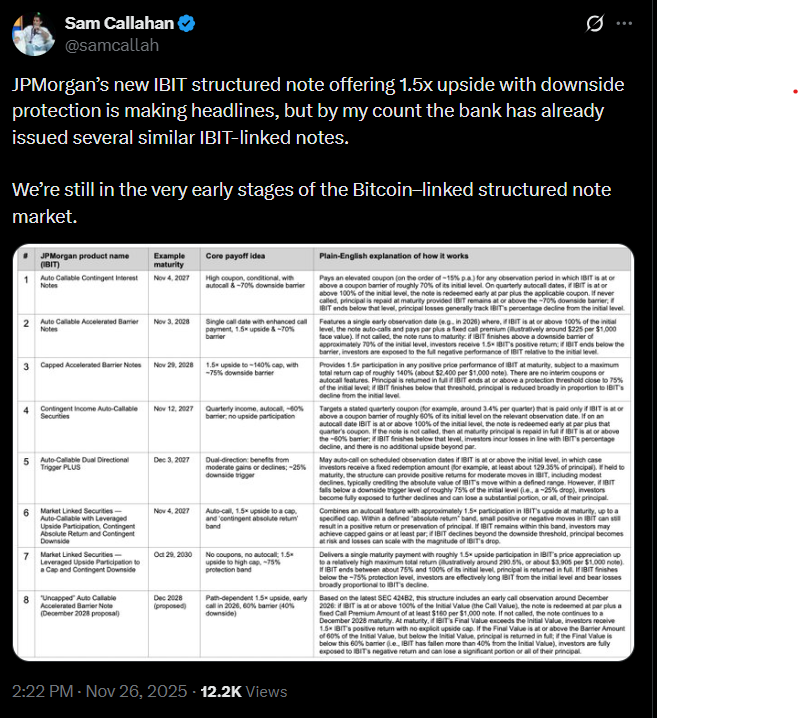
In a trading week shortened by holidays—an ideal quiet structural adjustment time—JPMorgan made a high-profile announcement of a "Bitcoin-linked" structured note.

Its design appears to be a form of "candor":

  • Linked to IBIT, not the spot price,

  • Cash-settled,

  • Not purchasing any Bitcoin,

  • Not reducing Bitcoin's circulation,

  • Limited upside returns,

  • Convexity returns retained by the bank,

  • Downside risk transferred to clients.

However, as @Samcallah revealed, its true implications are more sinister: JPMorgan recently launched a series of structured products linked to IBIT.

Source: @samcallah

This is not innovation; it is just the old centralized playbook—keeping the profits for the designers while socializing the losses.

This is an attempt at "recapture"—trying to pull Bitcoin exposure back into the banking system while completely avoiding real Bitcoin.

This is the rebirth of the "paper gold" system. In this system: "Synthetic Shadows" = undetectable paper Bitcoin quantities.

In contrast:

  • STRC requires real Bitcoin,

  • STRC tightens Bitcoin's circulation,

  • STRC strengthens the "Scarcity Engine."

Two products, two paradigms, one belongs to the future, the other to the past.

VII. Why MicroStrategy Became the First Target

(This is a pattern, not conclusive evidence.)

MicroStrategy threatens the Financialist model because it is:

  • The company with the largest publicly held Bitcoin balance sheet,

  • The first enterprise to treat Bitcoin as a reserve asset "bank,"

  • The only company to monetize Bitcoin collateral at an institutional scale,

  • The only regulated entity providing real yields on Bitcoin collateral,

  • The only bridge bypassing all synthetic exposure channels.

This also explains the pressure patterns against it:

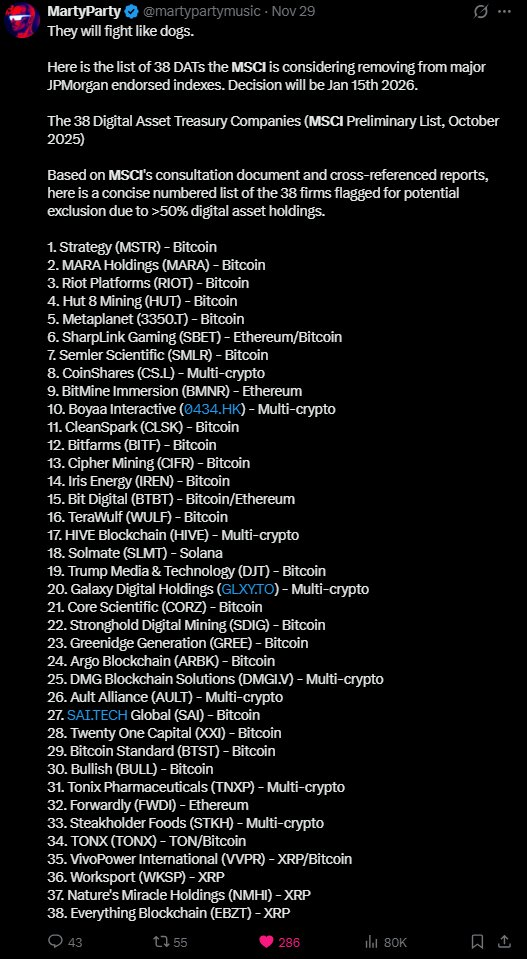
MSCI punishes companies heavily invested in Bitcoin—see @martypartymusic's post:

Source: @martypartymusic

(Note that they cleverly avoided Coinbase, Tesla, or Block.)

  • Credit Rating Agencies (a Wall Street product) barely rated MicroStrategy's preferred stock, yet "cleverly" shifted the target to Tether, both aimed at undermining the status of sound money as legitimate collateral.

  • Rumors of JPMorgan obstructing MicroStrategy's stock transfers.

  • The simultaneous decline in BTC and MicroStrategy (MSTR) stock prices coinciding with MSCI-related reports.

  • A sudden surge of interest from policymakers, both positive and negative.

  • Banks scrambling to rebuild synthetic Bitcoin exposure to pull demand back into the traditional system.

MicroStrategy is under attack not because of Michael Saylor himself, but because its balance sheet structure disrupts the Financialist system.

This remains a pattern (not conclusive evidence)… but these signals have striking similarities.

VIII. Sovereign Layer—The Final Destination

Looking at the big picture, the overall architecture is becoming clearer:

  • Stablecoins will dominate the front end of the yield curve,

  • BitBonds will stabilize the long end of the curve,

  • Bitcoin reserves will become the core anchor of sovereign balance sheets.

MicroStrategy is the prototype of a Bitcoin reserve bank at the capital market level.

Sovereignists may not explicitly articulate this plan, but they are gradually moving in this direction.

And STRC is the upstream catalyst of this process.

Because STRC is not actually a debt or equity product. STRC is a "breakout mechanism."

It is a derivative that can trigger a violent chemical reaction, allowing fiat to gradually dissolve in scarcity.

It breaks the monopoly over the following areas:

  • Yields,

  • Collateral,

  • And monetary transmission mechanisms.

More importantly, it initiates from within the traditional system, leveraging the regulatory framework of the system itself to achieve this goal.

IX. The Moment We Are In

At this moment, the embedded devaluation logic of fiat has become a simple and undeniable mathematical fact… and is being recognized by an increasing number of people.

If Bitcoin is utilized as a tool by Sovereignists, the Financialist structure could collapse as rapidly as the Berlin Wall.

Because ultimately, once the truth emerges, it will swiftly overcome all.

Bitcoin is the battlefield of this fight.

MicroStrategy is the signal of this fight.

STRC is the bridge connecting the two.

This war (public, visible, undeniable) is a war over the transition tracks between fiat and Bitcoin.

This war will define the entire 21st century.

And for the first time in the past 110 years, both sides are beginning to reveal their cards.

Living in such an era is truly extraordinary.

免责声明:本文章仅代表作者个人观点,不代表本平台的立场和观点。本文章仅供信息分享,不构成对任何人的任何投资建议。用户与作者之间的任何争议,与本平台无关。如网页中刊载的文章或图片涉及侵权,请提供相关的权利证明和身份证明发送邮件到support@aicoin.com,本平台相关工作人员将会进行核查。

Share To
APP

X

Telegram

Facebook

Reddit

CopyLink