Interview: Wormhole China
Guest: Mark N, Head of Mantle BD
Compiled by: Wormhole China
In today's rapidly developing blockchain technology, how to ensure security while improving network scalability and performance has become a highly concerned issue within the industry. As a representative of the new generation modular Layer2 solution, Mantle is gradually standing out in the competitive crypto market with its innovative architecture and strong ecosystem.
Within a year of its mainnet launch, Mantle has achieved over 3.5 million addresses and a TVL (Total Value Locked) of 1.2 billion USD (peaking at 2 billion USD), making it the fifth largest Layer2 solution. It has also pioneered the unique architecture combining Eigen DA technology with OP Stack, bringing significant performance improvements and cost reductions.
In this exclusive interview, we have invited Mark N, Head of BD at Mantle, to delve into Mantle's technological core, ecosystem development, and the prospects of collaboration with Wormhole. Mark N will decrypt how Mantle achieves innovation through modular architecture and share Mantle's future development blueprint and its layout in the Restaking field.
Whether you are a blockchain technology enthusiast, developer, or an investor interested in the crypto market, this interview will unveil the mysterious veil of Mantle, a cutting-edge project, and provide insight into its underlying logic and unlimited potential.
Here is the complete content of this interview after compilation:
1. Can you briefly introduce Mantle and its core concepts and vision?
Mark N: Mantle is building a more rewarding financial and consumer chain application center. Based on the $3 billion Mantle Treasury, it has developed core products such as Mantle Network, the first Ethereum Layer2 using EigenDA technology, and has driven the growth of core assets such as mETH, FBTC, and USDe. Mantle accelerates the adoption of innovative concepts, committed to supporting the long-term growth and success of its ecosystem products, assets, and developers.
2. Mantle is a modular architecture Layer 2 solution. Could you introduce Mantle's core technical architecture and working principles?
Mark N: Mantle Network, as a modular Layer2 solution, is built on top of Ethereum. We use OP Stack and combine it with a special data availability layer called Mantle DA, supported by EigenDA technology. This architecture distributes key functions across different levels—executing transactions on Mantle L2, consensus and settlement on Ethereum, providing scalable data availability through Mantle DA to ensure high throughput, low latency, reduced transaction costs, while maintaining consistency and security with the Ethereum ecosystem.
3. Modularization is an emerging technology/narrative. What benefits or advantages has modular architecture brought to Mantle, especially for developers and users?
Mark N: Adopting modular architecture allows Mantle to provide significant advantages, especially in scalability and cost reduction. For developers, this means easier migration of existing Ethereum contracts and tools to Mantle with minimal modifications. Users benefit from faster transaction speeds and lower fees compared to many other Layer2 solutions, while enjoying strong security guarantees.
The modular approach also makes us more flexible and open to innovation. We continuously study the most cutting-edge innovations in the industry and explore whether integrating them into our technology stack would improve performance. This approach made us the first to discover and adopt EigenDA solution for EigenLayer.
4. How is Mantle's ecosystem developing? What important partners and projects are being built on Mantle? What support and resources does Mantle provide for developers and ecosystem partners?
Mark N: On Mantle Network, we can see significant activities and growth of core assets such as USDe and FBTC; DeFi projects such as INIT Capital, Merchant Moe, Agni, and Pendle; and recently, impressive activities in the gaming field, such as Catizen and MetaCene. Personally, I see so much activity on Mantle every day, with new developers releasing and new protocols going live, that I can't keep up with everything happening on Mantle. This also means that the Mantle ecosystem is truly beginning to have its own vitality, which is great and exciting.
In terms of support for developers and founders, Mantle provides funding, technical resources, distribution assistance, strategic guidance, and mentor support to drive ecosystem development. We also host various developer programs, hackathons, and hacker homes to support early developers and founders. This is one of my favorite parts of working at Mantle, supporting the most innovative, passionate, and courageous developers who drive industry progress through original experiments and perseverance.
5. Could you share some key achievements or milestones Mantle has achieved so far? What are the anticipated development plans for the future?
Mark N: We have seen substantial, healthy growth, with over 3.5 million addresses and a TVL of 1.2 billion USD, becoming the fifth largest Layer2 after one year of launch. The adoption of mETH is also very impressive, reaching a TVL of 2 billion USD within a few months of launch, rapidly becoming the fourth largest liquidity staking protocol.
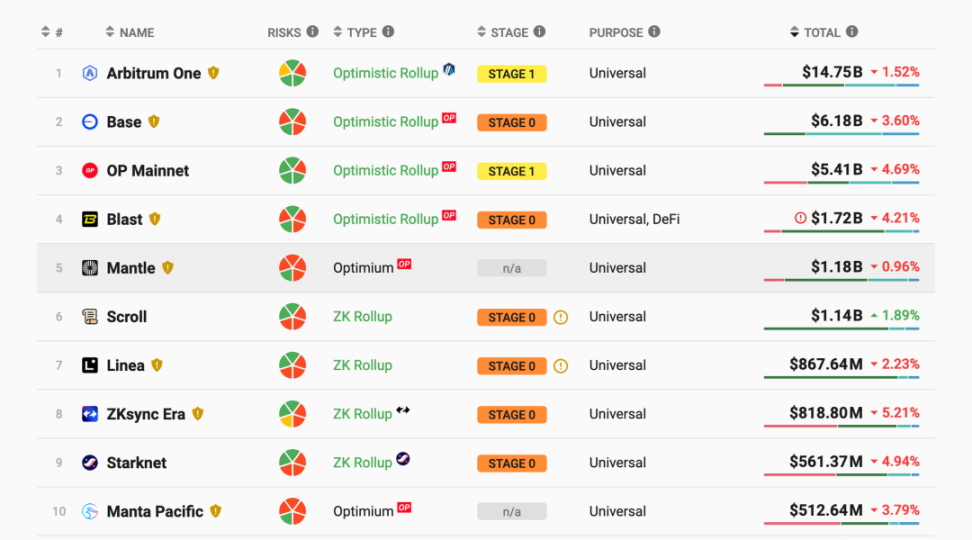
Note: The TVL data in the content is as of the guest's interview, and the screenshot TVL data is as of the article's publication, hence the slight difference.
In fact, most of the time, Mantle is the most active among all Layer2 solutions, regardless of market conditions. It is worth noting that unlike some other participants in our industry, even when our transaction volume and TPS reach their peak, our chain continues to operate smoothly without any faults. This is mainly attributed to our unique modular design, utilizing our EigenDA technology's alternative data availability solution, enabling Mantle Network to achieve higher throughput and performance than ordinary Layer2 solutions. As we move towards mass adoption, we believe our technology stack is ready for success and large-scale adoption.
There are many exciting developments underway for the future, some of which can be briefly disclosed:
First, we want to ensure that our Layer2 technology stack continues to improve and remains at the forefront of innovation. We are having exciting discussions about improvements to the chain technology stack, and the community will soon hear about these developments.
Second, I am excited to dedicate more effort to serving Mantle's developers and early founders. This industry needs more innovation and use cases for Crypto. In addition to our Hacker Home program Sozu Haus—which has unearthed and supported some of the industry's best developer talents—we will continue to strengthen support for developers and early founders. I believe that developers with talent, creativity, passion, and perseverance will not find a better home than Mantle. For more information about Sozu Haus, please follow @sozuhaus.
Finally, we are entering the field of liquidity staking and launching cmETH, which I usually describe as an index token for Farms. These products are suitable for those who are not willing to do all the Farming themselves across various protocols, and would rather simplify their on-chain behavior by holding a single asset while letting the protocol handle more complex Farming. I often hear people say, "I can't believe something like this didn't exist before," when I explain this concept.
In addition, we have many other exciting things in the works, so be sure to follow @0xMantle on Twitter to stay updated on our latest developments.
6. With the increasing number of L1/L2/Rollup solutions, how do you view the importance of cross-chain interoperability? What key factors do you consider when choosing a cross-chain solution?
Mark N: Everyone in the industry is talking about the apparent issues of (liquidity and user) fragmentation as the number of L1 and L2 solutions increases. Cross-chain interoperability solutions have not fully addressed the pain points of users and developers yet, but I believe it will be one of the most important issues in the coming years. We hope to become the most attractive base for various cross-chain and chain abstraction solutions by providing deep liquidity, low slippage, excellent chain performance, and consistently low fees.
While I believe that ultimately, in our ideal chain abstraction future, most users will use on-chain applications without having to consider all the underlying infrastructure, cross-chain bridging, routing, or manually moving assets from one chain to another, I think we need to take it step by step, implementing simple, elegant, secure, and practical ideas from the ground up. Due to the difficulty of solving synchronous operability, it may take several years, so I am very fond of the improvements proposed in ERC-3770 (chain-specific addresses) and ERC-7683 (cross-chain intent), and I believe they are good cornerstones for a better, more interoperable cross-chain ecosystem.
7. Why did you choose Wormhole as the cross-chain solution? From your perspective, what positive impacts has the integration with Wormhole brought to developers, users, and the entire Mantle ecosystem?
Mark N: We had many considerations for choosing Wormhole as the cross-chain solution. First, Wormhole has been battle-tested multiple times and is trustworthy, providing us with bridging between chains that were previously inaccessible to us. Second, Wormhole is cool (I really like their brand image and atmosphere), and they also have a great community and an amazing team. Finally, and perhaps most importantly, our ecosystem users and developers have repeatedly requested the use of Wormhole, so we chose to believe and support them, and the collaboration with Wormhole has been great so far. We really like Wormhole!
8. How do you evaluate the Wormhole protocol, and what major developments and updates are you looking forward to from Wormhole?
Mark N: Overall, Wormhole is an important part of our cross-chain technology stack and has served our community and products well. In terms of developments and updates, I hope to see a bridge between TON and Mantle, which has been one of the most requested routes by our partners and users in the past few weeks. Especially with the explosion of Telegram games and mini-applications on Mantle, our users are eager to start transferring assets between TON and Mantle. I hope Wormhole can be the first project to establish this bridge!
In addition, I am eager to explore more opportunities for developer programming, support early founders, and various joint programming and innovation activation between Mantle and Wormhole.
9. Restaking is a very hot trend/narrative in this cycle, and Mantle has a very close relationship with cutting-edge narratives such as modularity and Restaking. Could you introduce Restaking and Mantle's related layout in this area?
Mark N: Many people may not know that we are the first major partner of EigenLayer. As early as 2022, when we proposed the Layer2 at the DAO governance forum, we had already planned a modular Ethereum Layer2 and alternative data availability solution built on EigenLayer technology.
In fact, Sreeram (founder of EigenLayer) himself was a co-author of the proposal, a piece of history that many people are not familiar with. This shows that we have long been optimistic and excited about Restaking, and we are proud to be the first large chain to adopt and utilize this technology. Furthermore, a significant part of our ecosystem, mETH, has already been launched for Restaking on EigenLayer and has supported many AVS, such as Lagrange, and we are about to launch our own liquidity staking token, cmETH. I am personally very excited to see the growth in the Restaking field and am closely following new AVS projects and innovations.
10. How do you view the development potential and prospects of modular Layer2 solutions in the entire blockchain ecosystem? What role will Mantle play in this?
Mark N: We are confident in the modular approach to innovation and growth. Instead of creating a compromised and cumbersome whole, I believe in letting several professional teams with domain expertise each build their best Lego blocks, and then let industry participants creatively and innovatively combine these Lego blocks in various ways.
We have seen this approach work effectively in the field of computer science for decades, so I don't see why it wouldn't continue to be effective in the blockchain field. Although it may seem like a more chaotic, fragmented, and complex approach, I ultimately believe it will bring the fastest, most flexible innovation and achieve a balance in performance, security, and cost improvements.
At Mantle, we don't need to be the inventors of all the Lego blocks, we just need to combine them in novel, innovative ways at the forefront. We hope to provide the best user experience without sacrificing security, and we are constantly researching and experimenting on how to improve our infrastructure stack and core products for the benefit of our users and developers.
免责声明:本文章仅代表作者个人观点,不代表本平台的立场和观点。本文章仅供信息分享,不构成对任何人的任何投资建议。用户与作者之间的任何争议,与本平台无关。如网页中刊载的文章或图片涉及侵权,请提供相关的权利证明和身份证明发送邮件到support@aicoin.com,本平台相关工作人员将会进行核查。


