BTC ecosystem seed player Zulu: pioneering a dual-layer structure based on UTXO.

CN
PANews
Follow
1 year ago

Writing by: Riyue Xiaochu

The BTC ecosystem construction competition is in full swing, with participants such as Merlin, BounceBit, and B2 network currently leading. However, the finish line is still far away, and some closely following participants should not be underestimated, as they could potentially turn the tables at any time, which is worth our attention.

The participant we are researching today is called Zulu Network, which is the first double-layer structure in the BTC ecosystem.

Zulu's layer2 is a zkEVM that is EVM compatible. EVM projects can be quickly and cost-effectively deployed on ZuluPrime to implement ecological solutions. The other layer is Layer3, called ZuluNexus. It innovatively unifies UTXO and account asset types and achieves smart contract innovation based on the UTXO model. This means that it can maximize the advantages of UTXO and support future innovations on UTXO.

In the past few years, most of the blockchain innovations have been focused on EVM. Therefore, the majority of layer2 ideas in the Bitcoin ecosystem aim to introduce the EVM ecosystem to Bitcoin. However, in the past year or two, it has become apparent that EVM innovation seems to have reached a bottleneck.

Another innovative direction is based on UTXO. UTXO can be said to be the orthodox of Bitcoin, so the market is full of expectations for its innovation, such as the recent CKB, which essentially represents the market's expectations for the potential innovations brought about by UTXO. The infrastructure based on UTXO is becoming increasingly sophisticated, with the CKB team launching the Bitcoin programmable solution RGB++. The Bitcoin RAAS service provider UTXO Stac provides developers with one-click creation of Bitcoin L2, equivalent to OP Stack, and integrates the RGB++ protocol. It is also developing shared sequencers, shared verification, and other services. This means that the explosion of the UTXO ecosystem may be just around the corner.

This is one of the points that makes Zulu particularly worth paying attention to. If new projects based on UTXO suddenly explode, Zulu is one of the few in the market that supports UTXO and can simultaneously support both EVM and UTXO ecosystems.

Account Mode and UTXO Mode

Blockchain is considered a decentralized ledger, and it has two recording modes: UTXO (Unspent Transaction Output) and Account mode. Ethereum adopts the Account mode, which is the familiar account address system we know. Accounts have their own state. This model has better programmability, is easier for developers to understand, and has lower costs for batch transactions.

Bitcoin, on the other hand, adopts the UTXO mode. Simply put, when a miner mines a BTC, if it is transferred to address A, then address A owns a UTXO. If it is transferred to two addresses, it is split into two UTXOs. In the Bitcoin network, the assets of each address are calculated based on how many UTXOs it has. Satoshi Nakamoto adopted UTXO, and its advantage is that asset security is relatively high because transactions cannot be duplicated. It can also handle multiple UTXOs simultaneously, allowing for parallel transactions and encouraging scalability innovation.

It can be said that both the account mode and UTXO mode have their pros and cons. They have distinct logics, so UTXO also has the potential to bring about some different things.

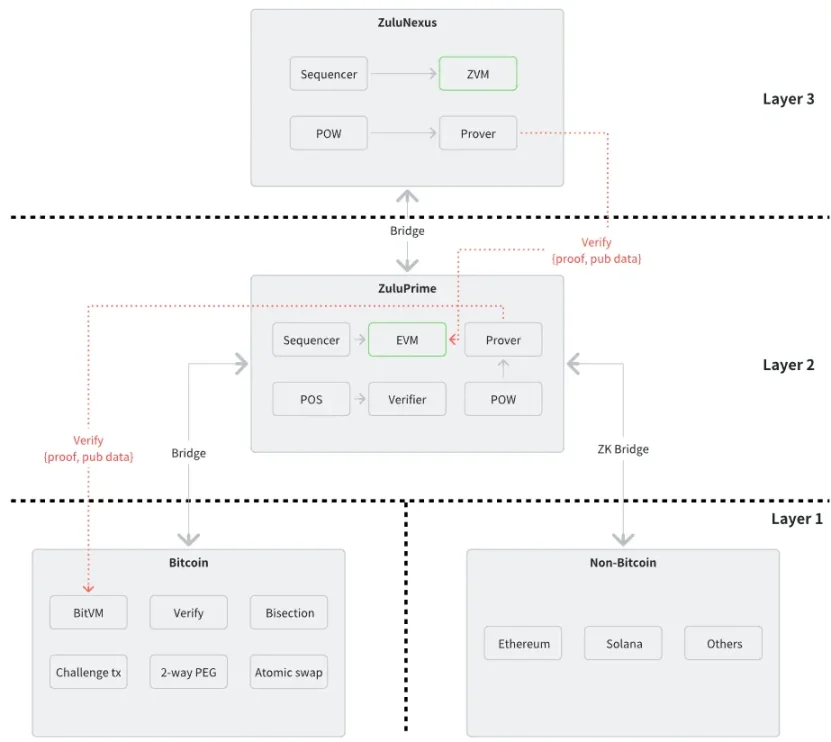
Zulu Network's Network Structure

BTC Seed Player Zulu: Based on UTXO, Pioneering Double-Layer Structure

Layer2

Zulu's layer2, ZuluPrime, operates as the second-layer solution for Bitcoin, focusing on EVM compatibility and providing complex Dapp applications on the Bitcoin network, allowing the Ethereum ecosystem to enter the Zulu Network quickly and cost-effectively. ZuluPrime builds ZKEVM on the zkSync ZK stack.

BitVM was proposed by Robin, and it introduces programmability to the Bitcoin network. It adopts on-chain verification and off-chain computation. BitVM means that Bitcoin can now have Turing completeness like any other chain: allowing developers to run complex contracts on Bitcoin without changing its basic rules. However, in terms of verifying transaction execution validity, BitVM is relatively inefficient. To address this issue, Zulu introduces zero-knowledge proofs (ZKP), which, from a verification perspective, mitigates the impact of higher-level transaction types, as the ZKP verification program always runs on BitVM regardless of the transaction logic. Given that ZKP verification programs have relatively low computational requirements, these networks are conducive to rapid proof verification, thereby ensuring system security.

Layer3

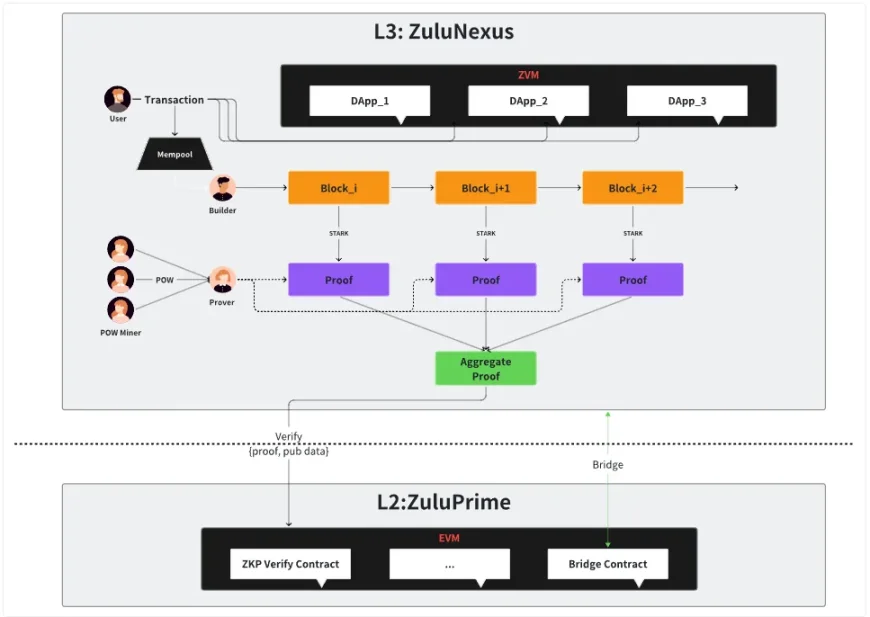
Zulu's layer3, called ZuluNexus, is directly deployed on ZuluPrime and seamlessly interacts with it. The core of Nexus is to unify UTXO and account asset types on the Zulu network.

ZuluNexus builds a virtual machine that is completely different from EVM, which can simultaneously support account type and UTXO type states. In practice, UTXO commitment trees may also be maintained. This approach is based on recent experience, where account types have shown greater compatibility with smart contracts, as evidenced by Ethereum's success. At the same time, UTXO types are more suitable for private transactions, as transactions based on UTXO types are executed by users locally and then verified by network nodes. Many privacy-focused projects, including Zcash, Aleo, Aztec, and Ola, are based on UTXO types.

BTC Seed Player Zulu: Based on UTXO, Pioneering Double-Layer Structure

Zulu Status

Zulu has launched a testnet called Lwazi and introduced an activity to earn Zulu Genesis Points (ZGP) upon completing the test. There were 25,000 users registered within one day of its launch. As of yesterday, it has over 640,000 registered users, with the testnet exceeding 5 million transactions. Users can participate in various activities, including registration, check-in, faucet collection, transfer transactions, cross-chain bridges, dex transactions, providing liquidity, and inviting friends, among others.

For specific details, please refer to the official documentation:

https://www.yuque.com/zulunetworkzhongwenshequn/zvggg8/ll78rsqpuigwhscg?singleDoc=#

Core Team

Zulu's core team mainly comes from the United States and Canada, with years of rich experience in blockchain development and operations. Co-founder Luke Vinci previously held strategic positions at J.P. Morgan and Nomura before transitioning to the cryptocurrency industry, where he served as a senior product manager at OKX. Luke Vinci has expertise in machine learning, financial products, and blockchain, and holds a master's degree in computer science.

Another co-founder, Eric Lifson, has 7 years of experience in traditional marketing and has worked for well-known companies such as Procter & Gamble, McDonald's, and General Mills. Since entering the blockchain industry in 2017, he has entrepreneurial experience in both public chain ecosystems and DeFi.

Conclusion:

In the thriving BTC ecosystem, Zulu's pioneering double-layer structure can, on the one hand, be compatible with the EVM ecosystem, and on the other hand, innovatively unify UTXO and account asset types, making it capable of accommodating potential UTXO innovations in the future. Many overseas media outlets have also reported on Zulu Network, including CoinMarketCap, CryptoSlate, hackernoon, TechBullion, and NewsCrypto. Therefore, Zulu Network is worth spending time to follow, as it could potentially overtake others at any time.

免责声明:本文章仅代表作者个人观点,不代表本平台的立场和观点。本文章仅供信息分享,不构成对任何人的任何投资建议。用户与作者之间的任何争议,与本平台无关。如网页中刊载的文章或图片涉及侵权,请提供相关的权利证明和身份证明发送邮件到support@aicoin.com,本平台相关工作人员将会进行核查。

Share To
APP

X

Telegram

Facebook

Reddit

CopyLink