Parallel EVM+ Drive: Exploring Unlimited Scalability and Mass Application Implementation of Blockchain

CN
1 year ago

EVM+ seamlessly integrates EVM assets, protocols, and infrastructure, promoting the development of large-scale applications and accelerating the integration of cryptocurrencies with mainstream applications.

Author: YBB Capital Researcher Ac-Core

Preface

EVM+ is an advanced model designed specifically to drive further development of the Ethereum Virtual Machine (EVM) to better adapt to the rapidly changing crypto space as Web2 innovations and productivity gradually integrate into Web3, practical technologies such as artificial intelligence, DePIN, and DeFi security are rapidly being integrated into crypto applications. EVM+ provides a new solution by seamlessly integrating EVM assets, protocols, and infrastructure, not only promoting the development of large-scale applications, but also accelerating the integration of cryptocurrencies with mainstream applications. It enhances the scalability of blockchain by implementing EVM+WASM native extensions and further optimizes the processing capacity of the blockchain by supporting parallel EVM execution.

According to Techandtips123, parallel EVM is like organizing a party with division of labor. Suppose you need to prepare for a move: A transports large luggage, B transports valuables, C handles item transportation, and D is responsible for the new site's sanitation layout. This division of labor allows the entire work to be completed by four people, greatly saving time and increasing efficiency.

The concept of parallel EVM is similar, as it distributes computing tasks to multiple execution units. In the Ethereum network, many participants simultaneously process different transactions, each transaction being an independent task, such as transfers or generating new tokens. Each participant independently processes a task on the EVM, similar to running independent computer programs on the blockchain. Once completed, the results of these tasks are aggregated back to the network and form the final block. When a single executor cannot independently process a large number of transactions, the speed decreases, and the difficulty of use increases. The introduction of parallel EVM is to solve this problem by allowing multiple executors to simultaneously process different transactions, enabling the network to process more transactions faster, reducing congestion and related costs.

Introducing the Idea of a New "Layer"

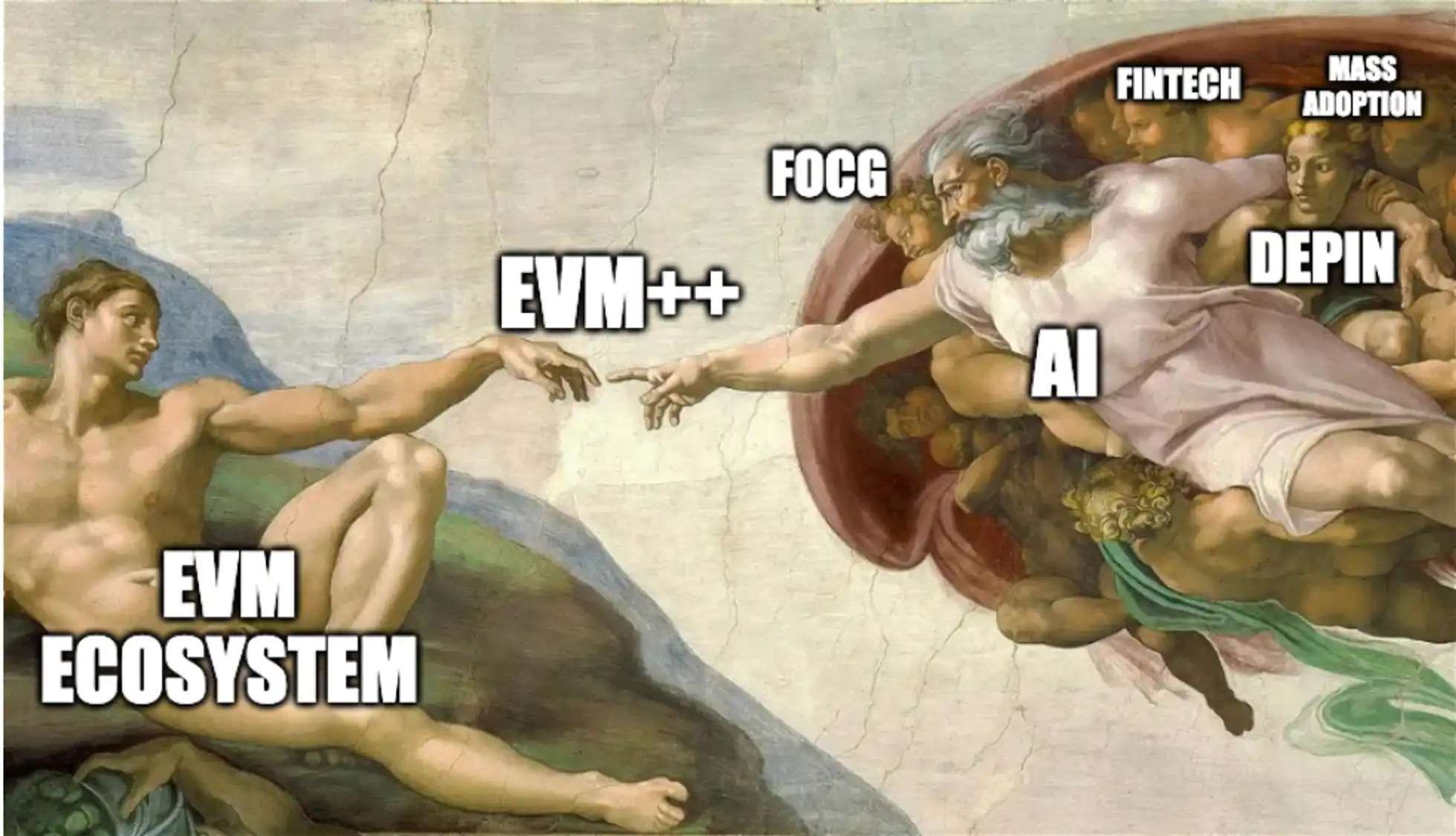
Image Source: Artela — From EVM+ to EVM++

Vitalik Buterin pointed out: "L2 is used for scaling, L3 is used for custom functionality, such as privacy protection. In this vision, no one is trying to provide a 'scalability square'; instead, there is a layer to help applications scale, and another layer to meet the custom functional needs of different use cases."

In Vitalik's Ethereum vision, the "layer" addressing non-scaling needs clearly plays an important role. His viewpoint emphasizes the necessity for blockchain networks to support "custom functionality." For Ethereum, the method to meet this need may be to establish a new layer, while Artela adds "native extensions" on the base layer.

In the context of blockchain, functionality refers to the ability to support various applications. The Ethereum Virtual Machine (EVM), as the runtime engine supporting smart contracts, is the mainstream model for creating DApps. EVM was initially proposed by Ethereum and is now adopted by many smart contract chains, often referred to as EVM-supporting chains or EVM equivalent chains. However, the current EVM has proven to be limited in supporting the extension of DApp functionality. The key challenge lies in how to expand the functional boundaries within EVM chains. In practice, there are two improvement directions:

● Replace EVM with a better virtual machine; ● Strengthen EVM through supplementary extensions.

The first approach circumvents the limitations of EVM but requires abandoning smart contracts based on EVM. MoveVM and FuelVM are examples of this implementation approach. While future advancements may require more advanced virtual machines, they will take a considerable amount of time to reach the same level of maturity and popularity as EVM.

The second approach involves introducing a new stack to enhance EVM through "extensions." The purpose is to push the functional limits of EVM beyond its original specifications while maintaining EVM equivalence. This method enhances DApp functionality on the existing EVM infrastructure. Exploring enhanced EVM functionality opens the door to exciting possibilities and continuous innovation for DApp functionality.

Artela

EVM+ in the Artela Network

Artela's mission is to create a foundational layer blockchain network to meet the growing demand for large-scale decentralized applications. Artela's innovative design allows developers to modularly create native extensions on the blockchain base layer, enhancing the programmability of the blockchain. This approach will help developers achieve custom functionality in a lightweight and dynamic manner, opening doors for faster innovation and more possibilities.

Artela has an extension layer that allows the addition of locally defined extension modules called Aspects, which enhance programmability while ensuring compatibility with existing EVM smart contracts. Aspects enable developers to inject additional logic to handle transactions and related blocks throughout the transaction lifecycle, beyond smart contracts.

Artela has established a highly scalable EVM+ network, utilizing Aspect programming (see extension link 1) and introducing the WASM virtual machine on EVM-compatible networks, allowing these virtual machines to interact with each other, enabling dynamic addition and execution of on-chain extension programs. EVM+ enables developers to build high-performance protocols, modular DApps, and customize underlying functionality for specific scenarios.

Image Source: Artela Official

During the DevNet and Public Testnet periods, Artela collaborated with community developers to explore the potential of the EVM+ network, resulting in imaginative use cases:

● Using WASM as an on-chain coprocessor to facilitate the direct execution of artificial intelligence agent algorithms and other high-performance modules on the blockchain, while ensuring seamless interoperability with the EVM system; ● Participating in on-chain artificial intelligence agents for autonomous worlds, achieving truly programmable on-chain NPCs that can interact with users; ● On-chain security modules with real-time execution options, allowing DeFi protocols to instantly identify and recover suspicious transactions.

A new era is approaching, one that fully realizes on-chain protocols, artificial intelligence, and secure DeFi, while maintaining compatibility and interoperability with the EVM world.

From EVM+ to EVM++

Artela's vision is to establish an infinitely scalable network, where EVM+ is not the ultimate goal but a starting point. The next step for Artela is EVM++, a parallel EVM+ network that can fully unleash the potential of a scalable blockchain. EVM+ unleashes the scalability of EVM, aiming to adapt to the new crypto world, where Web2 productivity and innovation, as well as practical technologies such as artificial intelligence, DePIN, and fintech, are rapidly integrating into DApps. EVM++ unleashes the scalability of EVM, enabling this highly creative network to further promote the large-scale application of DApps and accelerate the integration of cryptocurrencies with mainstream applications.

EVM++ Parallel Resilient EVM Network

Artela's parallel EVM++ will be implemented in two phases.

The first phase involves parallel transaction execution under EVM+. Artela's network not only implements basic parallel EVM, but also addresses the challenge of parallel execution under EVM+ Aspect, which is an extension program running on the WASM virtual machine that can be invoked throughout the transaction lifecycle.

In the second phase, Artela will utilize parallel functionality and combine it with elastic computing to achieve elastic block space, a dynamic mechanism that allows DApps to maximize the advantages of parallel execution.

Brief Overview of Parallel EVM

Artela's horizontally scalable architecture is designed around parallel execution, ensuring the scalability of network node computing capacity through elastic computing, ultimately achieving elastic block space.

  • Parallel Execution: Transactions on Artela can be executed in parallel. The Artela network groups transactions for parallel execution based on transaction dependency conflicts.
  • Elastic Computing: Validator nodes support horizontal scaling, and the network automatically adjusts the validator's computing nodes based on the current network load or subscription status. The scaling process is coordinated by elastic protocols to ensure sufficient elastic computing nodes in the consensus network.
  • Elastic Block Space: Based on elastic computing, large DApps with independent block space requirements can request dedicated elastic block space in the network, in addition to expanding the public block space.

"Elastic Block Space"

Elastic block space refers to dynamically expandable block space, providing dedicated block space with protocol guarantees for DApps with high transaction throughput demands. By default, the capacity of public block space in blocks is limited. When a DApp requests independent block space, additional space is added to the blocks, accommodating only transactions related to the DApp's smart contracts. As block space expands, validators need to add elastic execution nodes to expand the corresponding processing capacity.

Elastic block space is an extension mechanism for blockchain that achieves unlimited scalability while maintaining interoperability. Sharded blockchains, application chain networks, Layer2, and other scalable networks can also provide independent block space, but isolation and block generation are asynchronous. Elastic block space allows DApps with independent block space to interact synchronously through atomic transactions within the same block, eliminating the need for asynchronous cross-chain communication.

When DApps in the Artela network require high scalability, they can subscribe to elastic block space to handle increased throughput. Elastic block space and local extensions provide scalability and custom functionality for DApps in Artela.

Artela Enhances DApp Functionality with Local Extensions

By leveraging Aspect programming, developers can create local extensions (see extension link 2) to incorporate custom functionality into DApps on top of the blockchain base layer and integrate them with existing EVM smart contracts to enhance DApp functionality.

Image Source: Joshua Esin

1. Enhanced Scalability:

One of the advantages of Aspect programming in Artela is its unparalleled scalability. Traditional smart contracts are often limited when it comes to modifying or extending functionality. Aspect programming in Artela overcomes this barrier by providing a modular and scalable framework. Developers can seamlessly extend the functionality of existing contracts without modifying their core logic, paving the way for more agile and scalable DApp development.

2. Improved Security:

In the evolving field of blockchain security, Aspect Programming in Artela introduces a paradigm shift. Unlike traditional white-box security measures, Aspect programming provides a complementary black-box security solution. Real-time monitoring, proactive risk mitigation, and runtime behavior analysis help establish a robust security framework, preventing vulnerabilities and ensuring protocol continuity.

3. On-Chain Intent Resolver:

Aspect Programming in Artela introduces the revolutionary concept of on-chain intent resolver. Traditionally, users need to specify detailed function calls to execute transactions. With the on-chain intent resolver, users can express their desired outcomes in human-readable language, leading to a more intuitive and customizable experience. For example, users can specify their intent as "exchange X ETH for Y USDC" without the need for complex function calls.

4. Just-in-Time (JIT) Operations:

JIT operations, a powerful concept widely used in various scenarios, gain flexibility through Aspect Programming in Artela. Executing on-chain logic within the block lifecycle and combining it with smart contracts in atomic transactions enables the possibility of JIT liquidation, JIT LP management, and MEV capture AMM strategies.

5. Local Event-Driven Actions:

Native event-driven operations in Artela allow users to subscribe to real-time on-chain events, triggering atomic tasks. This feature helps maintain consistency between on-chain and off-chain states, enabling asynchronous cross-chain message notifications, and enhancing blockchain automation.

6. Whole-Chain Gaming:

Aspect Programming in Artela extends its influence to the gaming domain, providing tools to enhance the programmability of in-game assets for developers. With Artela, game assets NFTs can be upgraded through programmability, ushering in a new era of multifunctional user experiences in the gaming ecosystem.

7. On-Chain MicroServices:

Artela can create public on-chain services on the blockchain network, facilitating collective maintenance and governance by different users and organizations. This model promotes resource sharing, collaborative innovation, reduces development barriers, and contributes to the development of decentralized financial ecosystems.

Built-in "Functional Layer" for Decentralized Networks: Enhancing Blockchain Capabilities.

Artela's programming model introduces a built-in "functional layer" for the blockchain network, without the need for third-party networks or complex off-chain systems. This functional layer extends the native functionality of the base layer, including security protection, custodian functions, automation, and off-chain synchronization. The integration of this functional layer marks a leap for decentralized networks in protocol development and user experience.

Conclusion

The foundational technology of Web3 is public blockchain, first propelled into the world by Satoshi Nakamoto's Bitcoin network and later greatly expanded by smart contract platforms like Ethereum. Some people view blockchain as a decentralized data network, i.e., distributed ledger technology. In reality, it is much more than just a data layer.

Blockchain is more like a computer than a ledger or database. The challenge we face today is how to design a better computer. Artela blockchain is built on the Cosmos SDK and has made many improvements at the engine level. Additionally, Artela is compatible with EVM, and its innovation lies in introducing Aspect Programming to achieve on-chain extensions. In addition to EVM, Artela has added a second WASM-based virtual machine to support multiple programming languages (assembly script, Rust, C, C++), and access more on-chain resources. Therefore, EVM is suitable for general smart contracts, while Aspect VM is suitable for specific application extensions.

Extension Links:

(1) Official Explanation of Aspect

(2) Utilizing Local Extensions with Aspect Programming

免责声明:本文章仅代表作者个人观点,不代表本平台的立场和观点。本文章仅供信息分享,不构成对任何人的任何投资建议。用户与作者之间的任何争议,与本平台无关。如网页中刊载的文章或图片涉及侵权,请提供相关的权利证明和身份证明发送邮件到support@aicoin.com,本平台相关工作人员将会进行核查。

Share To
APP

X

Telegram

Facebook

Reddit

CopyLink